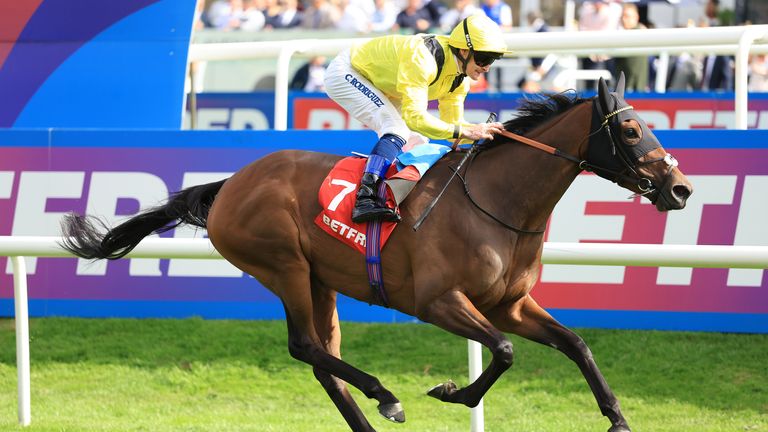
Alexander Zverev produced a dominant display to end his dismal losing streak against an injured Taylor Fritz and reach his first Wimbledon semi-final.
The second seed had lost his previous seven encounters with Fritz and trailed 10-5 in their head-to-head, which included two defeats at the All England Club.
… %!s()
But with the American hampered by a knee injury, Zverev capitalised with a near-perfect performance to claim a 6-4 6-4 6-2 victory on Court One - his first win over Fritz in more than two years.
A month after winning his maiden Grand Slam singles title at the French Open, Zverev is now only two wins away from a second major trophy and the German held his arms aloft after securing victory in just under two hours.
"He has been beating me for two years straight and I'm very happy to be in the semi-finals after finally getting a win," Zverev said.
"Of course it's in the back of your mind that you haven't beaten an opponent for more than two years, he has beaten you a lot of times in a row.
"That is always something you have in your mind, but today I knew I had to play a flawless match, I had to play an almost perfect match to have a chance and I felt like I did that today."
Zverev will face Arthur Fery in Friday's semi-final after the British wildcard defeated Italy's Flavio Cobolli, the runner-up to Zverev in last month's Roland Garros final.
As Zverev served for the match, news of Fery's triumph drifted across to Court One, carried by cheers from Centre Court and the Hill.
"It is OK, you guys can all be for Fery - I understand and don't have a problem with it," Zverev said when asked about his last-four opponent.
"For him it is a fairytale story - a fairytale for Arthur Fery, see what I did there?
"I have to trust myself and trust my tennis and see what happens."
Fritz missed the bulk of the European clay swing because of knee tendonitis. His team refused to travel with him, unless he took some time to recover.
He played two matches on the red dirt, losing both, but the 28-year-old hit a rich vein of form in the build-up to Wimbledon, reaching the final in grass-court events at Stuttgart and Halle, where he got the better of Zverev in the semi-finals.
However, Fritz looked laboured from the off in Wednesday's quarter-final, dropping serve early and struggling to cope with the power coming off Zverev's racquet.
After losing the first set, Fritz - a semi-finalist at Wimbledon last year - called for the physio at the start of the second, grimacing as he received a massage to his right knee.
Fritz said he was "really sad" that he could not put his best foot forward against Zverev.
"I don't want to take away from how well he's playing. I'm not saying the result would have been any different," he said.
"I was just panicking. I didn't expect it at all.
"Because I was thinking about the knee, my focus was kind of all over the place."
While he continued playing and seemed to be moving well, he was no match for Zverev and he won just eight points on the German's serve in the final two sets.
Zverev, who twice broke Fritz's serve in the third set, brought up two match points with his 14th ace of the match and he converted the first one with another unreturnable serve before sharing a warm embrace with his opponent at the net. %!s()
Before the FIFA World Cup 2026 began, Morocco’s head coach, Mohamed Ouahbi, was asked about his ambitions for the national team. His answer was bold, direct and almost provocative:
“We can win the World Cup.”
…
Recommended Stories
list of 4 items
list 1 of 4Key talking points before the FIFA World Cup quarterfinals
list 2 of 4FIFA World Cup: Biggest takeaways from the round of 16
list 3 of 4Mbappe levels with Messi as top goal scorer during World Cup quarterfinals
list 4 of 4Switzerland fans’ joy as team reaches World Cup quarter-final
end of list
When I first heard those words, I thought he could have chosen them more carefully.
It is widely understood in football that every coach wants his players to believe, but World Cups have a habit of punishing bold predictions. I wondered whether those words would eventually come back to haunt Ouahbi with a difficult group lineup and an unforgiving knockout path ahead.
Three group stage fixtures and two knockout matches later, I find myself not only repeating the same bold statement, but making a bolder one: Morocco can win the World Cup and could dominate world football for years to come.
Post-Qatar 2022 dreaming
Football occasionally rewards dreamers with shock tournament outcomes: Croatia’s run all the way to the Russia 2018 World Cup final was one such example, as was my home nation of Morocco’s unexpected progression all the way to the semifinals of Qatar 2022.
The latter result not only stoked a nation’s dream of one day becoming the first African and Arab world football champions but also substantially raised expectations inside the country that Morocco could go all the way in 2026.
With the World Cup in the United States about to enter the quarterfinal stage, my conviction of a Morocco triumph is simple: this team has already demonstrated at this tournament that it possesses many of the qualities that define world champions, setting the stage for an upset winner at this year’s edition.
Midfielder Ismael Saibari shoots and scores the match-winning penalty for Morocco against Netherlands in the round of 32 [Carl de Souza/AFP]
Domination against the Dutch
The victory over the favoured Netherlands side in the round of 32 – despite them being ranked one place lower at eighth in the official FIFA World rankings – was the Atlas Lion’s biggest game of the tournament.
The Dutch had to abandon their “total football” philosophy and adopted a low-block defensive mentality, which showed the level of respect Morocco has now garnered against world football powerhouses.
Morocco went behind, but equalised late to finish 1-1 in regulation. The North African side could have won in extra time, but they kept their composure and prevailed 3-2 in a strange penalty shootout, featuring multiple missed spot kicks from both sides.
The biggest statistical takeaway from that fixture was Morocco’s near-total control of the match for large periods, dominating the encounter with 70 percent of the possession against one of the most feared offensive teams in global football.
Gatecrashing the cohost’s party
But if the knockout contest against the Netherlands was Morocco’s biggest scalp at the World Cup, it was the following match against cohost Canada in the last 16 that was the most important.
These are the kind of games that show the character of the team and the resilience that separates good teams from the great ones.
There was a ruthless efficiency to their 3-0 victory, a superb understanding of the game from the coach, a bench that could make a difference and a patience that outfoxed a very fast, resilient, and physical team.
These traits are shared by World Cup winners, and Morocco has been developing them at an alarming pace during the 2026 tournament.
It’s this rapid acceleration of match-to-match improvement that proves why this team is undoubtedly stronger than the one that captivated the world in Qatar. Back then, we defended our way into making history – now, we are playing our way into history.
Moroccan fans celebrate their team’s victory against Canada in the round of 16 at the Houston Stadium in Houston, US, on July 4, 2026 [Thomas Coex/AFP]
Don’t get defensive
Of course you can’t win games without a solid defence. That is why the defensive discipline remains part of their core identity, but Morocco now controls matches with greater confidence.
Their midfield is more composed in possession. Transitions are cleaner, and the attack carries more variety and threats. This team is no longer dependent on counterattacks. It can dictate the tempo and press high when necessary or patiently wait for opportunities to appear.
Just as importantly, the squad has greater depth. Four years ago, the starting XI carried almost the entire burden. Today, it’s different. The play that led to the pivotal third goal against Canada in the knockouts was initiated by a substitute, Chemsdine Talbi, then facilitated through Real Madrid star midfielder Brahim Diaz, and finished by another bench player, Soufiane Rahimi.
Greatest test awaits against the favourite
With three matches still to win to get their hands on the trophy, I truly believe, like the coach Ouahbi, that Morocco can prevail, but this belief now faces its greatest examination against the old colonial enemy, and tournament favourite, France in Thursday’s quarterfinal in Boston.
For many, this is a rematch of the 2022 semifinal. I see it differently.
Revenge makes a good headline – but it is not what matters. What matters is whether Morocco can demonstrate that the talent gap separating the two nations has genuinely narrowed. Defeating France would not erase the pain of Qatar – but it would validate Morocco’s place among football’s elite in a profound way.
Should the Atlas Lions overcome France, then Spain or Belgium await in the semifinals. Neither opponent should intimidate this team.
Morocco eliminated both in Qatar; Spain in the round of 16 and Belgium in the group stage.
Those victories changed something, the fundamental thinking of the team. Morocco no longer approaches Europe’s traditional powers hoping to surprise them – they expect to compete with them.
The World Cup final, should Morocco reach it, could bring Argentina, England, Norway or Switzerland from the opposite side of the draw.
Argentina possesses unmatched experience in navigating pressure but their recent stumbles against Cape Verde and their controversial, come-from-behind victory against Egypt in the round of 16 have exposed sizeable gaps in the armour of the defending champions.
England, however, may offer Morocco the most favourable tactical matchup, with Morocco’s defensive structure and quick transitions capable of exposing England’s occasional lack of fluidity and creativity.
None of the above guarantees Morocco the trophy. World Cups are unpredictable at times. Who could have predicted Brazil would fall to Norway, or Germany to Paraguay, but there comes a point when belief is not just driven by emotion but also by evidence.
Morocco head coach Mohamed Ouahbi, left, speaks to star player Brahim Diaz during a World Cup match at Boston Stadium [Peter Cziborra/Reuters]
Bright future
For years, Morocco dreamt of competing with football’s great powers. In Qatar, the Atlas Lions proved they belonged, but now they have an opportunity to achieve something even greater: a multi-year period of domination.
In Qatar, we shocked the football world – but now we want to beat the world. Thus, the difference between now and then isn’t just tactical – it’s psychological.
When Ouahbi said Morocco could win the World Cup, I thought he was asking us to believe. Now I’ve come to the realisation he was simply describing the elite team standing in front of him.
One that can become WORLD CHAMPIONS.
The views expressed in this article are the author’s own and do not necessarily reflect Al Jazeera’s editorial policy.%!s()
British wildcard Fery stuns Cobolli to reach semi-finals
Figure caption,
Fabulous Fery storms past Cobolli to make Wimbledon semi-final history
ByHarry Poole
BBC Sport journalist at Wimbledon
British wildcard Arthur Fery will play for a place in the Wimbledon final after extending his sensational run with a remarkable victory over world number 10 Flavio Cobolli in front of an ecstatic Centre Court crowd.
… %!s()
Before this week, world number 114 Fery had never gone beyond the second round at one of the sport's major tournaments.
But on a scorching afternoon, Fery dismantled French Open runner-up and ninth seed Cobolli 6-4 7-6 (7-4) 6-0.
The 23-year-old dropped to the ground as the crowd chanted his name after becoming the first men's wildcard to reach the Wimbledon semi-finals for 25 years.
Goran Ivanisevic is the only other wildcard to have reached this stage at Wimbledon - and he went on to win the title.
Figure caption,
'Epic moments' - How 'relentless' Fery dismantled Cobolli
"I felt emotions that I've never experienced before in my life in that last game, and I'm sure it is the same up there [in my coaching box]," Fery said.
"I don't know what I'll do over the next couple of days, I've never been in this position before! I guess we will figure it all out as we go.
"I'm just going to keep going. I've been doing a great job for the past 10 days, so I'm just going to do the same thing and see where that takes me."
While Fery's victory over former world number three Grigor Dimitrov on his Centre Court debut two days ago had left him shaking his head in disbelief, this time around he lapped up the adulation of his adoring audience
It was an inspired display by Fery against Italy's Cobolli, defined by an unshakeable composure belying his experience at this level.
Once the dust has settled on one of the greatest days of his career as close to 15,000 home supporters roared him on throughout, Fery will prepare to face French Open champion Alexander Zverev in Friday's semi-finals.
Figure caption,
'I felt emotions i've never felt before' - GB's Fery on 'unbelievable' QF win
Fery was ranked outside the world's top 500 just 18 months ago after struggling with a bone stress injury in his arm, and did not enter the top 200 until October.
But, whatever happens in the next four days, he will leave Wimbledon as the new British number one.
Only the fifth British player in the Open era to reach the men's singles semi-finals at Wimbledon, Fery is now guaranteed to rise to 36th in the world - just four places short of a seeded position in the US Open draw.
This masterclass against Cobolli, one of the most promising talents in the men's game, also secured him prize money of £900,000 - more than doubling his career winnings to date of about £650,000.
As well as following in Ivanisevic's footsteps in reaching the semi-finals, Fery is also the lowest-ranked player to make the last four at the All England Club since the Croat in 2001.
But, despite the statistics, and claiming to have felt nervous before walking out for his quarter-final, Fery continues to take all in his stride on Wimbledon's biggest stage - just a short walk from where he grew up.
Figure caption,
GB's Fery at his most 'magical' in QF win over Cobolli
The outcome was unthinkable before the players, separated by more than 100 places in the rankings, walked out.
But, in terms of sets played, this was Fery's most straightforward success on his unforgettable journey to the last four.
The Briton came through back-to-back marathon five-setters in match tie-breaks to reach this stage, having battled back from a set down to prevail in his opening two matches.
Fery had demonstrated remarkable character and resilience against former world number three Dimitrov, twice recovering from a break down in a must-win fourth set before winning in just under four hours.
This was a different challenge entirely. While Fery could take confidence from a previous win over Cobolli at this year's Australian Open, his opponent had struggled physically with stomach issues on that occasion.
But Fery proceeded to punish Cobolli's inconsistency in their latest meeting by claiming both of his break-point opportunities in the first two sets, before racing to the finish line on the back of a superb tie-break.
Cobolli, who allowed the boisterous crowd to affect him in key moments, produced 41 unforced errors as his challenge quickly unravelled - and Fery was always there to capitalise.
The home favourite, who had his audience engaged from the start with his intent, hit 27 winners and remained solid from the back of the court, registering just 15 unforced errors.
Image source, Getty Images
Image caption,
Arthur Fery had only won two Grand Slam singles matches before this year's Wimbledon
Fery moved to Wimbledon when he was young, with his visits to watch the sport's biggest stars at the iconic venue fostering his drive to one day make it as a professional.
Now he is living out his dreams as his fairytale story continues to gather momentum.
Tennis is in his blood - his mother, Olivia, was a professional tennis player - and he showed promise on grass earlier this season by reaching the quarter-finals at Queen's.
But this is all unchartered territory for Fery, who delayed his transition to the ATP Tour to pursue a degree in science, technology and society at Stanford University.
His progress on the tour was slowed by injuries - including the bone bruising on his arm which hampered him for 18 months and left him experiencing "doubts and dark moments".
But, able to play more consistently since overcoming that issue he reached the second round at Wimbledon last year and at January's Australian Open.
Nothing could have prepared him for what has unfolded at his home Grand Slam this time around - but he will once again be backed passionately as he eyes another giant-killing against second seed, and German world number three, Zverev. %!s()
Focus Features has acquired “Elsinore,” the Ian Charleson biopic starring Andrew Scott and Oscar winner Olivia Colman, for the U.S. and multiple international territories, Variety has learned exclusively.
The deal closes a competitive bidding war among several studios for the Simon Stone-directed drama and adds a prestige contender to the Focus slate. Eyeing a fall release, the studio is planning a festival launch to kick off the film’s awards run. Sources tell Variety that programmers at each of the fall festivals — Venice, Telluride, Toronto and New York — are circling the title, though a premiere venue has yet to be set. Other sources who have seen the film have been ecstatic and overwhelmingly positive about the Irish actor’s work.
… %!s()
Written by Stephen Beresford, “Elsinore” tells the story of actor Ian Charleson, best known to film audiences as Olympic runner Eric Liddell in the best picture winner “Chariots of Fire.” The film focuses on the final months of Charleson’s life, when he took on the role of “Hamlet” at London’s National Theatre while privately battling AIDS. Charleson died in January 1990 at age 40, just weeks after the run concluded.
Focus Features declined to comment.
Scott, an Emmy and Golden Globe nominee for the miniseries “Ripley” and a BAFTA lead actor nominee for “All of Us Strangers,” stars as Charleson and also produces. Earlier this year, Scott starred in the war drama “Pressure” that was also released by Focus. Colman plays the doctor who treated him through his illness.
The ensemble includes Billie Piper, Johnny Flynn, Luke Thompson, Monica Dolan, Juliet Stevenson, Joe Locke, Adeel Akhtar, Matthew Beard, David Dawson as filmmaker Derek Jarman, Kadiff Kirwan, Dickie Beau and Peter Mullan.
Alongside Scott, “Elsinore” was produced by Andrea Occhipinti of Lucky Red (“Il Divo,” “Everybody Knows”) and Gaby Tana of Magnolia Mae Films (“Philomena,” “The Dig”), with Pete Shilaimon and Mickey Liddell of LD Entertainment, Stefano Massenzi and Carolyn Marks Blackwood. The film comes from StudioCanal, LD Entertainment, Lucky Red and Magnolia Mae Films, with Stone shooting on location across the U.K. earlier this year. The artisans team includes cinematographer Mike Eley and editor Valerio Bonelli.
The acquisition adds “Elsinore” to a Focus awards slate that has quickly become one of the fall’s most eclectic. The studio’s historic year began with the breakout horror hit “Obsession,” from debut director Curry Barker, which became its highest-grossing film ever. Still to come are a “Sense and Sensibility” remake starring Daisy Edgar-Jones, Robert Eggers’ gothic horror “Werwulf” and Paul Greengrass’ “The Uprising” with Andrew Garfield and Jamie Bell.
With “Elsinore,” Focus adds a genuine theater-world awards play to pair with its starrier titles — one built around a lead performance that had studios competing well before a festival was even named.
Scott is repped by United Agents, CAA, and Johnson Shapiro Slewett & Kole. CAA Media Finance brokered the deal with Focus. %!s()
The Puerto Rican star is up in the Outstanding Variety Special (Live) category
Bad Bunny stays winning. The Puerto Rican superstar just earned his first Emmy nomination for his historic 2026 Super Bowl halftime performance, specifically in the Outstanding Variety Special (Live) category.
… %!s()
Interestingly enough, the musician is credited twice under the official nomination, once with his birth name Benito Antonio Martinez Ocasio for his role as a supervising producer of the performance, and as a performer. The performance itself earned nine nominations, including Outstanding Choreography For Variety Or Reality Programming, Outstanding Directing For A Variety Special, Outstanding Hairstyling For A Variety, Nonfiction Or Reality Program, Outstanding Production Design For A Variety Special, Outstanding Lighting Design/Lighting Direction For A Special, Outstanding Music Direction, and the aforementioned Outstanding Variety Special (Live), though Bad Bunny is only listed under Outstanding Variety Special (Live).
Bad Bunny’s Emmy nomination marks a major moment of recognition after his halftime performance caused an intense meltdown among conservatives. Before he the star took the stage, prominent Republicans denounced the NFL’s decision to make Benito the headliner. President Donald Trump even weighed in: “I never heard of him. I don’t know who he is … I don’t know why they’re doing it, it’s crazy, and then they blame it on some promoter that they hired to pick up entertainment. I think it’s absolutely ridiculous.”
Turning Point USA, a conservative organization, went as far as setting up a “counterprogram” called “The All-American Halftime Show” as an alternative to the star’s performance. conservatives then decried the performance for being in Spanish (Bad Bunny’s primary language), and the FCC received over 2,000 complaints about the halftime show, criticizing the “vulgar” dancer moves as well as Bad Bunny’s lyrics.
Trending Stories
The 2026 Emmy Awards are set to take place on Sept. 14. Bad Bunny already has a few Grammys, so an Emmy win would bring him one step closer to EGOT status. %!s()