Please use Chrome browser for a more accessible video player
Sinner has not played since he successfully defended his Wimbledon title against Alexander Zverev in July
After revealing he was "not ready to compete" in Beijing last week, Sinner expressed his disappointment at having to now pull out of the Shanghai Masters, which commences on October 7 and is live on Sky Sports.
"I always enjoy playing in front of the Shanghai fans and I'm very sorry that I won't be able to do so next week," Sinner wrote on Instagram.
"Thank you for all your support. I'm looking forward to seeing you again next year!"
The world No 1 said last week that the injury was still not quite right.
Twitter
This content is provided by Twitter, which may be using cookies and other technologies.
To show you this content, we need your permission to use cookies.
You can use the buttons below to amend your preferences to enable Twitter cookies or to allow those cookies just once.
You can change your settings at any time via the Privacy Options.
Unfortunately we have been unable to verify if you have consented to Twitter cookies.
To view this content you can use the button below to allow Twitter cookies for this session only.
Zverev, meanwhile, has pulled ahead of Sinner in the Race to Turin Ranking, with the German now 800 points clear of the five-time Grand Slam champion.
The injury means Sinner's hopes of finishing the 2026 season as the year-end No 1 have taken a big hit.
Zverev, Carlos Alcaraz and Ben Shelton, who all currently occupy spots in the top eight of the Race to Turin Rankings, are set to feature at the Shanghai Masters.
Race to Turin standings
Alexander Zverev - 8,750 points
Jannik Sinner - 7,950 points
Ben Shelton - 4,430 points
Carlos Alcaraz - 4,150 points
Flavio Cobolli - 3,530 points
Frances Tiafoe - 3,380 points
Arthur Fils - 3,275 points
Stream tennis with no contract on NOWand the Sky Sports App. You can watch the ATP Japan Open, WTA/ATP China Open and ATP 1000 Shanghai Masters live on Sky Sports.%!s()
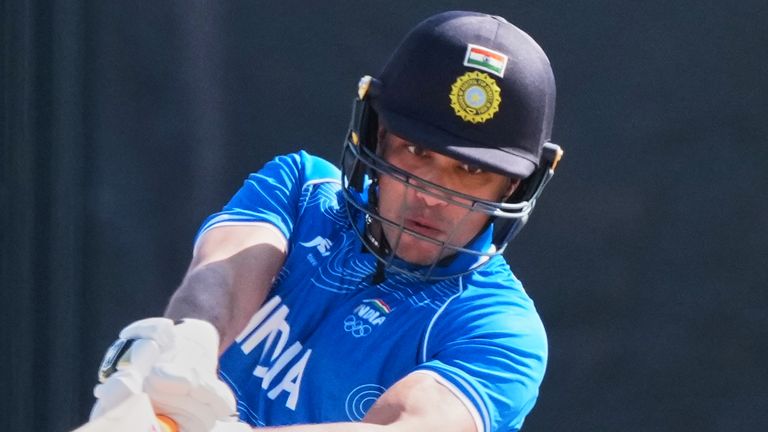
India beat Pakistan in T20 cricket to secure back-to-back gold medals at the Asian Games - but their ODI side were unable to complete a 3-0 sweep of West Indies on the same day after Shai Hope's 162 not out led the tourists to their record chase of 352.
… %!s()
In the Asian Games final in Japan, India smoked 211-6 from their 20 overs, underpinned by Abhishek Sharma's 61 off 28 balls, Tilak Varma's 51 not out from 22 and Shivam Dube's 27 off 15.
Pakistan plummeted to 39-3 in reply and despite Hasan Nawaz's 96 off 51 balls, they could muster only 192-6 and lost by 19 runs.
Scorecard: India vs Pakistan, Asian Games final, Japan
England avoid India, Australia in World Cup group stage
Image:
Abhishek hit seven sixes and three fours in his 28-ball 61
The victory was India's seventh in a row over Pakistan in T20Is and their 14th in the 18 matches between the teams in the format.
Tireless Hope hits brilliant ton as India denied ODI sweep
In New Chandigarh, however, India saw their total of 351-7 eclipsed by West Indies with 10 balls to spare as visiting captain Hope struck his 21st ODI hundred and second in as many matches to secure a five-wicket win after defeats in Thiruvananthapuram and Guwahati.
Hope's 143-ball knock featured 17 fours and and three sixes, with his final maximum, a slog sweep over deep fine leg off spinner Naman Dhir, bringing the scores level before he drove the match-clinching single to long-off.
Scorecard: India vs West Indies, third ODI, New Chandigarh
Listen to latest episode of the Sky Sports Cricket Podcast
Get Sky Sports on WhatsApp for news, video and more
Twitter
This content is provided by Twitter, which may be using cookies and other technologies.
To show you this content, we need your permission to use cookies.
You can use the buttons below to amend your preferences to enable Twitter cookies or to allow those cookies just once.
You can change your settings at any time via the Privacy Options.
Unfortunately we have been unable to verify if you have consented to Twitter cookies.
To view this content you can use the button below to allow Twitter cookies for this session only.
There was a controversial moment when Sherfane Rutherford was given out caught behind off Dhir for 24, with the on-field decision upheld after a review despite the West Indies batter feeling the spike on Snicko was bat on pad, not bat on ball.
Rutherford's dismissal left West Indies 206-3 after 30 overs but Hope - who kept for 50 overs and then opened the battings - shared half-century stands with Keemo Paul (44) and Gudakesh Motie (19), having earlier put on 109 with Amir Jangoo (67).
India's score, achieved after they had tumbled to 4-2, was based on KL Rahul's 129 not out off 87 balls, plus Rohit Sharma's 92 from 85 deliveries and Ruturaj Gaikkwad's 57 off 69.
Shubman Gill (1) - who hit an unbeaten 223 in the second ODI as India chased down 406 to take an unassailable 2-0 lead - and Virat Kohli (0) fell to successive balls from Jayden Seales in the third over.
Kohli was bowled for a golden duck as Seales flattened his middle stump, moments after Gill had edged behind and been dismissed by a one-handed diving catch from Hope.
Image:
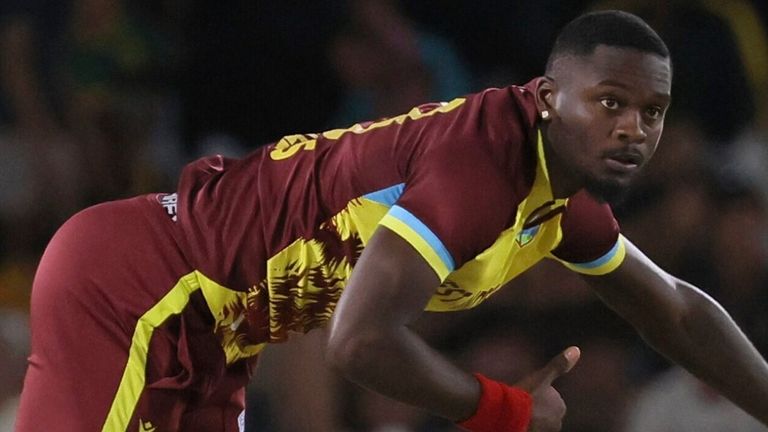
Jayden Seales dismissed Shubman Gill and Virat Kohli from successive deliveries in New Chandigarh
T20s up next for India and West Indies
The teams will now meet in five T20s, starting in Lucknow on Tuesday, with Abhishek, Tilak, Shreyas Iyer and 15-year-old Vaibhav Sooryavanshi among the players to fly in for that series following victory at the Asian Games.
Cricket has been part of the Asian Games at every edition since 2010, bar the 2018 event in Indonesia, with India claiming gold on their competition debut in China in 2022 before backing up that success in Japan this year.
The next Asian Games is due to be held in Qatar in November 2030. %!s()
Who: Portugal vs Norway What: UEFA Nations League 2026-27, Group A4 match Where: Estadio do Dragao, Porto, Portugal When: Sunday, October 4, at 8:45pm local time (18:45 GMT) How to follow: Al Jazeera Sport will bring you all the build-up and live updates from 15:45 GMT.
… %!s()
For the second time in a week, Portugal and Norway clash in the UEFA Nations League. But this time, things are not quite the same in the Selecao camp.
Recommended Stories
list of 4 items
list 1 of 4‘Verbal attack’: Israeli reporters interrupt Ireland news conference
list 2 of 4No handshakes and a delayed ceremony as India beat Pakistan at Asian Games
list 3 of 4Dominican Republic bans Haiti from its stadiums after football fans clash
list 4 of 4Who is Man City whistleblower Rui Pinto and what has become of him?
end of list
Sunday’s fixture in Porto will see the Nations League title holders play without their talisman, Cristiano Ronaldo, after the 41-year-old abruptly left their camp, raising questions about his international future.
Ronaldo’s dramatic exit and apparent rift with new coach Jorge Jesus have dominated headlines worldwide. Portuguese players have largely blocked the outside noise, however, maintaining a perfect record at the tournament where they are chasing a record-extending third crown.
Opponents Norway have won just one match, despite boasting a talented side that defied expectations with a historic quarterfinal finish at this year’s FIFA World Cup.
However, their striker Erling Haaland – one of Europe’s most lethal players – poses enough danger to put Portugal under pressure ahead of this weekend’s thrilling encounter.
What is the UEFA Nations League?
The UEFA Nations League was founded in 2018 to reduce the number of meaningless friendlies and give nations competitive matches against top-ranked teams.
In this competition, countries from across Europe participate in a league structure which features promotion and relegation.
What is the latest news on Cristiano Ronaldo?
Ronaldo left the squad late on Wednesday, shortly after a news conference in which coach Jesus confirmed the five-time Ballon d’Or winner would be left out of his starting line-up for a second consecutive Nations League game.
The 41-year-old’s decision to walk out came as a shock as he had been due to train with his teammates at the Parken Stadium in Copenhagen.
Portugal’s leading scorer with 146 goals had already spent the entirety of last weekend’s 2-1 Nations League win in Norway on the bench, having captained the side in the 1-0 home victory over Wales last Thursday.
He appeared to indicate that the reasons behind Jesus’s decision ran deeper and hinted at a departure from the national team he has graced for more than two decades.
“In due course, I will tell the truth to all the Portuguese people about my reasons for leaving the national team, to which I have always been dedicated,” Ronaldo said in a cryptic Instagram post, announcing his sudden exit from the camp.
Spanish sports daily Marca said that Jesus and Portuguese federation president Pedro Proenca followed Ronaldo to Copenhagen airport in an attempt to persuade him to stay with the squad, before the player boarded his private jet.
Jesus insisted earlier on Wednesday that there was no rift between them, although the 72-year-old, who was appointed in July, acknowledged that his captain was disappointed to remain on the bench against Norway.
How have Portugal and Norway played in the Nations League?
Portugal are on top of Group A4 on nine points, with three wins out of three. They started their campaign with a 1-0 home win over Wales, before adding a 2-1 victory over Norway in Oslo. In the last match, they thrashed Denmark 4-2 in Copenhagen.
Norway are second-bottom in the group, with only three points. They started their campaign with a 3-2 home win over fellow Scandinavians Denmark but suffered identical 2-1 defeats at home to Portugal and to Wales in Cardiff.
When did Portugal and Norway last meet?
They met in matchday two of this year’s Nations League, with Portugal beating Norway 2-1 in Oslo.
Joao Felix and Goncalo Ramos scored for Portugal, while Haaland struck the consolation goal for Norway.
Portugal vs Norway: Head-to-head
Matches: 12
Portugal wins: 9
Norway wins: 1
Draws: 2
Portugal vs Norway: Form guide
(Last five games, latest results first)
Portugal: W-W-W-L-W
Norway: L-L-W-L-W
Who are the top players to watch?
Joao Felix and Goncalo Ramos (Portugal): Al Nassr forward Felix has emerged as the reliable scorer in the Portugal setup, finding the net in each of the three games this term. Meanwhile, Ramos, playing in place of Ronaldo, has made up for CR7’s absence with goals in the last two matches.
João Felix of Portugal has scored in every Nations League game this season [File: Diogo Faria Reis/MB Media/Getty Images]
Erling Haaland and Oscar Bobb (Norway): All of Norway’s goals in the ongoing competition have come through Haaland (three) and Bobb (two). While their partnership proved successful in the opening match, their goals were not enough in the following matches, as the Norwegians suffered back-to-back defeats. Norwegians will demand better from Haaland, especially after the Manchester City talisman’s incredible start to the club season that features seven goals in as many games.
Team news and predicted lineups
Portugal
Winger Francisco Conceicao is doubtful for the game due to a thigh injury.
Probable Portugal XI: Diogo Costa; Joao Cancelo, Ruben Dias, Renato Veiga, Nuno Mendes; Ruben Neves, Vitinha; Pedro Neto, Bruno Fernandes, Rafael Leao; Goncalo Ramos
Norway
Wing-back Julian Ryerson is doubtful with a muscle injury, while centre-back Torbjorn Heggem is suspended.
Probable Norway XI: Orjan Nyland; Julian Ryerson, Kristoffer Ajer, Torbjorn Heggem, David Moller Wolfe; Martin Odegaard, Sander Berge, Patrick Berg; Oscar Bobb, Erling Haaland, Antonio Nusa
Norwegians need Erling Haaland to be on the scoresheet if they are to beat Portugal [File: Marius Nordnes / Nordnes Foto/Getty Images]
Portugal vs Norway: TV channel, livestreaming
Portugal
Norway
United Kingdom: ITV1
United States: FOX Sports, FuboTV, ViX
India: Sony Sports Network
Middle East and North Africa: beIN SPORTS
South Africa: DStv Stream
You can find your regional broadcaster on UEFA’s official broadcaster listing. %!s()
Jordan Pickford: A really good decision and save when he raced out and won the ball at the feet of Ivan Perisic early on. Not tested but was lucky to not concede with Mateo Kovacic's incredible miss. 6
…%!s()
Jarell Quansah: Surprisingly chosen at right-back over Trent Alexander-Arnold but the Bayer Leverkusen defender does exactly what manager Thomas Tuchel wants. A powerful runner, a good defender and his ability on the ball is underrated - he showed it with a quality assist for Gordon. 8
Ezri Konsa: Not loads of defending for Konsa to do as England pinned Croatia back but it was a calm assured performance from the defender. 7
Marc Guehi: The centre-back had to take up some risky positions as England pressed man for man all over the pitch. 7
Lewis Hall: The Newcastle left-back looks a great addition to the England back four. Hall offers pace going forward and also underlapped, going into midfield to recieve the ball. 7
Elliot Anderson: Anderson has been excellent throughout this international break and produced another mature performance. The Manchester City midfielder is a crucial part of the midfield and set up Kane for England's fifth. 8
Alex Scott: The Bournemouth midfielder was given his first England start and put in a really confident performance. Scott always looked to get on the ball and did not just try to keep it safe as England dominated. 7
Jude Bellingham: The best player on the pitch. Bellingham produced a lovely pass to thread Kane through for the first goal, scored England's second and assisted Saka for England's fourth. A truly world-class player and his quality was too much for Croatia throughout the game. 9
Bukayo Saka: The winger scored twice and looks to be building a good partnership with Quansah on England's right-hand side. Saka could have had a hat-trick but missed a big chance in the second half. 8
Anthony Gordon: Playing with a huge amount of confidence and continues to show that he has gone to another level in recent months. Assisted Bellingham and scored for the fourth England game in a row. 9
Harry Kane: Just an elite finisher and his goal put England firmly in control. The captain looked full of energy, pressed from the front and showed his passing range as he enjoyed having Gordon and Bellingham supplying him. Scored England's fifth goal too. 9%!s()
A murder investigation has been launched after a 40-year-old man was shot dead in a "senseless act of violence" as up to 50 people – including children – gathered for a memorial service in west London.
… %!s()
The Met Police said it was called to the scene at 19:47 GMT on Friday after multiple shots had been heard by members of the public at the junction of Braybrook Street and Erconwald Street in East Acton.
Officers attended alongside the London Ambulance Service but the man was pronounced dead at the scene, despite the efforts of medics.
No arrests have been made and a police cordon remains in place in Braybrook Street. Police are appealing for witnesses to come forward.
The victim's family have been informed and are being supported by specialist officers.
A post-mortem examination is scheduled to establish the cause of death, but the victim is believed to have sustained a gunshot wound, the force said.
Det Ch Insp Brian Howie, who is leading the investigation, said: "Our thoughts are with the family and friends of a man whose life was taken in a senseless act of violence.
"We understand a large number of people had gathered for a memorial service and what should have been a time to come together in remembrance has instead left a family devastated.
"We believe between 40 and 50 people, including children, were present when this incident occurred. Someone knows what happened and we need them to come forward."
He has asked anyone who was around Erconwald Street, Braybrook Street, the surrounding roads or Wormwood Scrubs playground between 18:00 and 20:00, to "please think carefully about what you saw".
He added: "Did you see anyone carrying or concealing weapons, people on bicycles acting suspiciously, or vehicles being driven at speed?
"We also want to hear from anyone with photographs, video, dashcam, doorbell or mobile phone footage or who has seen anything relevant on social media.
"However insignificant it may seem, the smallest piece of information could prove crucial in helping us establish what happened and identify those responsible."