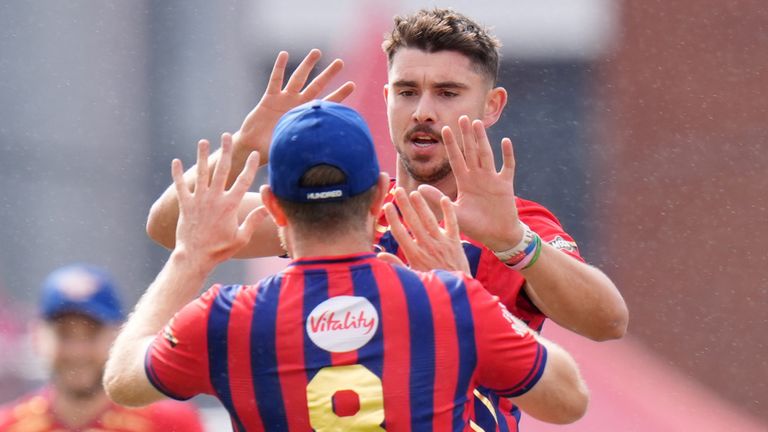
Mayo's emotional All-Ireland triumph on Sunday brought a collective release to everyone associated with the county, but victory on Gaelic football's biggest day also provided Ryan O'Donoghue a measure of redemption.
… %!s()
In the 2021 final, O'Donoghue missed a penalty that would have given Mayo the lead over Tyrone in the second half.
While O'Donoghue top-scored on the day with 0-8, Tyrone won the game, leaving the spot-kick failure - which came 12 months after the 2020 final loss to Dublin - to eat away at him for five years before he got another crack at the final.
And against Kerry on Sunday, the 27-year-old set the tone for a furious Mayo performance as he pressed and hassled the Kingdom defence from the first minute in a man of the match performance.
"The two main emotions are pride and relief," he told The GAA Social.
"After 2020 and 2021, if I'm being honest, I was never over 2021 until about a half-hour ago [at full-time on Sunday].
"Now I'm an All-Ireland champion, we're All-Ireland champions and I'm over it. I'm a firm believer that everything happens for a reason.
"There are a lot of things that have happened in the past couple of years on the pitch - 2020, 2021 and the Roscommon game [a 10-point loss in this year's Connacht semi-final]. I don't think today would have happened if we didn't go through those things."
O'Donoghue, who made his senior inter-county debut in 2020, had enjoyed a superb season for Andy Moran's side prior to Sunday's final.
But his indefatigable display - in which he scored 0-5 and launched the move that ended with Darragh Beirne's 40th-minute goal - has installed him as the frontrunner for the Footballer of the Year award (he would be the first Mayo winner since Moran in 2017).
It would be a remarkable achievement for a multi-talented sportsman, who fought in two All-Ireland boxing finals in his youth and played for the Republic of Ireland soccer team at underage level.
And like so many of his team-mates, Belmullet club-man O'Donoghue was able to savour the epic celebrations at Croke Park with his family, including his father Michael and County Down-born mother Brenda.
"What my mother and father have done for me since I was 11 years of age. Boxing, my dad used to leave at 4 o'clock in the morning to take me to Dublin to the National Stadium for Ireland training," explained O'Donoghue.
"Up and down the road to Castlebar when I was playing Kennedy Cup with Mayo, up and down the road, under-14, Minor. It's a long journey from Castlebar to Belmullet.
"My father worked two jobs. I was playing with Sligo Rovers 2014 to 2016. I didn't get paid, we had to pay our own diesel. There were bills to be paid and my father worked to get me up and down the road to Sligo.
"They've given me every opportunity, whether it's boxing, soccer or Gaelic. This is for them. That's the pride and the emotions in mum and dad. I'm so happy to have repaid them. There's been so many sacrifices. I'm so glad we've done it." %!s()
A forum website published a post on Reddit expressing disbelief that Google issued a manual action for thin content, finding it hard to reconcile how Google could send so much traffic for nearly twenty years only to find fault with it now. Google is calling it a manual action for thin content, but SEOs believe it may be for AI-generated content.
…
Manual Action For Thin Content
According to the Reddit post, a forum received a manual action for thin content. The notification specifically pointed to over half a million posts in one specific category of the site, /threads/. They explained that it’s a partial manual action and that the penalization does not affect the rest of the site, just this one part of the website.
“The message (WNC‑651700, ~17 July 2026) is: “Thin content with little or no added value.”
It’s a partial manual action, meaning a human reviewer looked at part of the site, judged it unworthy of ranking, and suppressed it pending a reconsideration request.
The Affects field names exactly one thing: the URL pattern windowsforum.com/threads/.
That’s 168,290 visible threads and over half a million posts, twenty years deep, suppressed together.
No example URLs were provided. Not one.”
Thin Content
Google has multiple definitions of thin content. One of them, thin affiliate content, is content published on affiliate sites that are word for word duplicates of what is found on the merchant websites.
Former Googler Matt Cutts has said that thin affiliate content lacks “original insight or research or analysis” or any other kind of content like original videos that “add value.”
Other forms of thin content:
Syndicated content
Article marketing content
Cutts has also explained that the opposite of thin content is content that site owners have written themselves, contains additional value, is unique, and leans in on the author’s actual expertise.
That last part may be critical for understanding why the Redditor’s forum received a thin content warning, but not in the context that the site owners were thinking of.
Why Is Actual Thin Content Not Penalized?
The part that confused the site owner is that there were two other sections of the website that were more clearly thin content, yet those web pages were not subject to a manual action. One section was a feed of syndicated headlines. The other section was an archived knowledge base. They said both sections have been inactive for three years, yet neither of them was called out for a manual action. It was the forum section of the site that received a manual action.
They wrote:
“The part that doesn’t reconcile
Two sections of the site are the obvious candidates for a thin‑content finding:
an old syndicated headline feed
an archived knowledge base
Together, that’s 11,927 threads with a mean age of about 12.5 years.
…This material has been crawled, indexed, and ranked continuously through Panda, Penguin, the September 2023 helpful content update, and through the community’s migration from its original domain… Fifteen years, two domains, every major ranking change Google has shipped and it never drew a manual action.”
Redditors expressed outrage, with one saying that it’s the result of Google’s monopoly in search.
Stablogger’s response was representative of the outrage many felt:
“This is pretty shocking indeed, especially knowing the reputation of this forum. Is there some thin content? Most certainly, but you have repetitive or pretty much empty threads on every single forum, you have them on Reddit, too.
It’s the nature of user generated content, some threads attract loads of interaction, some don’t at all, but it can’t be the solution to simply delete thin threads without the consent of whoever posted them.”
Well, contrary to what Stablogger wrote, pruning thin or outdated conversations is an option and many forum site owners do it.
Maybe Thin Content = AI Generated Content?
Google has in the past said that content that is AI-generated does not automatically mean it’s bad. However, Australian-based SEO Gagan Ghotra suggested that AI-generated content may be the reason for the thin content manual action.
The points of interest are that the forum characterizes its AI chatbot as a staff member, it has been active since 2023, and the chatbot has posted over a hundred thousand responses to questions.
Authenticity And Value Add
The possible reason why AI-generated answers may be considered thin content is that the expected value add of forums is that the answers are based on actual human experience.
AI does not have experience. It deals in received knowledge. Received knowledge is knowledge that comes from someone or somewhere else, like from a book or another website. There is no value add there in the context of a forum. It’s not what users expect when they post a question on a forum.
Flexing its muscles as one of the biggest new kids on its film industry block, Spain’s ISII Group has gone into production on “Amor de Dios” headlined by “The Orphanage” star Belén Rueda and produced by ISII banner label Inefable Productions.
… %!s()
The news comes as ISII Group distribution-sales house Deep Com Roots has sold “Summer Days” to half the world’s major markets and cameras have rolled on “La Cathédrale,” Inefable’s first fully English production starring “One Piece” icon Taz Skylar.
As a mark of its step-up in scale, ISII Group now has four films in production in 2026 and another quartet released or awaiting release, including Spanish Western “Trinidad,” an ambitious Wild West-set Spanish family saga led by “Your Fault’s” Gabriela Andrada, Paz Vega and Karla Sofía Gascón. All ISII Group titles are sold and distributed in Spain by Deep Com Roots, a strategic partner.
‘Summer Days’ Closes Half the World
“Summer Days” weighs in as a sun-drenched erotic drama with a thriller edge.
Headed by Maggie Civantos, star of “Locked Up,” “Money Heist” creator Alex Pina’s first international breakout, “Summer Days” has closed Latin America, bought by Brazil’s Sofa Digital, plus Germany, Austria and Switzerland (Busch Media Group) and CIS (Kinologistika). Tokyo’s Aya Pro has licensed Japan, Mumbai’s PictureWorks India, distributor of Anatomy of a Fall and Flow, has acquired rights to India, and Scene & Sound those to South Korea.
“Summer Days” (“Días de agosto”) begins with college students Juan (Pau Simón, “Nudes”) and Gabriela (Berta Galo, “La moderna”) escaping to his family beachside chalet for an idyllic summer.
The film is described as a romantic drama. It acquires almost immediately, however, an erotic charge, in dialog and the arrival of Juan’s father Fernando (Roberto Álamo, “Riot Police”) with his much younger girlfriend Monica (Civantos). Juan and Monica’s feelings for each other build, mixing Juan’s resentment for his father leaving his mother and impossible-to-ignore physical attraction.
“Deep Com Roots attended Cannes Market for the first time and was met with strong interest from the international market. Among our slate, Summer Days was one of the films that attracted the most attention from the buyers,” Emir Duzel, Deep Com Roots head of international sales, told Variety. “We believe its powerful story and the strong sense of tension made the film especially appealing. We are currently continuing negotiations for distribution deals for several more territories.”
Early fruit of the ISII Group’s new talent support, “Summer Days” is based on a screenplay by David Sueiro, which was one of the seven fiction winners in the ISII Group’s first Break on Time ’59 national screenplay competition in 2024. It also marks a return to fiction of versatile director Chema del Prado, behind “IsiDisi,” a Spanish gross-out classic.
Maggie Civantos in ‘Summer Days’
‘Amor de Dios,’ Led Belén Rueda, Goes Into Production
Also the female lead in Alejandro Amenábar’s Academy Award winner “The Sea Inside” and star of upscale genre hits “Julia’s Eyes” and “The Body,” in “Amor de Dios,” Rueda plays Sara Lanes, a renowned dancer and choreographer now living in Paris. When flamenco school Amor de Dios, once rated the world’s best, announces its closure, Sara returns to Madrid with disciple Ángela hoping to save the place where her own career began.
“At the School, Sara reencounters a past she has never been able to leave behind. That and her own physical decline turns her return into a profoundly personal journey where she has to decide what she is willing to sacrifice in order to preserve her legacy,” says the synopsis.
Inspired in its origins by an original idea by Spanish cinema great Carlos Saura, “Amor de Dios” is also produced by Inefable Productions
Key cast also takes in Asier Etxeandia, co-star of Pedro Almodóvar’s “Pain and Glory,” and celebrated French dancer Soleila Chaou, Spanish National Ballet principal dancer Irene Tena and Tania Santana (“Love on a Tightrope”).
Scheduled for release in 2027, “Amor de Dios” marks the awaited fiction feature debut of Paula Palacios, winner of the IDA Netflix 2022 Global Emerging Filmmaker Award and a double Goya best doc feature nominee for two stirring and affecting films, set against the context of African immigration to Europe: “Drowning Letters” (“Cartas Mojadas,” 2020) and “My Brother Ali,” (2024).
“La Cathédrale,” Headlined by Will Keen and Taz Skylar
“A new push for ISII Group’s fiction division,” it has noted, “La Cathédrale,” a double redemption thriller, turns on Thomas (Keen), a renowned violinist, who struggles to rebuild his life after the murder of his teenage daughter. When he agrees to take part in a restorative justice process with the man convicted of her killing (Skylar), the discovery of a mysterious violin among her belongings sets him on what the synopsis calls “a relentless search for the truth.”
Beyond Slylar, “La Cathédrale” stars Keen, the distinguished British theatre actor and Private Secretary Michael Adeane in “The Crown,” Venice Horizons best actress Award winner Marta Nieto (“Mother”), Ronald Guttman, whose prolific and long career takes in “The Hunt for Red October,” “Lost” and “Mad Men”; and Catalan actor-pianist Peter Vives (“The Time in Between”).
The film stands out for its “narrative tension, a powerful soundtrack and an immersive atmosphere,” Deep Com Roots has said.
Now shooting in the Canary Islands, in Tenerife and Las Palmas, ““La Cathédrale” reflects director Eduardo Cubillo’s fascination with restorative justice. “Two people who seem irreconcilable – filled with hatred and countless grievances – can, through a simple conversation – which may or may not be difficult – end up feeling liberated in a way that has to be seen to be believed; it’s truly magical,” he has said. The film is written by Cubillo and scribe-helmer José Ortuño (“The Extraordinary Tale”).
Taz Skylar in ‘La Cathédrale’
Deep Com Roots’ Slate
“At ISII Group, we conceive each project not only from its creative ambition, but also the commercial career it can have inside and outside Spain,” said ISII Group President Silvia Carvalho.
“So we have developed a structure which integrates development, financing, production, services, distribution and sales, with Deep Com Roots as the sales agent on all of our catalog,” she added. “‘Summer Days’ pre-sales and the interest generated by ‘La Cathédrale,’ ‘Amor de Dios’ and ‘Trinidad’ confirm that this model allows us to create value and market opportunities from the first stages of every film.”
“Trinidad,” directed by Laura Alvea and José Ortuño, bows Nov. 2026.
Gleaning great reviews, beginning in 1969 when Spain was still under the dictatorship of Francisco Franco, “Tal vez” charts the perhaps requited love of Canary Islands poet Natalia Sosa Ayala (“Hierro”) for trapeze artist Pinito del Oro (Adriana Ugarte, “Juileta”), star of New York’s Ringling Brothers. Bowed July 10, it is directed by Arima León, turning on their encounter and their correspondence afterwards.
Winner of the 2025 Break on Time competition, “Desde Arriba,” a father-son relationship dramedy, is now in post-production. Martín Cuervo directs from a screenplay by Arturo Ruiz Serrano and José Manuel Carrasco.
A realist survival thriller starring Milena Smit (“Parallel Mothers”) and Irene Escolar (“Tell Me Who I Am”) “My Zone” shot in the Canary Islands of Gran Canaria and Fuerteventura from May. It marks the feature debut of best short fiction Goya winner Cristián Beteta (“Ángulo muerto”). Directed by Violeta Salama (“Alegría”), “Auri,” starring Cristina Marcos (“Maravillas,” “Locked Up”), a comedy turning on a housewife’s later life revolution, bowed in April in Spain.
‘Trinidad’ (L-R) Gabriela Andrada, Paz Vega and Karla Sofía Gascón
Gabriela Andrada, Paz Vega and Karla Sofía Gascón in ‘Trinidad’. Courtesy of Deep Com Roots
Drug discovery is a high-cost, high-risk endeavor that is under growing pressure from a market increasingly defined by first-mover advantage.
Since the 1950s, the cost of developing new pharmaceuticals has roughly doubled every nine years—a phenomenon known as Eroom’s Law. Today, bringing a new drug to market takes an average of 10-15 years and costs anywhere from $1 billion to $2.5 billion, with failure rates upward of 90%.
… %!s()
AI has become the pharmaceutical industry’s biggest bet on bringing success rates up and timelines down. The faster drug companies can identify, test, and optimize new chemical compounds, the lower the risk of costly failures later in development.
“The main cost in drug discovery is still the clinical phase, so trying to reduce risk and increase your success rates there is obviously hugely beneficial,” says Paul Belcher, director of protein research strategy at global life sciences company Cytiva. “AI is one approach that drug companies hope will not only save time and compress timelines, but enable better quality candidates to reach the clinic.”
Early use of AI in drug discovery shows potential, but also highlights the need for robust and authentic data, as well as integration in lab systems.
AI brings efficiency to the lab
One of the most promising early-stage applications of AI in drug discovery is in hit identification. This involves screening libraries of molecular entities against a disease-related target, such as a protein, to find molecules that bind to it. A successful hit gives researchers a starting point for further testing and refinement, with the aim of eventually developing a viable drug.
Belcher has seen a shift from empirical screening to predictive design: Instead of physically screening libraries, drug companies are now using AI to design drug candidates from scratch and predict how they will interact with disease targets before committing anything to research and development (R&D).
This means companies are no longer limited by how much they can physically screen to identify starting points. “AI does away with that,” says Belcher. “And it can help eliminate low-quality candidates before you have to physically test them, saving time and resources.”
What AI can’t do yet is reliably predict kinetics or developability of new compounds, says Belcher. This means every AI-generated candidate still needs to be validated in the lab.
Traditional screening workflows were built to identify hits at scale, not to profile large numbers of complex candidates in detail. This is placing more pressure on lab teams, who now have to test, characterize, and purify a growing volume of more diverse, AI-generated compounds.
“The current techniques used in hit identification can screen hundreds of thousands, sometimes millions of compounds, using binary or threshold-based techniques producing low-fidelity data—yes-or-no responses,” Belcher explains. “AI can increase the number of hits you get and potentially give you better quality hits as well. That increases demand for higher-throughput, information-rich technologies to then validate and characterize those hits.”
Models need complete, quality data
As AI has accelerated demand for data-rich lab systems, it has also highlighted a fundamental need for better, more complete data.
Many earlier AI models were trained on publicly available datasets and are now hitting what Belcher calls a data wall. Because models have access to the same data, they all reach similar conclusions, with diminishing returns over time. Additionally, the datasets weren't built with AI in mind, meaning they lack the structure, labeling, and diversity needed to keep models accurate and free of bias.
Publication bias reinforces the problem. “Most publicly available datasets and scientific publications focus exclusively on positive results,” says Belcher. “No one wants to share their failures. This bias is almost like having one hand tied behind your back. AI models can identify patterns associated with success, but they lack the comprehensive understanding of failures that would make predictions more reliable.”
The data Belcher believes would markedly improve models—the failed experiments, the compounds that don’t bind—remains frustratingly difficult to come by. “We often joke that there should be a journal of negative data,” he says. “It’s often buried in lab notebooks, and it’s never used to inform or guide future research.”
This lack of negative data creates a fundamental problem: Without access to a broad range of data, models can’t be adequately trained to avoid bias. “In all machine learning applications, the model’s performance relies heavily on the quality and scope of the training data,” notes Belcher.
Fabrication has also become much easier with AI, compounding concerns around data integrity. Take Western blots, for example. These are part of a standard technique for identifying proteins in blood or tissue samples, and they are among the most common targets for manipulation in biomedical research. Belcher cites research by Dutch microbiologist Elisabeth Bik, who found that almost 4% of biomedical papers contained duplicated or manipulated images. This was back in 2016, before generative AI made fabrication trivial.
“Manipulated or faked data has always been a problem in science, but in the AI world, especially when used to train models, it could have potentially disastrous consequences,” says Belcher. “There needs to be more tools to verify that data is not manipulated.”
Some vendors are starting to tackle this challenge. Belcher points to solutions like Cytiva’s Image Integrity Checker, for instance, which uses secure hash algorithms—the same technology used in blockchain—to detect whether scientific images have been tampered with. “We’re starting to see a lot of interest from publishing houses that want to adopt this as standard because it’s a quick way to ensure that what gets published in the literature is genuine,” he adds.
Autonomous labs could accelerate breakthroughs
Belcher describes the future state of drug discovery as fully autonomous labs that run with minimal human intervention. Foundational to this vision is consistency in data and infrastructure.
These AI-driven dark labs, or labs-in-the-loop, operate around the clock. They cycle through prediction, testing, and optimization, and then feed results back into AI models to guide the next round of experiments. This can improve the success rates of drug candidates entering clinical trials, says Belcher. Better starting points, combined with more rounds of optimization, should result in better candidates with fewer liabilities reaching the clinic.
But automating a lab depends heavily on integration. That means interoperable systems, highly structured and comprehensive datasets, and information flowing easily in and out. Most labs aren’t there yet. “Today, a lot of the instruments in labs are standalone,” Belcher notes. “You can have the best technology in the world, but if it’s a closed ecosystem—if the user can’t get the data out—it doesn’t do any good.”
An integrated infrastructure can enable labs to generate FAIR (findable, accessible, interoperable, and reusable) data at scale. This would not only inform individual lab reports, but could also train subsequent generations of AI models, effectively closing the loop between the computational, AI-driven dry lab and the physical wet lab.
“Our goal is to help scientists and researchers accelerate their breakthroughs and make that future state of autonomous labs a real possibility,” says Belcher. “We want to help them generate reliable data, simplify workflows in discovery, and hopefully enable what they’re working on to become tomorrow’s life-changing therapies, faster and with greater confidence.”
On costs and what comes next
AI-driven drug discovery is still in its early days. Notably, no drug discovered primarily through AI-driven design has yet received full FDA approval—although Belcher expects that to change in the next two to three years.
How big of an impact could AI eventually have on drug discovery? “The holy grail would be full in silico prediction of efficacy and toxicity, eliminating the need for the vast majority of physical wet lab work,” says Belcher. But there are many barriers to this beyond the maturity of the models, including regulatory hurdles and cost challenges.
A Stanford study found that the cost of training frontier AI models has more than doubled every year since 2016, adding more financial pressure to a sector already defined by exceptionally high R&D spend.
Belcher acknowledges the tension, but remains optimistic about what’s ahead. “I think we’ll get to a point where there’s a balance between AI and wet work, from a cost perspective and a risk perspective,” he says. “As long as the cost of compute doesn’t ever outweigh the cost of clinical development, I think AI is going to be an advantage.”
This content was produced by Insights, the custom content arm of MIT Technology Review. It was not written by MIT Technology Review’s editorial staff. It was researched, designed, and written by human writers, editors, analysts, and illustrators. This includes the writing of surveys and collection of data for surveys. AI tools that may have been used were limited to secondary production processes that passed thorough human review.%!s()
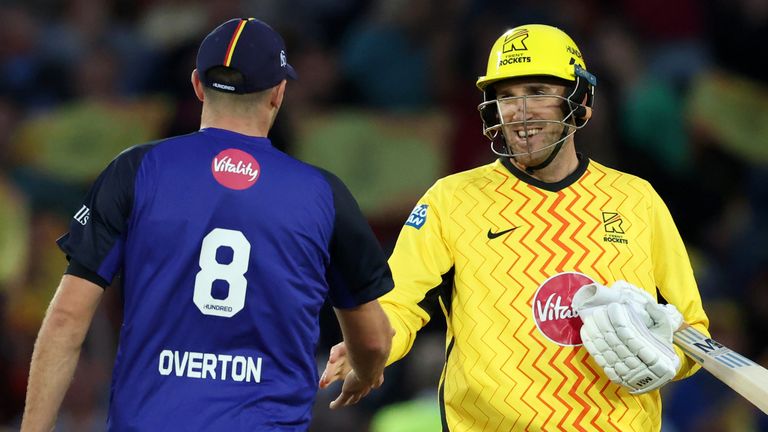
Craig Overton won his one-on-one battle with twin brother Jamie as Trent Rockets beat London Spirit by four wickets with two balls to spare in The Hundred.
Rockets needed 10 runs from the final five deliveries at Trent Bridge on Sunday night with Craig batting for the hosts and Jamie bowling for the visitors.
… %!s()
Craig (20no off six) earned bragging rights, and two points for his team, by top-edging Jamie for six over deep fine leg and then picking up successive twos to take Rockets to their target of 160, after Ben Duckett had spanked an excellent 75 off 47 balls up top.
Scorecard: Trent Rockets vs London Spirit, The Hundred
The Hundred - latest women's and men's tables for 2026
Image:
The Overton twins shake hands after Sunday evening's match at Trent Bridge
Craig Overton's six-two-two off his sibling had mirrored his efforts off Andrew Tye across the previous three deliveries with a maximum over long-on followed by a brace of two-run hauls, exploits that helped Rockets to a first win of 2026 and condemned Spirit to successive defeats.
Earlier in the game, Overton had caught and bowled Spirit opener Jonny Bairstow for a duck and also dismissed South African biffer Lhuan-dré Pretorius for 24.
Pretorius' compatriot Dewald Brevis top-scored with 39 from 24 balls in Spirit's 159-9, while captain Liam Livingstone contributed 33 off 24 deliveries.
Buttler blasts Super Giants to back-to-back wins
Please use Chrome browser for a more accessible video player
Watch all of Jos Butler's sixes in Manchester Super Giants' win over Birmingham Phoenix
Elsewhere, Jos Buttler cracked 90 from 50 balls as Manchester Super Giants hammered Birmingham Phoenix by 87runs to join Welsh Fire in winning their first two matches.
Scorecard: Manchester Super Giants vs Birmingham Phoenix
What cricket is live on Sky Sports and when?
Get Sky Sports on WhatsApp for news, video and more
Buttler's knock at Emirates Old Trafford, which featured seven fours and five sixes and helped Super Giants post 187-5, was only 10 runs fewer than Phoenix managed as an entire team, with the visitors bundled out for 100 as Liam Dawson claimed 3-15.
The hosts backed up their narrow seven-run win over Spirit at Lord's on Thursday, while Phoenix slipped to a first loss having edged Rockets by 10 runs in a high-scoring clash at Edgbaston on Friday.
Image:
Super Giants seamer Josh Tongue celebrates the wicket of Phoenix's Rehan Ahmed
Buttler was supported by Tom Moores' 39 not out off 17, which included five maximums, but Phoenix's batting never got going with skipper Donovan Ferreria (23) top-scoring.
England pacer Josh Tongue struck twice in two balls to rock Phoenix early, inflicting a golden duck on Rehan Ahmed, and the Midlanders never really recovered.
England quick Sonny Baker and Afghanistan spinner Noor Ahmad also bagged two wickets for Super Giants, who look to have an excellent all-round attack.
What is happening in The Hundred on Monday?
After the four-games-a-day set-up at the weekend, Monday sees a return to a single double-header with Southern Brave's women's side hosting MI London from 3pm before the men's sides square off from 6.30pm. Catch both fixtures live on Sky Sports.%!s()