The new series revisits fan-favorite couples from Love After Lockup as they navigate relationship woes with the help of a psychiatrist
If you purchase an independently reviewed product or service through a link on our website, Rolling Stone may receive an affiliate commission.
… %!s()
The post-prison reality series Love After Lockup is getting a brand-new spin-off, Love After Lockup: Relationship Rehab. The new show will revisit five couples from Love After Lockup as they navigate relationship challenges with the help of Dr. Ish Major, a psychiatrist and author specializing in relationships.
Couples returning to the screen for Love After Lockup: Relationship Rehab include fan-favorite couples like Brittany and Marcelino, Melissa and Louie, and Alexis and Julius as they navigate everything from infidelity to marriage to parenting.
At a Glance: How to Watch Love After Lockup: Relationship Rehab
“As emotions run high, long-buried secrets, painful truths, and unresolved conflicts come to the surface. With all five relationships pushed to their limits, Dr. Ish will give a final assessment of whether their bonds can be repaired or if some are beyond saving.”
Love After Lockup: Relationship Rehab premieres on Friday, Oct. 2 on We TV. If you don’t have a cable box, read on to find out how to stream the new series online.
How to Watch Love After Lockup: Relationship Rehab Online
The best way to watch Love After Lockup: Relationship Rehab online without cable is to get a subscription to Philo, an affordable live TV streaming service that carries We TV in its lineup of 200+ channels.
Philo offers two plans — Essential and Bundle+ — and both of them will get you access to We TV to stream Love After Lockup: Relationship Rehab. The Essential plan includes all 200+ pay TV and free TV channels that Philo offers, plus a year of unlimited DVR and thousands of on-demand titles for just $25 a month. Best of all, new subscribers can get a seven-day free trial to Philo Essential.
The Philo Bundle+ package includes everything in Essential, plus HBO Max Basic with Ads plan, AMC+, discovery+, meaning you can unlock some serious savings on your overall streaming bill every month. Bundle+ costs just $33 a month, although it doesn’t start with a free trial like the Essential plan.
Sign up for either Philo plan now to stream Love After Lockup: Relationship Rehab when it airs on Oct. 2. %!s()
Toronto, Canada: As Canadian Prime Minister Mark Carney races to make the country less dependent on the United States, attract billions in new investment and get major projects built faster, his economic overhaul is running into resistance from a group that says it wants many of the same things: organised labour.
… %!s()
The latest clash, over the right to strike, comes after months of mounting pressure on Ottawa from Washington, DC.
Recommended Stories
list of 4 items
list 1 of 4Why does Canada want to join the Europe-led JEF military partnership?
list 2 of 4Canadians warm to EU ‘associate membership’ proposal
list 3 of 4Trump tariffs hit Canada’s dairy farmers as US sales stall
list 4 of 4Canada’s BC sues OpenAI over ChatGPT role in Tumbler Ridge school shooting
end of list
US President Donald Trump, since taking up a second term in office last year, has imposed steep tariffs on Canadian goods and weakened trade agreements – perilous moves as Canada has historically sent close to 80 percent of its exports to its southern neighbour. He has repeatedly piled on with the tariff threats to make Canada the 51st US state.
Canada has responded with retaliatory tariffs, while a broader movement to “Buy Canadian” has taken hold. The hockey-inspired “elbows up” — meaning a readiness to defend against an opponent — has become a national rallying cry.
With trade talks stalled since August, Carney has moved with urgency to shore up the economy and invite new investments. Last month, he announced Bill C-39, known as the Building Canada Strong Act, promising to bring “speed, certainty and predictability” to investors.
Along with measures to speed up approvals for major projects, the bill would also give Ottawa clearer powers to intervene in legal strikes and lockouts in federally regulated workplaces — a provision that has put Carney on a collision course with unions.
Canada’s largest unions have come together against the changes. The largest, the Canadian Union of Public Employees (CUPE), had its national executive go as far as voting to defy the bill’s proposed limits on the right to strike if it passes Parliament without amendments.
CUPE National President Mark Hancock credited Carney’s handling of Trump and said the union’s 800,000 members, who work everywhere from hospitals to schools to municipal services, want to be part of “Team Canada”.
“But at what cost?” he said in an interview with Al Jazeera.
A fight over the right to strike
The controversy centres on Section 107 of the Canada Labour Code, which already gives the Labour Minister broad powers to step into disputes if needed to maintain “industrial peace”, end work stoppages and force the two sides into a binding arbitration.
Beginning in 2024, Ottawa used the provision eight times to intervene in disputes involving airlines, Canada’s two largest railways, three major ports and Canada Post and again during the Air Canada dispute in 2025 when flight attendants went on strike.
Unions have challenged the use of that law in court and had hoped the proposed C-39 would restrict, if not repeal, that clause while businesses wanted it strengthened.
The bill does neither. Instead, it introduces two conditions that the government would have to fulfil first before turning to Section 107.
Before stepping in, the government would have to appoint a special mediator, wait for a public report and consider whether a work stoppage is hurting the “national interest”.
Once a strike or lockout is underway, the minister could direct the Canada Industrial Relations Board to get operations running again and impose a binding process, such as arbitration.
A protester carries an effigy depicting Canada’s Prime Minister Mark Carney as people march to protest against the Canada Investment Summit in Toronto in September [File: Carlos Osorio/Reuters]
The government says those steps put clearer guardrails around a power that already exists, and Carney has said the bill “absolutely reinforces the right to strike”, according to the Canadian Broadcasting Corporation.
Unions have rejected this defence, pointing out that the meaning of “national interest” would ultimately be decided by the minister. They also argue that the prospect of government intervention is bound to change what happens at the bargaining table.
“The political lesson that employers will draw from it is simple,” Larry Savage, a professor of labour studies at Brock University, told Al Jazeera. “Hold out long enough, emphasise the economic damage, and then Ottawa will remove the union’s leverage for you.”
Disruption, Savage said, is precisely what gives a strike its power. “Every effective strike is disruptive,” he said.
Unions say they have already seen employers expect Ottawa to intervene.
Teamsters Canada alleges the Canadian National Railway (CN) and the Canadian Pacific Kansas City (CPKC) railroad companies were counting on Ottawa to step in when they locked out thousands of workers in 2024. Section 107 was invoked within hours.
“Companies have gotten used to the idea that if there is a labour dispute, they can just wait for the government to intervene,” Christopher Monette, Teamsters Canada’s director of public affairs, told Al Jazeera.
CUPE said it saw a similar dynamic at Air Canada in August 2025. Hancock said bargaining stalled after more than 10,000 Air Canada flight attendants voted overwhelmingly to strike because the airline was “expecting the government of Canada to step in and end the strike” — an account Air Canada disputed.
Less than 12 hours after workers walked out, Ottawa invoked Section 107. Air Canada CEO Michael Rousseau later told BNN Bloomberg the airline had expected the provision to be enforced and did not expect a strike.
“That was why they didn’t have a strategy on how to deal with the strike,” Hancock said.
Building Canada faster
The fight over the right to strike is also part of a much bigger argument taking shape around Carney’s economic agenda: Who gets a say in how Canada should change, and how quickly, in the name of making itself less vulnerable to the US?
Critics accuse Carney of using the economic threat from the US to push through changes that go well beyond responding to Trump’s trade war.
New Democratic Party leader Avi Lewis has accused him of using the “fear and disorientation around the trade war to push through a series of unpopular measures that he did not run on, has no mandate for and would never get away with under normal circumstances”.
A protester carries an effigy depicting Canada’s Prime Minister Mark Carney outside the Canada Investment Summit in Toronto [File: Carlos Osorio/Reuters]
That tension was on display in Toronto just a week before C-39 was introduced. Inside Canada’s first national investment summit, hundreds of global investors met with government officials and executives as Carney pitched a country ready to build.
Outside, hundreds of protesters marched through downtown towards the summit’s opening gala under the banner “The Many vs The Money”. The rally brought together labour, Indigenous, environmental and migrant-rights groups, with signs and speeches taking aim at everything from fossil fuel and military projects to AI and the use of public money to attract private investment.
For unions, C-39 has sharpened that debate, pitting the government’s promise of greater certainty for investors against workers’ ability to exert pressure through strikes.
But Jim Stanford, an economist and director of the Vancouver-based Centre for Future Work, questions how much of an economic threat strikes actually pose.
While work stoppages can be costly for individual companies, Stanford said, “It is very, very rare that you would see a noticeable and sustained impact on GDP, employment or incomes.”
Production and transportation are often delayed rather than permanently lost, he added, with businesses catching up once work resumes.
Stanford also questioned the idea that strikes are driving away investment, noting that more than 95 percent of collective bargaining ends without a work stoppage and saying there is “no empirical evidence whatsoever” that strikes have reduced investment.
“This is more of the government giving some icing on the cake for business. It’s not that this has to happen or else our investment won’t work,” he said.
There is also an economic cost to weakening the right to strike, Stanford argued. Workers need bargaining power to win higher wages, which can support consumer spending, productivity and worker retention.
“It may seem like labour peace is a good thing, but if it means that a worker’s share of the pie shrinks, then this actually hurts the economy.”
For labour leaders, that’s where Carney’s economic push goes too far.
“Canada’s unions are part of Team Canada. We have our elbows up,” Canadian Labour Congress President Bea Bruske said in a statement. “But we can’t have our elbows up against Trump with our hands tied at the bargaining table.”
Savage said the government’s “Team Canada” rhetoric risks treating workers’ bargaining power as a national liability.
“I don’t think Canada becomes stronger by telling workers in ports or railways or airlines that their rights have to be surrendered whenever employers invoke competitiveness or the national interest,” he said. %!s()
Retired General Nitzan Alon says more captives could have been returned alive and a deal was possible ‘maybe a year earlier’.
A former Israeli general who was the army’s point person for hostage negotiations at the beginning of the Gaza war says that a deal to return all Israeli captives could have been achieved “much earlier” than October 2025 but it was prolonged unnecessarily.
… %!s()
“I think that we could [have gotten to] this point much earlier, maybe a year earlier or so, without any major implication on the other strategic goals of the war,” Major General Nitzan Alon said on Friday. “We missed it, actually. The war was too long.”
Recommended Stories
list of 3 items
list 1 of 3UK arrests British-Iranian suspect over RAF ‘plot’: What we know
list 2 of 3Arab party leader forced to withdraw from Israeli elections
list 3 of 3How can Jordan respond to Israel’s escalation across the West Bank?
end of list
He was speaking during a Washington Institute for Near East Policy webcast marking three years since the October 7, 2023 Hamas attack on Israel preceding the genocidal war that has killed over 74,000 Palestinians.
Alon referred to Israeli Prime Minister Benjamin Netanyahu’s claim that Israel must achieve “total victory” before signing a deal as “false”.
He called the October 2025 “ceasefire” a “strategic achievement” that has since curbed Hamas’s military power. But he said it could have been secured much sooner with “maybe some hostages that got killed or murdered during their captivity [coming] back home alive.”
Hamas and Israel carried out a prisoner exchange deal in October 2025 under a ceasefire agreement that saw the release of nearly 2,000 Palestinians imprisoned in Israeli jails and 20 Israeli captives held in the Gaza Strip.
“We could have – and we should have – shortened the war, brought all the hostages back, maybe a year earlier, and moved forward and maybe, you know, saved thousands of lives on both sides,” Alon told the panel discussion organised by the United States think-tank.
Alon had made similar comments in July, when he also criticised Israeli Finance Minister Bezalel Smotrich, saying Smotrich had opposed some of the agreements put forward at various stages and therefore could not take credit for the return of all the captives.
‘Not just a missed opportunity, it’s tragic’
Speaking to Al Jazeera on Friday, former Israeli diplomat Alan Pinkas said Netanyahu had stalled the end of the war.
“A deal was possible very soon after the Hamas attack in October 2023,” he said.
“It took almost two years before the hostages were returned, so it’s not just a missed opportunity, it’s tragic.”
Earlier this week, Qatari Prime Minister Sheikh Mohammed bin Abdulrahman bin Jassim Al Thani said Israeli officials “rejected to entertain the idea” of a Hamas proposal to release all captives in exchange for a limited ceasefire soon after the attacks.
Al-Thani said Doha reached out to Israeli officials “on day one … Our message was very clear. They [Hamas leaders] are asking for a window of ceasefire to get the civilians out,” Sheikh Mohammed said in an interview with Piers Morgan. “And basically, they [the Israelis] were not interested to engage in the idea.”
Alon’s latest comments come less than a month before Israel’s October 27 legislative election, with polls showing the political battle remains at knife-edge.
Pinkas said Alon’s comments were unlikely to influence the outcome of the vote as polls already “reflect public anger” over the Netanyahu government’s failure to prevent the Hamas attacks.
A report by Israeli newspaper Haaretz claiming that United Arab Emirates President Sheikh Mohamed bin Zayed Al Nahyan had warned Netanyahu about a possible attack also sparked outrage across Israel last month.
Netanyahu said he would sue the outlet over its report, which he described as “fabricated” and “false”. %!s()
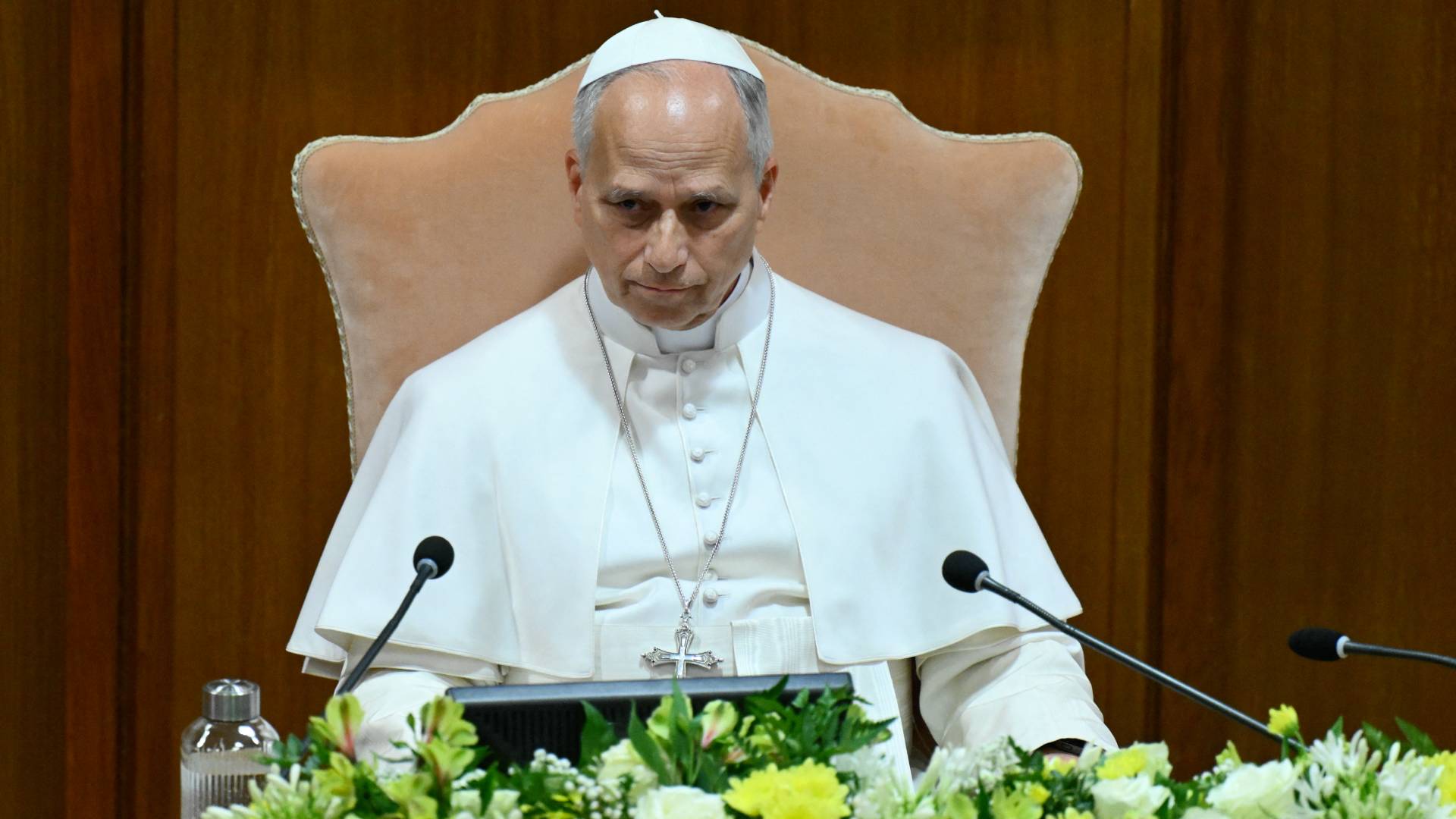
(Image credit: Alberto PIZZOLI / AFP via Getty Images)
Opinion
…
Opinion
For a while now, AI guys have been arguing with the pope—Bishop of Rome, Primate of Italy, Chicago White Sox fan—over whether or not their chatbots and image generators are consistent with the will of the Lord, and in one recently-revealed exchange, whether making a computer talk constitutes creating life.
According to a New York Times report published this week, Anthropic lobbied the pope's advisers "to take the prospect of AI model consciousness seriously" back in May.
The pope, apparently unmoved, stated in his Magnifica Humanitas that "so-called artificial intelligences do not undergo experiences, do not possess a body, do not feel joy or pain, do not mature through relationships and do not know from within what love, work, friendship or responsibility mean."
Former White House technology adviser Dean Ball criticized the pope's letter at the time, saying it "puts the Church into the awkward role of the European technocratic regulatory advocate."
Ball is now head of strategic futures at OpenAI.
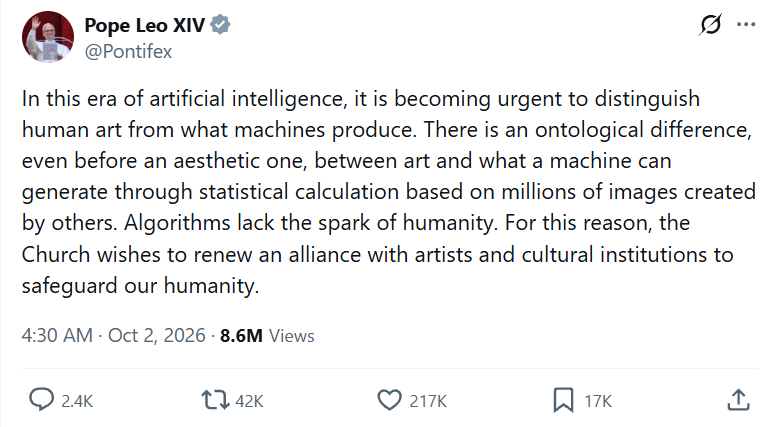
The latest in this ongoing beef between the pope and AI boosters is a new anti-slop message from His Holiness posted on X this week.
"In this era of artificial intelligence, it is becoming urgent to distinguish human art from what machines produce," wrote the pope. "There is an ontological difference, even before an aesthetic one, between art and what a machine can generate through statistical calculation based on millions of images created by others. Algorithms lack the spark of humanity. For this reason, the Church wishes to renew an alliance with artists and cultural institutions to safeguard our humanity."
Even on X, ruled as it is by the dunce king of tech and his Grok-riddled followers, there is a lot of support for the pope's stance. But of course there are also AI evangelists intent on schooling the Holy See about the beauty of "super intelligence," as it has been dubbed by people who must lack conviction in their own.
In one response I saw pointed out on Bluesky, the pope is asked "What about the Minions?" Indeed... what about them?
With the battle lines drawn between powerful AI interests and the Catholic church, will the next Great Schism be over whether or not Claude is a real person? Will an AI thoughtleader ascend to pope-like status of their own?
An event like that wouldn't be out of place in '90s cyberpunk-comedy novel Snow Crash. I'd once assumed that those satirical visions of mad techno-cultists and lawless megacorps would manifest in a somehow more buttoned-up way, more 'realistically.' I gravely misjudged reality's capacity for farce.
A tangentially-related case-in-point: Palmer Luckey, the guy who invented the first decent consumer VR headset, is now a weapons mogul with a personal UH-60 Black Hawk helicopter. Deus Ex bosses are real, and they wear Hawaiian shirts.
Tyler grew up in Silicon Valley during the '80s and '90s, playing games like Zork and Arkanoid on early PCs. He was later captivated by Myst, SimCity, Civilization, Command & Conquer, all the shooters they call "boomer shooters" now, and PS1 classic Bushido Blade (that's right: he had Bleem!). Tyler joined PC Gamer in 2011, and today he's focused on the site's news coverage. His hobbies include amateur boxing and adding to his 1,200-plus hours in Rocket League. %!s()
October is Halloween movie season, so it’s the perfect time for two of the year’s high-profile horror releases to debut on streaming platforms. “Evil Dead Burn,” the extremely grotesque ninth installment in the long-running franchise, premieres on HBO Max this month and should prove to be a big home viewing hit. For the indie horror lovers, Jane Schoenbrun’s instant cult classic “Teenage Sex and Death at Camp Miasma” arrives to on Mubi to stream after a buzzy summer run that kicked off at the Cannes Film Festival in May.
… %!s()
For non horror lovers, summer movie season tentpoles “Disclosure Day” and “Minions and Monsters” are both arriving on Peacock this October. Neither movie set the box office on fire, but streaming should prove a popular destination to watch the latest Steven Spielberg alien blockbuster and the latest entry in the uber-popular “Despicable Me” franchise. A24’s “The Invite” was a huge success in theaters, meanwhile, and should keep the Oscar buzz when it debuts on HBO Max this month.
Check out a full rundown below of the biggest movies hitting streaming this month.
The Invite (Oct. 23 on HBO Max)
Image Credit: Courtesy Everett Collection
Olivia Wilde’s acclaimed comedy “The Invite” arrives on HBO Max after earning a sturdy $58 million worldwide at the summer box office. Wilde stars opposite Seth Rogen, Penelope Cruz and Edward Norton in this story of two couples whose uproarious dinner party exposes the cracks in their relationships. Variety named “The Invite” one of the best movies of 2026 so far, calling it a “bravura dinner-party dramedy that’s like ‘Who’s Afraid of Virginia Woolf?’ remade by the Woody Allen of ‘Husbands and Wives.’”
Steven Spielberg’s “Disclosure Day” arrives on Peacock after a $241 million run in theaters worldwide over the summer. Heavily touted as the Oscar-winning legend’s return to alien-centric science fiction (he is the master who gave us “E.T.” and “Close Encounters of the Third Kind,” after all), the chase thriller casts Josh O’Connor and Emily Blunt as a cybersecurity analyst and meteorologist who set out on a mission to disclose the existence of alien life to the world. Colin Firth, Eve Hewson and Colman Domingo co-star.
The Death of Robin Hood (Oct. 16 on HBO Max)
Image Credit: Courtesy Everett Collection
“The Death of Robin Hood,” from “Pig” and “A Quiet Place: Day One” director Michael Sarnoski, casts Hugh Jackman as an aged and battle-weary version of the title character, who now lives in self-imposed exile and is tormented by his past. Robin Hood gets a shot at redemption after befriending an orphaned girl. Jodie Comer, Bill Skarsgård, Murray Bartlett and Noah Jupe also star in the A24 release.
“Evil Dead Burn” arrives on HBO Max just in time for Halloween movie season. The third movie since the “Evil Dead” series reboot in 2013 (and sixth film in the franchise overall) is directed by Sébastien Vaniček and stars Souheila Yacoub (“Dune: Part Two”) as a woman looking for comfort from her in-laws after her husband’s death. Their gathering at a secluded house quickly turns into a hellish reunion as the family members turn into Deadites.
Teenage Sex and Death at Camp Miasma (Oct. 2 on Mubi)
“We’re All Going to the World’s Fair” and “I Saw the TV Glow” director Jane Schoenbrun returned bigger and better than ever this year with the Mubi-backed meta slasher dark comedy “Teenage Sex and Death at Camp Miasma.” Hannah Einbinder plays a filmmaker tasked with rebooting a horror movie franchise who gets in over her head when she seeks out the franchise’s original star, played with seductive wit by Gillian Anderson. The movie rocked Cannes in May before earning $8 million worldwide over the summer, making it Schoenbrun’s highest-grossing movie yet.
“Minions & Monsters” is coming to Peacock after an underwhelming summer box office run with $523 million, putting it on the lower end of movies set in the “Despicable Me” franchise. However, family audiences are sure to turn out in force for the movie’s streaming debut. Pierre Coffin, the series co-creator and voice of the Minions, and Patrick Delage directed the film, which is set in 1920s Hollywood and follows the Minions as silent movie stars who struggle to adapt to talking pictures. Naturally, chaos ensues when the yellow creatures accidentally release monsters out into Los Angeles.
Ben Affleck directs, co-writes and stars in “Animals,” a Netflix original crime thriller that could continue the Oscar winner’s streaming luck after “The Rip” became one of Netflix’s biggest movies of the year. The synopsis reads: “When their son is kidnapped, a Los Angeles mayoral candidate and his wife find themselves drawn into a web of deception. As they scramble to raise the ransom payment, they’re forced to make choices – and reveal secrets – that could tear their world apart.” The cast also includes Kerry Washington, Gillian Anderson, Adriana Paz, Ray Fisher and Steven Yeun.
Oasis: Don’t Look Back in Anger (Oct. 9 on Disney+ and Hulu)
Noel and Liam Gallagher get reflective, philosophical and foul-mouthed in “Don’t Look Back in Anger,” the acclaimed documentary that chronicles the brothers’ highly-publicized reunion and comeback tour in 2025. Cameras were given access to rehearsals, backstage and onstage, while the documentary also includes the first joint interview with the brothers in over 25 years.
Netflix’s “Sacrifice,” starring the high-profile pairing of Chris Evans and Anya Taylor-Joy, marks the English-language debut of “Athena” director Romain Gavras. Evans plays a movie star trying to launch a Hollywood comeback after a viral meltdown. Taylor-Joy stars as the leader of a group of environmentalist radicals, who crash a black tie gala attended by Evans’ actor. This hostage situation quickly goes haywire. Vincent Cassel and Salma Hayek Pinault also star.
Rachel Morrison’s romantic drama “Love of Your Life” earned strong reviews after its premiere at the Toronto International Film Festival last month. Margaret Qualley stars as Maya, whose chance encounter with Charlie (Gabriel Basso) “sets in motion a sweeping romance and a future beyond anything she had imagined. When that future is suddenly upended, Maya is sent hurtling toward an unexpected new life — one that will force her to reckon with who she is, what she wants, and how to love again,” reads the synopsis from Amazon MGM.
Masterplan (Oct. 16 on Prime Video)
Stanley Tucci gets a star vehicle in Prime Video’s original heist movie “Masterplan.” The actor plays “a legendary thief who sets his sights on the Mona Lisa, recruiting two young strangers to help him — Chiara, a sharp Italian cybercrime expert, and Jay, a swaggering French explosives specialist — before revealing they are long-lost siblings… and oh yes, by the way, he is their father,” the synopsis reads from Amazon MGM. The supporting cast includes “The White Lotus” Season 2 favorite Simona Tabasco and Victor Belmondo.
V/H/S Mixtape (Oct. 9 on Shudder)
“V/H/S Mixtape” is the ninth installment in the long-running horror anthology series and features segments from Ernest Dickerson (“Tales From the Crypt: Demon Knight”), RZA (“The Man With the Iron Fists”), David Moreau (“Mads”) and Renee Zhan (“O Black Hole!”). Musician and director Flying Lotus (“Ash”) contributes music video interludes to the film, and debut filmmaker Tobias Forge contributes a music video. Heavy metal icons GWAR also make a featured appearance.
Sydney Sweeney and Amanda Seyfried powered “The Housemaid” to a hugely impressive $400 million at the worldwide box office this past winter. The success launched a new film franchise, with “The Housemaid’s Secret” now on the way for a December 2027 release. Sweeney is returning alongside director Paul Feig. New cast members include Kirsten Dunst and Paul Anthony Kelly.
Jennifer Peedom directs “Tenzing,” the Apple Original Films thriller starring Genden Phuntsok, Tom Hiddleston, Willem Dafoe and Caitríona Balfe. The synopsis reads: “Based on true events, ‘Tenzing’ chronicles the little-known story of Tenzing Norgay (Genden Phuntsok), a gifted Himalayan climber who, alongside New Zealand mountaineer Edmund Hillary (Hiddleston), became the first to summit Mount Everest. Encouraged by his wife Dawa (Thinley Lhamo), Tenzing finds an ally in expedition secretary Jill Henderson (Balfe). Together, they persuade Colonel John Hunt (Dafoe) that Tenzing belongs on the British climbing team, rather than merely serving it.”
Hokum (Oct. 10 on Hulu)
Image Credit: Courtesy Everett Collection
“Hokum” stars Adam Scott as the alcoholic author Ohm Bauman, who becomes an unlikely detective trying to solve the mystery of a haunted hotel in a remote Irish town. As answers get closer, Ohm is forced to confront the darkness that has made him such a curmudgeon. From Variety’s review: “Irish filmmaker Damian McCarthy enlists Scott to play a bitter American writer who grapples with his own trauma while fending off supernatural occurrences in this unnerving spine-chiller.”
Tyler Perry’s latest Netflix original movie is “Doing Life,” the synopsis for which reads: “A single mother fighting to survive and a reformed ex-con with untapped talent find in each other an unlikely second chance.” The cast features Naomi Baker, Jay Reeves, Tamberla Perry, Karen Obilom, Jasmine Sargent, Lucky Johnson and Danielle Moné Truitt.
Directed by Oscar winner Morgan Neville, “Lorne” is a behind-the-scenes portrait of the comedy icon and “SNL” creator Lorne Michaels. The documentary traces Michaels’ journey from a young Canadian writer to the force behind “Saturday Night Live,” the late-night sketch show that has shaped American comedy and pop culture for more than five decades. The film draws on exclusive archival material, plus candid interviews with Michaels and the comedians he turned into superstars.


 …
…