
Most enterprise marketing teams struggle with data architecture. When your contact databases are fragmented across various tools, misalignment is almost guaranteed. The results are messy handoffs, broken attribution, and campaigns that can’t scale without a proportional increase in the team.
Fortunately, this guide walks through what sets enterprise-grade automation apart from standard tools and provides the information you need about enterprise marketing automation.
Table of Contents
- What is enterprise marketing automation, and how is it different?
- Enterprise Marketing Automation Capabilities to Require
- How Enterprise Marketing Automation Orchestrates Buying Groups
- Enterprise Marketing Automation Needs Unified CRM and Governance
- AI Marketing Automation for Enterprise Teams
- Enterprise Marketing Automation, Attribution, and Revenue Reporting
- How to Implement Enterprise Marketing Automation
- How to Evaluate Enterprise Marketing Automation Platforms
- Frequently Asked Questions About Enterprise Marketing Automation
What is enterprise marketing automation, and how is it different?
Enterprise marketing automation is a tool and process that allows large organizations to automate marketing at scale while maintaining governance, data integrity, and a measurable connection to revenue.
“Automation” alone doesn’t capture what sets enterprise-grade platforms apart from tools that work perfectly for a 10-person marketing team. The differentiation lives in four dimensions: data model, governance, scale, and multi-team execution.
|
Dimension
|
Standard Marketing Automation
|
Enterprise Marketing Automation
|
|
Data model
|
Flat contact lists; CRM sync is optional
|
Unified CRM is the system of record; accounts, contacts, deals, and campaigns share a single data layer
|
|
Governance
|
Shared login; no approval workflows
|
Role-based permissions, partitions, approval chains, and audit logs
|
|
Scale
|
Single team; one brand
|
Multiple business units, regions, languages, and brands
|
|
Multi-team execution
|
Marketing-only workflows
|
Marketing, sales, and service orchestration with shared pipeline visibility
|
The Real Problem: Fragmented Tools and Siloed Data
When working with RevOps teams, I’ve noticed their pain point is never just “our email platform is slow.” The pain is that the email platform doesn’t talk to the CRM, the CRM doesn’t sync with the ad platform, and by the time a lead moves from marketing to sales, critical behavioral context has been lost.
According to a 2025 study by MarketingOps, only 16% of RevOps professionals trust the accuracy of their data, and they identify it as the single biggest blocker to automation maturity.
The lack of trustworthy data comes down to the structure in which it is kept rather than the tools. Therefore, the root-cause fix isn’t adding more connectors between siloed tools. Instead, marketers need to consolidate their tools onto a unified CRM and automation platform where segmentation, orchestration, attribution, and compliance all run on the same data layer.
Consolidation separates enterprise marketing automation that scales from a patchwork stack that creates more work than it saves.
Pro tip: Before evaluating any enterprise marketing automation platform, audit your current data architecture first. Map where contact, account, and deal data currently reside. If the answer is “three or more places,” your first purchase criterion should be unified data rather than feature count.
Enterprise Marketing Automation Capabilities to Require
Not all enterprise features are created equal. Below is the must-have checklist I recommend for any evaluation of an enterprise marketing automation platform.
Cross-channel Orchestration
Enterprise campaigns don’t live in a single channel. Your platform should coordinate email, SMS, paid media, in-app messaging, direct mail triggers, and event workflows from a single canvas. When evaluating, ask vendors to demonstrate a live orchestration flow that includes at least three channels and a conditional branch based on account-level data.
Best for: Teams running account-based programs alongside demand generation, where a CFO and a VP of Engineering at the same account need different messages at the same time.
AI Assistance and Content Optimization
AI-powered marketing automation is growing at a CAGR of 25% — nearly double the rate of the broader automation market. That growth rate reflects real enterprise adoption, not hype. Enterprise-grade AI should cover:
- Content generation
- Predictive lead and account scoring
- Send-time optimization
- Segment building
- Next-best-action guidance
When evaluating, ask for examples of AI-generated outputs and confirm there is a human review layer before anything goes live in regulated or compliance-sensitive categories.
What we like: HubSpot’s Breeze AI suite embeds AI across content creation, CRM data enrichment, and sales handoff recommendations — all within the same platform where campaigns run. There’s no separate AI layer to integrate.
Buying-group Scoring and Orchestration
Enterprise B2B purchasing decisions involve an average of 11 decision-makers, each with distinct priorities and timelines. Traditional lead-level scoring misses this entirely. Your platform should identify buying group members within target accounts, assign roles, score the completeness of group-level engagement, and trigger sales alerts when a group crosses a qualification threshold.
When evaluating, ask whether the platform scores at the buying group level natively or whether that requires a separate ABM tool and a custom integration.
Role-based Permissions and Partitions
Enterprise teams can’t operate on a shared login. Look for:
- Field-level permissions
- Workspace partitions (so the EMEA team can’t accidentally touch APAC campaigns)
- Approval workflows before publishing
- Complete audit log
During your evaluation, request a live demonstration of a permission-denied scenario — not just a screenshot of the settings page.
Asset Reuse and Brand Governance
Global teams need to reuse templates and approved materials without having to recreate them from scratch. Look for a centralized asset library, brand kit enforcement, and the ability to lock template sections so regional teams cannot edit them.
Ask vendors how brand governance works when a regional team needs to translate and localize content.
Multi-touch Attribution
Attribution is where most enterprise marketing teams fall apart. Your platform should support first-touch, last-touch, linear, time-decay, and custom attribution models, and connect marketing interactions directly to pipeline and closed-won revenue, not just MQL volume. Ask vendors whether attribution reports are available in the CRM or require exporting to a BI tool.
Native CRM Integrations and Open API
Enterprise marketing automation should serve as an execution layer atop a unified CRM — not as a parallel database. Evaluate whether the platform treats your CRM as the system of record, or whether it creates its own competing contact database.
Open APIs, pre-built connectors for Salesforce, Microsoft Dynamics, and SAP, and webhook support are baseline requirements. Ask about sync frequency: real-time bidirectional sync is very different from a nightly batch job.
Sandboxing and Staging Environments
Before a global campaign goes live, teams need a place to test without consequences. Sandboxing lets marketing ops teams build, break, and fix complex workflows before they touch production data. Ask vendors whether sandbox environments mirror production data structures and whether changes can be promoted with a review step.
Compliance and Audit Logs
GDPR, CCPA, CASL, and industry-specific regulations (HIPAA, FINRA) require documented evidence of consent, processing activity, and data access. Your platform should produce exportable audit logs, support consent management at the contact level, and flag data processing activities that may require review.
This is a non-negotiable for any enterprise operating across multiple geographies.
Pro tip: During vendor demos, ask specifically about GDPR data subject access request (DSAR) workflows. How long does it take to pull all data associated with a single contact? If the answer is “we’d have to check with the team,” that’s a governance gap.
How Enterprise Marketing Automation Orchestrates Buying Groups
Enterprise B2B buying is not a solo act. As I’ve said, the average enterprise purchase involves 11 stakeholders. When each of those stakeholders engages with your brand at different stages and through different channels, coordinating the message manually at scale is impossible.
Buying-group orchestration is the practice of identifying all stakeholders within a target account, assigning roles (economic buyer, technical evaluator, champion, end user), scoring the group’s collective engagement completeness, and triggering coordinated outreach based on that group-level signal — not just an individual contact’s behavior.
How do you personalize across channels without fragmentation?
The personalization problem in enterprise marketing is almost always a data-architecture problem disguised as a channel problem. When your marketing channels pull from different databases, you get inconsistent experiences.
The CFO sees a retargeting ad for a product she already bought. The VP of Engineering gets a cold email the day after his colleague had a discovery call.
The fix is a unified data layer. When all touchpoints — web activity, email engagement, ad clicks, CRM notes, sales calls — write to and read from the same record, personalization becomes a matter of execution rather than engineering.
From a platform perspective, enterprise marketing automation should support:
- Dynamic content that adapts based on industry, role, deal stage, and account data simultaneously
- Cross-channel suppression: if a contact is already in an active sales sequence, automation should know not to trigger a cold nurture email
- Account-level personalization: landing pages, email subject lines, and CTAs that reflect the account’s specific situation, not just a generic segment
What is the best way to align with sales on handoffs?
In my experience, MQL-to-SQL handoff failures are rarely a data problem. They’re a definition problem. Marketing and sales have to agree on exactly what a marketing-qualified buying group looks like before any automation is built.
The best handoff frameworks I’ve seen define:
- Buying group completeness score: the minimum number of identified stakeholder roles required before a group is handed to sales
- Engagement threshold: the cumulative behavioral signals (email opens, page views, webinar attendance, ad clicks) required from the group — not just one contact
- Intent signal layer: third-party intent data from sources like G2, Bombora, or Demandbase layered on top of first-party behavioral data
- Automated sales alert: when all three thresholds are met, the assigned Account Executive receives an alert with a buying group summary, including which roles are engaged, which aren’t, and the top content consumed
Organizations running nurture workflows with lead scoring and behavioral triggers see MQL-to-SQL conversion rates 30 to 50 percent higher than teams using batch-and-blast email, with a median lift of 38%, according to Marketo benchmark data. Programs that combine lead scoring with AI intent signals reach a 62% lift.
Enterprise Marketing Automation Needs Unified CRM and Governance
Unified CRM data is what powers segmentation, orchestration, attribution, and compliance.
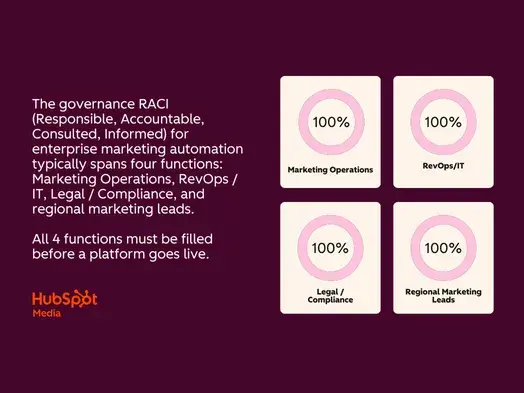
The governance RACI (Responsible, Accountable, Consulted, Informed) for enterprise marketing automation typically spans four functions:
- Marketing Operations
- RevOps/IT
- Legal/Compliance
- Regional marketing leads
Before any platform goes live, every cell of that RACI should be filled in.
How should you structure teams, roles, and permissions?
Enterprise marketing automation platforms should support at a minimum:
- Partitions: logical separations that allow the US team, EMEA team, and APAC team to operate independently without seeing or editing each other’s assets
- Role-based permissions: read, edit, publish, and admin roles with field-level granularity
- Approval workflows: campaign assets should require review and sign-off before they go live — especially for email, compliance-sensitive content, and paid media
- Audit logs: every create, edit, publish, and delete action should be timestamped and attributable to a specific user.
What we like: HubSpot’s Marketing Hub Enterprise includes user partitions, campaign approval workflows, and team-level permission sets — all native to the platform, not bolt-on modules.
How do you integrate existing tools without adding risk?
Most enterprises don’t start with a blank slate. There’s a legacy MAP, a sales CRM, an ad platform, a data warehouse, and a compliance tool already in place. Integration planning is therefore a risk management exercise as a technical one.
The integration risk checklist I recommend:
- Does each integration sync bidirectionally in real time, or is it one-directional and batch?
- Does the new platform create a competing contact database, or does it defer to the existing CRM as the system of record?
- Are there pre-built connectors for your existing automation tools, or will custom development be required?
- What happens to historical data during migration — is it preserved with its original timestamps, or does attribution reset?
- How does the vendor’s API rate limiting affect high-volume data sync scenarios?
Pro tip: Request a technical architecture review session as part of your vendor evaluation. Bring your solutions architect or marketing ops lead. The questions that come out of that session will tell you more about platform fit than any feature comparison matrix.
AI Marketing Automation for Enterprise Teams
AI in enterprise marketing automation adds value in four specific areas: content assistance, predictive insights, summarization, and next-best-action guidance.
The most significant shift in 2026 is the move from rule-based automation to agentic AI — systems that reason toward a goal rather than execute a predefined trigger. Instead of “if email opened, send follow-up,” agentic workflows evaluate churn risk, build a segment, and deploy a retention offer without a human having to assemble each step.
45% of marketing teams now use at least one agentic AI system for automation tasks, up from 15% in 2024. Teams adopting agent workflows report 27% faster campaign build times and 19% lower cost per qualified lead.
HubSpot’s Breeze AI suite is the most integrated expression of this approach I’ve seen in the mid-to-enterprise market — Breeze Agents handle prospecting research, content generation, customer service routing, and data enrichment from within the same CRM where deals close.
When should you trust AI vs. human review?
Human review is required for high-risk AI outputs, compliance-sensitive content, and model overrides. That’s not a hedge — it’s a governance requirement for any enterprise operating in regulated industries.
A practical framework for AI governance in enterprise marketing automation:
|
AI Output Type
|
Review Requirement
|
|
Email subject line suggestions
|
Human review optional; A/B test to validate
|
|
Predictive lead score
|
Human review before routing; sales should be able to override
|
|
Compliance-sensitive content (financial, healthcare)
|
Mandatory human review + legal sign-off before publication
|
|
Segment definitions generated by AI
|
Human review before any paid media activation
|
|
Next-best-action recommendations
|
Human review for high-value accounts; automated for long-tail
|
The failure rate for AI initiatives is real: between 42% and 54% of organizations scrapped AI projects in 2025 due to integration failures and data issues. The single most common cause is bad underlying data. Before deploying AI-driven automation, invest in a data audit. AI amplifies the data you have — if that data is dirty, the amplification makes things worse, not better.
Enterprise Marketing Automation, Attribution, and Revenue Reporting
Multi-touch attribution is how marketing connects interactions to the pipeline and revenue. It’s also where most enterprise marketing teams lose credibility with the CFO.
The fundamental problem is that attribution requires complete journey data, and most enterprises have gaps in that data because their marketing tools don’t share a unified record with their CRM. A contact can engage with six touchpoints across email, paid search, webinar, and direct mail, and if those touchpoints write to different systems, attribution picks up only the ones it can see.
The only durable fix is a unified CRM where every marketing interaction, sales touchpoint, and service event writes to the same record. That’s what enables true multi-touch attribution across the full buyer journey.
When evaluating attribution capabilities, look for:
- Support for multiple attribution models (first-touch, last-touch, linear, time-decay, W-shaped, custom)
- Native connection between campaign data and deal/opportunity records in the CRM — not just MQL counts
- Pipeline influence reporting: which campaigns touched deals that closed, regardless of whether they were the first or last touch
- Revenue-per-campaign metrics that go beyond cost-per-lead to closed-won revenue influenced
How do you handle anonymous and known journey data?
Every buyer journey starts anonymously. Someone reads three blog posts, downloads a guide, and attends a webinar before they ever fill out a form. If your attribution model only starts tracking at the form fill, you’re missing the majority of the buying journey.
Enterprise marketing automation platforms should support:
- Anonymous-to-known stitching: connecting pre-form-fill behavioral data to the identified contact record when a visitor converts
- Progressive profiling: capturing additional contact attributes over multiple form interactions rather than asking for everything at once
- Cross-device identity resolution: associating web activity from a work laptop, a mobile phone, and an office desktop with the same contact record
- Reverse IP lookup and intent data enrichment: surfacing account-level engagement signals even before any individual contact identifies themselves.
This is where enterprise platforms genuinely separate from mid-market tools. Anonymous journey data at scale requires infrastructure investment and not just a toggle in the settings panel.
How to Implement Enterprise Marketing Automation
Enterprise implementation follows a five-phase sequence. Skipping phases — especially the first two — is the most common cause of failed rollouts.
Phase 1: Data Audit
Inventory every database where marketing-relevant data lives. Assess data quality, identify duplicates, and document field mapping between systems. This phase is painful and frequently underestimated. Budget at least 4 to 6 weeks for a thorough audit at an enterprise scale.
Phase 2: Governance Design
Define your team structure, roles, permissions, and approval workflows before the platform. Build the governance RACI. Identify compliance requirements by region. This phase should involve Legal, IT, and regional marketing leadership — not just marketing ops.
Phase 3: Integration Planning
Map every tool that needs to connect to the new platform. Define the sync direction, frequency, and conflict-resolution rules (what happens when the same contact is updated in both systems simultaneously?). Prioritize your CRM integration above everything else.
Phase 4: Pilot Launch
Select a single use case — typically email nurture for one segment — and run it on the new platform with a defined success metric. Collect data for 60 to 90 days before expanding. The pilot phase is where you find integration gaps, data quality issues, and workflow design problems at low cost.
Phase 5: Phased Rollout
Expand use cases, teams, and regions in deliberate phases. Establish a monthly platform governance review. Document what’s working, what needs adjustment, and what’s next.
The average timeline from contract to full production launch for an enterprise marketing automation implementation is six to twelve months. Aggressive timelines are achievable but require dedicated internal resources, strong executive sponsorship, and a platform with thorough onboarding support.
What is the best way to migrate from a legacy MAP?
Legacy MAP migrations most often fail due to three issues: historical data loss, broken attribution, and workflow recreation errors. The migration checklist I’d recommend:
- Freeze new program creation in the legacy platform 60 days before cutover — this forces the team to build in the new environment and avoid last-minute migration scope creep
- Export historical engagement data with original timestamps preserved — you need this for attribution continuity
- Recreate, don’t import, core programs — automated workflows built in Eloqua or legacy Marketo often have undocumented dependencies; rebuilding from scratch surfaces those dependencies.
- Run parallel sends for the first two weeks post-cutover — both platforms execute the same campaign, so you can compare outputs before decommissioning the old one.
- Don’t decommission the legacy platform until 90 days of attribution data are validated in the new system.
How to Evaluate Enterprise Marketing Automation Platforms
The enterprise marketing automation platform landscape is more competitive in 2026 than it has been since 2019. AI agent capability has become the primary driver for platform evaluation, and AI capability is the most-cited reason.
What does today’s marketing automation landscape look like?
The dominant enterprise marketing automation platforms as of 2026:
HubSpot Marketing Hub Enterprise
HubSpot has successfully made the transition from an SMB-focused tool to a legitimate enterprise contender. The platform’s differentiator is that marketing automation, CRM, sales, service, content, and AI (Breeze) are native to a single data model — not integrated through connectors.
For organizations evaluating a unified revenue platform rather than a best-of-breed automation layer, HubSpot is the strongest current option in the mid-to-enterprise segment. HubSpot holds the largest market share in the marketing automation category at 29.58%, according to Datanyze.
Best for: Mid-to-large enterprises prioritizing CRM-unified data, fast time-to-value, and AI-native automation without significant integration overhead.
Adobe Marketo Engage
Marketo remains a recognized leader in Gartner’s 2025 Magic Quadrant and provides a robust orchestration and segmentation engine for global enterprises managing multi-product campaigns. The platform’s strength lies in its depth of segmentation and flexibility.
The trade-off is setup complexity and a steeper learning curve.
Best for: Large enterprises with sophisticated segmentation requirements and dedicated marketing ops resources.
Oracle Eloqua
Oracle Eloqua is governance-ready and excels in global organizations with complex compliance requirements. It supports fatigue management, cross-CRM integrations, and fine-grained campaign controls.
It’s the strongest option for organizations in regulated industries with strict data residency requirements.
Best for: Enterprise organizations in regulated industries (financial services, healthcare, public sector) where governance and compliance are the primary evaluation criteria.
Salesforce Account Engagement (Pardot)
Salesforce Account Engagement (Pardot) is tightly integrated with Salesforce CRM, which is its primary advantage for organizations already standardized on the Salesforce ecosystem. The trade-off is that non-Salesforce CRM users will find the integration story significantly weaker.
Best for: Enterprise organizations where the entire revenue stack — CRM, service, commerce — is already on Salesforce.
What we like: For organizations evaluating a platform that doesn’t require a separate CRM integration project to run, HubSpot’s unified architecture is its clearest competitive advantage. The CRM is the foundation on which the automation runs.
That distinction matters enormously when you’re trying to build attribution, run governance controls, and scale across regions.
How should you think about LinkedIn in enterprise programs?
LinkedIn deserves specific attention in enterprise B2B programs because it’s where buying-group members spend professional time. LinkedIn’s targeting capabilities — job title, seniority, company, department, and function — make it the most precise channel for reaching specific stakeholders within target accounts.
The integration between LinkedIn Ads and your enterprise marketing automation platform should enable:
- Audience sync: CRM segments automatically pushed to LinkedIn as matched audiences, updated in real time as segment membership changes
- Lead gen form sync: LinkedIn Lead Gen Forms pulling new leads directly into CRM workflows without manual export/import
- Conversion tracking: LinkedIn campaign touchpoints appearing in multi-touch attribution models alongside email, paid search, and organic
- Buying group enrichment: using LinkedIn data to identify and fill gaps in buying group completeness within target accounts.
Frequently Asked Questions About Enterprise Marketing Automation
How long does enterprise marketing automation take to implement?
The average enterprise marketing automation implementation takes six to twelve months from contract signing to full production launch across all use cases and teams. A focused pilot launch covering a single use case can typically go live in eight to twelve weeks.
The most common cause of timeline overruns is data quality issues discovered during the integration phase, which is why a data audit before vendor selection significantly reduces implementation risk.
How do we prove ROI to executives?
The most persuasive executive presentation ties marketing automation directly to pipeline and revenue — not to operational efficiency metrics like “hours saved.” The framework I recommend:
- Baseline measurement: establish MQL-to-SQL conversion rate, average deal velocity, and pipeline sourced by marketing before the platform goes live
- Attribution model alignment: agree with the CFO on which attribution model the company will use to credit marketing for revenue, before the reporting season
- 90-day incremental report: show pipeline influenced by automated workflows versus manually executed programs in the same period
- Benchmark comparison: marketing automation programs return an average of $5.44 for every $1 invested over three years, with top-quartile programs reaching $8.71 per dollar when CRM integration and AI-assisted segmentation are in place
Will enterprise marketing automation replace our CDP?
Not necessarily, but the line between MAP and CDP is blurring in 2026. Enterprise marketing automation platforms increasingly include first-party data management, identity resolution, and behavioral data capture that were previously CDP territory. Whether you need both depends on the complexity of your data.
If your primary use cases are B2B marketing orchestration, email nurture, lead scoring, and attribution, a unified CRM-powered marketing automation platform may cover your needs without a separate CDP.
If you require real-time event streaming, cross-product data stitching at petabyte scale, or direct integrations with data warehouses for ML model training, a CDP remains relevant as a separate layer.
Only 18% of B2B marketers currently use marketing automation integrated with a CDP, according to Adobe research. Of the remaining organizations, 42% have automation without a CDP, and 40% have both but haven’t integrated them.
What security and compliance features should we require?
At a minimum, enterprise marketing automation platforms should support:
- SOC 2 Type II certification
- GDPR, CCPA, and CASL compliance tooling with exportable data subject request workflows
- Field-level encryption for personally identifiable information (PII)
- Role-based access controls with IP allowlisting and SSO (SAML 2.0/OIDC)
- Complete audit logs with user attribution for every create, edit, publish, and delete action
- Data residency options for organizations with regional data sovereignty requirements
- Penetration testing documentation and vulnerability disclosure policy
For organizations in healthcare, financial services, or the public sector, confirm whether the vendor’s data processing agreements cover HIPAA, FINRA, or FedRAMP as applicable to your use case.
Do we need a separate tool for ABM?
Increasingly, no. Modern enterprise marketing automation platforms have absorbed the core capabilities that once required a dedicated ABM tool: account-level scoring, buying-group identification, target account list management, and account-level engagement reporting. The question is depth.
If your ABM program requires highly sophisticated intent data from multiple third-party sources (Bombora, G2, TechTarget), advanced account prioritization models, or custom orchestration logic that your MAP can’t natively support, a dedicated ABM tool may still add value.
But for most enterprise B2B organizations, the consolidation trend strongly favors handling ABM within the primary marketing automation and CRM platform — both for data integrity reasons and for the operational simplicity of fewer tools to govern and maintain.
%!s()


