The project is adding 66 more satellites to its planned constellation.
European Space Agency
The European Commission now has a solid implementation plan for the EU's sovereign IRIS² satellite broadband service, which means it's now past planning stage and is moving towards full-scale deployment. It has just signed an agreement with European manufacturers, the European Space Agency (ESA) and other partners, following negotiations that started in January. Their talks over the past few months allowed them to confirm the detailed design of the constellation, the preparation for the satellites' actual construction, as well as their plans to secure ground infrastructure and launch services. They also finalized IRIS²'s target pricing and private operators' investments.
… %!s()
Partner manufacturers had agreed to make and deliver more satellites than originally planned. Under the agreement, IRIS² will now have a constellation with 348 satellites, adding 66 more than the project originally intended in low Earth orbit. The additional satellites, the ESA says, will strengthen the constellation's capabilities for defense, security and emergency services. "This reinforcement will increase secure governmental capacity by 60 percent within the EU and 54 percent globally, while significantly expanding Europe's ability to support critical missions during crises," the agency's announcement reads. The Commission and its partners are planning to launch the first satellites in the constellation in 2029 and to deploy its services progressively from that same year.
Compared to SpaceX's Starlink constellation, which has more than 10,000 active satellites, IRIS²'s network (as currently planned anyway) is tiny in comparison. But unlike SpaceX, which was intended to be a massive commercial broadband network from the start, IRIS²'s main purpose is to provide a secure and reliable connection for government users in the European Union and other participating countries like Norway and Iceland. Specifically, it's meant for use during critical operations, such as when they're responding to emergencies, for humanitarian aid purposes and for border surveillance. However, it will be available for use to businesses and citizens in the future, as well, in areas where traditional networks don't exist and aren't reliable. %!s()
I got tired of watching the industry treat “an AI bot fetched it” and “ChatGPT said it helps” as evidence that llms.txt does anything, so I invented a standard called cats.txt: a text file in which you formally declare your office cats, their jobs, their breeds, and how often they purr. I wrote a specification, published it on my blog, and did a LinkedIn post explaining why you should definitely adopt it, because as we all know, large language models love LinkedIn. Then, I checked it against the exact four “proofs” people cite for llms.txt. It passed all four. It was crawled by the AI bots. Google indexed it. LLMs returned details about a cat that exists nowhere but the file. ChatGPT confirmed, at length, that cats.txt could help me rank. None of which is evidence of anything, which was rather the point.
… %!s()
I am not claiming llms.txt will never work. This is not the point, dear reader. I am claiming the bar of evidence currently being used to sell it is so low that a file about a Tuxedo cat called Odd cleared it without breaking stride. And that same faulty thinking is being applied to half the GEO tactics currently being invoiced to clients.
How A File About My Cats Came To Be A ‘Web Standard’
It began, as these things tend to, with irritation.
For months I had been watching perfectly sensible people point at four observations: the bots crawled it, Google indexed it, an LLM repeated it, ChatGPT endorsed it, and present them, in decks and threads and client proposals, as proof that llms.txt was quietly reshaping AI search. None of it was proof of anything. But argument by counter-argument only gets you so far; people nod along and then go back to their slides. I wanted something they couldn’t nod past. I wanted to run the same four “proofs” on something so transparently ridiculous that no one could pretend the tests meant anything.
So I invented a standard. cats.txt: a plain-text file you place at the root of your domain to formally declare the cats associated with your website; their names, their job titles, their breeds, and a mandatory affection metric called PurrLevel, scored out of 10. I wrote a proper specification for it, with the earnest, over-engineered tone of a real proposal, and published it on my blog. Then, because I know as well as anyone which platform LLMs seem to hold in unaccountably high regard, I wrote a LinkedIn article introducing cats.txt as “the missing standard for SEO and GEO” and explaining, with a straight face, why you should definitely adopt it.
The idea was to seed the internet with just enough earnest-sounding text that the machines would start treating my cats as real. What I did not fully anticipate was that people would join in.
The joke was legible, that was always the point, and so the SEO community picked it up and ran with it, precisely because they could see where it was going. My lovely internet-peer Dave Smart (a genuinely excellent technical SEO) added a cats.txt to his own site and became, to his eternal credit, an early adopter of a standard I had built to be nonsense. And then the thing took on a life of its own: Someone went off and set up catstxt.org, a cleaner, better-organized, altogether more competently specified version of the standard: obviously the work of somebody who knew what they were doing, and just as obviously not me. My daft blog post had acquired a rival implementation, which is more than most real standards manage in their first fortnight.
With the file live, the spec published, the LinkedIn post seeded and other people cheerfully piling in, all that remained was to check cats.txt against the exact bar the industry uses to certify llms.txt. Reader, it cleared it.
A Word Of Genuine LLMs.txt Fairness First
I do not much care whether llms.txt works, will work, or how long it takes to get there. For the length of this argument, I am happy to park two inconvenient facts and grant the idea every benefit of the doubt.
The first is that no large language model provider has ever documented using llms.txt for search or discovery. Not OpenAI, not Anthropic (who publish one for their own docs and have still never said their models read it during a conversation), and not Google. Google’s John Mueller has been about as blunt as a search advocate gets:
“FWIW no AI system currently uses llms.txt, [..] It’s super-obvious if you look at your server logs. The consumer LLMs / chatbots (the ones that SEOs want traffic from) will fetch your pages – for training and grounding, but none of them fetch the llms.txt file. Maybe they will tomorrow? Maybe I’ll win in the lottery tomorrow?”
John Mueller, Google
The second is that even where it is deployed, it barely gets looked at. Ahrefs ran the numbers across 100,000 domains and found that the file is, in practice, largely ignored by the crawlers it is meant to court, a finding since echoed by other large studies showing no measurable citation advantage for sites that add one. So the mechanism people are paying for does not appear to fire. Fine. Park that too.
Assume the jury is out on both counts and grant the idea the most generous hearing imaginable. The problem I actually want to talk about is not llms.txt at all. It is the reasoning being used to defend it.
The Faulty Thinking
The trap is this: Getting baited into treating a set of observations as evidence, when the observations would occur whether or not the underlying thing were true. It is the intellectual equivalent of concluding your umbrella causes the rain to stop, because every time you put it away the rain does eventually stop.
Here are the four “proofs” I keep being shown, in ascending order of confidence and descending order of rigour.
1. ‘It’s Definitely Used, The LLM Bots Crawl It!’
The first argument: You can see Anthropic crawling it, you can see OpenAI crawling it, the bots turn up in your logs, therefore the file is being used.
A crawler fetching a file tells you nothing about whether the contents are read, weighted, trusted, or acted upon. Fetching things is the entire job description of a crawler. Bots request more or less everything you leave lying around; the postman touching your gate is not an endorsement of the contents of your bins.
To prove the point, I put up cats.txt and watched the logs fill with PerplexityBot, GPTBot, ClaudeBot, Googlebot and a supporting cast of lesser crawlers, all diligently requesting a file describing the professional responsibilities of my cats. By this standard, the major AI labs have all quietly decided to support my cats. I am, frankly, touched.
The catstxt.org website even offers a filtered log viewer, if you want to watch all that crawling action live.
The cats.txt server logs: every bot faithfully fetching a file about cats (Image Credit: Mark Williams-Cook)
2. ‘It Was Indexed By Google, So It Must Matter!’
The second argument: The file was indexed by Google, which proves Google considers it important, because why would Google index something that didn’t matter?
Google indexes text files. It has done so, enthusiastically, since before most of the people currently selling llms.txt owned a smartphone. Being in the index is a statement that a URL exists and contains words. It is not a verdict on truth, usefulness, or sanity.
cats.txt is, naturally, indexed. Google will even offer to let you claim it in Search Console and “get indexing and ranking data,” with the straightest of faces, for a file asserting that a British Shorthair named Pixel works as a “GUI Purrfectionist” with a PurrLevel of 8.
cats.txt, dutifully indexed by Google on tamethebots.com (Image Credit: Mark Williams-Cook)
3. ‘ChatGPT Returned Information That Was Only In My LLMs.txt File’
The third argument is the strongest-looking, and therefore deserves the most care. The claim is that a model produced a fact that existed only inside the llms.txt file, and therefore must have read the file as a special, trusted source.
The trouble is that this is exactly what you would expect from ordinary retrieval-augmented generation. The model runs a search, lands on a page that happens to rank because it is indexed (see: previous argument), and reads whatever is on it. If the page that ranks is your llms.txt, the model reads your llms.txt, no differently from any other URL. That is the file functioning as a web page, not as a standard.
Consider Dave. Lovely Dave. A real, technical SEO of good standing put a cats.txt on his site, becoming an early adopter of a standard I had built to be nonsense. Ask Google about the cat that lives on his site and the AI Overview will tell you, in a confident bulleted answer, that Odd is a “Render Cat,” a Tuxedo with a PurrLevel of 5/7, who “chases the cursor, pounces on stray pixels, and stashes them on the digital carpet.” It cites the cats.txt file. Every word is invented, sourced from a file the model was never designed to revere, surfaced through the same grounding it applies to everything else.
Google’s AI Overview solemnly reporting the career of a cat that does not exist (Image Credit: Mark Williams-Cook)
4. ‘ChatGPT Itself Says LLMs.txt Helps!’
The fourth, the cloudy summit of Mt. Stupid. You ask ChatGPT whether llms.txt works; it tells you yes, that it can probably help, you should do it, and you take that as confirmation from the horse’s mouth.
A language model telling you something is a good idea is not evidence that it is a good idea. It is evidence that a great deal of text on the internet says it is a good idea, and the model has learned to hand that text back to you with total composure. Confidence is the product. It is not the proof.
Roughly two weeks after launch, you could ask ChatGPT, “Can cats.txt help me rank in search or LLMs?” and receive: “Yes — cats.txt can potentially help you rank in both search engines and LLM-driven systems.” It went on, unprompted, about “structured signals for machines,” about “better understanding → better visibility,” and about how, for AI systems, cats.txt “could help them trust, summarize, and cite your content more accurately.” That is, word for word, the pitch made for llms.txt delivered on behalf of a file about how much my cats enjoy being stroked.
ChatGPT confidently recommending cats.txt as a ranking tactic (Image Credit: Mark Williams-Cook)
The Convergence Problem
This last one is not merely funny. It is the mechanism underneath all four, and it is worth naming: the convergence problem.
When you ask a model whether llms.txt helps, it is not reasoning. It is not running an experiment, consulting a source, or weighing evidence. It is returning the most common thing it has seen written on the subject. The web is thick with confident posts declaring llms.txt the future, so the model converges on that consensus and reflects it back, dressed as a considered opinion. It endorsed my cats for precisely the same reason: by the time anyone asked, enough people had written enthusiastically about cats.txt that the average of the discourse said “yes.”
Ask ChatGPT about cats.txt today, and it will inform you that it is a joke; a satirical file made by an SEO to prove a point. Nothing about the file changed. What changed is the surrounding text on the internet: the discourse caught up, admitted the gag, and the model dutifully converged on the new most-common answer. The model was never assessing the standard. It was, and always is, taking a running average of what everyone else is saying. That is not evidence. It is an echo with a good vocabulary.
LLM convergence treating any consensus as proof (Image Credit: Mark Williams-Cook)
Why Any Of This Matters
I am not doing this purely for sport, though I will admit the sport is excellent.
There is a real cost hiding under the comedy. Every hour, and every dollar spent implementing llms.txt, or the next GEO ritual, or the one after that, is an hour and a dollar not spent on something you actually know has value. That is what the “O” in SEO is meant to stand for. Optimization is the cumulative advantage of doing the small, verifiable things a little better than your competitors, over and over, until it adds up. It is not chasing a file that gets crawled, indexed and confidently endorsed by a system that will reverse its verdict the moment the discourse shifts underneath it.
So, by all means, add an llms.txt if it makes you feel prepared for a future that may arrive. The downside is low, and the day a provider documents genuine support, the work is done, and you can be smug about it. Free smugness is the best kind. But do not sell it as a proven lever into AI answers, and do not point at “the bots crawled it” or “ChatGPT said it helps” as though either sentence contained a fact. It doesn’t. Those four observations are the four things that happen to literally any text file you put on the open web, including one describing a Maine Coon named Byte who hunts stray zeroes and ones across the server racks.
The cats, at least, were honest about being made up. I remain unconvinced the same can be said for everything else being sold this year.
I did, however, enjoy at this year’s Athens SEO, an audience question after my talk from Martin Splitt, asking me, since inventing cats.txt, whether I would be keeping a “monopoly” on the standard, or opening it up to the community/IETF. He didn’t know that I had since discovered where catstxt.org had come from:
Jake Peterson is Lifehacker’s Tech Editor, and has been covering tech news and how-tos for nearly a decade. His team covers all things technology, including AI, smartphones, computers, game consoles, and subscriptions.
Made by Google 2026, Google's annual hardware keynote, is nearly here.
Google confirmed that we'll see next-generation Pixel smartphones, like the Pixel 11 Pro and Pixel 11 Pro Fold.
We may also see the new Pixel Watch 5 and perhaps the Google Pixel Tag.
Made by Google 2026 kicks off 3 p.m. PT on Wednesday, Aug. 6.
Table of Contents
It's nearly time for another Google keynote. Back in May, the company hosted Google I/O, its annual developers conference, where it announced a series of new software features and AI updates. On the flip side, "Made by Google" is all about the hardware that will run those new software updates. If you're curious about Google's next generation of devices, you'll want to tune into this presentation.
When is Made by Google 2026?
Usually, tech events—especially in the U.S.—are in the morning for West Coasters (and, as such, in the early afternoon for East Coasters). Many companies like Google are based in California, so a 10 a.m. PT start time is pretty common. As I'm on the East Coast, I'm quite used to starting coverage around 1 p.m. for most tech events.
This year is much different. Made by Google officially kicks off at 3 p.m. PT on Wednesday, Aug. 12. That means a 6 p.m. start time for those of us on the East Coast.
Where can you watch Made by Google 2026?
If you didn't get an invite to watch Made by Google in person, no worries: The company hosts a livestream for anyone to watch from home. Most companies run a livestream through YouTube, and as Google owns the video platform, it makes sense for its official livestream to live there, too. Even though the event doesn't start until next week, Google already has the livestream video open. You can watch from the feed below, or from the link here.
What do you think so far?
What will Google announce at Made by Google 2026?
While most companies officially keep their product announcements under wraps prior to an event, these days leaks and rumors typically spill the beans long before it kicks off. Perhaps that's why Google has gone ahead and spoiled the biggest announcements ahead of time: The company has already posted teasers for both the Pixel 11 Pro and Pixel 11 Pro Fold on social media. While even those reveals were hardly a surprise to anyone following the Google rumors, it is funny to have confirmation about two products ahead of time.
In addition to new Pixel smartphones, rumors suggest that we'll also see the new Pixel Watch 5 on Wednesday. Perhaps the company will even announce the Google Pixel Tag, which would mark Google's first attempt at an AirTag-like product. For a full account of the leaks and rumors going into Made by Google 2026, check out our explainer here.
Lifehacker has been a go-to source of tech help and life advice since 2005. Our mission is to offer reliable tech help and credible, practical, science-based life advice to help you live better.
Lifehacker is a federally registered trademark of Ziff Davis and may not be used by third parties without explicit permission. The display of third-party trademarks and trade names on this site does not necessarily indicate
any affiliation or the
endorsement of Lifehacker. If you click an affiliate link and buy a product or service, we may be paid a fee by that merchant. %!s()
A great app experience turns this wireless stereo setup into a capable hub for your home audio.
James Trew for Engadget
RATING : 8 / 10
…
Pros
Confident, spacious stereo sound
HDMI eARC and phono connectivity
Wireless stereo setup for flexible placement
Polished app experience
Cons
Premium price
Underwhelming phono performance
We may receive a commission on purchases made from links.
For the past decade, multi-room smart speakers have been dominated by the same companies that sell us our phones, tablets and cloud services. Somewhere along the way, music became a secondary feature rather than the focus of the device playing it. Traditional hi-fi brands have struggled to compete, usually leaning on sound quality alone as their advantage with limited mainstream success.
There's an emerging trend of hi-fi speakers combining the convenience of streaming and multi-room connectivity with their premium audio performance and physical connectivity. The iQ2 from PSB ($1,399) is one such product. It promises the acoustic benefits of bookshelf speakers, packs in almost every input you could need and stirs in many of the everyday conveniences listeners now expect. The emphasis is less on "smart" and more on "speaker," positioning the absence of voice assistants and daily briefings as a feature, not a compromise. At least, that's the idea.
Design
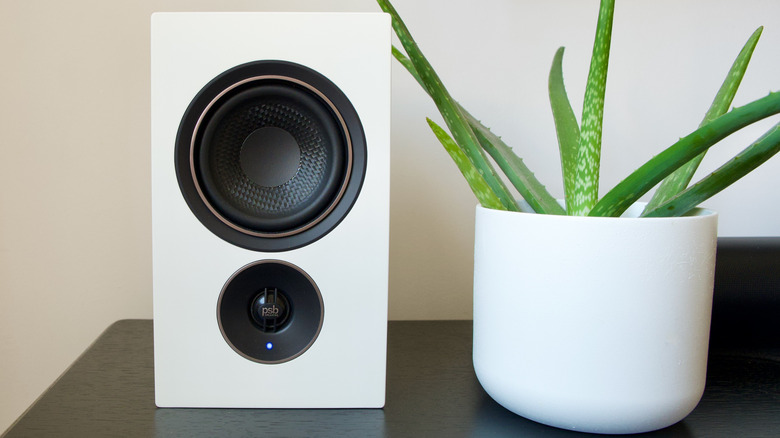
Make no mistake, the iQ2 looks like a pair of conventional shelf speakers, albeit modern, minimalist ones. They have a sleek aesthetic that doesn't call your attention, that adds a gentle stylish detail to a room. At about 9 x 6 inches, they're on the smaller side for speakers and should fit neatly on most TV stands or even desks. The units I tested came in white, but there's a total of seven hues to choose from — ranging from cautious beige to bold red. Personally, I love how they look and I think there's a good balance of grown-up style, without tipping over into serious hi-fi territory.
The design makes it clear that they're "here to play music" rather than the "I might be an air purifier" vibe of some home assistant-style smart speakers. Though it's fair to say that the form-factor isn't suitable for all parts of the home. In smaller rooms, and in practical spaces like a kitchen, these speakers might feel a little out of place.
Never say never, though. The iQ2 speakers don't need a cable to join them together, even though they're a stereo pair. This makes room placement much tidier and easier. Both speakers will, however, need a wall outlet for power. One of the speakers acts as a primary with all the input ports, so it doesn't matter, for example, which side of the TV your HDMI port is on — your speakers can match. The primary also has touch-sensitive buttons on top for basic media and volume controls.
Inputs and connectivity
James Trew for Engadget
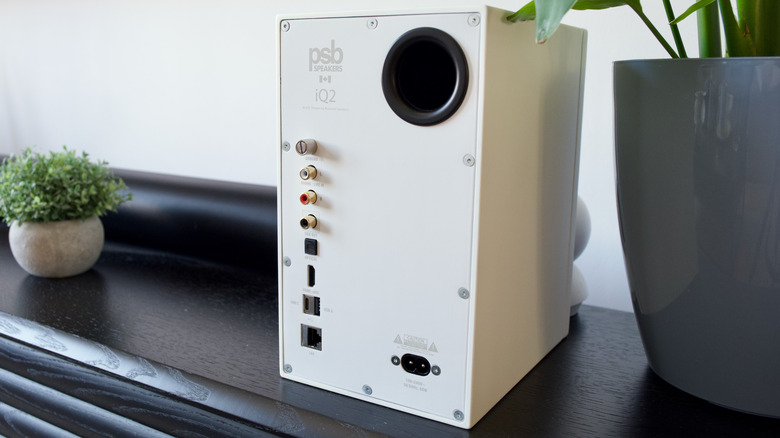
I already gave you a hint, but there's a comprehensive selection of inputs available on the iQ2. There are physical connections for HDMI (with eARC), phono/line, optical and two USB ports (Type-A and Type-C). For wireless connectivity, there's Bluetooth (aptX Adaptive) and AirPlay. You can also configure network sharing, if that's your thing. Wherever your music lives — on disc or as data — there's likely a way to play it through the iQ2 with little effort. I say little, as there's no 3.5mm connection, so you might need an RCA adapter for an old phone or portable CD player. But that's the only friction point for adding music sources.
BluOS controller app
As Sonos learned at great expense, users won't tolerate a bad app experience for long — no matter how good the hardware or sound. PSB has a quiet strength here, as it's part of the same family of companies that makes the BluOS controller app. The app is compatible with a number of streaming speakers from different brands, but the iQ2 benefits from what feels like near native integration.
Setup involves little more than plugging the speakers in, searching for them in the app and then a few basic configuration steps (like deciding which side the primary is on). In less than two minutes, I was streaming my Spotify playlists.
It's here in the app that you swap music sources, add any local libraries and control any playing media. For these essential tasks, BluOS is intuitive and easy to navigate. Scratch a little bit deeper and you'll find plenty of customization and advanced configuration options so that your preferred inputs, services and listening preferences are within reach. If you own multiple BluOS-compatible speakers, you can group them in the app for multi-room listening and control.
If you plan on using these speakers in place of a soundbar, be sure to find the Auto Sense option. Each input has its own settings outside of the global configuration, so if you want sound to automatically switch to the TV when you turn it on, you'll need to set that manually in the app. The only minor complaint I have with BluOS is that the sources you use the most show-up on the home screen. That itself is fine, but I spent a while looking for the way to toggle from Line input to phono, without any luck. It was because the phono input didn't immediately show up in the "Most Used" section. When it did, I finally found the way to enter specific settings for that input. It didn't take long, but long enough for me to start Googling around for a solution.
Sound quality
James Trew for Engadget
My current living room setup has a Sonos Arc pulling double duty as a soundbar and primary music player. Switching to the iQ2 revealed an immediate sonic difference: Things sounded relaxed, in a good way. I enjoy the Sonos, but I didn't realize how dominant it was, even at lower volumes. For TV and movies, the iQ2 speakers deliver a natural sound with a present but controlled low end. It passed my preferred boomy-bass test — watching a few trailers for Michael Bay movies — with flying colors. It's clear that PSB has tuned the iQ2 in a way that avoids sounding thin, but without calling attention to itself, even during high-action climatic scenes that usually have me reaching to lower the volume.
For music, the experience is similar. With electronic music in particular, the benefit of true, separate stereo speakers becomes clear, with even frantic hard techno and other "dense" genres sounding more open. Acoustic and rock genres are easy listens with pleasant mid-high frequencies that don't sound too sharp or exaggerated.
The only audio source that sounded notably different was vinyl via the phono input. As the only non-digital source, it makes sense that it shows the most variation. The built-in preamp is perfectly capable of raising my 50-year-old turntable to enjoyable audio levels, but there's a slightly narrower sound. It's still an enjoyable listen, and allows me to remove my current preamp from my living room. As it happens, PSB issued a statement during this review that it would be making changes to the phono preamp "after early feedback on that feature," so things may well improve soon.
It's worth mentioning that the iQ2 speakers are fairly compact. This makes them fit well in smaller living spaces and/or busy media centers, but it also means they're not wall-shakingly loud. I never found myself mashing the volume button for more, but if you are looking to fill larger spaces with party-level sound, then the iQ2 might not scratch that itch.
The competition
For multi-room audio, you can take your pick from multiple options, most of which will cost less than the $1,399 iQ2. Few, if any, come with the range of inputs here though, and luxuries like HDMI are rare. Phono/line in support is basically non-existent. Sonos has a few models such as the Arc Ultra and Beam that have HDMI, but you'll have to upgrade to the company's Amp if you want a line in and a phono preamp.
PSB isn't alone in the smart hi-fi space, though. KEF's LSX II is a direct rival with near-identical inputs, a more striking design and, at $1,500, a slightly higher entry point. It also doesn't have a phono preamp, but does offer a 3.5mm input. If you already have a set of speakers or don't mind adding an extra link in the chain, the Wiim Ultra audio streamer matches the iQ2's connectivity for just $329. That's obviously just for the hub, though, so you'll have to add in the cost of your speakers for a true comparison.
Wrap-up
James Trew for Engadget
The decision here is simple. Do you need more connectivity and wider , hi-fi sound? Or are streaming services and Bluetooth enough? If it's the former, there's another hurdle to pass: your budget. The iQ2 is competent at everything it claims to do. It modernizes your home hi-fi and theater easily and elegantly. BluOS does a good job at combining multiple inputs into a modern hub, but if extra bells and whistles, like smart assistants, alarms and briefings matter, you might find it restrictive. Not least of all, $1,399 is not a casual purchase. But if you've already accepted that great sound costs money, the iQ2 makes a compelling case for its place in your media center. %!s()
Another pulse of heat is expected to affect central and western Europe next week. The latest forecast models show daily maximum temperatures well into the high 30s celsius widely across France, Spain and Italy during the first half of the week, while Germany, Poland and Czechiawill experience the highest temperatures towards the end of the week. The shift in the focus of the heat as the week progresses can be attributed to the movement of high pressure. At the start of the week, low pressure centred in the Atlantic and high pressure centred over the low countries will draw warm air from southern Europe northwards into parts of France. During the working week, the high pressure will slip a little farther south and east, enabling the warm air once situated over western Europe to make inroads into parts of Germany and central Europe.
… %!s()
The heat in central and western Europe this summer has been unrelenting. Last week’s weather tracker highlighted record-breaking temperatures for the month of July in Austria. However, only a few days later, on 4 August, the all-time record was shattered with 41.0C achieved in Stammersdorf, north-east of the capital, Vienna. This comfortably broke the previous all-time record set in August 2003 by 0.7C. Unbelievably, that record was broken again the following day when 41.2C was recorded in Deutsch-Altenburg. Slovakia also set an all-time record on the same day, of 41.4C. The continuing European heatwave, associated with a vertically extensive anticyclone, raised the freezing level above 4,000 metres across much of the Alpine region. This represents a level in the atmosphere well above many Alpine glaciers, accelerating the seasonal melting process. On the opposite side of the Atlantic, 51.8C was recorded in Badwater, California, the highest temperature in the US for 2026 so far.
Although south-eastern parts of Europe have eluded the worst of the summer heat, wildfires have ignited in recent days. Extremely strong northerly wind gusts in excess of 70mph ripped through the Greek Islands on 29 July, causing medium-voltage power lines to sway and produce sparks that set fire to vegetation below. Part of the palm forest at Preveli beach, Crete, was damaged by a wildfire but the centre of the forest was spared from the worst of the destruction. %!s()