Rescue efforts continue to focus on hydropower sites, where hundreds of workers are believed to be trapped.
The death toll from catastrophic flooding in Nepal and China has reached 1,019, and more than 4,400 people remain missing as rescue crews work to reach communities cut off by the disaster.
… %!s()
In an update on Tuesday, Nepal’s National Disaster Risk Reduction and Management Authority (NDRRMA) increased the number of deaths from 987 to 1,003, with 3,916 people missing, including 583 foreigners.
Recommended Stories
list of 3 items
list 1 of 3Nepal FM speaks to Al Jazeera on devastating floods
list 2 of 3‘Nothing is usable’: Nepal residents return to flood-ravaged homes
list 3 of 3Aftermath of the Nepal-China floods in 30 Photos
end of list
Chinese authorities reported 16 deaths and 546 people still missing, including 261 foreigners, in their most recent update on Sunday.
The disaster hit on August 26 , beginning with a chain of events high in the Himalayas, when a glacial collapse sent large amounts of rock, ice, and meltwater into valleys below, triggering powerful floods downstream.
Scientists studying satellite imagery said the collapse appears to have involved the failure of bedrock beneath a glacier.
Hundreds of workers are feared to be trapped in tunnels at several devastated hydropower stations in Nepal that have become the focus of rescue efforts.
Prime Minister Balendra Shah said 279 workers had been rescued from hydropower projects so far, where authorities had initially estimated that more than 900 people were missing.
More than 11,000 people have been rescued across the affected region, and power and communication lines have been restored in some areas, he added.
“Thousands of citizens have lost their homes, families, loved ones, and property,” Shah said on social media.
“The government understands the immense pain they are enduring. The path ahead is to support them through this suffering and help them return to normal life through rehabilitation.”
Rescue teams had managed to restore road networks to Nuwakot, one of the worst-affected districts, facilitating rescue operations and the distribution of relief material, Shah said.
Aid arrives in Nepal
Police official Bipin Regmi said a search team recovered 24 bodies from a house in Betrabati village in Nuwakot district.
“We are reaching new areas and recovering bodies,” Regmi told the Reuters news agency.
Aid worth more than $42m has poured into the country after the disaster, Shah said, and the government expects the contributions to increase.
Neighbours India and China are helping with rescue efforts, including building Bailey bridges to reach remote affected areas.
Pictures and videos shared by rescue teams showed earth-moving equipment digging and shovelling mud and rocks under lights in the dark of the night as workers watched.
Soldiers used torchlight in a big pit they had created to look for space to get into one tunnel.
There has been a boom in hydropower projects in Nepal since the turn of the century, as the mountainous country sought to take advantage of its Himalayan water resources to address chronic domestic power shortages and exploit prospects for selling electricity to its southern neighbour, India.
Hydropower projects in Nepal’s mountains need tunnels to carry water through the steep terrain, allowing developers to exploit the sharp elevation drop between Himalayan rivers and powerhouses to generate electricity. %!s()
The rapper showcased “Shabang,” “Burning Bridges,” and “Janice STFU" on stage for the first time
Drake made a surprise appearance at Don Toliver‘s concert in Toronto last night, performing tracks off his recent LP, Iceman, live for the first time.
… %!s()
The rapper emerged on the stage at Scotiabank Arena for a mini-set midway through Toliver’s performance. He showcased three tracks off Iceman: “Shabang,” “Burning Bridges,” and “Janice STFU.”
“I just wanna thank Don for having me out tonight,” Drake told the crowd. “This is my first time performing the album since it dropped, so thank you for being here. Look, I love this thing that we do so much in front of the city, I just want to thank you for keeping this shit alive.”
After the performance, Toliver told Drake, “I appreciate you for inspiring us all. You know damn well this shit wouldn’t be this shit if you ain’t do this shit. I appreciate you so much. You inspired me, and you inspired all of us. Thank you so much for pulling up on me.”
Drake released Iceman in May alongside two other albums, Maid of Honour and Habibti. The album hit No. 1 on the Billboard 200 chart for numerous weeks. The LP joined Kendrick Lamar’s GNX as the only rap album in Billboard’s history to have every one of its songs Chart on the Hot 100 for three consecutive weeks. Iceman, Habibti and Maid of Honour debuted in the top three spots on the Billboard 200 in their opening week, making Drake the first artist to occupy the chart’s entire top three simultaneously. Iceman also marked Drake’s 15th chart-topping album, passing Jay-Z for the most by any rap artist.
Trending Stories
Furthermore, Drake’s “Janice STFU” debuted at Number One on the Hot 100. This marked the rapper’s 14th Hot 100 chart-topper, allowing him to eke past Michael Jackson as the male solo artist with the most Number One singles in Hot 100 history.
Toliver’s Octane World Tour continues on Sept. 2 in University Park, Pennsylvania. It continues through November, when it wraps in London on Nov. 23. %!s()
Tehran, Iran – When the United States threatened an “economic D-Day” for Iran, announcing a series of new sanctions against Tehran, President Donald Trump’s administration said it was seeking to cripple its adversary economically.
… %!s()
To many Iranians, though, the latest measures also appear targeted at them, rather than the Iranian government and its leadership.
Recommended Stories
list of 1 item
list 1 of 1US plans to sanction another bank to keep economic pressure on Iran
end of list
Like previous waves of sanctions imposed by the US and its allies on Iran, the latest measures again disproportionately impact the country’s civilian population. And one sector in particular appears poised to take a major hit: education.
Previous sanctions have contributed to making Iranians poorer by triggering a currency collapse, leading to surging food and medicine prices. They have financially isolated Iranians through blocked bank transfers and digital exclusion through restricted software, cloud services and platforms. The US travel ban, which counts Iran among its primary targets, has dashed countless dreams.
But the latest steps go one step further, and come at a time when the Iranian government has also ramped up domestic pressure.
New sanctions on assets, education and sport
As part of “Operation Economic Outcast”, the Trump administration last week expanded secondary sanctions in five more key economic sectors impacting civilian life — aviation, digital assets, gold, shipping and technology.
Those sectors were added to a comprehensive list that includes financial sectors, construction and manufacturing, among others. Any person anywhere in the world operating in, or engaging in any significant transaction with, or providing any assistance to anyone operating in those sectors may be designated as a blocked party under US secondary sanctions.
That could bring about asset freezes and an effective quarantine from US-linked and much of global commerce. That is why, despite some humanitarian-linked protections, the years-long “maximum pressure” campaign of the US against Iran has had wide-ranging impacts on civilian life, including availability of some medicine and medical equipment.
Last week, the Office of Foreign Assets Control (OFAC) of the US Treasury also indefinitely suspended education-related general licences that permitted limited cooperation with Iran by American universities or people, including but not limited to academic exchange programmes and certain nonprofit education services.
The US also indefinitely suspended another general licence that permitted services in support of professional and amateur sports activities and exchanges involving Iran.
Another suspension targets services related to conferences in the US or third parties, while OFAC also suspended its permissions for certain non-commercial, personal remittances to or from people in Iran.
A very short wind-down period has been set for existing activities in all those areas until September 8, after which activities will require specific OFAC authorisation.
Washington has further emphasised that both US and non-US people anywhere risk being sanctioned if they engage with Iran or its Persian Gulf Strait Authority and other organisations in connection with obtaining guarantees of safe passage through the Strait of Hormuz.
A man walks past a memorial depicting a symbolic classroom representing the Minab schoolchildren in Tehran [File: AFP]
Language tests cancelled
As part of its latest economic measures, the US has contacted Iran’s neighbours to limit trade, targeted the operations of Egypt’s second-biggest bank in the United Arab Emirates and is considering action against another bank.
The stated goal of the operation is to sever every economic lifeline sustaining Iran’s government and the Islamic Revolutionary Guard Corps (IRGC) in order to coerce them into shifting their behaviour.
But the suspension of General License G, which permitted education-related activities, is already quietly impacting thousands of young Iranians who have no links to the government.
Educational Testing Service (ETS), the nonprofit organisation which holds TOEFL and GRE language exams required to get into thousands of universities worldwide, this week paused administration of the tests in Iran and cancelled previously booked test appointments.
“This step reflects our full compliance with US sanctions law,” an ETS spokesperson told Al Jazeera in an emailed statement, adding that Iranian nationals can test outside of Iran.
“We are actively working to understand the scope and duration of this change and pursue any available paths to resume service, allowing learners to continue their educational journey uninterrupted.”
Duolingo, the American educational technology company that offers learning apps and language certifications, decided to go one step further than ETS by banning English language tests for all users holding only an Iranian ID – meaning that Iranian passport holders outside the country would also be rejected.
“Following an August 24 action by the US Treasury Department, Duolingo is required to stop offering the Duolingo English Test to people testing in Iran or using Iranian government-issued identification beginning September 1. This includes people outside Iran who need to use Iranian government-issued ID,” the company said in an emailed statement to Al Jazeera.
“We recognise that changes to test availability can be disappointing for affected test takers. We have contacted those with active credits directly about completing their tests or receiving refunds.”
Duolingo said in its statement that it does not know “whether or when the regulations may change”, and would “reassess the test’s availability” if circumstances changed.
Over recent days, many Iranians who were planning to obtain language certificates – whether to leave Iran, participate in international scholarships and research or seek better employment – were taken by surprise by the latest impact of sanctions.
In a Telegram group for people wishing to take the TOEFL test, which has 25,000 members, frustrated, panicked and dejected users have been reflecting on the news this week and speculating about what more could be in store over the coming years as the war with the US drags on after more than six months.
Some only know that they do not want that future to be inside tumultuous Iran.
“I couldn’t stop crying for two days, but so what? I won’t let it stop my plans for going to an English-language country or Germany as a backup. They [my plans] will be delayed at best,” said Faezeh, who added that she is now forced to calculate the additional costs of going to Turkiye, Armenia or other regional countries to take the test, even as the Iranian economy falters.
Some are now creating petitions and gathering signatures in long-shot attempts at overturning the restrictions, while others are calling on millions of diaspora Iranians to raise awareness or downvoting Duolingo on app stores.
Regardless of whether people can afford to or be able to overcome the mounting obstacles, many say they are being discriminated against based on their nationality, without any perceivable harm coming to the leaders and institutions of the government.
“Truly, who are these types of sanctions hurting? It feels like they are taking Iranians out of the list of accepted human species,” Danial, a young Tehran-based man considering moving away from Iran in search of a more stable life, told Al Jazeera.
He pointed out that the IELTS language test was also suspended for Iranians inside the country in January, blocking another major pathway. He said students looking to pursue academic degrees outside Iran have been watching other developments with concern, including several universities in Australia, Norway and the United Kingdom pausing PhD applications, sponsorships or enrollment for Iranians in recent months.
Many Iranians reacting to the news online this week said the latest impact of the sanctions was particularly jarring since, in January, when thousands were killed during nationwide antigovernment protests in Iran, the US president said: “help is on its way.”
The Trump administration has also tried to make a distinction between the majority of Iranian people and the government, with Secretary of State Marco Rubio saying in February he knows of “no other country where there’s a bigger difference between the people who lead the country and the people who live there”.
“Iran is officially a Failed Nation. IT IS DEAD!” Trump wrote in a post online on Monday. %!s()
Andy Burnham will drive home his pledge to bring more essential services back into public control, telling MPs in the Commons on Tuesday that it will be the only way to improve growth across the country.
… %!s()
Burnham will address the house for the first time in 16 years from the frontbench, and six weeks since he became prime minister, after spending the summer recess announcing a slew of policies that will now be put before MPs.
He will use the statement to put public control of services at the heart of his priorities for the coming months, sources told the Guardian, saying he would make the case that it would unlock investment, jobs and growth.
Burnham will say that the cost of everyday services to family budgets is holding back the economy and promise a plan to regain control of the costs.
A No 10 source said: “Andy is optimistic about our country’s future. He has a clear plan for how we turn things round. He is determined we make this the moment we bring back hope.”
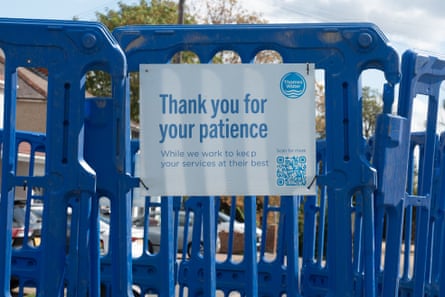
The prime minister will face an early test of his commitment to public control as he mulls legislation to make it easier to bring struggling utilities such as Thames Water under government ownership. The Guardian reported last week Burnham was considering laws to make it easier to put companies into insolvency proceedings and then take control of them afterwards.
The prime minister has said taking water companies such as Thames Water into public control is crucial to his vision for the country. Photograph: Maureen McLean/Shutterstock
He will also face crunch decisions on possible changes to the immigration bill to exempt carers, as well as pressure from MPs to back moves towards electoral reform. A quasi-judicial decision on whether to allow more North Sea drilling is also expected soon: a highly divisive issue within the party.
Burnham will tell MPs that he wants to “bring back hope” in politics and pledge to work constructively with opposition parties.
On Monday, the Conservative leader, Kemi Badenoch, sacked her shadow chancellor Mel Stride and shadow foreign secretary Priti Patel, promoting Andrew Griffith in Stride’s place in the hope of making further inroads in attacking Burnham’s economic approach. Patel is replaced by Tom Tugendhat.
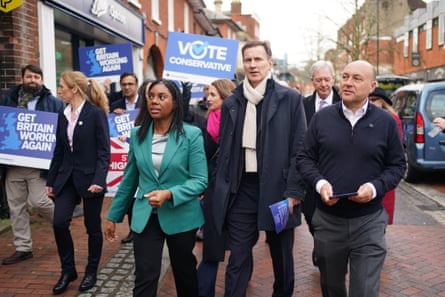
Andrew Griffith, right, with Kemi Badenoch and former chancellor Jeremy Hunt, second from right, during a visit to Godalming, Surrey earlier this year. Photograph: Ben Whitley/PA
Burnham will give a scathing analysis of how privatised services have done little for the public, saying that utilities and transport have not been run in the public interest and are neither reliable nor affordable.
He will point to action already being taken to bring more bus routes under public control, including through a partnership between No 10 North and the West Midlands Combined Authority. The Liverpool City Region will start taking control of bus services from next weekend.
Burnham has promised a 10-year project to take public control of utilities which is expected to be a major focus of his next few months in power. Allies have said the prime minister is “completely committed” to putting utilities such as energy and water companies into public control, and is looking at every option.
As well as setting out key priorities for his first months in office, Burnham will face a two-hour grilling from MPs about policies announced over the summer – including a cut to VAT on energy bills, £2 bus fares, the scrapping of digital ID, a major expansion of devolution and a plan for a national care service.
Opposition MPs are expected to ask tough questions on how the pledges will be funded as well as how Burnham expects to fill a £4.7bn gap in the defence investment plan left by his predecessor, Keir Starmer.
On Tuesday, the justice secretary, Alex Norris, will also present the government’s plans to cut the number of prisoners eligible for early release, including the killers of PC Andrew Harper.
skip past newsletter promotion
after newsletter promotion
Though the decision will see most of those convicted of manslaughter remain in prison to serve longer sentences, it has also raised alarm that the number of prison places may reach crisis point faster.
Later in the week, Burnham will face Badenoch for his first prime minister’s questions and will also need to navigate the growing number of Labour MPs who are heaping pressure on him to toughen up the representation of the people bill which returns to the Commons this week.
Nearly 100 MPs have called on Burnham to back a commission on electoral reform, given the prime minister has previously been a vociferous supporter of changing the voting system. MPs have also been angered by the decision to drop any cap on party donations, after pressure from trade unions, despite the prime minister having previously backed a cap of £500,000.
The Liberal Democrats said on Monday they would put their full backing behind an amendment from the Labour MP Alex Sobel that calls for a commission on electoral reform to be established within 100 days.
The party’s leader, Ed Davey, said it was a chance for Burnham to prove he was different to Starmer. “Reform stand to benefit from our terrible voting system and could manipulate it all the way to No 10,” he said.
Davey added: “Keir Starmer never would have agreed to a national commission. He failed to grasp that it is our role as progressives to fix the broken system the Conservatives created. The only question now is: what kind of politician is Andy Burnham? Is he willing to do the right thing?”
Reform will host its party conference this week in Birmingham, with Farage speaking on Friday.
In the latest poll from More in Common, Labour hold a four-point lead over Reform, with the Tories a point behind. The latest Opinium poll found that Burnham’s net approval rating had increased over the last fortnight by three points. %!s()
The presidents Truth Social feed is clogged with AI generated hallucinations depicting successes that only exist in his imagination
AI slop continues to deliver insight into the mind of Donal Trump, who has relied increasingly on hallucinogenic visuals spat out by generative computer algorithms to reinforce his delusions. As the war with Iran continues to drag out — and drag down his approval ratings — Trump is resorting to increasingly desperate ploys to gin up enthusiasm from his base. As part of that, he’s been regularly reaching for AI fantasies depicting him as a successful president.
… %!s()
Earlier in the weekend, Trump shared AI-generated videos showing a flock of geese sporting his signature blond overcomb and holding assault rifles. They were ostensibly armed to protect Lake Ontario, which Trump is attempting to rebrand “Lake America” amid his trade dispute with Canada.
Around midnight on Sunday, he took to Truth Social to unleash one of his now-routine, late-night content storms, this one related to the ongoing war against Iran. Though many of the pictures he shared were AI, Trump appeared to think at least one of them was real.
“Kharg Island being blown to smithereens!!!” Trump wrote in the caption to one AI generated video showing a massive aircraft carrier and industrial coastline engulfed in flames and artillery fire. Kharg Island, a critical logistics node for Iranian oil exports in the Persian Gulf, has not been actively bombed in real life since early April, and no reports of military action at the energy outpost were released this weekend by the Department of Defense.
A few hours later, Trump returned to Truth Social to rant that “Iran is officially a Failed Nation. IT IS DEAD! They have no Navy, they have no Air Force, they have no currency, they are not paying their soldiers or police, Inflation is at 300%, and their leadership is in total disarray and incapable of properly representing the country.”
Iran’s military operations have certainly been decimated by the American offensive, and inflation is indeed making necessities more costly to citizens. Nevertheless, the nation has continued to effectively throttle oil shipments out of the Strait of Hormuz. Iran has also severely damaged at least 20 American military installations across the Gulf region while keeping the conflict at a gridlock through the use of cost effective drone warfare.
In fact, while Kharg Island was not attacked over the weekend, the United States did fire on Iran Sunday after weeks of offensive stalling. U.S. Central Command said it had targeted rocket launchers on the Iranian island of Larak. Iran responded by firing missiles and drones at Jordan and the United Arab Emirates, both American allies in the region.
Trending Stories
In a statement to Fox News, Trump said, “we’re going to hit them hard… there will be a response.”
So far no response or military action by the Trump administration has managed to end the war which, while only supposed to last a few weeks at its outset, is now creeping into its seventh month. %!s()