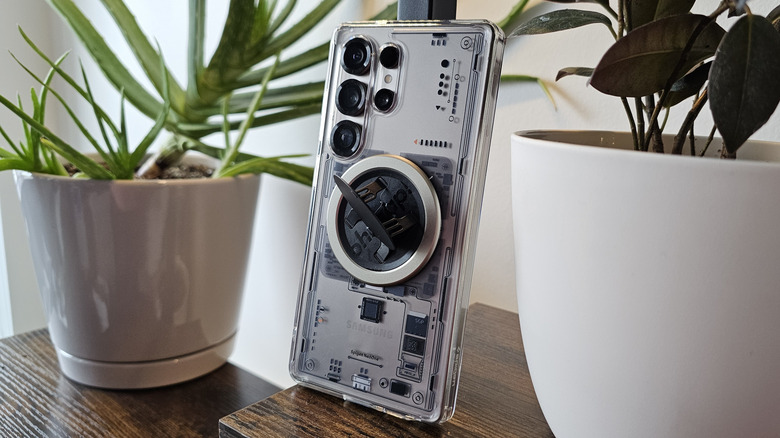
The Galaxy Z Fold 8 series will launch next week, and while we’ve seen some early leaked images of the new phones, Samsung has now confirmed new technology is powering the displays.
… %!s()
Samsung calls its new foldable display stack "Flex Titanium", which it says will reduce crease visibility and improve durability on its "next-generation" Galaxy foldables: the Galaxy Z Fold 8, Fold 8 Ultra and Galaxy Z Flip 8.
While Samsung has tinkered with the durability, or functionality of its foldable displays (like adding and removing a digitiser layer for S-Pen support), Flex Titanium seems like one of the more drastic material upgrades to the Fold line because it adds this new titanium-alloy.
That distinction is important. As Samsung tipster Ice Universe put it, the crease was never just a hinge problem, it’s also the result of stress building up across every layer of a foldable screen, the ultra-thin glass, the OLED panel, the adhesive, and the support structure beneath it all.
Every fold adds a little more of that stress, and if it isn't evenly distributed, it eventually becomes permanent. Flex Titanium tech supposedly tackles that at source.
MORE FOR YOU
Galaxy Z fold 8 Display: What’s Actually In Flex Titanium
A fairgoer tries out the Samsung Galaxy Z Fold7 with games at the Samsung booth at the Cologne trade fair center in Cologne, Germany, on August 21, 2025, on the second day of Gamescom 2025 (Photo by Ying Tang/NurPhoto via Getty Images).
NurPhoto via Getty Images
Samsung's press release describes two new components: a titanium-alloy film sitting beneath the OLED panel, offering 20 times the mechanical stiffness of the polymer film it replaces while measuring roughly a third the thickness of a human hair.
There’s also a titanium plate beneath that, using "micro-patterned" holes to bond tightly to the display module without air gaps. Eliminating air gaps should offer more stable support every time the phone folds.
How important is this new tech? Ice Universe has gone as far as comparing its significance to Ultra Thin Glass (UTG), the invention that made foldables possible in the first place. History will tell us if that’s right, but to me it looks like UTG made foldable phones possible while Flex Titanium is a significant improvement on flexible glass tech.
Check out my video below of me handling some early UTG when it first landed in 2020.
Could Flex Titanium Save You Money On The Galaxy Z Fold 8?
Screen repairs on the Galaxy Z Fold 7 are genuinely brutal: Samsung’s European parts pricing puts the inner display at €761, around $885. Break both the inner and outer screens, and you’re looking at roughly €1,286, or around $1,500, on a phone that started at $1,999. That's most of the price of a brand new device just to fix the one you already own.
If Flex Titanium meaningfully reduces the chances of needing a screen replacement, which is the biggest argument against buying a foldable, it makes it more of a palatable investment. Especially if you combine that with Samsung's commitment to seven years of software updates on recent Galaxy devices.
With that said, this is also new display technology that itself may be expensive for Samsung to produce. "Titanium" doesn’t exactly sound cheap. We’ll have to see what repair prices are, but don’t be surprised if the phone is less likely to break with the cost of fixing it is even higher.
Heading back to Palworld after two-and-a-half years, I can definitely see where Nintendo’s patent lawsuits have needled the game. You can’t glide with Pals anymore, a concept apparently Nintendo owns and wants to keep to itself. And there is some sort of stipulation that you can’t throw a ball and have a battling creature come out of it (now you just hold up your hand and they appear). It’s all rather absurd..
… %!s()
However, there is not just a legal conflict between Pokémon and Palworld, but rather fanbases clashing as well. There is a contingent of fervent Pokémon fans who make it their mission to try and take down Palworld, calling it a cheap knock-off of the series that inspired it, or claiming that it outright plagiarized the original. In some cases, saying it looks like “AI slop,” a more common phrase now from 2.5 years earlier.
Palworld is not the most polished game in the world, and it has certainly taken ideas from a host of games. Not just Pokémon (which of course does not own battling and catching monsters. Not yet, anyway), but you certainly see echoes of Breath of the Wild as well in its open world. None of this, however, takes away from the fact that Palworld is a fundamentally fun game, and it is hardly the first title to borrow from other big industry leaders. It has combined a number of systems under its own banner to create something unique, and if it was just a bad clone, well, we wouldn’t be here, would we? Through all of this, we have to keep in mind that Nintendo is a monster company with one of the biggest IPs of all time, and Palworld doesn’t have a fraction of its cash. Yet, it’s doing all this, creating a game that is almost, if not frequently more engaging.
Pokemon Z-A
Nintendo
There’s a line I’ve heard out there that if you truly think Palworld is better than Pokémon, you have nostalgia glasses on and haven’t played for generations now. You’re thinking only about the bare-bones games from ages ago.
Play Puzzles & Games on Forbes
I did play those, but what I do remember is eagerly looking forward to seeing how the series would evolve from there. Even when I was like, ten, I was hoping we’d get a more action-based take on the series. A big (for its time) world to explore and no turn-based combat. It never came, not in the ways I wanted. Not until Palworld, 25 years later.
The combination of survival mechanics, base-building, live combat against Pals and humans alike, world exploration and secret-finding, breeding and min-maxing, and playing in the same world with friends all adds up to a tremendous experience, which is why so many people have logged on for Palworld 1.0.
Game Freak has not innovated at nearly the pace it should have over all these years. This isn’t to say Pokémon is crashing and selling terribly, but if fans are introspective, there is a lot of “bare minimum” progress going on here. Even brand experiments like Pokopia aren’t matching what Palworld is doing here. Pokémon is not a terrible series by any means, but Palworld is not a terrible game either. Both can coexist, but yes, Palworld certainly has some advantages, expanding the genre more than Pokémon has in a long, long time.
After announcing the end of physical Playstation media, the corp builds yet another wall in the garden
…
Sony’s Crunchyroll store changes feel like subscription culture gone too far
Image: Eiichiro Oda/Shueisha
For most people, an online store serves one purpose: you find something you like, you buy it, and a few days later it shows up on your doorstep. Crunchyroll's upcoming storefront overhaul has a different goal in mind.
According to its FAQ page updated late on Tuesday, Crunchyroll is transitioning its online store this August to "a brand-new shopping experience" that will be tailored exclusively to the Mega and Ultimate subscription tiers, which cost a monthly fee of $14 and $18, respectively. The new storefront will focus on collectibles, curated drops, limited-release products, and exclusive merchandise inspired by the anime series fans love. Ahead of the transition, it's also increasing its Summer Sale discounts to 50 percent before the current store gives way to whatever comes next (to get merchandise off shelves as fast as possible).
It's a curious shift, not because anime merchandise is changing, but because the relationship between retailers and customers is changing with it. Crunchyroll is now making membership itself the price of admission for something that shouldn’t need it in the first place. It’s a subtle distinction, but an important one, as it speaks to a larger trend that has quietly reshaped everything from streaming to shopping: companies don't just want customers anymore. They want — need — members.
The language Crunchyroll uses throughout its FAQ page is particularly telling. Rather than talking about making shopping easier or expanding its catalog, the company repeatedly emphasizes exclusivity. The new store promises "curated drops," "limited-release products," and merchandise designed to capture the excitement of convention exclusives. It even cites "the thrill of discovering something special before it's gone" as part of the vision behind the redesign.
On the surface, it might sound punchy and filled with fun, but to me it’s a pitch for scarcity, something Crunchyroll’s owner, Sony, knows all too well. There's nothing inherently wrong with limited-edition merchandise. Collecting has always been part of anime culture, and genuinely rare items have long been part of the hobby. The major concern is broader, with many fearing the modern anime industry is manufacturing scarcity more than it is responding to it. Limited drops, countdown timers, members-only access, lottery systems, convention exclusives; the product itself often feels secondary to the fear that if you don't buy it right now, you'll never get another chance.
Crunchyroll isn't alone in chasing that strategy. Sneakers, trading cards, Magic: The Gathering, vinyl records, even fast-food collaborations now revolve around carefully engineered moments of exclusivity. Anime merchandise is simply the latest thing to be folded into the same playbook.
But there's also a practical business reason for the shift. Running a traditional online retailer is expensive. Warehouses full of inventory, products that sit on shelves for months, clearance sales, returns, and thousands of individual SKUs all eat into margins. Limited drops flip that equation on its head. Produce a smaller run, announce it with fanfare, sell through in a matter of hours, and move on to the next release. Less inventory, less risk, fewer warehouses, and a product that's sold before it ever has the chance to gather dust.
That's what makes this announcement feel like the final chapter in a story that began when Sony acquired Right Stuf in 2022. Right Stuf was beloved because it sold everything, not just collectibles. Obscure Blu-rays, hard-to-find manga, niche art books, discounted box sets — if you were an otaku looking for something extremely specific, Right Stuf probably had it. Since being folded into Crunchyroll, that sprawling catalog has steadily become leaner. Now, rather than positioning itself as the place to buy anime, Crunchyroll appears to be repositioning itself as the place to buy exclusive merchandise around anime.
The shift to curated and exclusive retail is perhaps most obvious in manga. After Crunchyroll absorbed Right Stuf, it proudly advertised a storefront with more than 30,000 products, including roughly 17,000 manga volumes, promising fans they would spend "less time searching and more time falling in love with our expanded selection." In the months leading up to Crunchyroll’s latest announcement, however, collectors had increasingly noticed entire series disappearing from the catalog, missing preorders, and a noticeably slimmer selection than the Right Stuf era. While those reports are anecdotal, they've become common enough across manga collecting communities that the new strategy almost feels like confirmation rather than surprise.
The irony of the shift is hard to ignore. Long before anime became a mainstream entertainment giant, fans dealt with imported DVDs, delayed releases, fansubs, and merchandise that was often impossible to find outside Japan. Crunchyroll built its reputation by removing those barriers, launching in 2006 as an unauthorized anime streaming platform before evolving into what it is today. Whatever you think of the company's changes under Sony, making anime easier to access was central to its identity. But the merchandise side now appears to be moving in the opposite direction — or, at the very least, in the same direction as Sony.
Image: Crunchyroll
Over the past few years, the Japanese tech giant has increasingly prioritized ecosystems over individual products, whether through PlayStation's digital-first future or Crunchyroll's expanding role as an all-in-one anime platform. A members-only storefront doesn't feel like an isolated retail decision so much as another expression of that philosophy: the more reasons consumers have to stay inside Sony's ecosystem, the less reason they have to leave it.
Crunchyroll’s shift is also reflective of where anime fandom finds itself today. As the medium has exploded in popularity, nearly every part of the hobby has become more premium. Convention VIP badges sell out in minutes. Figures disappear behind preorder windows. Collector's editions, exclusive Blu-rays, lottery sales, early-access tickets, and now, potentially, subscriber-only storefronts all ask the same question: how much more are your biggest fans willing to spend?
From a business perspective, it's easy to understand the appeal. The changes reportedly come in response to community feedback and a desire to create a more compelling experience for its most engaged fans. Restricting purchases to subscribers could make it easier to predict demand, reduce scalping, and justify producing more ambitious merchandise. Those are legitimate goals, and collectors may very well appreciate a more curated shopping experience.
Image: Melvin Chavez/Unsplash
But they also reveal a philosophical shift: The priority is no longer about making anime merchandise available to as many fans as possible, but building a better experience for the fans already paying to be inside the club. That may ultimately prove to be good business. Sony, after all, has spent years building interconnected ecosystems across PlayStation, Crunchyroll, and Aniplex, encouraging fans to stay within its own services rather than venture elsewhere. There's a logic to making every part of that ecosystem reinforce the next. The danger is that walls have a way of getting taller over time. Anime fandom as a luxury.
Anime didn't become a global phenomenon because companies found more ways to charge the people who were already here. It grew because the industry spent years making the medium easier to discover, easier to watch, and easier to fall in love with. If even buying a figure or a Blu-ray starts to require another subscription, that's not just a storefront redesign. It's another step toward a future where being an anime fan means paying for access before you've bought a single thing, and that's a future that feels far less exciting than any limited-edition drop ever could. %!s()
The secret of how seals can hear in air and water has been revealed, thanks to pioneering research led by Natural History Museum scientists.
… %!s()
Humans and other land mammals hear by transferring sound waves from the eardrum to the cochlea, where vibrations are converted into neural signals. Underwater, however, this system fails because the air pocket behind the eardrum reflects almost all sound.
Seals are the only mammals that hear equally well in both air and water, prompting scientists to investigate how they achieve this.
By micro-CT scanning more than 200 living and fossil seal specimens, researchers found the answer lies in the seals' cavernous tissue. This structure swells with blood to protect the ear from damage caused by the extreme pressure changes that happen when a seal dives.
As blood has a similar density to seawater, most of the sound is carried through the middle ear to the cochlea—allowing seals to hear and communicate underwater.
The paper "The origin and evolution of amphibious hearing in pinniped" was published in the journal Proceedings of the Royal Society B: Biological Sciences.
An artist’s reconstruction of Enaliarctos mealsi, one of the earliest marine seals from around 23 million years ago, being followed by a cetacean. Credit: Jaime Bran
An ancient shift to amphibious hearing
Dr. James Rule, the study's lead author, is a Scientific Associate at the Natural History Museum, London, and a Postdoctoral Research Fellow at Monash University. He says, "We know that seals are masters of sound. They have eerie songs that sound like something out of a sci-fi film, can keep a beat and can even mimic human speech. But how they manage to hear in air and water has been a puzzle for decades."
"We now know that the cavernous tissue in their ears holds the answer. Fossils of seals and their relatives suggest that this extraordinary mechanism evolved more than 26.7 million years ago, with all modern seals inheriting their amphibious hearing from this one event."
Credit: Natural History Museum
While ancient relatives of seals, such as Potamotherium and Puijila, probably only heard well in air, animals like Enaliarctos would have been among the first to have amphibious hearing. It's likely this transition was driven by the ancestors of seals moving into the sea, where hearing underwater would have offered distinct advantages.
The hearing abilities of later seals change depending on their lifestyle, with early true seals like Devinophoca being better at hearing underwater, while the first eared seals appear to have been more adapted to listening in air.
Credit: Natural History Museum
Rising ocean noise threatens communication
Dr. Natalie Cooper, Merit Researcher at the Natural History Museum, London, adds, "The Natural History Museum has some of the best seal collections in the world, and this study really shows its value. This research simply wouldn't have been possible without these specimens, which have been collected across hundreds of years from all over the world."
"It's important that we know how seals hear because noise pollution in the ocean is growing. As the seas get louder, it's harder for seals to find mates and communicate with each other—putting their survival at risk. By understanding how these animals hear, we can start to put solutions in place."
Publication details
James P. Rule et al, The origin and evolution of amphibious hearing in pinnipeds, Proceedings of the Royal Society B: Biological Sciences (2026). DOI: 10.1098/rspb.2026.0178
Master's in physics with research experience. Long-time science news enthusiast. Plays key role in Science X's editorial success.
Full profile →
Citation:
Seals filter sound through blood-filled tissue to hear underwater, study reveals (2026, July 15)
retrieved 16 July 2026
from https://phys.org/news/2026-07-filter-blood-tissue-underwater-reveals.html
This document is subject to copyright. Apart from any fair dealing for the purpose of private study or research, no
part may be reproduced without the written permission. The content is provided for information purposes only.
%!s()
This image from ESA’s Mars Express shows part of Kaiser Crater and its surroundings in Noachis Terra, one of the oldest parts of Mars. This image comprises data gathered by Mars Express’s High Resolution Stereo Camera (HRSC) on 5 October 2025 (orbit 27461). It was created using data from the nadir channel, the field of view aligned perpendicular to the surface of Mars, and the color channels of the HRSC. North is to the right. The ground resolution of the original image is approximately 17 m/pixel and the image is centred at about 48°S/19°E. Credit: ESA/DLR/FU Berlin
The European Space Agency's Mars Express has spotted a swath of metallic-looking waves filling Mars's large Kaiser Crater—an ancient and otherworldly dune field sculpted by wind.
… %!s()
This month's snapshot of Mars, taken by the High Resolution Stereo Camera (HRSC) aboard ESA's Mars orbiter, captures one of the oldest parts of the red planet: Noachis Terra. Situated in Mars's ancient southern highlands, Noachis Terra has been heavily bombarded with rocks from space over the past 4 billion years—and the scars from these collisions are clear to see.
This image is packed with impact craters. The right half of the image is dominated by part of the floor of the giant Kaiser Crater, a large basin that measures about 180 km (112 miles) across and a couple of kilometers deep. The prominent ridge running down the middle of the image marks part of the crater's southern rim.
On the left is a wide scattering of smaller craters, some with crisp edges and others that have been gradually worn away over time. The difference in elevation between the left and right sides of this image—a result of Kaiser Crater's formation—is marked and fascinating, and best seen in the associated topographic map below.
This color-coded topographic image shows part of the huge Kaiser Crater (right, in blues and greens), a smaller neighbouring crater, and their surroundings on Mars. It was created from data collected by ESA’s Mars Express on 5 October 2025 (orbit 27461) and is based on a digital terrain model of the region, from which the topography of the landscape can be derived. Lower parts of the surface are shown in blues and greens, while higher altitude regions show up in whites, pinks, and reds, as indicated on the scale to the top right. North is to the right. The ground resolution of the original image is approximately 17 m/pixel and the image is centred at about 48°S/19°E. Credit: ESA/DLR/FU Berlin
A number of notable craters also lie nearby but out of frame (see context map below), including Greeley, Le Verrier and Neukum craters. All of these craters have been the focus of previous Mars Express releases, and the last is named after Gerhard Neukum, one of the planetary scientists that founded the Mars Express mission itself and led the development of the spacecraft's HRSC.
This image marks the location of Kaiser Crater, a large crater in Mars’s ancient Noachis Terra. A large dotted square highlights the area of Mars featured in new images from the High Resolution Stereo Camera (HRSC) aboard ESA’s Mars Express, released in July 2026. The two smaller boxes within mark the precise patch of surface shown in the images, captured by Mars Express on 5 October 2025 (orbit 27461). The elevation of the surface, shown by the bright colors marking the surface of Mars, is indicated by the scale to the bottom-right. Credit: NASA/USGS; ESA/DLR/FU Berlin
Sandy waves shaped by water and wind
Much of the floor of Kaiser Crater is covered by distinctive, dark, almost shiny waves that look almost as if they're carved out of metal. These ridges are sand dunes that have been molded by Martian winds—they can tower more than 100 m (330 feet) above the surrounding surface. Some are more solitary and isolated, while others merge to form a continuous dune field that extends for several kilometers. Their shiny, slightly metallic appearance is caused by bright frost deposits on their south-facing slopes.
This dune field comprises a mix of "transverse" and "barchan" dunes. Barchan dunes are sickle-shaped; they are the most common type of dune found on Mars and are also prevalent in Earth's deserts (such as Africa's Sahara and Namib deserts). Also seen on our planet, transverse dunes are more elongated and parallel in their distribution, and can evolve as barchans accumulate more and more sand. Both types of dune are formed by sand building up and being swept about by winds blowing from the same direction.
Bird's eye view of wind-blown dunes in Mars's Kaiser Crater, generated from the digital terrain model and the nadir and color channels of the High Resolution Stereo Camera on ESA’s Mars Express. Credit: ESA/DLR/FU Berlin
The winds in this part of Mars blow predominantly from the west (top), pushing and moving sand around to form these distinctive wave crests. The sand itself is fine and basaltic in nature—meaning that it's rich in minerals such as pyroxene and olivine, which are formed by volcanoes—and is constantly in motion, causing these dynamic landforms to slowly change and evolve over time.
The floor of Mars’s Kaiser Crater from above, generated from the digital terrain model and the nadir and color channels of the High Resolution Stereo Camera on ESA’s Mars Express. Credit: ESA/DLR/FU Berlin
There are also signs of water-related activity here. Martian winds have stripped away the upper layers of the planet's surface in places, revealing light-toned clay rock that likely formed in the presence of water. There are also little gullies and narrow channels lining the steeper walls of some of the craters here—while these were likely formed by dry landslides slipping down unstable slopes, some of the older gullies may have formed as ice reserves melted, or buried groundwater reservoirs caused the ground above to shift.
Bird’s-eye view of craters in Noachis Terra, generated from the digital terrain model and the nadir and color channels of the High Resolution Stereo Camera on ESA’s Mars Express. Credit: ESA/DLR/FU Berlin
Decades of Mars exploration
Mars Express has been capturing and exploring Mars's many landscapes since it launched in 2003. The orbiter has mapped the planet's surface at unprecedented resolution, in color, and in three dimensions for more than two decades now, returning insights that have drastically changed our understanding of our planetary neighbor.
Master's in physics with research experience. Long-time science news enthusiast. Plays key role in Science X's editorial success.
Full profile →
Citation:
Metallic waves on ancient Mars (2026, July 15)
retrieved 16 July 2026
from https://phys.org/news/2026-07-metallic-ancient-mars.html
This document is subject to copyright. Apart from any fair dealing for the purpose of private study or research, no
part may be reproduced without the written permission. The content is provided for information purposes only.
%!s()