For Bradley Whitford, being back on Broadway in “A Few Good Men” and reuniting with writer Aaron Sorkin, feels like “a time machine.”
When Whitford was cast in the original 1989 Broadway production of “A Few Good Men,” little did he know a friendship and creative collaboration would be born — one that most notably led to the long-running series “The West Wing.”
… %!s()
“It was an extraordinary thing, and it’s where I met Aaron. ‘The West Wing’ never would have happened if that hadn’t happened. It’s where we became friends,” Whitford says on a phone call from his New York base, where he’s in rehearsals for the new production of the iconic play. It opens Oct. 8 at Lincoln Center Theater, just about one week after he receives a star on the Hollywood Walk of Fame Sept. 30. “West Wing” co-stars Martin Sheen and Dule Hill are scheduled to speak at the ceremony.
In the revival, Whitford tackles Col. Jessup, so memorably played by Jack Nicholson in the 1992 film — and even if you’ve never seen the play or film, you know the line that Nicholson yells at Kaffee (Tom Cruise in the film): “You can’t handle the truth!”
Since he landed the role, he’s repeatedly been asked about how he’ll say the iconic line.
“I woke up and my lovely wife was kind of gazing at me, and she was just like, ‘How are you going to say it? I heard you running lines last night.’ And I’m like, ‘I’m not gonna do it.’ My own wife. This is ridiculous,” he says with a laugh. “I don’t know how I’m gonna do it. I shouldn’t know how I’m gonna do it. She’s like, ‘Do it,’ and I did it, and she was not impressed.”
Sorkin was just 26 and Whitford, 30, when they first met. “We were talking about how strange it is because Aaron is like an institution. I’m doing this play where, frankly, it’s much better to be the understudy who surprises you,” he says in a characteristically self-deprecating way. In the original production, he played both Lt. Ross and the understudy for the role of Lt. Kaffee. “It’s much better to be that than the guy with his name on the poster. I can tell you that.”
Whitford jokes about not taking acting seriously — “I love acting, I’m just not sure I respect it,” he says — telling a story about how after an L.A. screening of “Get Out,” “people were blown away.”
“All these people, like, blowing smoke up my ass, and I’m kind of believing it,” he says. “My kid turns to me and very casually says, ‘No offense, Dad. I’ve seen dogs be good in movies.’ Which is only devastating because it’s true.”
But it’s his way of staying grounded. He allows himself this aphorism: “The best way to take the work seriously is to not take yourself seriously doing the work. There are two atmospheres on a set. One is, ‘I hope you don’t fuck this up,’ and the other is, ‘I can’t wait to see what you’re gonna do.’ And now that I am a white-haired senior citizen about to have the star on the Walk of Fame, I know the best way to get to the good work is for the atmosphere to be more like recess than like school.”
The three-time Emmy winner’s resume is packed with memorable characters, from “The West Wing,” “Studio 60 on the Sunset Strip,” “The Handmaid’s Tale” and “Transparent” to “Get Out,” “tick… tick… BOOM!,” “Death by Lightning” and, most recently, “The Diplomat.” But that’s just a fraction of his career. And he hopes to do more comedies moving forward, pointing to a short directed by his wife, Amy Landecker, for Funny or Die called “Bradley Whitford: Emotional Stuntman.”
“That may be my favorite part ever,” he says, and you believe him. He also loved the work he did with her — and loved working with her — on her 2025 feature debut, the comedy “For Worse.”
As for his honor on the Hollywood Walk of Fame, he feels odd.
“I always said, there’s no segues in show business. You feel like you’re starting out, and then suddenly you’re Wilford fucking Brimley,” he says with a wry laugh. He thought about his late parents when he first got the Walk of Fame news. “I wish they could be there because they would really get a kick out of that. They certainly didn’t push me into show business, but I have vivid memories of my father’s joy at a high school play, taking a picture. They would really get a kick out of it that I get to spend all eternity with Allison Janney and Lucille Ball, dodging dog doo.”
The kid from Wisconsin got hooked on acting in grade school — “I will probably never be better than I was in seventh grade as Teddy in ‘Arsenic and Old Lace,’” he says.
“It sounds really corny, but I was like, Oh, my God! When I play a sport, I have to turn off my brain and my heart. When I read a book, I have to turn off my body. When I play an instrument, I have to stand still. But this is everything,” he remembers. “I really had that moment in seventh grade. Like, holy fuck, I need my brain. I need my heart. I need to prepare. I need to let go. And I guess I still enjoy that.”
Back to the present, Whitford is thrilled to be reuniting with Sorkin for “A Few Good Men,” and sees the urgent relevancy to today in this 37-year-old play he says is about obeying — and so much more.
“It’s not only about obeying illegal orders, it’s about what I think is a really fundamental question going on in the world: What is the best way to survive? Is it through cooperation, or is it through dominance?” he says. “And I see the play as a kind of an argument about that.”
Though it raises questions about how we use the law to solve problems and the men in charge of the military, Sorkin’s writing is still infused with hope. Whitford feels that Sorkin is radical in his own way: “It’s kind of radical not to be cynical.”
The actor is outspoken about his progressive politics and works closely with many different organizations.
“Something I’ve been saying for a long time is — pulling together what a bunch of people have said — despair is a luxury that my children can’t afford, that their future can’t afford, and action is the antidote,” says Whitford. “What I see as the sort of civic virus of this malignant narcissist who has somehow gotten himself elected again, we have to fight our way out of this. We can’t give in to it.”
He continues, “I’m actually amazed because I do a lot of stuff with the Democratic Party in my home state of Wisconsin. My fear is always that young people — justifiably — are going to check out, get cynical about the political process and leave that process and sentence themselves to a gulag dictated by the business interests who do participate in the political process. And I haven’t seen that happen. And I’m actually optimistic about how things are going to change politically, but boy, I didn’t see this coming.” He’s also very aware that some want celebrities to shut up about politics.
“There’s nothing less democratic than telling people they should shut up. I try not to censor myself. I always feel like I should be doing more,” he says. “Uninformed celebrities spouting their idiotic political views start with the guy in the Oval Office.”
%!s()
Say the name “Pete Davidson” aloud, and it will conjure a certain image: a man strutting down the street in baggy pants, swarmed by paparazzi, clenching the hand of a screen beauty with a grin on his face. A man who’s dated everyone from Ariana Grande and Margaret Qualley to Kate Beckinsale and Kim Kardashian, who inspired the term “big dick energy” and the earworm “Thank U, Next.”
… %!s()
“There should be a group for us,” Davidson jokes of guys like himself and Jake Gyllenhaal who’ve been the subject of breakup anthems. “It’s something that comes up once in a while. But I think Ariana’s fuckin’ cool and immensely talented and an awesome girl. We’re not texting or whatever, but we’re cool.”
Mary Ellen Matthews for Variety
It’s easy to see why women are drawn to Davidson. In person, he’s imposingly rangy and muscular and shoots you straight — a working-class fella from Staten Island, unlike those posh theater kids running around Hollywood. He’s also possessed of a wounded, underdog quality that invites warmth. You want him to be OK.
Davidson’s lothario image has come to overshadow his obvious talent: In 2014, at the age of 20, he became one of the youngest “Saturday Night Live” cast members ever, regaling audiences with his direct-to-camera monologues about his mental health and the travails of living at home with his mom in Staten Island. By 26, he was starring in his own Judd Apatow-helmed biopic, “The King of Staten Island,” which was supposed to be his “Trainwreck” moment, only to have its release derailed by COVID. In the years since, he’s performed stand-up to sold-out theaters alongside pals Jon Stewart and John Mulaney; popped up in films like “Fast X” and “Dumb Money”; created and starred in “Bupkis,” a critically acclaimed TV series based on his life; dated a Kardashian; hosted his own talk show on Netflix; and fathered a child.
Now the 32-year-old is making his big return to the silver screen in November’s “How to Rob a Bank,” playing a wounded war veteran who turns to robbing banks to provide for his family. He took the assignment seriously, packing on 15 pounds of muscle for the role. “I got on all the peptides that everyone’s doing. They work,” he says. Davidson took Sermorelin and BPC-157 while training around the clock and consuming loads of protein. “I just think it’s really important for people to know that that’s what I did. When someone says, ‘Whoa, you’re in tremendous shape!’ and an actor goes, ‘Yup! Just broccoli, rice and chicken!,’ it’s like, ‘No, dude, you have a fuckin’ vein going from your forehead to your thumb.’”
“How to Rob a Bank” is his most dramatic role yet, and he steals every scene he’s in. So are people finally ready to take Davidson seriously?
Directed by David Leitch (“Bullet Train”) and hitting theaters Nov. 13, “How to Rob a Bank” is a hyperkinetic action film that follows a group of 20-somethings (led by Nicholas Hoult) who’ve been screwed by the system and turn to bank robbery as payback, livestreaming their heists on social media in the hope of igniting a movement. Davidson plays Vince, Hoult’s second in command and a veteran of the war in Afghanistan whose lungs have been ravaged by exposure to burn pits.
“What Pete is doing in this movie isn’t something he’s put on. It’s him,” says Leitch. “Pete, in real life, is one of the warmest, most engaging people I’ve ever worked with. Disarming. People feel safe around him in about 10 seconds.”
Knowing his days are numbered, Vince robs banks to provide for his wife and young child. The film’s most heartbreaking scene sees Davidson’s character singing to his daughter over the phone before a deadly shootout ensues, and the actor nails it. No wonder: Right before filming, Davidson discovered he and his then-partner, Elsie Hewitt, were expecting a daughter.
“Once I got in the room [with the young actress], I got really choked up. It really fucked me up.” His voice begins to crack. “What happens to the character is adjacent to what happened to me with my dad” — a firefighter who died in the line of duty on 9/11, when Davidson was 7 — “and the age and all that. … I’m a comic first, so I never understood when actors would be like, ‘It was very painful.’ But it is. It was very tough, and the first time I felt like a real actor because I wasn’t just playing myself.”
The first time Davidson played himself was supposed to be his splashy movie-star debut. He’d received plaudits for his turn in the Sundance dramedy “Big Time Adolescence,” but “The King of Staten Island” was an Apatow movie dropping at South by Southwest — or at least that was the plan. It was March 2020, and the festival was canceled due to COVID. With theaters around the country shuttered, the movie was released digitally that June.
Mary Ellen Matthews for Variety
Davidson’s first thought was “I hope the world is OK.” Then came the intrusive ones. “It definitely helped me believe my self-fulfilling prophecy that I am doomed,” he recalls.
The film was a particularly personal one for Davidson. In a story based on his Staten Island upbringing, the comic plays Scott, a 24-year-old high school dropout grappling with the loss of his firefighter father, who died in a blaze when Scott was 7. Scott (named for Davidson’s father) suffers from Crohn’s disease, PTSD and depression — just like Davidson.
“I wanted to make ‘The King of Staten Island’ because I was interested in exploring the sacrifice Pete’s father made for others and how it affected Pete and his family,” explains Apatow. “Pete has always been able to find comedy in the most challenging subject matter. He is fearless, never censors his truth and is always willing to show you everything.”
Bill Burr, whom he tapped to play his mother’s boyfriend in the film, lauded Davidson’s leadership on set: “He was considerate about everybody else’s time. And as the star, he could’ve requested to be shot out of scenes, and instead, he chose to have his fellow actors wrapped before him. It was a level of maturity and consideration that you don’t see a lot in any business.”
It was in the summer of 2023, after the release of “Bupkis,” an autobiographical series on Peacock starring Davidson as himself, that Davidson says he reached rock bottom. He was one year removed from “Saturday Night Live,” which had given him much-needed structure, with no projects on the horizon. “Playing yourself and constantly living in your own crap” had forced him to revisit a number of harrowing moments in his life, so he used drugs to numb the pain. “It was K. I was getting liquid and cooking it,” he says. “And I would do acid and shrooms and whippets and smoke weed all day and eat pills every day. It got scary because I didn’t feel high. I felt high when I wasn’t doing it, so I was like, this is a huge problem.”
An emotional FaceTime call with his mother, Amy, convinced him to get clean. “She told me her biggest fear was waking up one day to see on the news that something bad had happened to me,” recalls Davidson. “I reached a point where I couldn’t do that to her anymore.”
Davidson checked himself into rehab and, even though Peacock had renewed “Bupkis” for a second season, walked away from the show. He was tired of playing himself, tired of turning his trauma into content. He wanted more for his career. He wanted, more than anything, to be taken seriously. “I was part of the problem of what I hated the most, which was the invasiveness around my personal life. I was just lobbing it up and continuing the narrative,” admits Davidson. He’d gone to rehab plenty of times to placate other people, but never because he really wanted to get clean. “When I turned 30 and I was there, it was a real low point. Nothing much was going on with my career and I was like, ‘This fuckin’ sucks. I can’t do it anymore.’ And it can’t be for anyone or for a job. You really have to want it, and when you’re done, you’re done.”
Mary Ellen Matthews for Variety
He says he’s sober now, save around “four beers a year.” “I don’t fuck with drugs anymore. It’s been two or three years from doing really hard stuff and about a year or more from weed. Weirdly, the hardest thing to stop was weed,” he says. “And now it’s easy because I have a kid. Anytime there’s ever a thought, I look at my phone background and go, ‘Oh yeah, no.’”
On top of kicking drugs, Davidson is in the process of getting most of his nearly 200 tattoos removed. “One, they were fuckin’ horrible,” he cracks. “Two, it was a business decision. I hated coming into the makeup trailer three hours early to spray-paint over horrible fuckin’ tattoos. And third, I was like, ‘I’m not this dude.’ I got these when I was in an immense amount of pain and I was trying to show people my pain.”
Davidson has struggled with self-harm. “I used to cut, so some of [the tattoos] covered up the cuts,” he says.
He will be keeping a few, though, including the one of Hillary Clinton in a power suit on his right leg: “She stays. That’s my dog. I love Hillary, man. She’s awesome and a good friend.”
As I wait for our interview to begin, Davidson is pacing the hotel room. We are moments away from capturing the cover photo — the comedian standing tall and triumphant atop lower Manhattan — and he’s adorned in a striped tracksuit and big dark sunglasses, the latter a remedy for the concussion he suffered days earlier shooting the film “Tommy Karate.” But Davidson seems with it — or is doing a really good job of acting like it. His head isn’t the thing bothering him at the moment.
It is Sept. 9, one day before “NYC Still Rising After 25 Years,” a comedy benefit for 9/11 charities at Madison Square Garden organized by Davidson and Stewart and featuring an all-star roster of stand-up comics. Two of Davidson’s pals have bailed at the last minute. He removes his sunglasses and turns to his team. “Why the fuck would they do that?” he says. They shrug their shoulders.
Then his phone rings. It isn’t another comedian dropping out of the event, but his ex, Hewitt. He answers and sees their 9-month-old daughter, Scottie, staring back at him. “Hello, sweetie!” he exclaims, beaming from ear to ear. “Beebeebooboo,” he coos while taking their FaceTime session to a back room and closing the door behind him. One minute passes. Then two. Then three. A crowd has formed in the room — publicists, assistants, photo editors — waiting on Davidson. We are now running behind schedule. Will he ever emerge? Ten minutes later, the door swings open, and it is as though all his troubles have washed away.
Mary Ellen Matthews for Variety
“Scottie is my whole life,” Davidson says of his baby girl, who’s named after Davidson’s dad. “I was living or dying on this business and what I thought people thought of me. It was all validation and ‘If I do this, then I’ll do that.’ But as soon as I saw her for the first time, I was like, ‘Oh my God, none of this fuckin’ matters at all. It’s a job. If I get to do cool stuff, great; if not, cool, I get to be home more with my kid.’”
This time of year is always tough for Davidson. The loss of his father at such a young age left him with severe PTSD and crippling bouts of depression, which he manages to this day. “It’s tough going to firehouses where a lot of the guys knew my dad. It’s just a lot,” he says. “I got kind of used to it, but this year is different because of my kid. And I’ll be my dad’s age [when he died] in two months. Now I just understand it a little differently.”
He pauses. “I understand it more from my mom’s side. That would be like my daughter’s mom not having me around and having to do it alone. My mom did that and never fuckin’ complained once. I look at that like, ‘Holy shit. My mom is the best. How fuckin’ lucky am I?’”
There is also “the peanut gallery,” as he calls them — the army of online haters who’ve spent years scolding him for telling the occasional 9/11 joke as a way to cope with his grief. “For a while it bothered me when I would get, ‘Oh, why is he talking about 9/11 and his dad and all this stuff?’ from weird people on the internet, like it was all I talked about. I’ve made maybe five jokes about it in my specials over a span of 16 years, and then every 9/11 I try and do a benefit to help out. So I have my blinders on and do whatever I feel is necessary to do.”
I ask Davidson about a recent tale told by President Trump at a 9/11 anniversary event involving a pair of firefighters lifting him from the rubble near ground zero mere moments after the attacks. (Records and eyewitness accounts show he was miles away at Trump Tower.) “Nothing that guy says is surprising anymore,” Davidson laments. “It’s sad that it’s to the point where it’s so ridiculous that you’re like, ‘Yeah, whatever.’ He’s the drunk uncle, but he has the keys to the nukes. That’s the problem. If he didn’t have those keys, you’d be like, ‘Oh, that’s just the silly drunk uncle. He’s old.’ That’s unfortunate that he said that, though, because that’s definitely not what happened.”
As a teenager, Davidson would sit in the back of the bus and write jokes on his way to and from basketball games and try them on his teammates. They eventually goaded a 16-year-old Davidson to enter an open mic night called “Wacky Wednesdays” at The Looney Bin, a Staten Island comedy club tucked inside a bowling alley. “There were four people there, it went good enough, and I really loved it and got addicted to the laughs,” he remembers. “Growing up not having many friends and having a moment where you’re talking and everyone’s listening was very attractive to me.”
His first TV performance came on the VH1 reality series “Mob Wives.” Set in Staten Island, the show followed a number of women whose husbands were jailed for mob-related activities. Davidson was 18 and working as a chauffeur in real life, driving a guy around Staten Island. “I had to drive him to a party, and something happened where there was a fight, and he ran back into the car with his suit ripped in half,” Davidson says laughing. “I drove the getaway car. That’s my first TV gig ever.”
Then Davidson joined “SNL.” He got the gig thanks in large part to Bill Hader, who acted with the young comedian in “Trainwreck.” “He was in one scene in the movie, and I thought he was funny, so I texted Lorne [Michaels] and sent him a video of Pete’s stand-up. He obviously loved it,” Hader recalls, adding, “He didn’t need much advice. He was self-possessed and eager to show his stuff.”
Davidson says it took him a while to settle into “SNL”: “I wanted to leave after my first year and asked Lorne to leave every year. I was like, ‘I don’t fuckin’ work in this! And I just tell my stand-up on ‘Update’ and then burn it and can’t do it on the road, and I just want to do stand-up,’ and he’d always be like, ‘You’ll figure it out after four years.’ And he was right.”
Davidson found his footing with the character Chad, a monosyllabic stoner who navigates intense situations with apathy, and the memorable Please Don’t Destroy sketch “Three Sad Virgins” with Taylor Swift. He decided to walk away from “SNL” in 2022. “After eight years, it was just time. I just happened to be 28 when I left, so it was a little weird, but Lorne was cool with it. I love Lorne. He’s my Yoda. I love him very much, and I’m grateful that we’re still pals.”
It was on “SNL” that Davidson met Kim Kardashian. The two shared a kiss as Aladdin and Jasmine in an October 2021 sketch and began dating shortly thereafter. Davidson was thrust into a reality-TV world of prying paparazzi and untold media scrutiny. “I’m one of the survivors — the few and the proud. We’re like the Marines,” he jokes of men who’ve dated Kardashians. “Look, man, that’s a really tough atmosphere if you’re not game. One of the things I love about Kim and that whole family is they’re like, ‘This is what we do.’ I found that very attractive and mature.
“And I was never subjected to anything I didn’t want to be a part of. She was super respectful of all of it, but the craze of that lifestyle — being followed everywhere, having security and looking over your shoulder — for a guy with mental stuff, and at the time drug problems, was a little too much for me. But we’re cool, and I have a lot of love for her, and I knew what I was getting into.”
Mary Ellen Matthews for Variety
The one thing he couldn’t predict was the wrath of her ex, Kanye West. Kardashian was still in the process of divorcing West when she began dating Davidson, and the rapper took it upon himself to make Davidson’s life a living hell, posting threats on Instagram and, in the music video for his song “Eazy,” depicting a Claymation Davidson getting kidnapped and beheaded. “What tripped me out is I was super open about mental stuff — everyone knows this about me — and it’s like he was [saying], ‘Kill yourself.’ And he did push me.”
As for whether Davidson, who’s half-Jewish, thinks he’s the reason why West started going on antisemitic rants, he chuckles. “What people don’t understand about that dude — and I’m not one-one-millionth as talented or influential or powerful as that dude, but I have dealt with a fraction of what he’s had to deal with public-wise — is that’ll do it. He’s also lost a parent and has mental stuff, and I don’t know how he deals with it or who he has around him. Probably a lot of people who want to be his friend. I’ve had that. When people are so far up your ass and constantly pushing and provoking you and not showing you love, you want to burn it all. I think it got to a certain point where he was like, ‘Leave me the fuck alone. I’m just going to say crazy shit.’ There’s zero way he really feels like that.”
Davidson jokes he did Kardashian a service by absorbing West’s attacks. “I like to think I got that one out of the way for her because whoever that guy was going to be was gonna get it,” he remarks. “I cleared the path for her to get back into the dating pool.”
As someone who deals with an immense amount of scrutiny regarding his own appearance, Davidson is pained to see the vitriol another ex, Grande, has been subjected to of late. “I don’t like it at all. It’s not cool. She’s a really strong person — I’ve witnessed it — and I don’t understand it. She knows how to handle this stuff though. She’s been around. So she’ll be OK, but I think it’s fucked up.”
The most frustrating thing for Davidson when it comes to his dating life — and the media’s fixation on it — is the amount he feels it’s detracted from his career, reinforcing the idea that he’s unserious, girl-crazy tabloid fodder. “It’s been over a decade. My work and my relevance is super overlooked, and it’s confusing to me,” he declares, suddenly working himself into a lather. We’ve struck a nerve. “I’m still only 32, but I have really crazy credits: nearly a decade at ‘SNL’; I hosted a year after I left; I worked with Gillespie and Gunn and Liman and Leitch and Judd and Edie and Pesci.” (Craig Gillespie, James Gunn and Doug Liman directed Davidson in, respectively, “Dumb Money,” “The Suicide Squad” and the forthcoming “Bitcoin.”)
Davidson’s voice is getting louder as he runs through his self-defense. “What the fuck do I have to do? And look, I get it — I’ve dated a lot of people. But so has everyone else! Everyone is fucking everyone in this business! Everyone! And for some reason it’s zeroed in on me, and I can’t feel sorry for myself because I put myself in those situations, but everyone else is doing it. I was in my 20s. Am I not supposed to fuck around and do drugs and have fun and be in Hollywood like everybody else? Sorry, everyone!”
If “How to Rob a Bank” is evidence that Davidson can nail a dramatic role, then “Tommy Karate” is the film he believes will really change people’s perception of him as an actor. Directed by Justin Chon from a screenplay Davidson wrote during his rehab stint in 2023, the film centers on Thomas Pitera, aka “Tommy Karate” — a real-life hit man for New York’s Bonanno crime family who is suspected of murdering 60 people. Pitera is tracked down by DEA agent Jim Hunt (Paul Walter Hauser), with Camila Mendes, Simon Rex and Gina Gershon joining in on the fun.
When Davidson sent the script around town, it received plenty of positive feedback, except for the idea that Davidson would portray Pitera. “They were like, ‘Pete Davidson? Fuck him,’” he recalls. “And I was like, ‘OK, I’m pretty used to it.’” He spent years shopping it around and considered letting someone else take on the role until a Zoom chat with Sylvester Stallone convinced him otherwise. Davidson contacted Stallone because he was trying to remake his favorite Stallone movie, the 1981 cop thriller “Nighthawks.” “He said something that really fucked me up,” Davidson recalls. “He goes, ‘I’ve seen some of your work. I think you could be a really good actor, but no one’s ever going to write a part for you that’s good. You have to write it yourself, and you have to take it.’ I was like, ‘Rocky is telling me to make “Rocky.”‘”
Pete Davidson in “How to Rob a Bank”
Megan Schoenbachler
Davidson just wrapped principal photography on “Tommy Karate,” but photos from the Atlanta set depicting him in a clumsy wig and icy blue contacts leaked online, leading to more sniping at his expense. “I wish my fuckin’ wig was set, and I wasn’t eating in my photos. I promise you it doesn’t look like that in the movie,” he says. “If ‘Tommy Karate’ is not my coming-out party, then I have zero pulse on this business at all. I think people are going to be really surprised and be like, ‘What the fuck.’ And I’m not online, but I see what people are saying. It’s all negative. It’s so in the toilet and the bar is so low that it makes me even more excited. I hope more people trash it before it comes out because they really have no fuckin’ idea what we did. We’re really proud of it.”
“Tommy Karate” is expected to hit theaters in fall 2027 after making the festival rounds. Davidson also has wrapped “Wizards!,” a stoner comedy from David Michôd, and “Bitcoin,” a thriller about the cryptocurrency and its mysterious founder, Satoshi Nakamoto. He’s happy to be back in New York City, the place he’s called home his whole life. “You can have the absolute worst day of your life in public here, and nobody blinks. Everyone minds their own business because they’ve got somewhere to be,” he says.
But he’s mostly excited about spending time with Scottie, pushing her stroller around their Brooklyn neighborhood and trying to make her laugh. “It’s a lot of trial and error and a lot of bombing. If you think I bombed on ‘SNL,’ you should see me with my fuckin’ daughter.”
Whenever he talks about Scottie, Davidson lights up. He is adamant that he’s doing a lot better, and Scottie is the reason. “It’s filling a lot of emptiness. If you think the internet’s sick of Pete Davidson, I’m sick of it. I’m exhausted from being me all the time. That it’s all about her first is the best gift ever. It’s an indescribable feeling.” He smiles. “It’s the best, man. I’m excited to get up every day.”
Shot at W New – Union Square | Living Room | Guardian Rooftop; Styling: Britt Theodora/The Wall Group; Stylist assistants: Alexandra Crown, Taliana Esposito; Grooming: Kumi Craig/The Wall Group; Look 1 (cover): Tracksuit: Willy Chavarria/FWRD; T-shirt: Sunspel; Look 2 (Green Wall a Mirrored Look): Suit: Homme Plisse Issey Miyake; T-shirt: Sunspel; Hat: ’47; Sunglasses: Ferrari Style; Look 3 (Gray Sweater): Sweater: Helmut Lang; Pants: Versace/FWRD; Sunglasses: Jacques Marie Mage; Look 4 (Seated Stripe Shirt): Shirt, tie and shoes: Saint Laurent; Pants: Brut Archives; Sunglasses: Cubitts %!s()
A commercial plane travelling from Dubai in the United Arab Emirates to Israel has been forced to make an emergency landing in Saudi Arabia, after an apparent brawl between its pilots prompted distress signals that briefly raised fears of an attempted hijacking. The flydubai flight was over Jordan when it diverted to Saudi Arabia, transmitting three emergency signals, one of which indicated a possible unlawful interference.
…
The plane dipped dramatically during the reported fight, descending about 16,000ft in just two minutes. Israeli officials scrambled fighter jets, fearful of a possible hijacking attempt on a plane containing dozens of Israelis, and the plane landed at Tabuk airport in north-western Saudi Arabia.
Israeli prime minister Benjamin Netanyahu said one of the flydubai pilots stabbed his fellow pilot and intended to crash the plane. He added that one of the passengers on the flight managed to break into the cockpit with one of the crew members, and together they “neutralised” the attacking pilot.
Netanyahu described it as “an extremely severe security incident”. Other officials, including defence minister Israel Katz, have called it an attempted terrorist attack. Netanyahu thanked the passengers and crew who helped to stop the attack, saying they “showed exceptional resourcefulness and courage”.
An Israeli official has identified the attacker as an Omani national, Reuters is reporting. The co-pilot of a flight from Dubai to Tel Aviv is believed to have stabbed the captain in a possible attempted “terror attack”.
The Boeing 737 plane, which Israeli officials said had between 160 and 180 passengers on board, transmitted a general emergency signal about two and a half hours after departing from Dubai, according to flight-tracking website Flightradar24.
Passenger Miryam Shira Ohayon said the plane was “pretty much out of control” when the alleged stabbing took place over Jordan on the flight’s path from Dubai to Tel Aviv. “The co-pilot tried to murder the pilot and basically carry out a suicide attack on the plane,” she told reporters by speakerphone held up by her mother who was waiting at Ben Gurion Airport near Tel Aviv.
The plane again transmitted the initial general emergency signal before later landing at Saudi Arabia’s Tabuk airport. Tabuk airport said the plane landed at 9.45am local time and that both pilots were taken to hospital after sustaining injuries.
A second flydubai flight from Dubai to Tel Aviv landed safely at its destination after the tracking data website Flightradar24 initially showed the plane diverting back towards the UAE. Flight FZ1081 was later shown to be on its way to Israel, where it landed in Tel Aviv this afternoon.
Key events
2h ago
Closing summary
2h ago
Passengers of diverted flydubai flight land in Israel
3h ago
Saudi Arabia turned down Israeli request to allow its planes to pick up Israeli passengers, security sources say
4h ago
What we know so far
4h ago
Suspect stabbed pilot and attempted to crash the plane, Israeli PM says
4h ago
Pilot arrested and being questioned by Saudi authorities, says Netanyahu
5h ago
Second flydubai flight landed safely in Tel Aviv
6h ago
Read our full report here...
6h ago
What we know so far
6h ago
Israeli minister claims 'terrorist' attempted to crash plane bound for Tel Aviv
Closing summary
A commercial plane travelling from Dubai in the United Arab Emirates to Israel has been forced to make an emergency landing in Saudi Arabia, after an apparent brawl between its pilots prompted distress signals that briefly raised fears of an attempted hijacking. The flydubai flight was over Jordan when it diverted to Saudi Arabia, transmitting three emergency signals, one of which indicated a possible unlawful interference.
The plane dipped dramatically during the reported fight, descending about 16,000ft in just two minutes. Israeli officials scrambled fighter jets, fearful of a possible hijacking attempt on a plane containing dozens of Israelis, and the plane landed at Tabuk airport in north-western Saudi Arabia.
A plane carrying passengers from an earlier diverted flydubai flight has landed at Tel Aviv airport on Wednesday, AFP TV images show. The second aircraft, also operated by flydubai, landed on the tarmac of Ben Gurion airport at 3.34pm GMT, after the passengers’ earlier flight was diverted to Saudi Arabia due to an altercation between the pilots.
Israeli prime minister Benjamin Netanyahu said one of the flydubai pilots stabbed his fellow pilot and intended to crash the plane. He added that one of the passengers on the flight managed to break into the cockpit with one of the crew members, and together they “neutralised” the attacking pilot.
Netanyahu described it as “an extremely severe security incident”. Other officials, including defence minister Israel Katz, have called it an attempted terrorist attack. Netanyahu thanked the passengers and crew who helped to stop the attack, saying they “showed exceptional resourcefulness and courage”.
An Israeli official has identified the attacker as an Omani national, Reuters is reporting. The co-pilot of a flight from Dubai to Tel Aviv is believed to have stabbed the captain in a possible attempted “terror attack”.
Saudi Arabia turned down a request by Israel to allow its planes to bring back Israeli passengers from a FlyDubai flight that made an emergency landing in the kingdom, two security sources told Reuters. The request was made to allow Israeli military planes to bring back Israelis from Saudi Arabia, which has no diplomatic relations with Israel, the sources said.
The Boeing 737 plane, which Israeli officials said had between 160 and 180 passengers on board, transmitted a general emergency signal about two and a half hours after departing from Dubai, according to flight-tracking website Flightradar24.
Passenger Miryam Shira Ohayon said the plane was “pretty much out of control” when the alleged stabbing took place over Jordan on the flight’s path from Dubai to Tel Aviv. “The co-pilot tried to murder the pilot and basically carry out a suicide attack on the plane,” she told reporters by speakerphone held up by her mother who was waiting at Ben Gurion Airport near Tel Aviv.
The plane again transmitted the initial general emergency signal before later landing at Saudi Arabia’s Tabuk airport. Tabuk airport said the plane landed at 9.45am local time and that both pilots were taken to hospital after sustaining injuries.
A second flydubai flight from Dubai to Tel Aviv landed safely at its destination after the tracking data website Flightradar24 initially showed the plane diverting back towards the UAE. Flight FZ1081 was later shown to be on its way to Israel, where it landed in Tel Aviv this afternoon.
US attorney-general Todd Blanche said that the US was coordinating “very closely” with counterparts overseas, including Israel, regarding the flydubai flight from Dubai to Tel Aviv that was diverted.
Mid-air panic as pilot attacked on Israel-bound flight - The Latest
US attorney-general Todd Blanche said that the US was coordinating “very closely” with counterparts overseas, including Israel, regarding the flydubai flight from Dubai to Tel Aviv that was diverted.
Passengers of diverted flydubai flight land in Israel
A plane carrying passengers from an earlier diverted flydubai flight has landed at Tel Aviv airport on Wednesday, AFP TV images show.
The second aircraft, also operated by flydubai, landed on the tarmac of Ben Gurion airport at 3.34pm GMT, after the passengers’ earlier flight was diverted to Saudi Arabia due to an altercation between the pilots.
A plane, carrying passengers who were on the FlyDubai aircraft bound for Israel from the United Arab Emirates, which was diverted to Saudi Arabia following an emergency signal, on the tarmac as it arrives at the Ben Gurion International Airport, in Lod, near Tel Aviv, Israel, September 30, 2026. Photograph: Ammar Awad/Reuters
Israeli prime minister Benjamin Netanyahu has ordered authorities to “ramp up” security on both on Israeli carriers and non-Israeli carriers on Wednesday.
The order was confirmed by a spokesperson for the prime minister’s office after the flydubai flight incident.
The flydubai aircraft plummeted a little over two hours into the flight, dropped from nearly 34,000ft.
Between 5.21am GMT and 5.22am GMT, the plane dropped to less than 17,000ft, according to data from the Flightradar24 website.
Saudi Arabia turned down Israeli request to allow its planes to pick up Israeli passengers, security sources say
Saudi Arabia turned down a request by Israel to allow its planes to bring back Israeli passengers from a FlyDubai flight that made an emergency landing in the kingdom, two security sources told Reuters.
The request was made to allow Israeli military planes to bring back Israelis from Saudi Arabia, which has no diplomatic relations with Israel, the sources said.
The mother of a passenger onboard a flight from Dubai to Israel said her daughter told her the plane lost control before other pilots took over and the aircraft landed in Saudi Arabia.
Yasmin Abukasis, whose daughter Miriam was on the flight, said she told her she heard screaming and saw a man pull out a knife and force the pilot to the floor.
Mother of passenger on Israel-bound flight describes incident – video
What we know so far
A commercial plane travelling from Dubai in the United Arab Emirates to Israel has been forced to make an emergency landing in Saudi Arabia, after an apparent brawl between its pilots prompted distress signals that briefly raised fears of an attempted hijacking. The flydubai flight was over Jordan when it diverted to Saudi Arabia, transmitting three emergency signals, one of which indicated a possible unlawful interference.
The plane dipped dramatically during the reported fight, descending about 16,000ft in just two minutes. Israeli officials scrambled fighter jets, fearful of a possible hijacking attempt on a plane containing dozens of Israelis, and the plane landed at Tabuk airport in north-western Saudi Arabia.
Israeli prime minister Benjamin Netanyahu said one of the flydubai pilots stabbed his fellow pilot and intended to crash the plane. He added that one of the passengers on the flight managed to break into the cockpit with one of the crew members, and together they “neutralised” the attacking pilot.
Netanyahu described it as “an extremely severe security incident”. Other officials, including defence minister Israel Katz, have called it an attempted terrorist attack. Netanyahu thanked the passengers and crew who helped to stop the attack, saying they “showed exceptional resourcefulness and courage”.
An Israeli official has identified the attacker as an Omani national, Reuters is reporting. The co-pilot of a flight from Dubai to Tel Aviv is believed to have stabbed the captain in a possible attempted “terror attack”.
The Boeing 737 plane, which Israeli officials said had between 160 and 180 passengers on board, transmitted a general emergency signal about two and a half hours after departing from Dubai, according to flight-tracking website Flightradar24.
Passenger Miryam Shira Ohayon said the plane was “pretty much out of control” when the alleged stabbing took place over Jordan on the flight’s path from Dubai to Tel Aviv. “The co-pilot tried to murder the pilot and basically carry out a suicide attack on the plane,” she told reporters by speakerphone held up by her mother who was waiting at Ben Gurion Airport near Tel Aviv.
The plane again transmitted the initial general emergency signal before later landing at Saudi Arabia’s Tabuk airport. Tabuk airport said the plane landed at 9.45am local time and that both pilots were taken to hospital after sustaining injuries.
A second flydubai flight from Dubai to Tel Aviv landed safely at its destination after the tracking data website Flightradar24 initially showed the plane diverting back towards the UAE. Flight FZ1081 was later shown to be on its way to Israel, where it landed in Tel Aviv this afternoon.
Netanyahu described it as “an extremely severe security incident”. Other officials, including defence minister Israel Katz, have called it an attempted terrorist attack.
Netanyahu thanked the passengers and crew who helped to stop the attack, saying they “showed exceptional resourcefulness and courage”.
He added: “They saved many lives and prevented a major disaster.”
Israeli prime minister Benjamin Netanyahu said passengers and crew who stopped the attack on the FlyDubai flight prevented a ‘major disaster’. Photograph: Paulina Patimer/ZUMA Press Wire/Shutterstock
Suspect stabbed pilot and attempted to crash the plane, Israeli PM says
Netanyahu said one of the FlyDubai pilots stabbed his fellow pilot and intended to crash the plane.
He added that one of the passengers on the flight managed to break into the cockpit with one of the crew members, and together they “neutralised” the attacking pilot.
The Israeli prime minister said:
double quotation markAlmost all the passengers on the flight were Israelis. During the flight, as they were approaching Israel, one of the pilots stabbed the other pilot, and it appears he was attempting to crash the plane with everyone on board.”
Pilot arrested and being questioned by Saudi authorities, says Netanyahu
The Israeli prime minister, Benjamin Netanyahu, has issued a video statement on the FlyDubai plane incident.
He said one of the pilots who allegedly attacked the other has been arrested and was being questioned by Saudi authorities.
He said all of those on board were safe after the attack.
Second flydubai flight landed safely in Tel Aviv
A second flydubai flight from Dubai to Tel Aviv landed safely at its destination after the tracking data website Flightradar24 initially showed the plane diverting back towards the UAE.
Flight FZ1081 was later shown to be on its way to Israel, where it landed in Tel Aviv this afternoon. There was no immediate comment from Flightradar24.
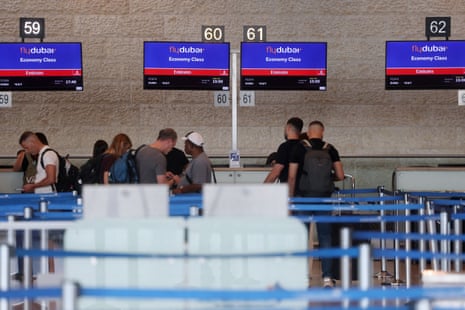
People queue at FlyDubai desks at Ben Gurion airport in Lod, near Tel Aviv, Israel. Photograph: Ammar Awad/Reuters
In a video from inside the plane that was reposted by Israeli social media users, one passenger, blood dripping from an open wound on his head, pleaded for assistance and said they were descending into Saudi Arabia, with which Israel has no diplomatic relations.
“We are here during an attack on the plane. We just subdued the terrorists and are preparing to land,” the man said in Hebrew.
“Anyone who can hear me, we need help. We are about to land in Tabuk, apparently in Saudi Arabia. An unknown area. All the passengers are safe and well, except for the pilot. We need help.”
Oliver Holmes
A key piece of information from the FlyDubai flight is that someone in the cockpit transmitted emergency codes.
Pilots use four-digit ‘squawk codes’ to broadcast their position for air traffic control. These are used for routine flight but also in emergency situations.
Aircraft trackers at Flight Radar say the FlyDubai plane transmitted both emergency and hijack signals.
The plane transmitted a 7700 squawk code that means emergency. It also transmitted a 7500 squawk code, which can mean a hijacking.
These codes have to be manually entered from the cockpit.
An Israeli official has identified the attacker as an Omani national, Reuters is reporting.
The co-pilot of a flight from Dubai to Tel Aviv is believed to have stabbed the captain in a possible attempted “terror attack”.
Passenger Miryam Shira Ohayon said the plane was “pretty much out of control” when the alleged stabbing took place over Jordan on the flight’s path from Dubai to Tel Aviv.
“The co-pilot tried to murder the pilot and basically carry out a suicide attack on the plane,” she told reporters by speakerphone held up by her mother who was waiting at Ben Gurion Airport near Tel Aviv.
“It was really on the way to crashing and it was simply the resourcefulness of many people who took control of the co-pilot and neutralised him,” she said.
“There was also a doctor who gave first aid and people who treated both of them. Other than the pilot, there were no injuries but the bigger fear was really a crash, which is exactly what he was trying to do.”
Her mother, Yasmin Abukasis, said her daughter was on the flight to attend a service for her brother killed in the 7 October 2023 Hamas attack.
Her daughter “thought they were going to die”, Abukasis told AFP, adding that one woman “went to the [cockpit] and saw a lot of blood”.
She said that two other pilots were on the plane and took charge, diverting it to Saudi Arabia.
Read our full report here...
William Christou
A commercial plane travelling from Dubai in the United Arab Emirates to Israel has been forced to make an emergency landing in Saudi Arabia, after an apparent brawl between its pilots prompted distress signals that briefly raised fears of an attempted hijacking.
The flydubai flight was over Jordan when it diverted to Saudi Arabia, transmitting three emergency signals, one of which indicated a possible unlawful interference.
The plane dipped dramatically during the reported fight, descending about 16,000ft in just two minutes.
Israeli officials scrambled fighter jets, fearful of a possible hijacking attempt on a plane containing dozens of Israelis, and the plane landed at Tabuk airport in north-western Saudi Arabia.
A passenger told the Jerusalem Post that one pilot stabbed another and tried to force him out of the cockpit, prompting other Israelis to rush into the cockpit and subdue the attacker as the plane began to plunge.
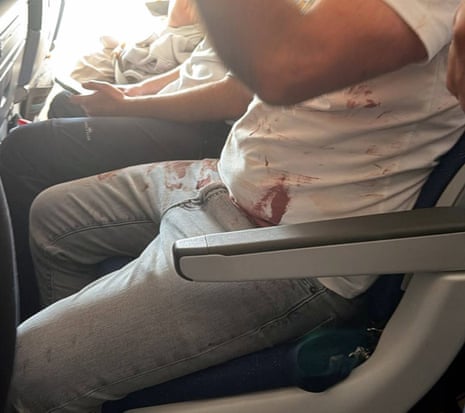
It was not immediately possible to verify those reports. Pictures of a passenger with blood on their shirt were published by Israeli media.
A spokesperson for the Israeli prime minister’s office initially said that the flight diversion was not because of a hijack attempt; authorities later said they were investigating.
What we know so far
The FlyDubai flight FZ 1073 from Dubai to Tel Aviv made an emergency landing in Saudi Arabia this morning after transmitting emergency signals.
According to Israeli media, a fight had broken out between the plane’s two pilots. Passengers described one of the pilots being seriously injured in an alleged stabbing.
The Boeing 737 plane, which Israeli officials said had between 160 and 180 passengers on board, transmitted a general emergency signal about two and a half hours after departing from Dubai, according to flight-tracking website Flightradar24.
It diverted to Saudi Arabia as it flew over Jordanian airspace, transmitting another emergency signal that indicated what is known as a possible unlawful interference.
The plane again transmitted the initial general emergency signal before later landing at Saudi Arabia’s Tabuk airport.
The aircraft’s data appeared to show that it had suddenly and rapidly descended by nearly 14,000 feet in less than 30 seconds before the first emergency signal. It was not immediately clear who transmitted the emergency signals.
Tabuk airport said the plane landed at 9.45am local time and that both pilots were taken to hospital after sustaining injuries.
The Israeli prime minister’s office said the situation was “under control” and that steps were being taken to bring the passengers to Israel.
Israeli minister claims 'terrorist' attempted to crash plane bound for Tel Aviv
An Israeli minister has decried what he described as a “terrorist” incident to kill Israelis after a flight was forced to land in Saudi Arabia when a physical altercation between the pilot and co-pilot prompted initial fears of a hijacking.
A Boeing 737 Max 8 with up to 180 passengers on board made an emergency landing at Saudi Arabia’s Tabuk airport this morning after transmitting three emergency signals, one of which indicated what is known as a possible unlawful interference. Israeli media have reported dramatic testimonies and video from people on board, with some describing passengers storming the cockpit to subdue the attacker and one of the pilots being seriously injured.
Passengers aboard the Boeing 737 Max 8 travelling from Dubai to Tel Aviv told Israeli media that one of the pilots tried to crash the plane before being overpowered. Photograph: Amit Segal
The Israeli national security minister, Itamar Ben-Gvir, said the incident highlighted the need for Israel to escalate its military campaigns across the region.
“Thank God and the heroic passengers, but Israel’s security doctrine must be taken to the next level,” he wrote on X, adding that the country “must continue until achieving total victory” in Iran, Lebanon, Gaza and the occupied West Bank.
“The naive notion that our enemies value life and deserve our pity was given yet another stark reminder this morning in the form of a terrorist who planned to blow up a plane and murder the 180 Israelis on board.”
Similarly, the Israeli finance minister, Bezalel Smotrich, said that “anyone who tried to bring down a plane and murder 180 Israelis should pay as though they had murdered them – as should any country or terrorist organisation that sent them”.
According to the Israeli Hareetz newspaper, citing an unnamed official, authorities were treating it as a “terror” incident and “believe that one of the pilots may have purposefully attempted to crash the plane”. The newspaper added that other scenarios were also being considered.
Commenting this morning, the Israeli prime minister’s office said the situation was “under control” while measures are being taken to bring the passengers to Israel. Local media reported the military had scrambled fighter jets after fears of a possible hijacking, which the prime minister’s office had ruled out shortly after the incident came to light.
In a statement, Tabuk airport said the flight that was bound for Tel Aviv landed at 9.45am local time and that its captain and co-pilot “were found to have injuries and were transported to hospital”.
FlyDubai said flight FZ 1073 “experienced an incident while en route” and that all passengers “are safe and accounted for”.
My colleague William Christou has more on the story here:
The International Committee of the Red Cross (ICRC) has said Israeli settler violence in the West Bank has made everyday life for Palestinians “untenable”, as a mob attack on Palestinians trying to return home prompted one of Benjamin Netanyahu’s main rivals to warn of a campaign of settler terror.
… %!s()
More than 100 militant settlers overwhelmed Israeli security forces early on Tuesday to attack a Palestinian family as they attempted to reclaim their homes which had been seized by settlers in the West Bank village of Jalud. Three Israeli security officials were injured and houses were set on fire.
The impotence of the Israeli military, the scale of the assault and the injuries inflicted on Israeli security officers by settlers prompted unusually harsh condemnation from Israeli politicians and commenters.
Israel is facing unprecedented international pressure over surging violence in the occupied West Bank, where settler militants backed by cabinet ministers have accelerated a campaign of ethnic cleansing ahead of Israel’s elections next month.
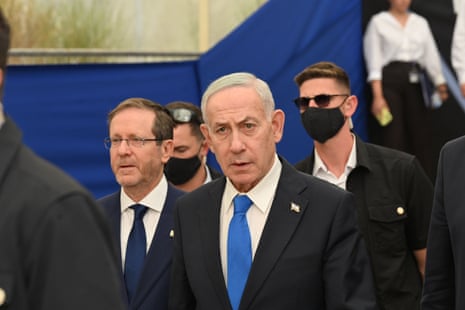
Israel’s president, Isaac Herzog, condemned the attacks in Jalud as a “moral stain”. Gadi Eisenkot, a former military chief and Netanyahu’s leading challenger in the upcoming elections, called for action to halt a “campaign of terror and violence”.
Deadlier attacks by Israeli settlers, including ones targeting Palestinian children, have drawn less attention inside Israel.
“Palestinian rights or safety are not the concern, even for people who are in the opposition,” said Mairav Zonszein, a senior analyst on Israel-Palestine with International Crisis Group. “The settler violence is an issue [for them] because it’s making Israel look bad, and also the idea that the military is losing control.”
A Palestinian family were attacked as they attempted to reclaim their homes which had been seized by settlers in Jalud. Photograph: Atef Safadi/EPA
The ICRC said attacks, settlement expansion and severe restrictions on movement were making everyday life untenable for Palestinian civilians, who Israel has a responsibility to protect under international law. .
“The frequent and severe violence must be brought to an end,” said Julien Lerisson, the head of the ICRC’s delegation for Israel and Palestine. “What international humanitarian law says on the protection of private and public property, and on the population’s access to essential services, must be respected.”
A bar on imports of settlement goods came into force in the Netherlands last week, the UK has announced plans for even broader controls on trade and financing of settlements, and a similar bill will be introduced in the US legislature on Thursday.
On Tuesday, a Senate bill demanding a human rights report on Israel’s occupation of the West Bank was narrowly defeated after winning backing from all but one Democrat.
“Tonight a disaster was averted, but the barrier has been broken,” the Israeli analyst Roy Sharon wrote on social media after the vote, warning that “anarchy in the West Bank” may cost Israel military aid from the US and its international legitimacy.
A cartoon in Israel’s largest-circulation newspaper, Yedioth Ahronoth, on Wednesday showed two soldiers watching an arson attack on a Palestinian home. “They’re going to ruin my trip to Amsterdam,” one says to the other.
More than 60 Palestinian communities in the occupied West Bank have been wiped off the map since October 2023 and 18 others have been partly displaced, according to the Israeli rights group B’Tselem. Nearly 5,000 people have been forced from their homes, almost half of them children.
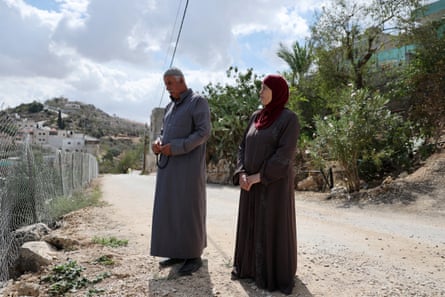
Mahmod Tubasi, 60, and his wife, Aedah, 51, and their family had been forced out of their homes this summer by settler militants. Photograph: Ammar Awad/Reuters
The Tubasi family, whose homes were burned in Jalud, had been forced out this summer after a weeks-long siege by settler militants. Last week they secured a high court ruling ordering the Israeli state to evict settlers and secure their return.
Late on Monday the Israeli military told the family that about 15 military police officers would escort them home immediately, Israel’s Haaretz newspaper reported. That was a small number given that Israel is celebrating the Sukkot holiday. The number of violent extremists in illegal settlements usually rises during festivals, and the force was outnumbered by a violent crowd within minutes of arriving.
“To carry out an operation such as this, and during the holiday of Sukkot when the [settler] outposts are packed, is madness,” a security source said. The military had not informed national police and the Shin Bet domestic intelligence service of their plans, so they had no security backup.
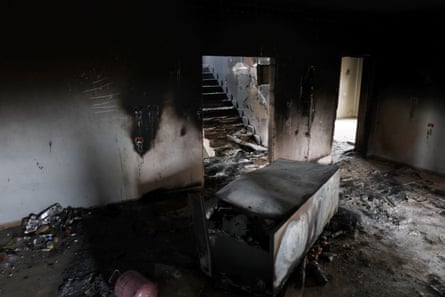
Settlers attacked a house when the Tubasi family arrived, forcing them to the roof, before the military decided to evacuate them in armoured military vehicles. The crowd then set the homes on fire, blocked roads and threw stones at Israeli security forces, injuring three personnel.
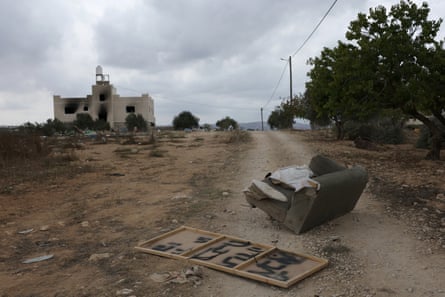
The two houses “were damaged beyond description”, said Wael Tubasi. “They damaged everything – the doors, the tiles were removed, the stairs were removed. They smashed the bathrooms, doors and windows. They left nothing, everything was broken,” he told Reuters.
The Tubasi family’s homes were ‘damaged beyond description’, said Wael Tubasi. ‘Everything was broken.’ Photograph: Ammar Awad/Reuters
Earlier this year the former prime minister Ehud Olmert called for the international criminal court to intervene to stop settler violence because the state had failed.
Netanyahu condemned the “violent riots” and called for prosecution of the attackers, but defended the illegal settler movement. “The handful of rioters are not representative of the law-abiding settler public in Judea and Samaria,” the prime minister said, using an Israeli term for the occupied West Bank.
A landmark 2024 ruling from the UN’s international court of justice found that the occupation violated international law, a position the British government has endorsed.
An Israeli military spokesperson said two suspects had been detained, and called for action to tackle settler militants who targeted Israeli security forces.
“The violence directed at soldiers while they were carrying out their duties crosses a clear red line and is unacceptable,” the spokesperson said. “There is no place for such incidents in the state of Israel, and they must not be allowed to become the norm. Such phenomena must be addressed at their root.”
On Wednesday, some in Israel questioned whether the army and the state had the capacity to do that. “We have to look reality squarely in the eye: this was a terrorist attack and a failure by the Israeli defence establishment in its entirety,” Avi Ashkenazi wrote in the Maariv newspaper. “It is clear at this point that the real sovereign in Judea and Samaria are the extreme rightwing terrorist activists.” %!s()
A close political ally of Donald Trump has broken from the administration’s aggressive immigration enforcement agenda and recommended it “step back” to evaluate what it could do better.
“To get better, the first thing you got to do is admit you’re doing something wrong,” Jim Justice, a Republican senator of West Virginia, told Politico. “And in this situation, with all that’s going on and all the stuff, we probably got to step back from it and say: ‘Maybe we’re doing something wrong here or there,’ and then adjust to that.”
… %!s()
Justice, who also sits on the Senate agriculture committee, made his comments after three rancher associations condemned Immigration and Customs Enforcement (ICE) activity for negatively affecting agricultural communities.
But his comments also come after an ACLU of West Virginia investigation found that about three-quarters of the more than 593 arrested by ICE in the state during “Operation Country Roads” in January had no criminal record.
“Before you know it, you get people that get carried away in their job and whatever it may be, and all of a sudden, then you’re dragging people away that have lived on your street corner for 15 years, and I don’t know that we need to be doing that stuff,” Justice told Politico.
Trump’s immigration enforcement agenda is a signature policy of his administration. Many voters indicated they wanted stricter immigration policies, but the intense tactics of federal agents have sparked anger nationwide.
For ranchers in rural communities, ICE operations have had “a massive chilling effect on the legal, documented, skilled workers” who assist in beef production and the cattle supply chain, the Kansas Livestock Association, Oklahoma Cattlemen’s Association and Texas Cattle Feeders Association said in a statement released last week.
Dairy farmers have also recently raised concerns that ICE operations in rural areas could soon hurt their industries.
“If we had a concerted effort to have enforcement activities within agriculture, you could really harm our ability to produce food to feed ourselves,” Rick Naerebout, the CEO of the Idaho Dairymen’s Association, told NPR.
West Virginia is home to more than 22,700 ranchers, most of which are family-owned.
Justice’s criticisms make him the latest Republican to distance himself from Trump in the lead-up to the midterm elections.
Maria Elvira Salazar, a Republican congresswoman from Florida, recently ran a campaign advertisement telling Trump his “immigration enforcement efforts have gone too far”.
The Guardian has asked the White House for a response. %!s()


![]A plane, carrying passengers who were on the FlyDubai aircraft bound for Israel from the United Arab Emirates, which was diverted to Saudi Arabia following an emergency signal, on the tarmac as it arrives at the Ben Gurion International Airport, in Lod, near Tel Aviv, Israel, September 30, 2026.](https://i.guim.co.uk/img/media/98db03b3d43e674ad477310935e547b49e124ba6/0_0_1723_1153/master/1723.jpg?width=465&dpr=1&s=none&crop=none)