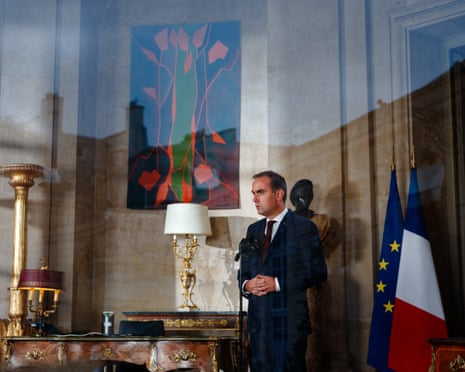
South Korea has said it will recall its ambassador to Ukraine, the latest escalation in a diplomatic spat between both countries.
It started last month when Ukrainian President Volodymyr Zelensky announced that his government had transferred two captured North Korean soldiers to Seoul.
… %!s()
Seoul says Ukraine broke an agreement to keep the transfer a secret but Zelensky's office maintains that there was no non-disclosure agreement in place.
The two North Korean soldiers, who were among thousands from the country supporting Russia in the Ukraine war, had earlier told local media they wanted to be sent to South Korea.
South Korean Vice Foreign Minister Park Yoon-joo had in September lodged a formal complaint with his Ukrainian counterpart Andrii Vieshkin over the matter.
And earlier this week, Foreign Minister Cho Hyun said he received an apology from his Ukrainian counterpart, but added that it fell short of Seoul's expectations, according to local reports.
But on Wednesday, Ukrainian Foreign Ministry spokesperson Heorhii Tykhyi told reporters at a media briefing that its Foreign Minister Andrii Sybiha had not apologised, according to Ukrainian news site Liga.
In a statement on Thursday, South Korea's Foreign Ministry said it would "continue consultations with the Ukrainian side", adding that it expected that "various outstanding issues...[would] be resolved smoothly".
Zelensky had revealed the transfer at a speech at the UN General Assembly in September, adding that the two North Koreans had not been "easy to capture alive".
It prompted a swift condemnation from South Korean President Lee Jae Myung, who called it "greatly disappointing" and said the transfer was a "highly sensitive issue" impacting national security.
President Lee also faced heavy criticism at home in light of the revelation, with local opposition accusing him of wanting to cover up the transfer to appease Pyongyang.
But his office said that it had been kept confidential partly to protect the North Koreans' families and added that Kyiv also wanted the transfer kept secret to avoid criticism that it had given up an opportunity to exchange the soldiers for Ukrainian prisoners of war.
Lee's office explained Ukraine had indicated the soldiers would be mentioned in Zelensky's address, but not the fact of their transfer.
The spat escalated when Zelensky's office responded claiming that the two countries did not have a non-disclosure agreement.
Seoul later demanded Ukraine apologise for "announcing a falsehood" and said its actions had seriously damaged trust between the two nations.
Seoul has been sympathetic to Ukraine since Russia's full-scale invasion, but has refused to break from its longstanding policy of not providing lethal weapons to any country engaged in active war.
After North Korean troops were deployed to support Russia in 2024, Kyiv stepped up pressure on South Korea to supply cutting-edge anti-air missiles to help defend Ukraine's energy infrastructure from Russian drone and missile attacks.
This July, Seoul had announced a $100 million assistance package to Ukraine. Lee's office said it would be an expansion of earlier assistance which was comprised of non-lethal items including helmets, personal armour and medical equipment.
Meanwhile Russia's foreign ministry has warned it would have "no choice but to retaliate" if South Korea provided Ukraine with arms, without specifying action it might take.
South Korea has long pursued cordial ties with its neighbours who may be at odds with its ally, the US.
Since the collapse of the Soviet Union, it has worked to deepen trade and diplomatic relations with Russia, which borders North Korea, and views both Moscow and Beijing as key partners in efforts to influence Pyongyang. %!s()
Voters go to the polls in Holborn and St Pancras byelection
Good morning and welcome to our UK politics live blog.
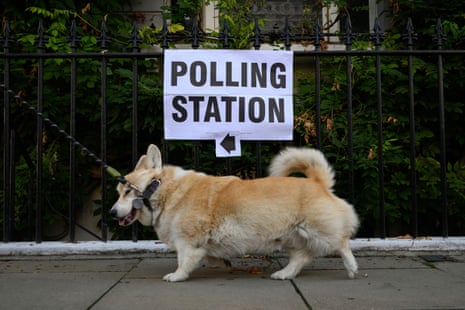
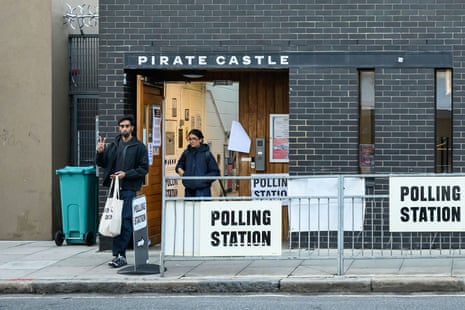
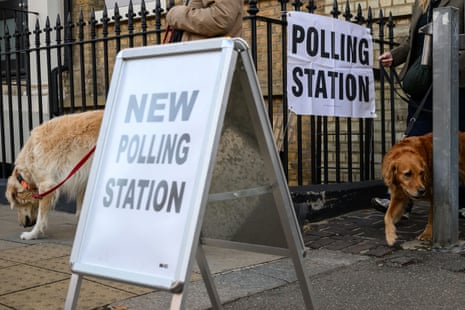
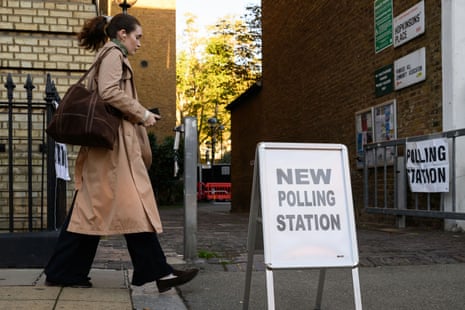
Polls have opened in Keir Starmer’s old seat in Holborn and St Pancras, where the Green party leader, Zack Polanski, is hoping to break Labour’s longstanding grip in the north London constituency.
…
A dog is led towards a polling station as voting begins in the Holborn and St Pancras byelection. Photograph: Leon Neal/Getty Images
He might have his work cut out for him. Labour’s Sagal Abdi-Wali is projected to retain the seat in today’s byelection, but the party shouldn’t take victory for granted. As the Guardian’s senior political correspondent, Peter Walker, reports, Polanski has mounted an intensive campaign, but the scale of the challenge is clear from the numbers. Starmer won the seat by 11,500 votes in 2024, after Labour majorities of nearly 28,000 in 2019 and more than 30,500 in 2017.
You can read Peter’s report from this morning here:
In other news:
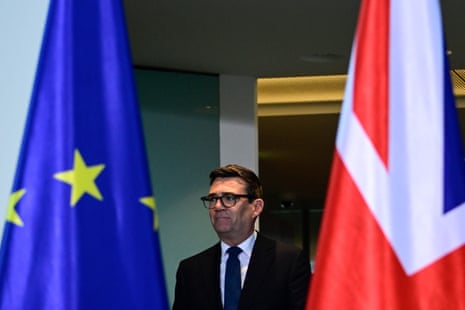
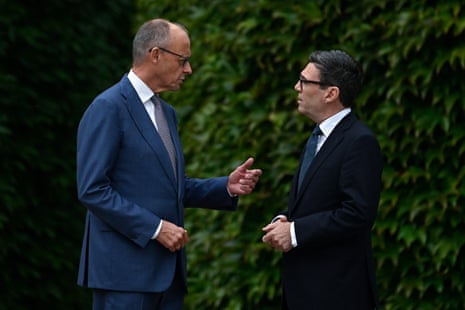
Andy Burnham is in Berlin today where he will hold meetings with German chancellor Friedrich Merz. On the agenda is a new joint security partnership to counter sabotage, cyber-attacks and other hybrid threats, as well as support for Ukraine, instability in the Middle East, and disruption to global trade routes. We’re expecting to hear from the prime minister this afternoon.
The diplomatic row between Britain and Israel is escalating over the UK’s consular presence in East Jerusalem. Israel said the British consulate has “ceased to function” with 20 diplomats due to leave, but the foreign secretary, Ed Miliband, said the building will remain open and renamed the “UK Mission”.
Key events
48m ago
Burnham 'committed to securing deeper cooperation' with EU at looming summit
1h ago
UK’s military needs to focus spending on domestic defence, not overseas missions – report
2h ago
Burnham arrives in Berlin for meetings with Merz
3h ago
British consulate in East Jerusalem will stay open as UK mission, says Ed Miliband
4h ago
Voters go to the polls in Holborn and St Pancras byelection
There are 100 tagging breaches a day in London “and rising”, the Metropolitan Police commissioner has said.
Mark Rowley warned many offenders are being bailed back into the community on the same conditions with “zero sanction”. He also said the force is arresting “two or three early release offenders a week”.
The first wave of the latest early prison releases began last week, with nearly 5,000 prisoners set to be freed in stages over the next year as the Sentencing Act 2026 comes into force.
It follows a previous scheme launched in 2024 and is intended to address prison overcrowding. Speaking on LBC today, Rowley said:
double quotation markI’m worried about the number of offenders being released into communities. At the moment we’re arresting two or three early release offenders a week who are being recalled to prison or doing further offending.
That’s been since the start of August we’ve been capturing that data. We’re getting increasing numbers of tag breaches to enforce that probation is sending to us – it’s now over 100 tag breaches a day in London… and rising.
Burnham 'committed to securing deeper cooperation' with EU at looming summit
Jakub Krupa
Back to Berlin, Germany’s Merz and UK’s Burnham have issued statements after their talks.
Andy Burnham in Berlin where he addressed a press conference with the German chancellor, Friedrich Merz. Photograph: Tobias Schwarz/AFP/Getty Images
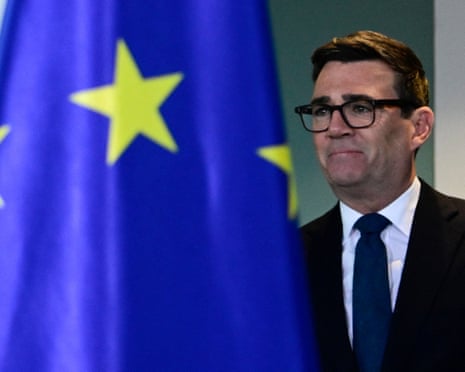
Burnham talked about rebuilding the UK’s relationship with the EU after Brexit. Their meeting in Berlin came ahead of the UK-EU summit later this year – expected in late November – as he said he is “very committed to securing deeper cooperation” with the EU at the summit.
He wanted to see “if we can bring the UK closer to Europe, particularly in the interest of economic growth and collaboration on irregular migration,” he said.
You can read more of his statement, and that of Merz, over on the Europe live blog:
We have some comments (via the Common Wealth thinktank) from Labour MP Alex Sobel and the general secretary of the University and College Union (UCU), Jo Grady, in response to the Transition Security Project report on the government’s military strategy.
As Peter Walker reports, the study warns the UK’s military is too focused on global commitments at the expense of domestic defence, meaning the government’s planned increase in defence spending is likely to result in even greater waste
Sobel said: “At this time of global instability, it is critical that we spend every pound carefully ensuring our troops are well looked after and that procurement supports UK industry and provides best value.”
Grady added: “Working people are repeatedly told there is no money to properly fund our colleges, universities and public services, whilst billions of pounds are poured into maintaining the capacity to fight wars around the world.
“This report exposes the enormous costs to taxpayers and the huge amounts of waste involved. Real security means decent jobs, strong public services and social security, not ever-increasing spending on weapons and war.”
UK’s military needs to focus spending on domestic defence, not overseas missions – report
Peter Walker
The UK’s military is too focused on global commitments at the expense of domestic defence, meaning the government’s planned increase in defence spending is likely to result in even greater waste, a thinktank report has warned.
Calling this a symptom of a “destructive, outdated foreign policy” centred on overseas missions that have often made the world less safe, the report says ministers should prioritise changing their approach rather than immediately increasing spending, with resources shifted from overseas commitments to domestic defence.
The government is committed to spending 3.5% of GDP on defence by 2035 and a defence investment plan (Dip) was unveiled in July at the tail end of Keir Starmer’s premiership.
Starmer’s then defence secretary John Healey resigned over a refusal to commit to reaching 3% by 2030, but now that Healey is chancellor that target has been shelved for now.
It would involve a doubling of the defence budget in nominal terms from £70bn in 2026 to £151bn in 2035, according to the Transition Security Project, a research centre that was spun out of Common Wealth, a thinktank with close links to Andy Burnham.
Read more:
Burnham arrives in Berlin for meetings with Merz
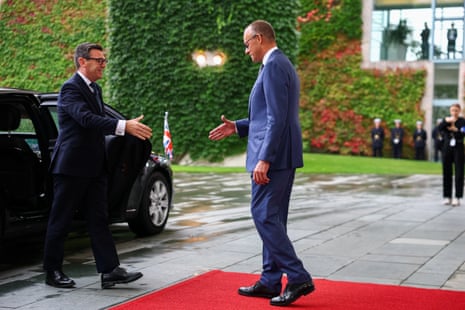
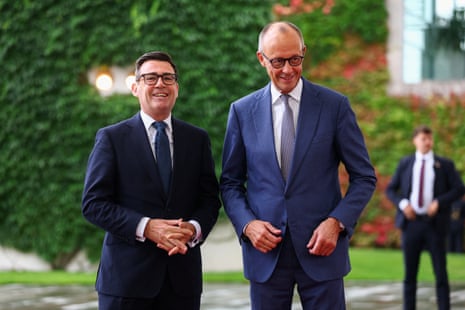
Prime minister Andy Burnham has arrived in Berlin, where he was welcomed by German chancellor Friedrich Merz.
Their meetings today will focus on tackling cyber-attacks and hybrid threats in the form of a new security partnership. My colleague Jakub Krupa will have more over on the Europe live blog here.
German chancellor Friedrich Merz welcomes UK prime minister Andy Burnham in Berlin. Photograph: Lisi Niesner/Reuters Photograph: Lisi Niesner/Reuters Photograph: Tobias Schwarz/AFP/Getty Images
Ben Quinn
A serving member of the Royal Navy has been charged with spying, police have said.
Teddy Young, 24, will appear today at Westminster magistrates’ court after he was charged with obtaining protected information that could benefit a unnamed foreign power.
He was arrested at his home in Bedfordshire on 6 October after an investigation by Counter Terrorism Policing London (CTPL). He had now been charged with a number of offences under the National Security Act, the Metropolitan police said on Thursday.
Cmdr Helen Flanagan, the head of CTPL, said: “These are very serious charges against a serving member of the armed forces. We have worked extremely closely with relevant operational colleagues within the Ministry of Defence as our investigation has progressed to ensure appropriate measures could be taken to mitigate any potential risks linked to this matter.”
Read more:
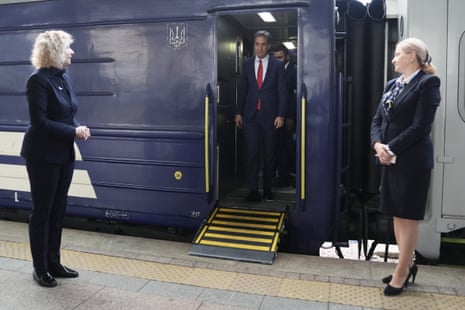
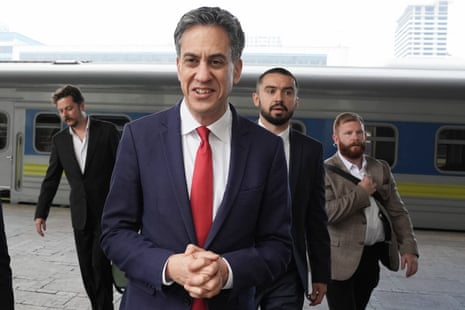
Ed Miliband is in Kyiv this morning. There’s scant information about what he’s actually doing there, other than “make clear the UK’s unwavering support for Ukraine”, as the Foreign Office says. We shall, as ever, bring you more when we get it.
Foreign secretary Ed Miliband at Kyiv train station as he arrives in Ukraine for a one day visit to the capital. Photograph: Stefan Rousseau/PA Photograph: Stefan Rousseau/PA
Denis Campbell
Away from the byelection, research has found Brexit, Liz Truss’s mini-budget and other “shocks” over the last 10 years have led to a serious and lasting deterioration in the UK population’s mental health.
The findings come as Prof Peter Fonagy prepares to publish the report of his long-waited government-commissioned inquiry into the dramatic increases in recent years in diagnoses of mental illness, ADHD and autism. It will be published on Friday amid concern that those conditions help explain why a record 2.8 million Britons are too sick to work and almost 1 million young people aged 16 to 24 have become “Neets” – not in education, employment or training.
Researchers led by Dr Annie Jeffery of University College London used data from the UK Household Longitudinal Study of 87,857 people aged 16 and older, which was collected every year between 2009 and 2024, to estimate the mental health impact of those five “systemic shocks”.
Jeffery said:
double quotation markThe past decade or so has been tumultuous, shaped by multiple overlapping shocks and ongoing uncertainty and instability that have impacted mental health in Britain,” said Jeffery.
We have shown that major government decisions and current global events can have substantial impacts on people’s mental health.
Here are some of the latest images from the Holborn and St Pancras constituency, which the Guardian’s head office is just on the boundary of:
Photograph: Leon Neal/Getty Images Photograph: Leon Neal/Getty Images Photograph: Leon Neal/Getty Images
Richard Adams
Labour’s flagship changes to special education in England are at risk of unravelling because parents are rushing tosecure support for their childrenbefore the system changes, new analysis has found.
The Institute for Government (IfG) thinktank says the government’s plans to largely replace education, health and care plans (EHCPs) in England with more widespread support in mainstream schools may be too optimistic and take longer to complete than its 2030 timeline.
The thinktank’s report calls on the government to review the timetable for the changes. And it suggests that if ministers do not act they “risk basing both their reforms and spending plans on assumptions that the system cannot deliver”.
The news will be seen as a sign that the government’s ambitious plans to overhaul the special education system did not reckon with the scale of worry among parents, many of whom appear to have acted to ensure support and avoid uncertainty in the future.
The Guardian recently reported that councils and schools have reported a surge in applications for EHCPs, with one school describing the level as “unreal” compared with previous years. Several councils are now projecting that at the current rates of increase, nearly one in 10 pupils will have an EHCP by 2029.
Amber Dellar, the author of the IfG report out this week, said the long rollout of the changes created a “moral hazard” that encouraged parents to apply for EHCPs now rather than wait for the new system.
Read more:
British consulate in East Jerusalem will stay open as UK mission, says Ed Miliband
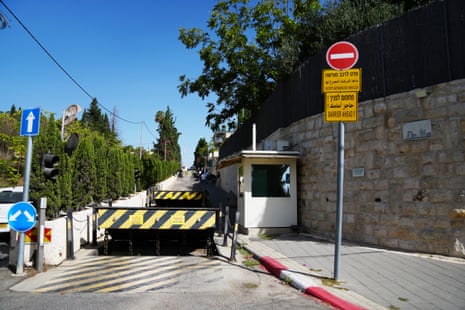
The foreign secretary, Ed Miliband, has said Britain’s consulate general building in East Jerusalem will not be closing but will be known as a UK mission, remaining independent, operational and serving Palestinian people.
Israel had ordered the British consulate in East Jerusalem to close on Thursday over the UK’s plans to impose sanctions on settlements in the West Bank.
Miliband said that having withdrawn a number of staff and families in recent weeks, it would now work to build up its presence.
Barricades block the main road leading to British consulate in East Jerusalem after the sign outside the building was taken down. Photograph: Mahmoud Illean/AP
He said Britain would not take any reciprocal action against Israel while the two sides engaged in talks, following speculation it could expel some Israeli diplomats from Britain.
Diplomats from other western countries had been worried about any closure setting a precedent, and suggested Britain had to respond strongly to the Israeli move because it had implications beyond the immediate dispute.
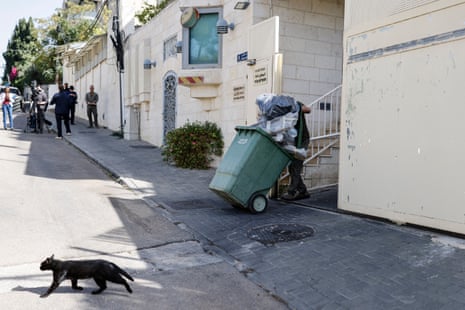
An employee wheels a rubbish bin as journalists wait outside the British consulate. Photograph: John Wessels/AFP/Getty Images
The consulate is separate from the UK embassy, based in Tel Aviv, and has a distinct diplomatic role, covering East Jerusalem, the rest of the West Bank and Gaza, where it provides consular services to Palestinians.
Israel had threatened to close it in protest at the UK’s decision to ban trade in goods from illegal Israeli settlements in the occupied West Bank. Israel’s foreign minister, Gideon Sa’ar, said Britain’s decision to impose sanctions was “morally distorted” and accused the governing Labour party of being hostile towards his country.
Read more:
The French finance minister, Roland Lescure, said the UK could rejoin the EU “anytime” after Andy Burnham indicated a major review of Britain’s relationship with the bloc.
Lescure said it was up to the British public whether to return to the EU, telling the BBC that “if they’re willing to come back, they will have to decide”.
“But what I can tell them is: come back, anytime,” he added. Ben Quinn has the full report here.
France’s finance minister Roland Lescure said the UK should rejoin the EU ‘anytime’. Photograph: Kenzo Tribouillard/AFP/Getty Images
As our political correspondent Aletha Adu reported last week, the prime minister opened the door to the UK rejoining the EU, saying Britain could “go all the way” as he prepares to reconsider Labour’s post-Brexit red lines.
Read more:
Voters go to the polls in Holborn and St Pancras byelection
Good morning and welcome to our UK politics live blog.
Polls have opened in Keir Starmer’s old seat in Holborn and St Pancras, where the Green party leader, Zack Polanski, is hoping to break Labour’s longstanding grip in the north London constituency.
A dog is led towards a polling station as voting begins in the Holborn and St Pancras byelection. Photograph: Leon Neal/Getty Images
He might have his work cut out for him. Labour’s Sagal Abdi-Wali is projected to retain the seat in today’s byelection, but the party shouldn’t take victory for granted. As the Guardian’s senior political correspondent, Peter Walker, reports, Polanski has mounted an intensive campaign, but the scale of the challenge is clear from the numbers. Starmer won the seat by 11,500 votes in 2024, after Labour majorities of nearly 28,000 in 2019 and more than 30,500 in 2017.
You can read Peter’s report from this morning here:
In other news:
Andy Burnham is in Berlin today where he will hold meetings with German chancellor Friedrich Merz. On the agenda is a new joint security partnership to counter sabotage, cyber-attacks and other hybrid threats, as well as support for Ukraine, instability in the Middle East, and disruption to global trade routes. We’re expecting to hear from the prime minister this afternoon.
The diplomatic row between Britain and Israel is escalating over the UK’s consular presence in East Jerusalem. Israel said the British consulate has “ceased to function” with 20 diplomats due to leave, but the foreign secretary, Ed Miliband, said the building will remain open and renamed the “UK Mission”.
In front of 66,000 home fans creating an electric atmosphere inside Rabat's Prince Moulay Abdellah Stadium, Morocco appeared set for a date with destiny as they chased their first Afcon title since 1976.
… %!s()
Instead, the final descended into chaos deep into stoppage time.
With the match still goalless, Senegal thought Ismaila Sarr had scored a dramatic winner, only to discover that referee Jean Jacques Ndala had already blown for a Moroccan free-kick.
The controversy deepened in the 98th minute when, after a VAR review, Ndala awarded Morocco a penalty.
Tempers boiled over on the touchline and in the stands. Senegal coach Pape Thiaw led some of his players and staff down the tunnel, while supporters clashed with security as order briefly collapsed.
Play eventually resumed and, in the 124th minute, Morocco missed a golden chance to end their 50-year wait for continental glory when Real Madrid's Brahim Diaz failed to convert a penalty, chipping it 'Panenka' style into the grateful arms of goalkeeper Edouard Mendy.
Pape Gueye's extra-time strike then secured a 1-0 win for Senegal, who lifted the trophy for a second time.
Or so they thought.
Unsurprisingly the Royal Moroccan Football Federation (FMRF) quickly lodged a complaint with the Confederation of African Football (Caf), arguing Senegal had breached competition regulations.
Article 82, contained within a chapter titled "Withdrawals", states: "If, for any reason whatsoever, a team… leaves the ground before the regular end of the match without the authorisation of the referee" they shall be "considered the loser and shall be eliminated from the current competition".
In March, a Caf appeals board agreed, ruling that Senegal had forfeited the match and awarding Morocco a 3-0 victory.
While there is precedent for Caf overturning results during Afcon and World Cup qualifying, others, including one former senior Caf official, argued that only the referee has the authority to abandon a match if a walk-off occurs.
The FMRF said it was seeking the proper application of tournament regulations, but Senegal's federation (FSF) described the ruling as "unfair, unprecedented and unacceptable" and appealed to Cas.
Founded in 1984 and based in the Swiss city of Lausanne, Cas was set up as an independent legal body designed to settle disputes as global sport became more lucrative and, as a result, more litigious.
For governing bodies which recognise Cas' authority, it is deemed to be the supreme arbiter, meaning its ruling is final unless, in rare cases, Switzerland's highest court decides to set it aside based on a limited number of technicalities.
More than 900 cases are filed every year, from more than 50 different sports, covering issues such as employment contracts and transfers, doping, corruption, TV rights and, in this case, the organisation of sporting events.
The appeal will be heard by a panel of three arbitrators chosen by Cas for their expertise in sports law.
In this instance, the panel will be led by 76-year-old Frenchman Gerald Simon, founder of the Sports Law Laboratory at the University of Burgundy and a Cas member for 23 years.
If the panel fails to come to a consensus, its president will make the final decision.
Even though Caf's appeals board is independent, a reversal of its judgement would deliver another blow to the reputation of African football's governing body, which has already been heavily criticised for the retrospective decision to hand Morocco the title.
Caf president Patrice Motsepe said back in March that they will "adhere to" and "respect" whatever Cas decides, so if things go in Senegal's favour, it could mean someone having to tinker with the Afcon rulebook.
The Teranga Lions' walk-off has, however, already brought about a change in football's rules.
"The referee may sanction with a red card any player who leaves the field of play in protest at a referee's decision," said Ifab, the game's lawmaking body, back in April.
"This new rule will also apply to any team official who incites players to leave the field of play. A team that causes a match to be abandoned will, in principle, forfeit the match."
Thiaw has already been given his marching orders by Senegal, having lost his job following the team's last-32 World Cup exit, while Walid Regragui, the man in the Moroccan dugout back in January, was dismissed in March.
Both men will no doubt still view success with Cas as a moral victory.
Whatever the outcome, animosity is likely to linger between the two federations.
The FMRF's senior hierarchy were furious with Senegal's behaviour, believing the pictures beamed around the world irrevocably tarnished the image of the first Afcon hosted by the kingdom since 1988 - a tournament into which a huge amount of time and money had been invested.
The FSF and the Senegalese government have, meanwhile, leaned into a feeling prevalent across the continent that Morocco holds too much influence within African football.
Other incidents also irked them, such as laser pens being directed into players' eyes and ball boys moving goalkeeper Mendy's towel, something which eventually led to the barely believable sight of reserve keeper Yehvann Diouf being tackled to the ground by three ball boys when he tried to intervene.
With the next Afcon scheduled to take place in June and July next year, the chances of a high-profile rematch between Africa's best two teams is a tantalising thought.
But while the chaos of this year's final may have given birth to a new rivalry for fans to revel in, there is unanimous agreement that such encounters should be settled on the pitch and not in a courtroom. %!s()
Merz welcomes new treaty as new opening after UK's 'regrettable' decision to leave EU
Merz is speaking now.
His remark focus exclusively on the bilateral British-German Kensington Treaty, as the pair exchange the documents and formally complete its implementation.
… %!s()
He says the treaty “opens up new opportunities” between the two countries, following Britain’s “regrettable” exit from the European Union.
He focuses on a particular element of the treaty that gives better access to both countries, with no visas required – even for extended stays by school pupils and university students – and for student exchanges between the two countries.
“That is precisely why we are doing this: so that the younger generation, within the context of bilateral relations between Germany and Great Britain, can simply see just how well we Europeans work together and how closely we belong together,” he says.
Key events
15m ago
Zelenskyy: strike on Kramatorsk buses 'will not go unanswered'
35m ago
French education minister to draft proposals on teachers' absences in response to protests
54m ago
Burnham 'committed to securing deeper cooperation' with EU at looming summit
1h ago
Burnham hails Germany as a partner for 'challenging times'
1h ago
Merz welcomes new treaty as new opening after UK's 'regrettable' decision to leave EU
1h ago
Merz and Burnham expected to deliver statements in Berlin shortly
2h ago
Rubio gets pushed on allegations of misconduct by US ambassador to Greece
2h ago
Germany's Merz hosts UK's Burnham for talks in Berlin
2h ago
French high school protests spill over to Belgium with concerns about violence
3h ago
30 people killed after Russian strike on public transport in eastern Ukraine
3h ago
More high school protests take place across France - in pictures
3h ago
One dead, two injured in another knife attack at Polish school
4h ago
EU drops sponsorship of disinformation conference at Trump officials’ request
4h ago
French high school protests this morning - in pictures
4h ago
French education minister to hold talks with high school students later today
5h ago
Morning opening: French high school protests continue despite PM's promise of action
Zelenskyy: strike on Kramatorsk buses 'will not go unanswered'
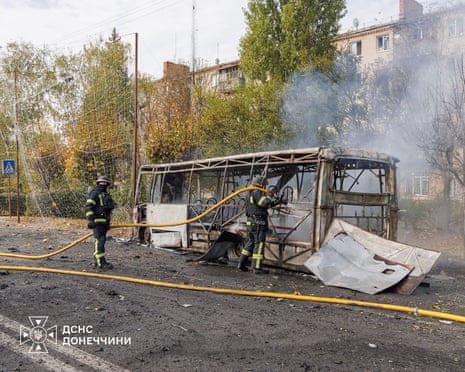
In a post to social media, Ukraine’s president, who included graphic footage from the scene, has said that a Russian strike on public transport in Kramatorsk which has left at least 30 dead “will not go unanswered”.
Doctors are now fighting to save the lives of people injured in the Russian strike on Kramatorsk. As of now, 30 people have been confirmed killed, and sadly, that number may rise. The Russian bomb effectively hit two city minibuses. Some of those killed have still not been identified because of the severity of their injuries. My condolences to all their families and loved ones. Another 18 people were injured in the strike. Residential buildings and cars were also damaged.
This strike will not go unanswered. Russia is trying to destroy all life in Donbas, and a response from the world is a must. A forceful response – exactly as the Russians deserve for all the deaths they have brought. May all those killed rest in peace.
Handout photograph released by the Ukrainian State Emergency Service. Photograph: Ukrainian State Emergency Service/AFP/Getty Images
French education minister to draft proposals on teachers' absences in response to protests
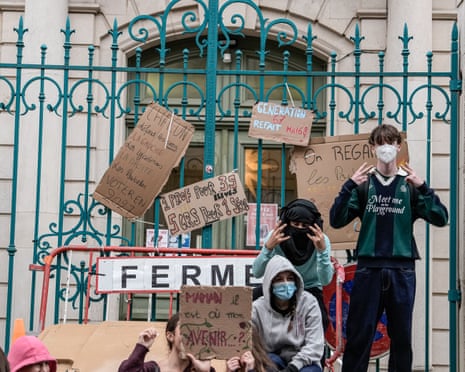
Back to France,education minister Édouard Geffray said his ministry would prepare a plan to address on of the key demands of the students’ movement on providing cover for absent teachers “in a few hours or a few days,” Le Figaro reported.
He is expected to meet with the three main student groups later today to discuss details (10:10).
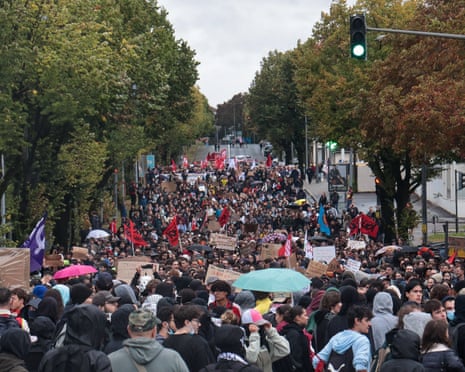
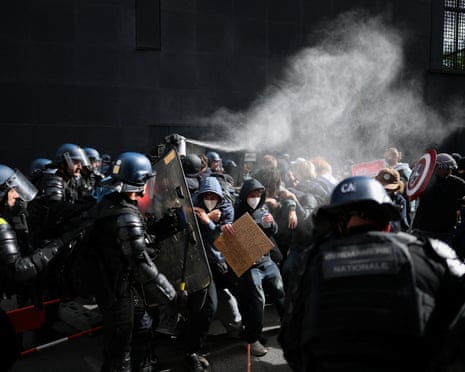
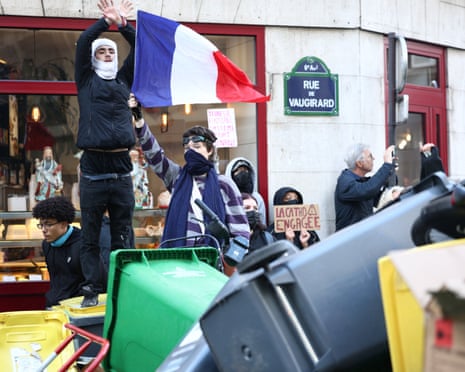
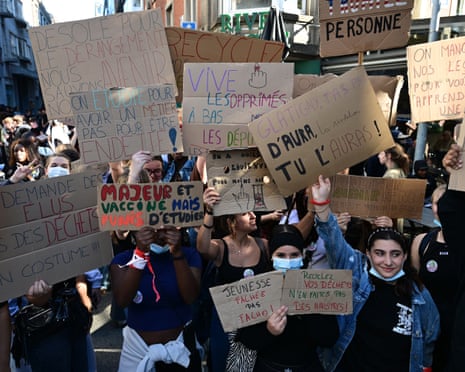
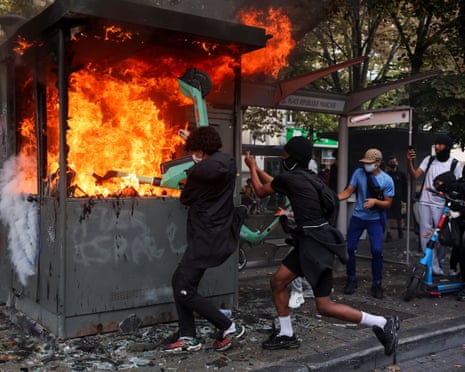
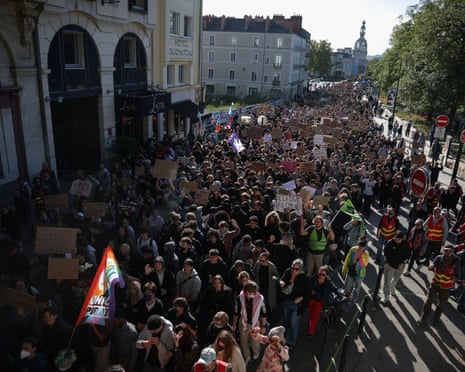
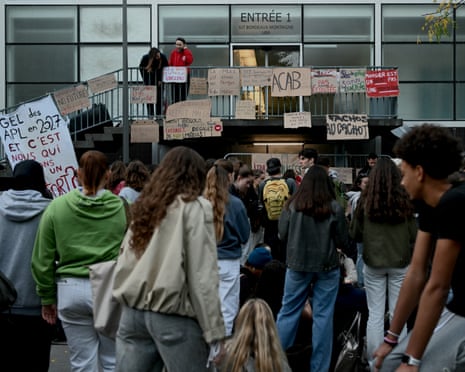
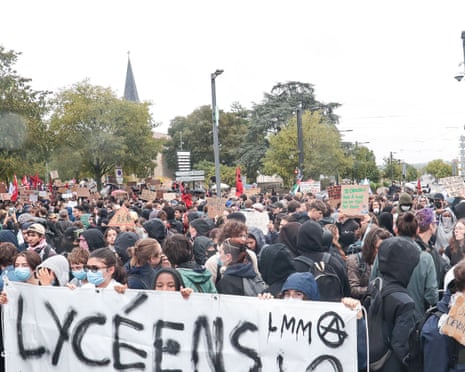
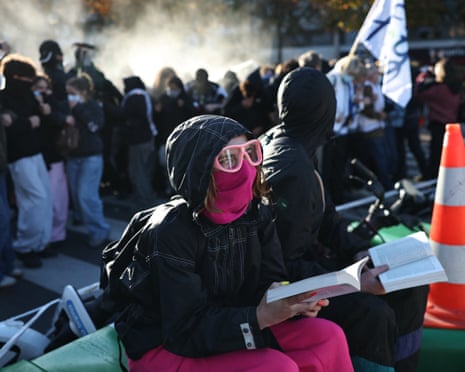
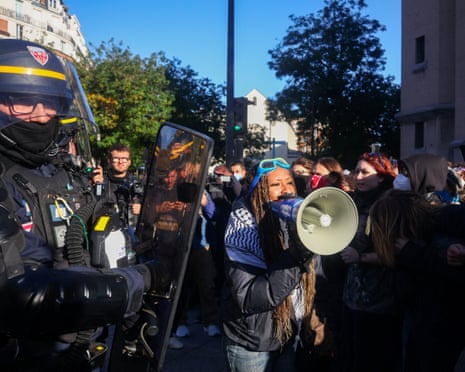
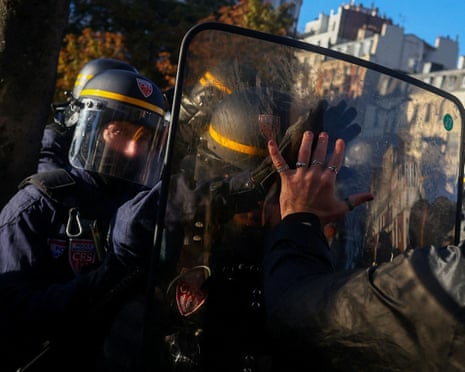
In the meantime, protests continue across the country, and AFP notes that while they have been largely peaceful, some demonstrators resort to acts of violence or clash with police officers.
Students take to the streets to protest education conditions in Nancy, France. Photograph: Muhammed Said Tako/Anadolu/Getty ImagesProtesters hold placard as they march during a demonstration of high-school students in Bordeaux. Photograph: Christophe Archambault/AFP/Getty ImagesHigh school students gathered in the Laennec district of Bron, France. Photograph: PITTORE/NEIRDAPROD/SIPA/ShutterstockProtesters clash with French gendarmes, as French high school and university students attend a demonstration in Nantes. Photograph: Stéphane Mahé/ReutersStudents gather outside Paris-Panthéon-Assas University during a demonstration in support of high school students. Photograph: Raphaël Lafargue/ABACA/Shutterstock
Burnham 'committed to securing deeper cooperation' with EU at looming summit
Burnham also talks about rebuilding the UK’s relationship with the EU after Brexit.
British prime minister Andy Burnham arrives to address a briefing with the German chancellor at the Chancellery in Berlin. Photograph: Tobias Schwarz/AFP/Getty Images
He says their meeting in Berlin comes ahead of the UK-EU summit later this year – expected in late November – as he says he is “very committed to securing deeper cooperation” with the EU at the summit.
He wants to see “if we can bring the UK closer to Europe, particularly in the interest of economic growth and collaboration on irregular migration,” he says.
In terms of more symbolic gestures, he says he will take part in talks with German business leaders later today, and hopes to host them in the UK next year – alongside the full German cabinet to show that “this treaty is not just words on a page, left on a shelf,” but a meaningful document.
He then turns to students standing somewhat awkwardly behind the pair throughout their exchange, and they briefly chat about their experiences with the UK, with someone mentioning their visited Scotland.
Aaaaaand that’s it.
Burnham hails Germany as a partner for 'challenging times'
In his response, Burnham focuses on broader cooperation with Germany.
He says that in these “challenging times, we need the highest quality collaboration with our closest partners.”
He says their talks also looked at defence and security issues, including their preparedness and ability to counter hybrid threats.
He also says the UK is open to Germany joining GCap programme of work on the next generation fighter jet, together with Italy and Japan.
He also flags cooperation on quantum, AI, and tech more broadly.
Merz welcomes new treaty as new opening after UK's 'regrettable' decision to leave EU
Merz is speaking now.
His remark focus exclusively on the bilateral British-German Kensington Treaty, as the pair exchange the documents and formally complete its implementation.
He says the treaty “opens up new opportunities” between the two countries, following Britain’s “regrettable” exit from the European Union.
He focuses on a particular element of the treaty that gives better access to both countries, with no visas required – even for extended stays by school pupils and university students – and for student exchanges between the two countries.
“That is precisely why we are doing this: so that the younger generation, within the context of bilateral relations between Germany and Great Britain, can simply see just how well we Europeans work together and how closely we belong together,” he says.
Merz and Burnham expected to deliver statements in Berlin shortly
Back to Berlin, Germany’s Merz and UK’s Burnham are about to speak after their talks.
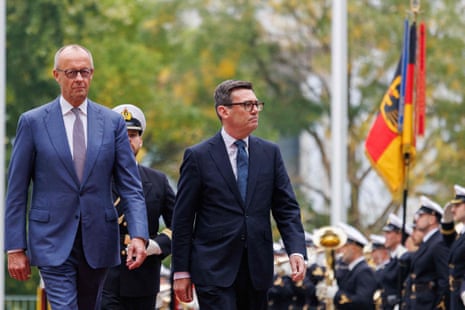
German chancellor Friedrich Merz marches with prime minister of the United Kingdom, Andy Burnham as the honour guard performs military honours at the Federal Chancellery following his arrival in Berlin, Germany. Photograph: Carsten Koall/DPA/AP
Annoyingly, it’ll be just statements, with no questions from the press.
You can watch along below, and I will bring you the key lines here:
Merz and Burnham deliver joint remarks after Berlin meeting – watch live
Rubio gets pushed on allegations of misconduct by US ambassador to Greece
Helena Smith
in Athens
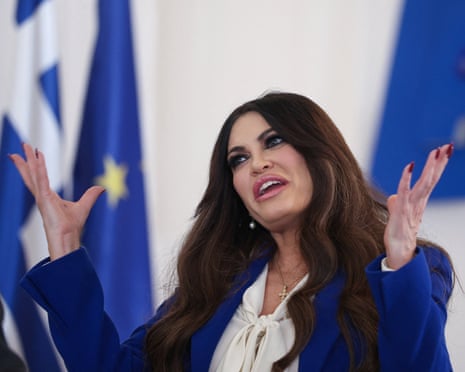
Over in Athens, Marco Rubio, the US secretary of state, has been forced, yet again, to address allegations of misconduct by Kimberly Guilfoyle, America’s ambassador to Greece.
US secretary of state Marco Rubio flanked by US ambassador to Greece Kimberly Guilfoyle arrives to board a plane at Eleftherios Venizelos International Airport near Athens. Photograph: Mark Schiefelbein/AFP/Getty Images
For the second time in the space of 12 days the Wall Street Journal had run a report detailing misconduct by Guilfoyle – the former fiance of the US president’s oldest son Donald Trump Jr.
The report was published late Wednesday as Rubio was holding talks with Greek premier Kyriakos Mitsotakis.
It alleged the former Fox News channel host had asked Eric Deters, a Republican donor and supporter of president Trump, to pay off a $100,000 American Express credit card bill ahead of her confirmation hearing on 9 July 2025. In exchange, Guilfoyle reportedly promised direct access to the White House and high profile officials in the Trump administration.
Kimberly Guilfoyle, US ambassador to Greece, speaks during US secretary of state Marco Rubio's visit at the prime minister's office in Athens, Greece. Photograph: Louisa Gouliamaki/Reuters
Early Thursday as he was about to board a plane for Portugal – the last stop in his three-day tour of Europe – Rubio was asked to comment.
Acknowledging he was aware of the report – and as Guilfoyle looked on – he told reporters:
“You guys walk around thinking that because some source told you something and you reported it, it’s the gospel. It’s not the gospel. It’s not the gospel for me. That’s not the way we do things.”
It was not the first time the foreign policy chief has been forced to address reports of misconduct swirling around Guilfoyle – or alluded to fake news in debunking them.
On Wednesday, at a press conference with Greece’s foreign minister, he was asked if he remained confident in the envoy amid mounting congressional scrutiny of Guilfoyle’s tenure following earlier allegations detailed by Journal.
Visibly irritated, Rubio shot back saying: “This is not the forum to address this, as simple as that. Suffice it to say, our embassy here is doing a great job. Our ambassador here has been a strong ambassador here.”
Late last month the Wall Street Journal ran a report accusing the high-profile ambassador of improper behaviour around the sale of US natural gas exports to the region via Greece.
The paper reported an incident in which Guilfoyle was also said to have boasted about America’s ability to undermine governments, including the Greek government, if they didn’t comply with US wishes.
Germany's Merz hosts UK's Burnham for talks in Berlin
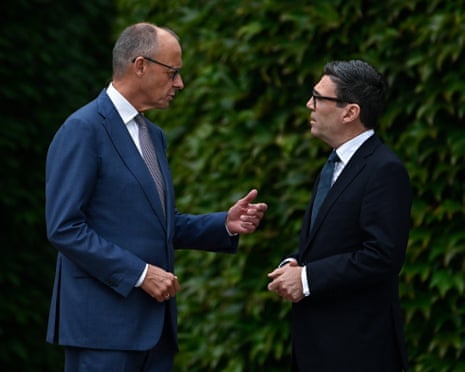
Meanwhile, UK’s prime minister Andy Burnham has now arrived in Berlin, and is taking part in a formal welcome with German chancellor Friedrich Merz.
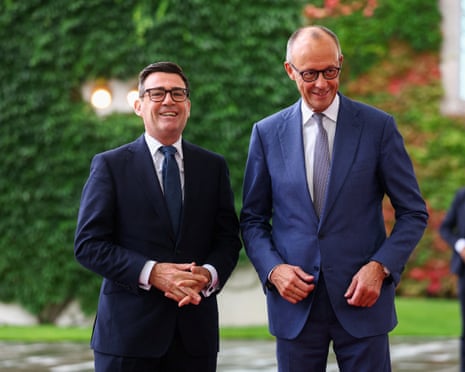
German chancellor Friedrich Merz welcomes British prime minister Andy Burnham with military honours at the Chancellery in Berlin, Germany. Photograph: Lisi Niesner/Reuters
Some parts of the German media claim it as Burnham’s first stand-alone overseas visit, arguing that both his trips to Ukraine and the UN were part of a broader group. Not sure that really works, but either way his early trip to Berlin shows the importance he attaches to this relationship.
Curiously, there will be no press conference – Politico reported that it was a decision made upon the UK’s request – but the two leaders will deliver some press statements.
German chancellor Friedrich Merz greets British prime minister Andy Burnham as he arrives at the Chancellery in Berlin. Photograph: Tobias Schwarz/AFP/Getty Images
I will bring you the key lines when they step up to the microphones.
French high school protests spill over to Belgium with concerns about violence
The French protests are also spilling over the border to Belgium, particularly Brussels and Liège, Reuters and broadcaster RTBF reported.
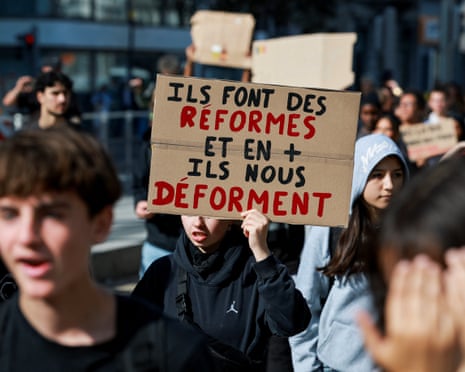
In Liege, local media have reported more than 200 arrests in connection with student protests this month, and authorities have imposed a ban on public gatherings of more than three people until 16 October, Reuters reported.
Protestors hold placards during a protest against education reforms by the Wallonia-Brussels Federation government and an increase in student fees in Liège, Belgium. Photograph: Nicolas Tucat/AFP/Getty ImagesA person holds a placard reading: "They make reforms, and on top of that, they deform us.", as high school students take part in a spontaneous street protest in Liège, Belgium. Photograph: Stéphanie Lecocq/Reuters
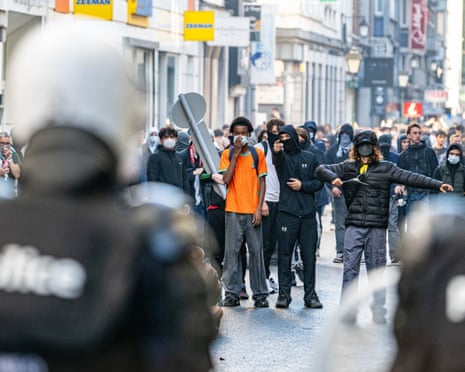
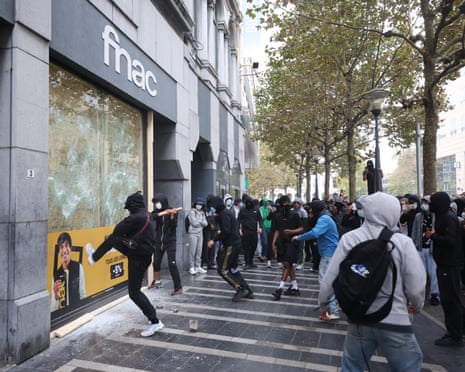
But Belgium’s foreign minister, Bernard Quintin, said hard-left activists had infiltrated the Liège school protests and were causing damage to property.
Youths confront riot police as students gather outside several schools in Liège during a protest against education reforms and budget cuts. Photograph: Jonas Roosens/Belga/ShutterstockDemonstrators smash a shop window as protesters clash with riot police during a high school students' demonstration against education spending cuts in Liège, Belgium. Photograph: Olivier Hoslet/EPAPeople attempt to put an electric scooter into a burning structure on a street in Liège, Belgium. Photograph: Stéphanie Lecocq/Reuters
Julien Doeche, a member of the Liège Antifascist Front, told RTBF Quintin’s claims were “fantasies“.
30 people killed after Russian strike on public transport in eastern Ukraine
Meanwhile, we are getting sad news from Ukraine, where at least 30 people were killed in a Russian attack in the proximity of a bus stop in the city of Kramatorsk in eastern Ukraine.
At least 18 people were also injured.
Responding to the strike, the region’s governor Vadym Filashkin suspended the operation of public transport, warning it was “an attractive target” for Russia given “a single strike can kill the highest number of people.”
“Russia consciously disregards all conceivable rules of warfare and norms of international humanitarian law. It selects targets where it can inflict the greatest suffering on civilians,” he warned.
“Under these circumstances, we have no right to risk the lives of passengers and drivers. The safety of the residents of Kramatorsk and Sloviansk is paramount,” he added.
Ukraine’s president Volodymyr Zelenskyy said earlier that the strike targeted “an ordinary public transport stop.”
More high school protests take place across France - in pictures
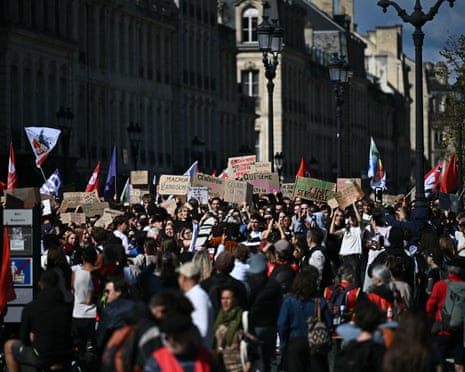
Back to France,let me bring you more pictures from this morning’s high school protests, which are taking place not just in Paris, but also in other cities, including Nantes and Bordeaux.
French high school and university students attend a demonstration in Nantes. Photograph: Stéphane Mahé/ReutersStudents protesters hold placards as they gather for a blockade at the IUT Bordeaux Montaigne university institute of technology in Bordeaux. Photograph: Philippe Lopez/AFP/Getty ImagesHigh school students gathered in Bron for a demonstration, as part of student mobilisation taking place today. Photograph: PITTORE/NEIRDAPROD/SIPA/ShutterstockA protester reading a book reacts as tear gas sprayed by police is seen in the background during a blockade action part of a demonstration of high-school students near Helene Boucher high school in Paris. Photograph: Simon Wohlfahrt/AFP/Getty Images
One dead, two injured in another knife attack at Polish school
We are getting reports of another knife attack at a school in Poland.
The incident took place in Leszczydół-Nowiny, east-central Poland, leaving one person dead and two injured. A 15-year-old boy was apprehended at the scene.
It comes just a day after a 17-year-old boy injured nine people in a separate school stabbing attack (Europe Live, yesterday). An improvised explosive device was discovered in his backpack.
Elsewhere in the country, another 17-year-old has been detained on suspicion of planning a similar knife attack.
In response to the wave of incidents, Polish police said they will step up spot checks near schools to scan for knives and identify suspicious behaviour.
EU drops sponsorship of disinformation conference at Trump officials’ request
Aisha Down in London, Joseph Gedeonin Washington andJennifer Rankinin Brussels
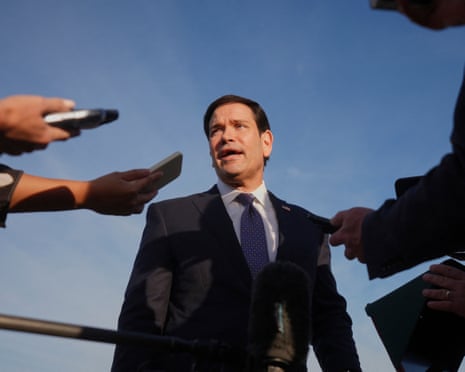
In other news, the Trump administration pressured multiple countries to withdraw their sponsorship of a leading European conference on disinformation, with Canada, Lithuania and the EU’s diplomatic service subsequently agreeing to do so, the Guardian understands.
US secretary of state Marco Rubio speaks to the press in Athens Photograph: Mark Schiefelbein/AFP/Getty Images
The conference, #Disinfo2026, taking place Wednesday and Thursday, is the annual meetup of Europe’s counter-disinformation community and has drawn hundreds of researchers, journalists, technologists and policymakers to a hotel in Vilnius, Lithuania. It is run by an independent Brussels non-profit, EU Disinfo Lab.
Days before the conference, the logos of its main supporters – the Lithuanian ministry of foreign affairs, the European External Action Service (EEAS) and Global Affairs Canada, the country’s foreign ministry – were wiped off its website.
Photos of the event shared with the Guardian also show white stickers affixed over the logos of these organisations printed on official conference materials, appearing to indicate they were struck from the program in haste.
Three persons familiar with the matter, including European officials, confirmed that the US state department had been in touch with multiple governments over their support for the conference.
Internal state department documents seen by the Guardian also show US officials thanking Lithuania for “taking US concerns seriously”. The document says Washington was “grateful” Lithuania supposedly found a panel framing the US as a foreign information threat “reprehensible and surprising” and welcomed its decision to limit involvement in the conference.
French high school protests this morning - in pictures
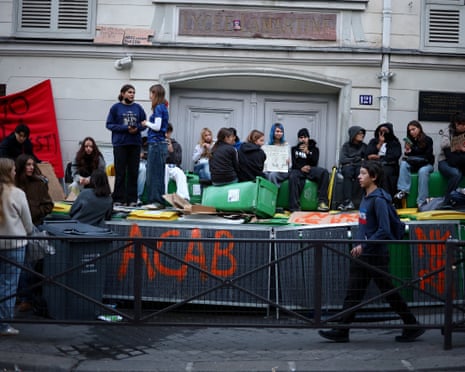
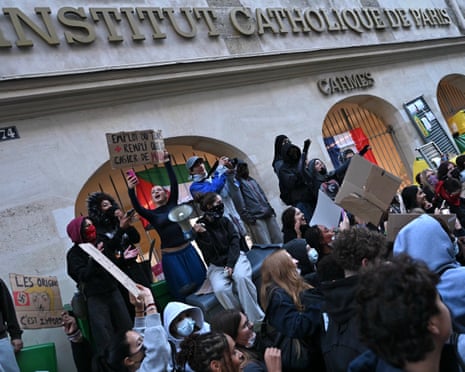
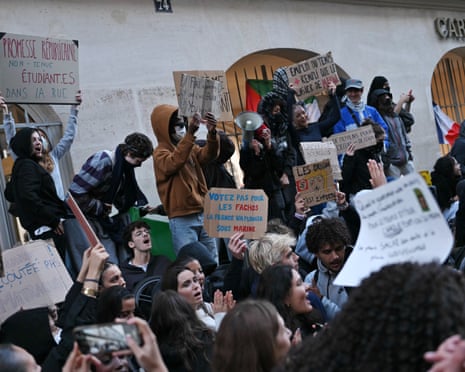
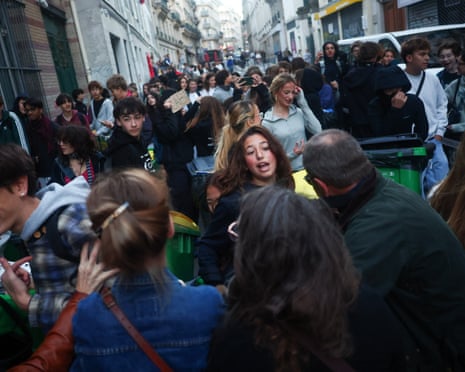
A protester uses a megaphone next to French CRS riot police outside Lycee Helene-Boucher high school, during nationwide protests in Paris, France. Photograph: Pedro Nunes/ReutersFrench high school students sit on barricades outside the Lycee Lamartine high school in Paris. Photograph: Pedro Nunes/ReutersA protester confronts riot police officers outside Lycee Helene-Boucher high school as students block the road, during nationwide protests in Paris, France. Photograph: Pedro Nunes/ReutersStudents demonstrate outside the Carmes campus of the Institut Catholique de Paris (ICP), in Paris, France. Photograph: Firas Altoukhi/EPA
French education minister to hold talks with high school students later today
French education minister Édouard Geffray has invited the three leading high school students associations for further talks at the ministry later this afternoon.
This comes as a recent opinion poll showed that the French public broadly supports the protest – with three-thirds agreeing with the students’ demands, and 55% backing the demonstrations – but is divided on whether they should continue (Europe Live, yesterday).
Students hold placards as they demonstrate outside the Carmes campus of the Institut Catholique de Paris (ICP), in Paris, France. Photograph: Firas Altoukhi/EPA
Morning opening: French high school protests continue despite PM's promise of action
Jakub Krupa
High school protests across France show no sign of slowing down, with nearly 400 educational establishments facing disruptions this morning.
A French high school student confronts people who want to prevent her from building a barricade, outside the Lycee Lamartine high school in Paris. Photograph: Pedro Nunes/Reuters
Demonstrators have rejected a promise by prime minister Sébastien Lecornu to present a plan to fix the country’s education system by the end of the month, demanding he fully engages with their demands sooner than that.
In a televised address last night, Lecornu said the country could not be “indifferent” to their concerns, and acknowledged that their anger “does not come from nowhere,” but did not make any immediate headline-grabbing announcements.
France's prime minister Sébastien Lecornu makes a statement regarding the situation in high schools, fuel prices, the agricultural crisis, and the France's financial situation in Paris. Photograph: Dimitar Dilkoff/AFP/Getty Images
“We want real action, and until we get it, we’ll keep mobilising,” a high school student named Marilou in Fontainebleau told AFP.
I will keep an eye on today’s events in France as they unfold.
Over in Spain, I will look at reactions after last night’s death of María del Carmen Abascal, the 87-year-old whose eviction set off a nationwide wave of protests against Spain’s housing crisis.
Elsewhere, Britain’s prime minister Andy Burnham will meet with Germany’s Friedrich Merz in Berlin for political talks. Unusually, however, the pair will not hold a joint press conference.
Lots to cover.
It’s Thursday, 8 October 2026, it’s Jakub Krupa here, and this is Europe Live.
Andrew Garfield plays OpenAI CEO Sam Altman in "Artificial," which hits theaters on Christmas Day.
Michael Loccisano/Getty Images for FLC
Portraying OpenAI CEO Sam Altman in the upcoming film "Artificial" didn't make Andrew Garfield an AI enthusiast.
… %!s()
In fact, Garfield said it had the opposite effect during an interview with Variety published on Tuesday.
"I got a bit scared. I felt a little mistrusting of the technology," Garfield said. "It feels like the people who are creating and kind of encouraging us to use the technology don't exactly know its capacity themselves. So, that feels a little irresponsible to me, personally."
Garfield said he's used ChatGPT for research or as a "kind of fancy Google," but doesn't need to rely on AI for his career.
"Luckily, I don't need it in my life in the same way other people in other industries might as an actor," Garfield said.
Directed by Luca Guadagnino, "Artificial" details the turbulent period when Altman was temporarily ousted from OpenAI in 2023. The film will be a who's who of Silicon Valley, with Yura Borisov as Ilya Sutskever, Monica Barbaro as Mira Murati, Ike Barinholtz as Elon Musk, and Cooper Hoffman as Greg Brockman. The film hits select theaters on Christmas Day.
In interviews, Altman has said he has some reservations about the film.
"I'm sure it won't be accurate, but I hope it's funny and enjoyable to watch," he told Politico's Decoded this week.
Altman told Vanity Fair he had seen the film's trailer and that Garfield had mastered some of his mannerisms.
"They filmed outside of our house. There were these notices on our street that there was going to be some filming or whatever. I didn't realize what was going on. I paid no attention," he said. "And then one morning I was walking down the street to get coffee, and there were all these cameras, and there was a guy dressed exactly like me with my same backpack walking so much that I felt I was in some weird glitch of the simulation or something."
He called the moment "very strange."
"Then I immediately figured out what was happening. We waved and went on, but it was really weird. I mean, it's like a strange thing to see someone that has nailed your kind of quirky mannerisms or whatever," Altman said.
Read next
Lauren Edmonds
You're currently following this author!
Click to unsubscribe from email alerts.