Leaseholders will be given extra protections from "cowboy" property agents and hidden fees, Angela Rayner has announced.
The housing secretary told Labour's annual conference the government would legislate for a new independent regulator and launch a consultation to cap "rip off" administrative fees.
… %!s()
The changes would cover the estimated five million leaseholders in England and Wales who can be forced to pay a landlord for simple changes to their home, despite having bought it.
Rayner told party activists she had heard of leaseholders being charged £250 for permission to own a pet and £400 to change their front door.
She said people in these situations were "powerless against the vested interests that only take, while giving nothing back in return".
The government is already legislating, external to ban new leasehold flats, described in Labour's 2024 election manifesto as a "feudal" system where people own the right to occupy a property via a lease for a limited number of years from a freeholder, or landlord, who owns the land.
Through the Commonhold and Leasehold Reform Bill, ministers want a commonhold system where residents collectively own and manage their buildings.
Now, Rayner is taking aim at the web of management companies that operate between leaseholders and their effective landlords.
She said the sector had many decent businesses which were "undermined by far too many cowboys, crooks and con artists".
People excited at buying their own homes are "tricked" into using in-house services, meaning that "with no transparency or accountability, vultures can take advantage", Rayner added.
"We will legislate for an independent regulation to rein these cowboys in," she said, announcing legislation for an independent watchdog of property agents.
This includes estate agents, managing agents and estate managers.
This regulator would be able to set codes of practice, such as standards of conduct and proper complaint handling for those they regulate, and property agents will be required to obtain a licence.
If they fall foul of the required standards, the regulator would have the power to take their licenses away, the government added.
The government said it wanted to bring forward the changes "as soon as possible".
Rayner also said new legislation would create the power for caps on permission and administration fees leaseholders pay to landlords.
These caps would cover freehold estates and privately managed estates where people can face additional fees for making cosmetic changes to their properties and requesting documents like building safety certificates.
A public consultation will be launched to help decide the rate of caps.
It comes in addition to an already-announced £250 cap on yearly ground rents paid by leaseholders in England and Wales, which had stalled during the change of prime minister over the summer.
The government has said it expects the limit on ground rents - an annual fee paid by leaseholders to their freeholder - to come into force in late 2028, but MPs have called for this to be brought forward to late 2027.
Rayner said she was "capping and then scrapping" ground rents, indicating she may try to go further than a cap.
In her speech, Rayner did not mention the government's housing target of building 1.5m homes in England by the next election. She admitted earlier this month there was only a "slim chance" of hitting it.
Last week, ministers announced a new Your First Home policy to help first-time homebuyers in England with a deposit of 2.5%, similar to the Help To Buy scheme introduced under the Conservatives in 2013.
Rayner also said she plans to strengthen council powers to take over empty homes to meet the need for council houses and tackle homelessness.
But this was criticised by the Tories as a "desperate" attempt by Labour to try to hit its housing target. %!s()
The MLB postseason is here — use these streaming services to watch every game online
If you purchase an independently reviewed product or service through a link on our website, Rolling Stone may receive an affiliate commission.
… %!s()
The 2026 MLB postseason has arrived.
This year’s playoffs will kick off with the Wild Card Series on Sept. 29. In the American League, the Boston Red Sox will face the New York Yankees, and the Chicago White Sox will face the Houston Astros. In the National League Wild Card, it’s the Chicago Cubs vs. the San Diego Padres and the Philadelphia Phillies vs. the Atlanta Braves. Teams that have already secured a spot in the Division Series are the reigning champion Los Angeles Dodgers, the Milwaukee Brewers, the Cleveland Guardians, and the Tampa Bay Rays.
TV coverage of postseason baseball will be handled by TBS, FOX, FS1, and, for the first time since the 2000 ALCS, NBC. Don’t have a cable subscription? Read on to find out where you can livestream MLB playoff games online — including ways to watch postseason games for free.
Where to Stream 2026 MLB Playoffs Online
If you don’t have a cable subscription, the best way to watch the MLB playoffs online is with a live TV streaming service. Four of the best options are DirecTV, YouTube TV, and Sling. Here’s how to watch the MLB playoffs using each of these services:
editor’s Pick
DirecTV
DirecTV carries TBS, FOX, FS1, and NBC in a few of its streaming plans, and all subscriptions start with a five-day free trial that you can use to stream MLB playoff games for free. Packages that carry all four playoff channels include the MySports Genre Pack and all of DirecTV’s larger Streaming Packages. These plans start at $64.99 a month, but you’ll also get a discount on your first few months (in addition to the free trial).
Free Trial
YouTube TV
Another one of the best services for MLB livestreams is YouTube TV. The streamer carries TBS, FOX, FS1, and NBC in both of its packages. These start at $71.99 a month, but you get a free trial and a discount on your first three to six months, depending on which plan you choose.
Most affordable
Sling
The most affordable way to watch every MLB playoff game online is Sling. This budget-friendly streamer carries TBS, FOX, FS1, and NBC in its Blue and Orange + Blue packages. These start at just $45.99 a month, although you don’t get a free trial.
2026 MLB Playoffs Odds, Top Seeds
This year’s top seeds in the MLB postseason are the Brewers and the Rays. The Dodgers and the Guardians are the No. 2 seeds.
Although they didn’t nab the No. 1 seed, the Dodgers are the favorite to pick up another World Series title with +200 championship odds. If they can pull it off, LA would join the Yankees and the Oakland A’s as the third MLB franchise to win three or more titles in a row.
Sitting in second place on Vegas’s books is the Brewers with +600 odds, followed by the Rays at +800 and the Yankees at +850. %!s()
The 2026 International Documentary Film Festival Amsterdam (IDFA), which takes place Nov. 12-22, has added more than 100 films to its program, including in its IDFA Competition for Short Documentary.
… %!s()
The Dutch doc fest has also added to its Best of Fests, Signed and Paradocs programs, while unveiling first projects for its new media program DocLab.
The IDFA Competition for Short Documentary “celebrates the versatility of the form, with 15 films that use creativity and imagination to push the boundaries of short documentary,” organizers said on Tuesday. “Together, they form a mosaic of styles, themes, and perspectives, driven by ambitious directors with singular cinematic voices and strong artistic visions.”
Among the titles are a tragicomic portrait of humanity and its fallibility, The Bus of Broken Hearts by Björn Carlberg and Johan Palmgren, which follows the world’s biggest cross-country ski race, where thousands of disheartened participants fail to make it to the finish line. Several titles turn their attention to the act of looking itself, including Perihan Incegöz’s Our Village From the Moon, set in the aftermath of an earthquake in southern Turkey, and PICNIC – In Light Invisible to the Human Eye by Jan Ijäs, which “follows Israeli tourists who travel to the border of Gaza to make a spectacle of the devastation of the Palestinian people.”
‘Our Village From the Moon,’ courtesy of IDFA
IDFA DocLab, in its 20th anniversary edition, will feature two films that the Netherlands Film Fund and IDFA DocLab have selected for the 2026 Film Fund DocLab Interactive Grant: The Love Files by Sanne De Wilde and Samir Veen, which invites audiences to step inside and critically review a “love file” application for a residence permit, and All the Downtime by Ant Hampton, immersing audiences in an algorithm-led distribution center, just as a power outage disrupts the order and gives way for creative disorder.
Also set for the IDFA DocLab and Tamara Shogaolu’s The Invisible Woman, a VR opera that recovers the story of Francisca de Angola, a 17th-century Black woman in Amsterdam, and Polymorf’s Microbiome Restaurant, with two sensory experiences exploring the human body as an ecosystem. Other projects include Orgasmagoria and Archive Arcade.
Signed “showcases the latest cinematic adventures of some of the most original filmmakers of our time,” and its selection of films “celebrates those with a unique artistic signature, beyond the canon,” IDFA highlighted. “The selection reflects on lives lost, those left behind, and what remains after upheaval.”
Among this year’s Signed films are Michal Marczak’s Closure, following a father in search of his missing son along the Vistula River near Warsaw, Ava DuVernay’s 14th, tracing the legacy of the U.S. Constitution’s 14th Amendment, Guillaume Massart’s Detention, about a French prison officers’ training school, and They’re Here by Laura Poitras and Rachel Lauren Mueller, an account of the show of force by US Immigration and Customs Enforcement (ICE) in Minneapolis.
And in Wild Asparagus, Avi Mograbi returns to his archives of a visit to Palestinian village Saffuriya with his friend Ali Al-Azhari, giving new meaning to decades-old footage.
Meanwhile, IDFA’s Best of Fests section will present 59 titles spanning diverse styles and genres and engaging with some of the world’s most pressing topics. Among them are Pegah Ahangarani’s Rehearsals for a Revolution, Ahmed Hassouna’s Citizen Osama, Lukas Marxt’s >1.5°C: Pyropolitics and the New World, The Illusion of an Everlasting Summer by Alessandra Sanguinetti, and Concrete Land by Asmahan Bkerat.
Paradocs, in which visual artists and filmmakers present their explorations in non-fiction filmmaking, will this year feature 16 titles exploring the world “through bold formal experimentation, genre-bending, and unexpected perspectives,” Amsterdam organizers said. “A hedonistic escape to a melting glacier is interrupted by apocalyptic climate change and existential anxiety in Susanne Regina Meures’s Eternity – adapting Florentina Holzinger’s performance art to the screen. In The Case Against Space, Graeme Arnfield offers a reconstruction of the first ‘strike’ in space, reframing the astronaut hero through a critical lens on capitalism and surveillance.”
Also, Johann Lurf’s Forever…Forever presents a vision of the cosmos in motion, with an ever-accelerating timelapse of the sun’s path filmed over 22 months. Plus, Ãsheghetam by Filmsaaz blends computer animation, fiction, and documentary in a kaleidoscopic portrait of queer love in Tehran, while in Together, ecofeminist art collective Neozoon uses archival and social media footage to explore the tension between communal life and the desire for private property.
Check out all the titles selected for the IDFA Competition for Short Documentary and Signed below.
IDFA Competition for Short Documentary all that appears solid is built on blood, dir. Izdihar Afyouni, Gelare Khoshgozaran, (Palestine/United Kingdom/United States), 11’ – International Premiere
All the Hands I’ve Let Go, Laura Chará (Colombia/France), 23’ – International Premiere
Another Sky, Evi Cats (Belgium), 15’ – World Premiere
The Bus of Broken Hearts, Björn Carlberg, Johan Palmgren (Sweden/Finland), 34’ – International Premiere
Canina, Néstor López (Spain), 17’ – World Premiere
Certainties, Calum Walter (United States), 14’ – International Premiere
Eye Sun, Maricé Castañeda (Peru), 19’ – World Premiere
From a Vertebral Collapse Mountains Arose, Giovanni Benini (Italy/Belgium), 11’ – World Premiere
Man of Seed, María Abenia (Spain), 33’ – World Premiere
One Early Morning, the Alligator Swallowed Me, Nicolás Palacio (Colombia), 16’ – World Premiere
Our Village From the Moon, Perihan Incegöz (Switzerland/Turkey), 14’ – World Premiere
PICNIC – In Light Invisible to the Human Eye, Jan Ijäs (Finland), 26’ – International Premiere
Six Weeks, 3 Days, and All the Years Before, Ankita Gusain (India), 15’ – World Premiere
Spectators, Stanislavs Tokalovs, Betija Zvejniece (Latvia), 18’ – World Premiere
The Unabsorbed Past, yietnu (Yi Zhang, Nu Ha) (France/China), 26’ – World Premiere
Signed
14th, Ava DuVernay (United States) – Dutch Premiere
A single extender might fix a dead zone, but can't compete with better network tech.
New Africa/Shutterstock
… %!s()
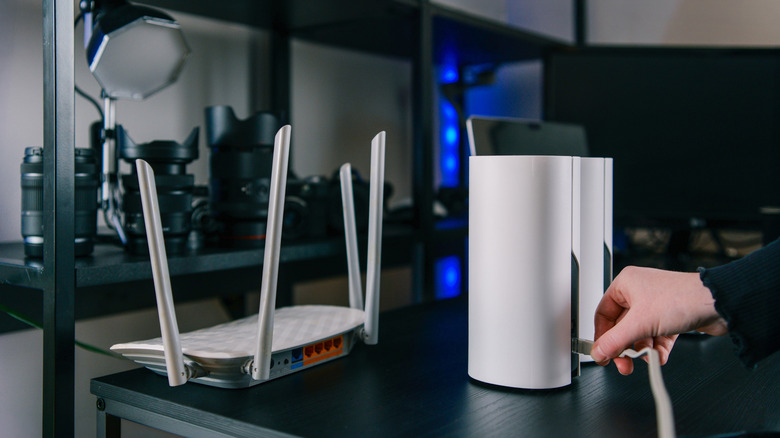
A Wi-Fi extender is generally the cheapest fix for rooms that can't pick up a strong Wi-Fi connection from your router. They're common and easy to set up, but the catch is that an extender can't magically create a strong signal out of a weak one. Thus, deciding where to put one is a game of compromise, with the sweet spot usually being halfway between the router and the low-signal area you want to fix. Unfortunately, it's not easy to find that "best compromise" in every home, so most people take what they can get.
Even the best Wi-Fi range extenders trade speed for distance. Many basic extenders use the same band for receiving and transmitting, which cuts its speed by up to half (because the extender can't receive data from the router at the same time it sends a device that information). Models with separate bands can work in both ways at the same time, but still struggle to deliver speeds close to the router itself. Throughput can plummet before it even has to deal with walls or interference that will further weaken the link.
Most extenders (not all) are poor substitutes for better tech, and it's difficult to achieve seamless, whole-home coverage with them. For a single small room that's relatively close to the router, an extender gets a solid "maybe". If we're talking about several rooms or a backyard office, an extender may not cut it.
A router, mesh or Ethernet
Before you buy anything, check your existing router first. Many newer routers (not the lousy one your ISP provides by default) are much more capable than you might realize. Make sure it's as close to the center of the home as possible, and not sitting inside a cabinet or anything else that blocks signals. If you have an old router, an upgrade will likely do more than an extender. But if it's relatively new and your home is not especially large, a capable standalone router can make the cut if you're smart with placement. Even the way you set the router antennas can have an effect.
Now, if you're dealing with thick walls and concrete, or you have an exterior office with no Wi-Fi, a good mesh Wi-Fi system can take care of broader coverage. A basic mesh setup uses a strategically placed router with a few "satellite nodes" installed throughout the home. While this sounds like extenders, it's not the same.
A mesh network is designed to work together under a single network name (SSID), so your devices automatically connect to the strongest node as you move around the house. In contrast, with a Wi-Fi extender, using the same SSID often results in your devices bouncing back and forth between connecting to the router and extender. Giving the extender a distinct name isn't always a solution though, since that requires you to switch connections manually as you move around.
Mesh isn't a magical solution, however. The nodes still require a good link to each other, and wireless backhaul can reduce speeds. Cheaper mesh systems often have the same "half-throughput" problem as extenders, where the same wireless band is used to both send and receive information. A tri-band system improves this, with a separate band used only for backhaul.
Otherwise, running Ethernet between satellite nodes (where it's aesthetically and practically doable) is a common method for boosting network capacity and speed. If possible, an outdoor office should definitely run Ethernet, or at least have nodes set up in line-of-sight via windows.
Where should you not place an extender?
shine.graphics/Shutterstock
The worst place to stick a Wi-Fi extender is in a dead zone. An extender can't repeat something it's not receiving in the first place, so it needs a good signal from the router it can pass along. If an extender is receiving 40 percent signal strength from your router, a 100 percent connection to that repeater is still pretty weak.
Extenders are generally pretty small, so they have an advantage in placement flexibility. Unfortunately, Wi-Fi's kryptonite is basically everything except clean, open air. Never place extenders behind TVs, cabinets or mirrors — and especially not metal objects or surfaces.
If at all possible, line of sight with the router is best. For example, if the router is in the living room and the hallway is visible from the router, place the extender in a hallway outlet so it can better cover some of the adjacent rooms, especially those directly across. If the only option is a socket behind the fridge or on the other side of a thick wall, you may as well not bother.
If you need to improve signal in a single room and you have a good place to plug it in, an extender can do the job. The problem is that all the factors working against extenders limit their usability. Some extenders can be switched to access point mode if you can run Ethernet to them, but that's usually not the ideal scenario. %!s()
US journalist Evan Gershkovich has said that he knew he was being set up by Russia when he was arrested by FSB agents and accused of being a spy.
In an interview with Radio 4's Today programme, Gershkovich spoke about the moment he realised he had been "lured into a trap" when masked men surrounded him at a restaurant in 2023, and detained him.
… %!s()
"I'm not interrogated, I'm not tortured… I'm accused of espionage," he said, describing a sense of relief: "They've set me up and fabricated this case so that I can be a valuable hostage - a pawn in a greater game".
Gershkovich, now 34, was sentenced to 16 years in prison, but freed 16 months later as part of a high-profile prisoner swap deal.
Gershkovich had been living in Russia since 2017, and was the Wall Street Journal's foreign correspondent in Moscow when he was arrested - he is now based in Berlin, Germany. He and his employer have always maintained that the charges were false.
On the day he was arrested, Gershkovich was in Yekaterinburg - about 1,600km (1,000 miles) east of Moscow - meeting someone who he thought was a source for a story.
They were sitting in a half-empty dining hall "and a group of about half-dozen masked men marched in and said 'I think we booked that table'." An odd phrase, Gershkovich said, but on reflection it is clever because it "freezes you in place".
The two men stood up and Gershkovich was told he was under arrest by the notorious and powerful FSB, Russia's domestic security service.
"It's at that moment that you realise it's something really serious… When it's the FSB, you know it's been planned."
What about the man he'd been meeting? Gershkovich saw him disappear into the crowd.
Not long after his arrest, the journalist said he realised that the fact he was not being interrogated or tortured - common tactics used by Russia's security service on spies - likely meant that he was being treated more like a commodity, not a true enemy of the state.
"I have this odd moment - a sense of relief flooding over me," he said. "I realised they're not treating me like a real spy. They've set me up and fabricated this case so that I can be a valuable hostage, a pawn in a greater game. That means it will take a while, but I won't be here for 12-20 years."
That realisation helped him stay "stable and disciplined in prison", but also gave him a unique way of predicting what might happen next - and one guess was a prisoner swap.
"I assumed that it would be really loud, that it would cause a global uproar. I mean, it's a foreign correspondent for the Wall Street Journal," he said - and he was right.
Media organisations around the world reported on the case, his face was on a billboard in Times Square and then-US President Joe Biden said he had "no higher priority" than bringing Gershkovich home.
The journalist believed that this was all part of Moscow's plan - to have a high-profile prisoner that it could swap for one of its own - and that was Vadim Krasikov, an assassin who was serving a life sentence in Germany.
"They [Moscow] got away with it in the sense that there were no sanctions imposed. And so they played it really smart, if you think about it cynically."
Gershkovich was held in Moscow's infamous Lefortovo jail, which has held some of the country's most high-profile inmates over the years, including political prisoners and dissidents. During the Great Terror of Joseph Stalin in the 1930s, torture and execution were commonplace.
He described it as a "really isolating experience", in a tiny space.
"That wears on you psychologically," Gershkovich said, but added that he was treated ok: "I was allowed to sleep, the food was fine."
Pictures of Gershkovich smiling at cameras during his court appearances in Moscow were broadcast around the world - and that was deliberate, he said - a way of showing that he was alright.
"I wanted to show people this kind of defiance... We know that this is a fabricated case, and so if this is a game of theatre, let's not let [Moscow] have it play out the way they want it to."
But he stressed that not everyone's time in a Russian prison is like his: "Some people... get tortured. They get broken as human beings, deprived of food, of hot water for showers, told that they're never going to see their families again. I was treated completely differently."
Gershkovich compared his experience to the case of Ukrainian journalist Viktoriia Roshchyna, who died while in Russian captivity in 2024, aged 27. Months later, when her body was finally returned, it reportedly showed signs of torture and her organs had been removed.
Gershkovich knew there was a prisoner swap planned three weeks before it happened - an "excruciating" time, he said, "because now every day is painfully long".
When it finally did happen, on 1 August 2024, it was a moment of "pure joy". But then "the joy fades, the adrenaline subsides, and you're faced with the reality of having to return to normal life again."
Gershkovich said this period was difficult and sometimes overwhelming. He wasn't sleeping, suffered panic attacks in large crowds and had a short temper because he was trying to hold in his emotions.
He has seen therapists who specialise in post-traumatic stress disorder (PTSD), and said writing a book on his ordeal also helped.
And what about a return to Russia? Gershkovich has a deep history with the country - his parents moved to the US from the Soviet Union in the 1970s. He grew up in a Russian-speaking home, with a Russian name, moved there when he was 25 and made many friends, including his Russian girlfriend.
"I would hope to get back one day, but I guess we'll have to see what comes after [Russian President Vladimir] Putin. And it's not completely clear that the next government will be any better." %!s()