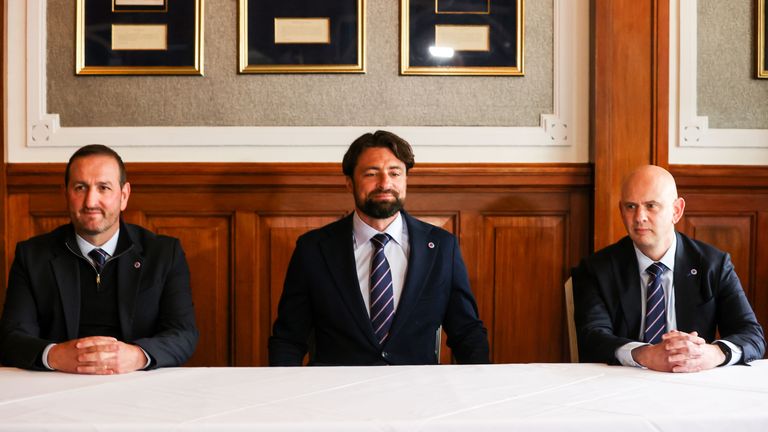
The Tallinn Black Nights Film Festival (PÖFF) on Wednesday unveiled a five-member jury for its 30th edition’s official competition. Two-time Oscar-winning screenwriter and director Christopher Hampton will lead the jury, joined by Lebanese producer Myriam Sassine, U.S. cinematographer and visual effects specialist David Stump, French producer Julie Billy and Estonian actress Tiina Tauraite.
… %!s()
Hampton won Academy Awards for best adapted screenplay for Dangerous Liaisons and The Father. His other film credits include Atonement, The Quiet American and A Dangerous Method, while his work for the stage includes Les Liaisons Dangereuses and Sunset Boulevard. He has also written and directed three feature films: Carrington, The Secret Agent and Imagining Argentina.
Sassine’s credits include Costa Brava, Lebanon, 1982, Dancing on the Edge of a Volcano and Diaries From Lebanon. In 2016, she co-founded the Maskoon Fantastic Film Festival, dedicated to genre cinema in the Arab region.
Stump is known for his work on Breaking Bad, The Morning Show, Quantum of Solace and the first two X-Men films. His honors include an Emmy Award and an Academy Award for Scientific and Technical Achievement.
Billy is a Paris-based producer who founded June Films in 2020 after working with such filmmakers as Jonas Carpignano, Nadav Lapid and Yorgos Lanthimos. Her recent productions include Hafsia Herzi’s The Little Sister, which premiered in competition at Cannes in 2025 and won the Queer Palm and best actress award, and Emma Benestan’s Animale.
Tauraite has appeared in such films as Autumn Ball, The Temptation of St. Tony, The Spy and the Poet and 8 Views of Lake Biwa.
The 30th edition of the Tallinn Black Nights Film Festival will take place Nov. 6-22. It will open with Viesturs Kairišs’ Ulya, a co-production between Latvia, Estonia, Poland and Lithuania that world-premiered in the Un Certain Regard program of the Cannes Film Festival earlier this year.
THR Newsletters
Sign up for THR news straight to your inbox every day
We have passed the 100-day landmark in the Derek McInnes era at Rangers, and it has certainly been a rollercoaster ride.
His first four games were winless, followed by that humiliating European exit to Jablonec.
… %!s()
However, when Rangers return from the international break, they will have their sights set on going top of the Scottish Premiership for the first time this season.
That's down to a new-look squad and six consecutive wins, including back-to-back Old Firm victories. There is a feel-good factor in the stands at Ibrox once again.
Here, we look at how a key summer transfer window helped pave the way for a remarkable turnaround - one McInnes knows he must keep on track against Kilmarnock on October 10.
Please use Chrome browser for a more accessible video player
Highlights as Rangers made it back-to-back wins over Celtic within a week as they won at Parkhead
Scottish Premiership fixtures | Table | Live on Sky Sports
Got Sky? Watch Scottish Premiership games on your phone
Before we get into the fine detail, it's important to take a look at the bigger picture.
This was the second consecutive summer that Rangers signed 14 players. However, the two windows couldn't be more different.
For full context, you need to go back 12 months. It was a new era (yes, another one) at Ibrox. Russell Martin had been appointed head coach, and the club were being led by CEO Patrick Stewart and sporting director Kevin Thelwell. However, that fresh start proved to be a false dawn.
As Rangers went off track, Martin was sacked after 123 days, before Stewart and Thelwell followed soon after. Meanwhile, of the 14 signings sanctioned by the likes of the aforementioned, only four remain. Chairman Andrew Cavenagh admitted mistakes had been made, and after issuing the P45's, he took a more hands-on role at the club.
Image:
Kevin Thelwell, Russell Martin and Patrick Stewart were all sacked by Rangers last year
Some might think it was Robbie Thelwell, who has the title "head of recruitment", who was in charge of the signings. In truth, his title does not reflect his responsibility, and he works in the scouting team.
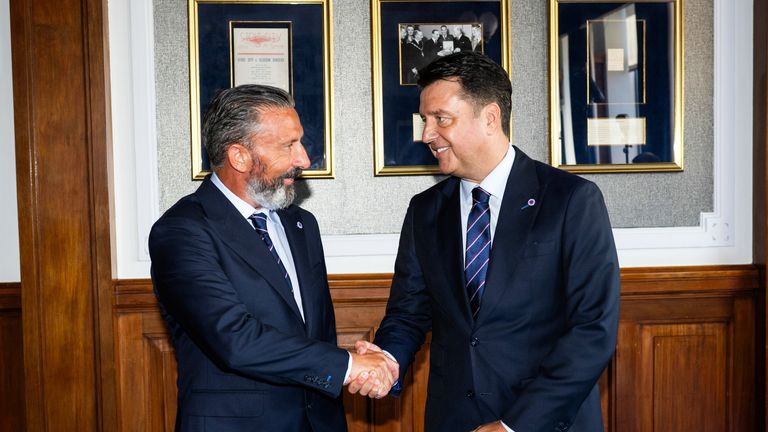
Instead, fast-forward 12 months and working alongside Cavenagh were the likes of CEO Jim Gillespie, who joined in March, now outgoing technical director Dan Purdy, Paraag Marathe and Gretar Steinsson of the 49ers, plus Stig Inge Bjornebye, who was appointed performance director in June following a spell as consultant.
Image:
Former Everton head of recruitment Dan Purdy has stepped down from his role as technical director but will continue assisting Rangers this season after helping rebuild the squad
Rangers were not only looking at players' attributes, but also how they'd fit in the dressing room, their injury history, trading value and so on. Things which in the past were not always prioritised but are now all part of the equation.
The likes of Purdy would identify the options, Cavenagh and Gillespie were among those signing off on the deals, all done with the backing of the 49ers and ultimately the manager.
While there will always be successes and failures, this time Rangers had a united approach.
Image:
CEO Jim Gillespie joined in March and led the search for manager Derek McInnes who both played a key role in summer transfers
So what was the plan this summer?
Rangers' initial target was to sign fewer players than they did the previous summer, but opportunities and injuries saw that number rise from around 10 to 14.
The club's leadership group set the parameters, the model of how Rangers should play both domestically and in Europe was in place, and it was over to the new powers that be to sign the players - just like they did in January when Tuur Rommens, Tochi Chukwuani and Ryan Naderi were permanent additions.
Image:
Ryan Naderi and Tochi Chukwuani have impressed after joining Rangers in January
Rangers' goal this season - under McInnes, who knows the Scottish game inside out - was to taste domestic success once again.
So what was the plan to end Celtic's Premiership stranglehold? Well, rather than trying to copy their Old Firm rivals' possession-based style of play, Rangers were focussing on physicality and speed. The view was that to beat Celtic, they couldn't be like Celtic - they had to work differently.
Furthermore, following the departures of captain James Tavernier, vice-captain Jack Butland and co, they needed leaders in the squad, plus wanted to reduce the overall age of the group - something they had achieved over the previous windows.
Image:
Dan Neil was captain at Sunderland and Lawrence Shankland was Hearts skipper before both joined Rangers in the summer
Finally, while chairman Cavenagh was willing to splash the cash for the right players, many signings would still need to have the potential to grow in value and help the club flourish.
Did they deliver?
It was a complex checklist and not everything has been fixed at Ibrox over a few months. This was always going to take multiple windows. However, there are positive signs.
The average age of the team that beat Celtic in their two games before the international break was less than 24 - compared to their rivals, who were closer to 27.
The starting XI in those games comprised of a new-look spine and six summer signings: goalkeeper Ivor Pandur, defender Olwethu Makhanya, captain Dan Neil in midfield along with James Penrice, Minsu Kim out wide and Kevin Kelsy leading the line.
Image:
Kevin Kelsy and Olwethu Makhanya, both 22, have impressed since joining Rangers in the summer
At Ibrox in their League Cup quarter-final triumph, Rangers played like a team with an identity and style. They were strong, physical, fast and dominated the battle for second balls. That was reaffirmed at Parkhead in the Premiership a week later, while their rivals changed shape in a search for answers that didn't arrive.
Both in January and this summer, Rangers have been adding to their squad with a clear plan in place. They now have a group boasting speed, physicality, desire and the types of players who could attract interest from bigger leagues across Europe.
That recognition is coming on the international front too, with 13 of the squad selected by their country for this three-week window. Of those away with their countries, 12 of the 13 are 26 or under too - a clear sign of the change in direction at Ibrox.
Rangers starting XI vs Celtic age
Ivor Pandur (26); Dujon Sterling (26), Emmanuel Fernandez (24), Olwethu Makhanya (22); Kim Minsu (20), Nicolas Raskin (25), Dan Neil (24), James Penrice (27), Djeidi Gassama (23); Ryan Naderi (23), Kevin Kelsy (22)
There has been significant work to alter Rangers' recruitment process since last summer, and while the early signs are positive, nothing is won in September.
Rangers still need to catch Celtic in the Premiership and face a tough test in Aberdeen, if they're to book a spot in the League Cup final, where Hearts or Hibs would await.
However, for the first time in years, after a busy transfer window and consecutive Old Firm victories - they head into Autumn with a platform that will allow them to deliver. %!s()
Speaking at the Iberseries & Platino Industria conference in Madrid, Amazon MGM execs Javiera Balmaceda and Nicole Morganti offered a candid look at how the streamer decides which non-English language projects to back, pointing to “Zeta” in Spain and “Venganza” in Mexico as examples of taking bigger swings in genre.
… %!s()
The two executives said Amazon’s international teams are in frequent creative contact, sharing scripts, casting ideas and talent. “We share talent globally — actors, creators, writers and authors,” said Morganti, Prime Video head of international originals, Italy & Southern Europe.
The real work, however, comes when a project needs to be sold internally.
Morganti said “Zeta,” an espionage actioner starring Mario Casas and produced by Pablo Isla’s Fonte Films, was a chance to prove that Spain could deliver a big action movie with a distinctly Spanish identity. “Spain has a strong ability to make action,” she said, noting that the film also benefited from its mix of action, family and emotion. The movie ranked among Amazon Prime Video most watched Global Top Ten hits earlier this year.
Balmaceda, head of international originals, Latin America, Canada and Australia for Prime Video & Amazon MGM Studios, described “Venganza” as a similar bet for Mexico. The challenge was convincing Amazon that a Mexican production could deliver the scale and action audiences expect from the genre.
“We believed a Mexican production could tell a story that would resonate globally and demonstrate that great action could come from somewhere other than Hollywood,” she said.
Neither project was an automatic greenlight. Morganti said the teams had to make the case around directors, talent and production capabilities. “You have to keep pushing and show the different elements of why the project could work,” she said.
That willingness to take risks extends beyond action. Morganti pointed to Spanish-language horror, a genre that was once treated as niche, as another area where Amazon has seen the market expand.
Success can also open the door to sequels and franchises, although Balmaceda said those opportunities don’t necessarily have to be engineered from the beginning.
“When you have a success, you naturally look at the audience and the fans around it,” she said. “The important thing is not necessarily to manufacture a franchise, but to recognize when an audience wants more.”
For creators pitching Amazon, the executives stressed conviction over quantity. Morganti’s advice was straightforward: “You need an original idea and, above all, to really believe in it. Know what you want to tell and why it matters.”
Balmaceda also emphasized having a clear point of view. “Passion matters,” she said, arguing that creators should know which story they want to tell rather than arrive with a menu of interchangeable concepts.
Reflecting on Latin America, she noted that its challenge is not necessarily a lack of talent, but a shortage of experience and opportunities to work at scale.
“Sometimes what’s missing is experience, craft or simply the opportunity to do something at scale,” she said.
On “Venganza”, a relection of Amazon MGM and El Estudio producer Pablo Cruz‘s push for genre at scale, Amazon brought Bulgarian action specialists to work with the Mexican crew, giving local filmmakers the chance to learn from an experienced international team.
The discussion comes as Amazon has announced a $2 billion-plus investment in Latin America through 2030, including spending on local content.
Balmaceda also pushed back on the idea that mass popularity and quality are mutually exclusive. “A hugely popular global title can still involve excellent production, substantial budgets and exceptional talent,” she said.
Morganti described the current moment for Spanish-language entertainment as a “renaissance,” while saying Amazon’s pipeline remains active. “We’re continuing to develop many projects, and there will be significantly more coming from 2028 onward,” she said, adding that the company is already looking toward 2029 and 2030.
Greta Thunberg made a surprise appearance on Tuesday at Zurich Film Festival, where she joined the screening of a new documentary “My Home of Wind and Sand,” which looks at the occupation of Western Sahara by Morocco.
… %!s()
Calling the film “powerful” and able to “create change,” Thunberg minced no words when speaking about the world’s attitude toward the region. “There’s this extreme hypocrisy that makes me so, so angry and upset,” she said.
“For me, this movie was so much about betrayal. There are so many levels of betrayal. First, there’s the occupation and the violence itself that somehow becomes ‘normal’ or is viewed as normal. It’s not easy to get any media attention and clicks, which is another betrayal,” she said. Then there’s “the betrayal of the international solidarity movement.”
Western Sahara has been occupied by Morocco since 1975. It is often referred to as the last colonial conflict in Africa. In 2025, the U.S. reaffirmed its recognition of Moroccan sovereignty.
Recently, Christopher Nolan’s “The Odyssey” faced backlash for filming scenes in the Western Sahara, with Nolan accused of “contributing to Morocco’s repression of the Sahrawi people.” The Western Sahara International Film Festival (FiSahara) even put out a statement urging him to stop production.
Turning to the film’s protagonist, Sahrawi human rights activist Najla Mohamed-Lamin, Thunberg said: “I’m convinced that people like you do not want thanks or applause, but action. It falls on every single one of us in this room, especially us privileged people who have a platform and access to resources, to take that moral obligation to amplify the Western Sahara struggles.”
“Otherwise, we are nothing more than hypocrites,” she added.
Mohamed-Lamin, whose life and fight for Western Sahara independence is depicted in the doc, became emotional, noting: “As I was watching these 10 years of my life, I couldn’t stop thinking about all the stories and lives in the last 50 years that nobody has heard of, which are probably far more inspiring than mine: My grandmother, my sister who passed away, my mother, all our neighbors. All the thousands of people we buried in these camps who would have never wished to be buried there.”
Mohamed-Lamin added, “As somebody who’s a refugee forgotten in the desert, you’re always looking for a little window to share your story. I didn’t know it would develop into a documentary. The only thing I know is that I carry the message of my people, and I will share it everywhere I go: In a documentary, in an article, in a train station or on a plane, because I’m the voice. The world has to know the truth.”
Directed by Patrick Wally, the film is sold by Lightdox.
Thunberg, who visited a Sahrawi refugee camp in 2025, also took part in a special panel discussion on “Resistance and Activism for Western Sahara.” %!s()
Malaysia began sending back about 1,500 Myanmar nationals on Tuesday, the government confirmed, as it launched a scheme that rights groups say may endanger migrants and asylum seekers by returning them to the war-torn country.
… %!s()
The group is the first of 5,000 Myanmar citizens that Kuala Lumpur says agreed to “voluntary” repatriation from detention centres amid a huge uptick in anti-migrant sentiment in Malaysia.
Both the UN and advocacy organisations voiced concern on Tuesday, saying the group could face a dangerous homecoming in Myanmar, where a civil war has raged since 2021.
Neither Malaysia nor Myanmar have officially clarified the number of Rohingya people in the first group, and there is worry they may be returned to a country where they face persecution rights groups say amounts to genocide. The Rohingya, a Muslim minority group, make up two-thirds of the 190,000 Myanmar refugees and asylum seekers in Malaysia, according to the UN.
Many of the Rohingya escaped to Malaysia during a brutal military crackdown in 2017.
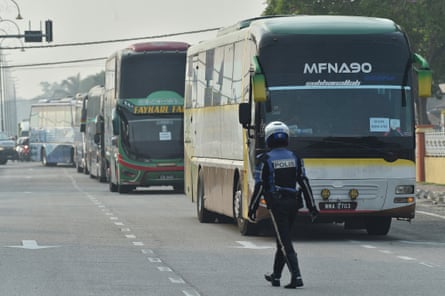
On Tuesday afternoon, AFP reporters saw three ships belonging to the Myanmar navy, used in a previous repatriation exercise, departing from Malaysia’s Lumut naval base. The Myanmar nationals were processed at the naval base before boarding dozens of buses which arrived under police escort at the Majlis Perbandaran Manjung stadium.
Malaysia’s interior ministry confirmed that the repatriations were under way.
A policeman walks in front of buses carrying Myanmar nationals being repatriated from Malaysia. Photograph: Arif Kartono/AFP/Getty Images
It said it a statement that the repatriation was part of the government’s plan to resolve the “legacy issue” of foreign asylum-seekers in Malaysia – of which it said 95% were from Myanmar.
“This long-standing issue has imposed a significant financial burden on the nation, triggered serious social crises, and created tangible security threats for the Malaysian people,” the statement said.
But in Geneva, the UN rights chief, Volker Turk, urged Malaysia to stop the process immediately, saying nobody should be deported to Myanmar, given the severity of the situation on the ground.
“This is no time to return anyone forcibly to a country plagued by egregious human rights violations and abuses, and where many cruelly face the real risk of more of the same violence again upon their return,” he said in a statement.
“The conditions are far from safe and sustainable, and it is deeply questionable whether any return in these circumstances can be considered truly voluntary.
“The hundreds of thousands who have fled Myanmar in fear for their lives must be protected, and their fundamental human rights to seek asylum and protection abroad properly considered.”
The Malaysian prime minister, Anwar Ibrahim, announced in July that Myanmar had agreed to take back 5,000 Rohingya. The plan was announced after authorities detained more than 100 Rohingya who had gathered outside the UN refugee agency’s office in Kuala Lumpur.
They were seeking help after being threatened with eviction from an informal settlement in northern Penang state. They were later released after officials confirmed they held valid UN documentation.
Myanmar earlier this month pledged “safe and dignified” returns for its citizens displaced abroad, after criticism from the UN and rights groups.
Last week more than 160 civil society groups in a joint statement called upon the Malaysian government to “immediately halt the deportations,” pending talks with civil organisations about the situation on the ground in Myanmar.
Malaysia, which shelters one of Southeast Asia’s biggest refugee populations, is not a signatory to the 1951 Refugee Convention and does not formally recognise refugee status. %!s()