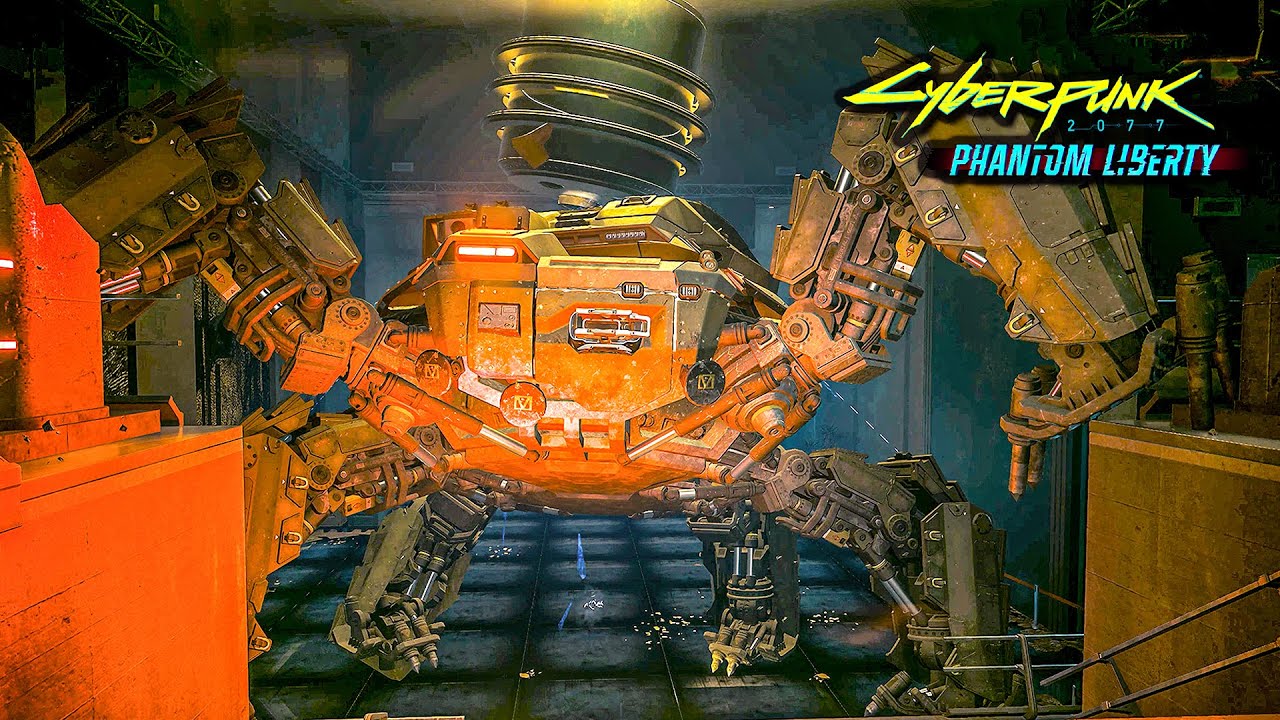
One of the most striking early sequences in Cyberpunk 2077: Phantom Liberty is its Chimera Tank boss fight, in which V and President Myers battle an enormous, Ghost in the Shell-inspired spider-tank in the bowels of a Barghest facility. The battle forms the explosive culmination of Phantom Liberty's opening act, and CD Projekt recently revealed just what it took to get the sequence where they wanted it.
… %!s()
Speaking on CD Projekt's official AnsweRED podcast (via Eurogamer), Phantom Liberty's game director Gabe Amatangelo, and creative director Igor Sarzyński discussed various production challenges the studio faced during Cyberpunk 2077's creation, bringing up the Chimera Tank as an example. "Sometimes we're making content that's a nexus point of different disciplines, the Chimera is a great example of that," Amatangelo said. "It was gameplay, narrative, art, worldbuilding."
Amatangelo explained that CD Projekt wanted the Chimera Tank to "terrify" players with its weapons, and that there were "so many moving parts" to balance appropriately for the sequence to work. "Sometimes it was too gameplay [focussed], sometimes it was too narrative, sometimes too art direction. It was about striking a balance and I think the three of us got into it and went: 'Okay, beat-by-beat, let's do this.'"
Cyberpunk 2077 Phantom Liberty - Chimera Boss Fight - YouTube
According to Paweł Mielniczuk, Phantom Liberty's art director and the podcast's co-host, creating the boss fight was a years-long process. "I think when we were iterating, it was two years to make this boss fight work," he explained. Later in the chat, Mielniczuk stated the tank went through "four" different iterations that involved "changing equipment [and] the weapons", while Sarzyński claimed that the Chimera's construction represents "one of the most expensive art assets I think ever."
It's interesting to hear CD Projekt discuss the encounter's development, especially since, when I played it around Phantom Liberty's launch, I thought it would have benefited from slightly more balancing. Slowly blasting it to bits was one of the more gruelling parts of Phantom Liberty, and reminded me a lot of the unexpectedly punishing battle with The Toad Prince in The Witcher 3: Hearts of Stone.
Nonetheless, fighting the Chimera Tank is certainly memorable, while Phantom Liberty more broadly is one of the best things I've played this decade. I'm keen to see how CDP takes all the lessons it's learned making Cyberpunk into the sequel, though we've got several years, a Witcher 3 expansion, and The Witcher 4 to come before we see it.
Keep up to date with the most important stories and the best deals, as picked by the PC Gamer team.
Rick has been fascinated by PC gaming since he was seven years old, when he used to sneak into his dad's home office for covert sessions of Doom. He grew up on a diet of similarly unsuitable games, with favourites including Quake, Thief, Half-Life and Deus Ex. Between 2013 and 2022, Rick was games editor of Custom PC magazine and associated website bit-tech.net. But he's always kept one foot in freelance games journalism, writing for publications like Edge, Eurogamer, the Guardian and, naturally, PC Gamer. While he'll play anything that can be controlled with a keyboard and mouse, he has a particular passion for first-person shooters and immersive sims. %!s()
I quit the corporate job that asked me to do the work of 3 to become an indie game developer who travels the world
As told to
Katherine Li
You're currently following this author!
Click to unsubscribe from email alerts.
…
Kelsey Fiegle
This as-told-to essay is based on a conversation with Kelsey Fiegle, an independent game developer behind Vortella's Dress Up. She developed the game with her husband, Wes Thorburn. Their games are available on the browser gaming platform Poki. The essay has been edited for length and clarity.
I spent seven years as a user experience designer at a Chicago creative agency. When two people on my team were laid off,
I was expected to take on their work.
I remember thinking, "I can't do the work of three people."
I left without another job lined up. My husband, Wes Thorburn, who was already developing games independently, thought we could make games together, but I wanted to find another tech role first.
After about 100 applications, I decided to give the dress-up game I had been building a real shot, and it changed my life entirely within the month.
Client work wore me down
Wes and I met in a game design class while I was studying abroad in Australia in 2013. Neither of us was pursuing game design. I took the class because I needed extra credit and thought it sounded fun.
After we got married and settled in the US, Wes started experimenting with web games while waiting for his work permit. He eventually released games on Poki, and they began bringing in enough money to help pay our bills. I helped him with sound, 3D modeling, and user experience design while keeping my agency job.
For a long time, I was the agency's only UX designer. Some days, I tracked time for 10 different clients. There were weekly presentations, deadlines, and projects that changed when a client mentioned a requirement late in the process.
I learned a lot and had a really good team, but the work was stressful. I'd pour my heart into a project, only to find out it was all wrong because the client had forgotten to tell us something.
Once, a client needed work finished on short notice. I worked all Saturday and Sunday to get it done. When the client saw it on Monday, they decided they needed a week to review it instead of two days. Moments like that wore me down.
A layoff became the last straw
Kelsey Fiegle
At a game developer conference in 2023, Wes and I asked the Poki team what kinds of games they wanted to see more of. They said dress-up games. I liked making things in 3D, so I began building a 3D dress-up game alongside my full-time job.
I had been trying to get more help for my team, so I wouldn't have to work so much. Then the agency laid off two of my coworkers and expected me to pick up their work.
I liked my team and didn't want to leave them in a difficult position, so I gave the agency a couple of months to find another solution. But they didn't, so I couldn't keep going.
Wes told me, "Kelsey, you can do this. We could do this together. It'd be fine. We could pull this off." I wasn't sure. I was applying hard for jobs because I wanted an in-house tech role, not another agency job.
It was difficult to make that move. Going through interviews and getting rejected hurt my confidence, especially when I really wanted a particular job. I told myself that if I reached 100 applications without finding anything, I would try game development.
That's what happened. I spent about four months working full time on my dress-up game. I needed income, including money for health insurance, so I eventually released it even though I didn't feel it was finished.
"Vortella's Dress Up" launched in December 2024. I was shocked at how well it did. It got about 10 million plays in its first month.
The game gave us freedom
Vortella’s Dressup
Poki team members suggested that the game could do even better if it were multiplayer. Until then, Wes and I had mostly worked on separate games. He had experience building multiplayer features for his pizza game, so we decided to develop my game together.
Today, the game gets roughly 10 million to 15 million plays a month, though that changes with the season. It has so far reached 276 million total plays from 63.1 million unique players, with 50.6 million hours of total playtime. We keep adding clothing, minigames, and other features, and try to update it at least twice a month.
Wes and I had always wanted the flexibility to spend time with his family in Singapore and Australia. We visit them each year and add other destinations when we can. We've traveled to Vietnam and Hong Kong, visited relatives in Italy and Germany, and stopped by Poki's office in Amsterdam.
I think about the tech job I wanted so badly during my search. If I were offered it now, I'd turn it down. I have a way better job.
Read next
Katherine Li
You're currently following this author!
Click to unsubscribe from email alerts.
Katherine Li is a reporter on Business Insider's West Coast business news team. She covers career, the future of work, and how AI is changing hiring practices and workplace trends.Previously, she was a newsroom fellow who wrote international breaking news and produced newsletters for Semafor. Before that, she wrote about climate policies for The Lever, covered the AAPI community for the SF Chronicle as a freelancer, and wrote about the 2019 Hong Kong protests as an intern for The New York Times.She is an alumna of the Graduate School of Journalism at UC Berkeley and a graduate of the international journalism program at Hong Kong Baptist University with minors in French and English literature. Email Katherine at [email protected] and follow her on Bluesky @katherineli.bsky.social.
Donald Trump stood before the United Nations on Tuesday and threatened to “annihilate” Iran. Yet even as the most powerful man on the planet flexed his military muscles, he was powerless to keep the gravitational pull of domestic politics at bay.
… %!s()
Heading into the UN building in New York, the US president was questioned by Kaitlan Collins, an anchor at CNN, which he had banned from the White House before a judge ruled against him. “I’m surprised that CNN is here covering me,” the 80-year-old snapped. “You should not be here covering me.”
The lashing-out was a reminder that even Trump, who has expanded executive power and dominated the national consciousness, finds some things beyond his control. Indeed, 20 months into his second term, there is a widening gap between the president’s self-perceived invincibility and the reality of his waning influence.
Federal courts are reining him in. Congressional Republicans are straying from the script. Poll numbers are tumbling to historic depths, driven by persistent inflation, rising fuel costs and an increasingly unpopular war in Iran. For the first time since his improbable political resurrection, Trump’s aura of authority is fading.
Rick Wilson, a longtime Republican strategist, prophesied: “This is the beginning of the end. This is the decline. As powerful and transgressive as he’s been, the country does not have a positive outlook right now. In fact, the negativity and pessimism among voters has reached a point that is unparalleled since Jimmy Carter.”
Trump’s self-belief never wavers. He faced four criminal cases and two assassination attempts before winning the 2024 election. He has lived by a mantra of “it will all work out well in the end” while his supporters wear hats that state: “Trump was right about everything.”
Yet he has had a rough month. TheFederal Reserve defied him on interest rates. The supreme court blocked his administration’s attempt to impose new restrictions on mail-in ballots for November’s midterm elections. One judge prevented him adding his name to the Kennedy Center, prompting him to threaten the national arts complex with demolition; another judge blocked his ban on three news outlets from the White House grounds, ordering the administration to “immediately return, reinstate and restore” their access.
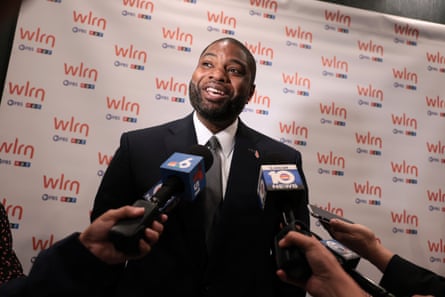
Now even Trump’s dependable power base, the Republican party, is showing cracks amid fears that he will cost them seats in November. In Florida, his home state, gubernatorial candidate Byron Donalds quietly scrubbed most Trump references from his campaign website, while the congresswoman María Elvira Salazar ran campaign advertisements openly declaring that federal immigration enforcement had gone “too far” and asserting that Latino voters “feel betrayed”.
Byron Donalds, the Republican candidate for Florida governor, has distanced himself from Trump. Photograph: Joe Raedle/Getty Images
Wilson, a co-founder of the Lincoln Project, an anti-Trump group, sees a herd mentality among congressional Republicans and compares the current mood to a wildlife documentary.
“It needs a David Attenborough voiceover,” he said. “It’s like the gazelles wandering the savannah. They’re sniffing the wind now and they smell something in the wind. They know it’s a predator but they don’t know what to do about it yet. What they haven’t realised is that the predator has been among them all along. The risk factor that they face now is Trump.”
For nearly a decade, elected Republicans maintained a posture of submission, fearful of drawing a primary challenger or a scathing post on Truth Social. But with the elections looming and control of Congress hanging in the balance, self-preservation is rapidly overriding loyalty to the president.
Wilson said: “Now it’s reached the point where the magic doesn’t work any more.There’s no political upside from a president who is at 29% approval rating in some polls, has presided over a disastrous war, and has ended up raising energy prices and food prices – all the things that they can’t spin away.
“The voters now have very much put that together. They associate the war with Trump. They associate the gas prices with Trump. They associate the grocery prices with Trump.”
Gas prices on 22 September 2026 in Doral, Florida. Photograph: Lynne Sladky/AP
This creates a vicious circle, Wilson argues.“The more he becomes a liability, the more he acts out. The more he demands loyalty from people and doesn’t get it, the more he demands loyalty from people and doesn’t get it. Everything was handed to him for a decade by that party and, now that they’re paying the price, they’ve decided this has got a little too hairy.”
Faced with shrinking authority and a hostile economic landscape, Trump has reverted to his trusted playbook: manufacturing spectacle, picking cultural fights and raging against the press. His recent decision to ban the news outlets CNN, MS Now and Politico from the White House campus following critical coverage was viewed by critics not as a display of strength, but a symptom of deep frustration.
The administration rejects such charges and insists that the president’s agenda is succeeding. Davis Ingle, a White House spokesperson, said in an email: “President Trump is the unequivocal leader, best messenger, and unmatched motivator for the Republican Party, and he is committed to maintaining Republican majorities in Congress.
“The president signed the largest working-class tax cuts in history, lowered the cost of prescription drugs, sealed the border, drove violent crime to the lowest level in nearly a century, unleashed an energy revolution, added more than a million private-sector jobs, and sent Americans’ 401(k)s climbing to record highs,” he added. “The choice has never been more clear: doubling down on President Trump’s winning, commonsense agenda or the Democrats’ extreme liberal policies and obstruction.”
But the trend lines are only set to worsen for Trump. If Democrats gain control of the House of Representatives next year, they plan to launch investigations into how he has allegedly abused his office to enrich his family, grant favours to supporters, hollow out the federal government and carry out expensive construction projects. The attention economy, meanwhile, will inexorably shift to the 2028 presidential race and the question of succession.
Bill Galston, a senior fellow at the Brookings Institution thinktank in Washington, said the inevitable shift of focus toward potential candidates – such as the vice-president, JD Vance,or the secretary of state, Marco Rubio – will be cause for friction.
“Nothing will drive him crazier than the shift of the spotlight away from him,” said Galston, a former domestic policy adviser to Bill Clinton. “The prospect of passing the torch, giving up the spotlight, is intensely painful for him. It’s his oxygen. Will he be able to breathe, spiritually and emotionally speaking, without it?”
Trump is not the first president to run into trouble after winning re-election. From Richard Nixon’s Watergate downfall to Clinton’s impeachment and George W Bush’s quagmire in Iraq, second terms have historically served as the graveyard of presidential ambition.
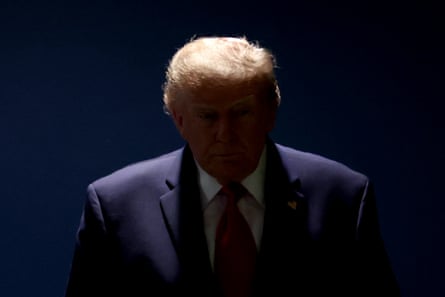
Donald Trump arrives at the 81st United Nations general assembly in New York on 22 September 2026. Photograph: Timothy A Clary/AFP/Getty Images
Lichtman, a history professor at American University in Washington, believes that Trump is driven by two things: money and glory. “He cannot stand not being the centre of attention and that’s dangerous,” he said. “I don’t care much about his verbal lashing-out; I don’t think that helps him at all. But who knows what crazy things he might do to reassert attention on him? And that’s frightening.
“Never underestimate the power of the president. Just because Republicans are criticising him, his poll numbers are low, prospects for Republicans look dim, doesn’t mean he doesn’t have enormous power – and he is certainly quite willing to use that power unconstrained. He doesn’t care about the courts and doesn’t care about the Congress.”
From this perspective, Trump’s last refuge will be the unchecked use of executive authority, a politicised justice department and a sweeping pardon power. With nothing to lose in his final two years, he could go out all guns blazing.
Charlie Sykes, a conservative author and broadcaster, said: “Donald Trump fears irrelevance more than anything and he’ll rage against it as long as he can. The notion that he will go quietly would be incredibly naive.
“We’re headed for a collision between a lame duck who has no respect for the constitutional norms and an opposition that may have some power to hold him accountable. The paradox is the weaker he gets, the more dangerous he gets.” %!s()
A very jet-lagged Scarlett Johansson reunited with co-stars Adam Driver and Miles Teller for the New York Film Festival premiere of “Paper Tiger,” which kicked off the festival’s 64th edition.
… %!s()
“I’m hallucinating,” said Johansson, who just got off a long international flight, where she’s filming another movie. “It’s 5 in the morning — which is a great time to be doing an interview on stage.”
“Paper Tiger” premiered in May at the Cannes Film Festival. However, this marked Johansson’s first time watching the movie (at least in a festival setting); she missed the Cannes premiere because she was shooting yet another movie, “The Exorcist: Martyrs.”
“Don’t rub it in!” Johansson joked about her absence on the French Riviera.
Set in 1986, “Paper Tiger” follows two brothers, Irwin and Gary Pearl, whose get-rich-quick scheme to help clean up the Gowanus Canal lands them in the crosshairs of the Russian mafia. Johansson plays Linda, wife of Teller’s character.
Johansson, Driver and Teller walked the red carpet with Gray at Lincoln Center’s Alice Tully Hall and sat for a post-screening Q&A, during which they spoke about their close camaraderie during production.
“No work required. There’s a mutual admiration between the four of us,” Driver said. “A set culture comes from the top down, and James sets a culture where everyone feels free. We immediately felt comfortable with each other.”
Added Gray, “We had a nauseatingly lovely set. I love them. I’m not on the Today show. I’m telling you the truth.”
Scarlett Johansson, Miles Teller and Adam Driver introduce “Paper Tiger” during the 64th New York Film Festival.
Getty Images for FLC
Before the screening began, Gray took the stage and consciously kept his intro remarks short and sweet.
“When I was in film school many years ago, students would show their films, and the students that talked the most [before] often made the very worst movies,” he said. “So I am going to speak very briefly.”
Gray praised the producers and actors who helped bring the film to life and reflected on his early dreams of being a filmmaker.
“I can’t help but remember my mother and father when I said I wanted to be a movie director. ‘How are you ever going to do that?’ And here I am,” Gray said. “I’m not sure the lesson in that.”
NYFF artistic director Dennis Lim introduced Gray as “one of the great living American filmmakers” and praised the director for championing a “singular” artistic vision.
“It’s not easy to make personal films in the current landscape of American cinema,” Lim said. “The fact that there are 24 executive producers credited on this film, like, who speaks to that.”
New York Film Festival’s 64th edition, which runs through Oct. 12, will host the world premieres of “Artificial,” Luca Guadagnino’s buzzy movie about OpenAI founder Sam Altman; Ava DuVernay’s documentary “14th”; director Tony Gilroy’s music drama “Behemoth!” with Pedro Pascal, Olivia Wilde and Will Arnett; and Takashi Yamazaki’s kaiju sequel “Godzilla Minus Zero.”
“Premiere status is never the be-all and end-all for us,” NYFF artistic director Dennis Lim told Variety ahead of opening night. “Timing is always part of it. But I think we’ve proved in the last few years that we create a pretty interesting context for the launch of a film.”
“Paper Tiger” filmmaker James Gray (center) with the film’s stars Roman Engel, Miles Teller, Scarlett Johansson, Adam Driver and Gavin Goudey.
Getty Images for FLC
In a statement to Rolling Stone, the rapper-producer responds to accusations that he agreed to change his name and later failed to follow through on his promise
California rapper and producer Ovrkast is pushing back against a lawsuit filed by influential hip-hop duo Outkast. The complaint accuses the rising artist of unlawfully using a “nearly identical” stage name after previously agreeing to change it.
… %!s()
In an exclusive statement to Rolling Stone, Ovrkast said that throughout his career, he has built his name independently of Outkast and never had the intention to copy their moniker or cause confusion among fans.
“As a rising creative with recent career milestones and accolades attached to my professional name, I stand firmly on the fact that I have established this name and its meaning completely independently of the parties in question,” Ovrkast says. “I have never had any intention of trying to copy, misrepresent or confuse fans with the name of such a legendary act.”
He emphasized his admiration for the duo, adding, “I have a deep and personal respect for this iconic group and their storied legacy, and sincerely hope we can find a resolution that allows me to continue my lifelong pursuit of leaving my own mark on hip-hop history.”
In the 31-page complaint filed by Outkast in Georgia, the group accused Ovrkast of trademark infringement, unfair competition, and breach of contract. The lawsuit claims Ovrkast, whose real name is Silas Wilson, knowingly chose his stage name “to trade upon the tremendous fame and goodwill associated with plaintiff’s Outkast name and mark” and alleges Wilson’s use of the name has already caused confusion among consumers, pointing to a 2025 Rolling Stone interview as evidence.
In that interview, Wilson said the “worst thing” about handing higher visibility as his fame grows is being accused of attempting to imitate Outkast. “It’s like, ‘No, bro. I wasn’t even thinking about Outkast,’” he said at the time. “They read Ovrkast [as] Outkast. They’re like, oh my God, I thought they said Outkast. And it’s like, it don’t.”
The complaint also claims that Wilson reneged on a binding, negotiated agreement where he would change his stage name to Overkxst and stop using Ovrkast on his website, social media and streaming accounts, domain name, newsletters, advertising and marketing materials, clothing, and merchandise.
Trending Stories
Earlier this week, Wilson wrote on X: “For the record, I NEVER signed any agreement. I tried my hardest to cooperate with different options every step of the way. This narrative that I’ve done wrong is also wrong. (had to clarify) peace.”
A rep for Outkast did not immediately respond to a request for comment on Friday. %!s()