What is QoS on your router, and should you turn it on? - Engadget
tags:If your connection is struggling, it's worth a look.

Kazakova Yana/Shutterstock
You can be forgiven for avoiding the guts of your Wi-Fi router's settings. There's been an attempt to simplify menus over the years, especially with phone apps becoming the preferable means of control. Still, these settings often float beyond the realm of familiar experience, even for a relatively tech-savvy individual. Someone who spends most of the day developing mobile apps or fixing e-bikes probably doesn't need (or want) to tinker with DHCP options.
It's worth learning the nuts and bolts of your router, though, because under some circumstances, tweaking it can have a meaningful impact on overall network performance. That shouldn't be surprising, given that even light bulbs and smartwatches are talking to the internet these days. You might think of a Wi-Fi router as a highway interchange, or perhaps Grand Central Station. If there's a lane reduction or some other holdup, traffic in the rest of the city is going to feel it.
One of the more mysterious settings affecting performance is something called QoS. On your own router, it may have a different label, especially since the technology has evolved over the years. Regardless, toggling it on or off can be an important decision, for reasons that will quickly become clear.
What does QoS do on Wi-Fi routers?
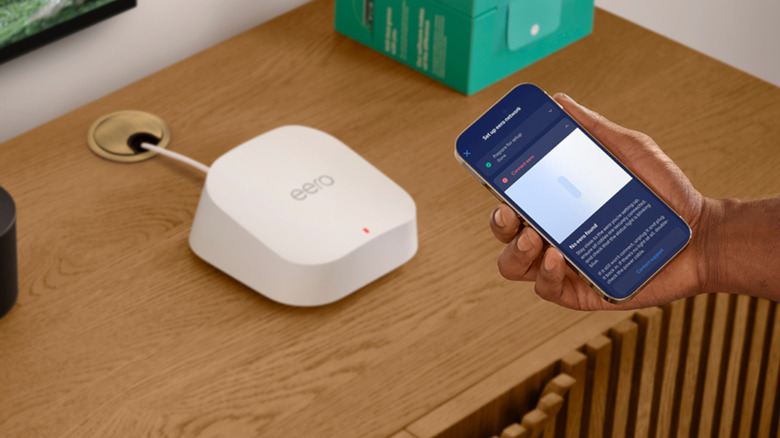
Eero
As you may have guessed, QoS is short for Quality of Service. What it's really referring to is traffic prioritization. You see, all the data that arrives from the internet is delivered in the form of packets. And much like your physical mailbox, not every packet is mission-critical. Most aren't. Without prioritization, your router tends to treat things like email, Netflix and smart home automations with the same degree of urgency.
QoS detects the nature of incoming packets and selects what gets to go first. Most often, priority goes to traffic like streaming media — including voice and video calls — as well as online games like Big Walk or PUBG: Battlegrounds. That last example might seem frivolous, but its playability is often hampered by lag. Even an extra 20 milliseconds could mean the difference between landing a shot or becoming the victim of one. Some routers may let you assign priorities, say, if you're a video editor and you'd rather large project downloads from your clients finish sometime today.
If you can't find a QoS option in your router's settings, what you might be looking for instead is an evolution of the concept called SQM, short for Smart Queue Management. This goes beyond QoS to cope with "bufferbloat" — the lag created when a bunch of packets are essentially waiting for their turn to be processed. Specifically, it implements things like advanced scheduling and traffic shaping, instead of dumbly shuffling some items to the front of the line.
The catch to SQM is horsepower. Being able to detect, sort and shape traffic in a flash requires processor specs that some routers don't have. Outside of Eero mesh systems, your best bet is to shop for the feature on gaming routers, which are high-performance products built with prioritization in mind. Check official product pages if either QoS or SQM sounds like something you might need.
Why you should probably leave QoS off

Annastills/Getty Images
QoS might be essential if your internet plan offers less than 500 megabits per second and your home is full of demanding devices (or users, for that matter). While 50 megabits used to be mind-blowing, consider that the recommended minimum for 4K HDR video is typically 15 to 25 Mbps, and some PC game downloads now measure in the dozens or hundreds of gigabytes. If you layer routine functions like app and OS updates on top of that, you can see how critical traffic might suffer.
The issue is that on faster connections, any form of QoS — SQM included — can be redundant. A gigabit internet plan offers so much bandwidth that it's unlikely any device will be starved for it. QoS features can actually backfire, say if they prioritize the wrong traffic at the wrong times, or they overwhelm your router's processor. As we mentioned, vanilla QoS doesn't even solve the problem of bufferbloat.
If your internet speeds are limited and you're encountering genuine performance barriers, it can't hurt to try QoS if it's not already enabled. You should, in fact, since it may be a quick fix. If everything is running relatively smoothly, however, QoS won't suddenly make your internet experience transcendent.