Weak connection: Why influencers sometimes fail to influence
tags: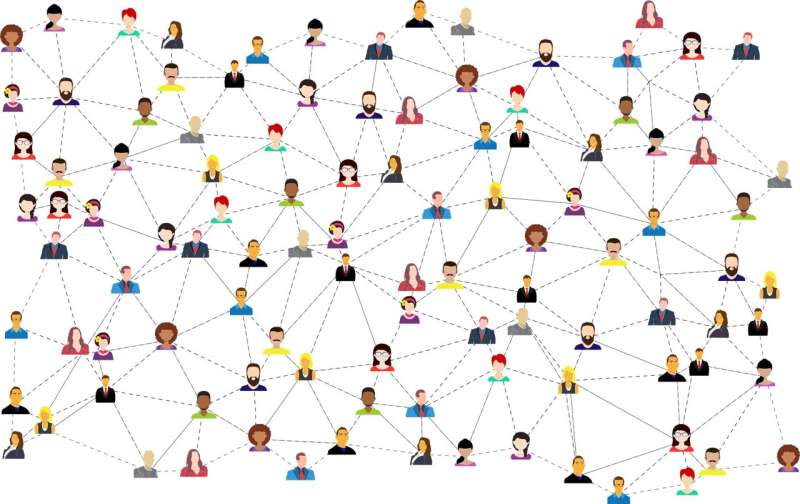
Conventional wisdom holds that targeting the best-connected individuals in a social network is an effective way to nudge a wider group of people to change their behavior. For example, public health officials launching a campaign to improve nutrition might target a community's leaders on the assumption that they wield the most influence. The effectiveness of this approach, however, depends on the structure of the social network, a new Yale study finds.
In the study, researchers provide evidence of a structural paradox: When social networks concentrate around a small number of well-connected community members, focusing on those individuals alone does not effectively influence others' behavior. The paper is published in the journal American Sociological Review.
"People look to leaders to spread change. But we show that change is not dependent on leaders alone, it also depends on the structure of the social circles around them," said Yuan Hsiao, assistant professor of sociology and statistics and data science (secondary) in Yale's Faculty of Arts and Sciences and the study's lead author. "It matters how people connected to leaders connect to each other. When network ties are concentrated around a few well-connected leaders, it undermines the leaders' ability to effect large-scale change in behaviors, especially those behaviors that require social reinforcement from many people."
Since individuals in these factions are so drawn to leaders, there is little interconnection among them, he added.
"These social barriers restrict the diffusion of new information and behaviors," he said. "In contrast, we find that behaviors spread better if ties in the network structure are less concentrated around highly connected actors."
Nicholas Christakis, Sterling Professor of Social and Natural Science in Yale's Faculty of Arts and Sciences, is the study's co-author.
The study has three parts. In the first, the researchers revisited a classic 1999 study that showed that focusing on well-connected people in a network influences behavior more effectively than targeting random individuals. But this time, the researchers adjusted the network structure on which that study rested, which generated different outcomes. Specifically, they showed that the more network ties are concentrated around a few individuals, the less new behaviors spread across the whole network.
For the second component, the researchers analyzed empirical data from a 2015 study, which used a randomized trial to test how to enhance adoption of two public health interventions in rural villages in Honduras. (One urged people to use chlorine to purify their drinking water, and the other encouraged them to take multivitamins to treat nutrient deficiencies.)
For each intervention, the authors of the 2015 study examined the effectiveness of targeting well-connected individuals versus random targeting in nine villages. In an analysis, Hsiao and Christakis found that the data from that study support the hypothesis that when social ties are concentrated around a few individuals, adoption of the new behaviors across the networks decreases.
For the third component of the new study, the researchers used computer simulations to explore why the paradox occurs. This revealed that when the social circles of highly connected people are not connected to each other, it reduces reinforcement of new behaviors throughout the social network.
"This work has a range of real-world applications," said Hsiao, who is also a faculty affiliate at Yale's Institution for Social and Policy Studies. "It can affect how companies market their products, how nonprofit organizations strategize advocacy campaigns, or how public officials initiate policy interventions.
"In short, efforts to change behaviors should look beyond simply targeting leaders to consider the structure of the social circles around the leader, which ultimately determines their influence."
Publication details
Yuan Hsiao et al, The Influence "Paradox": When More Network Ties Lead to Less Change, American Sociological Review (2026). DOI: 10.1177/00031224261438845
Who's behind this story?

Master's in TESOL from The New School. Passionate about language learning and editing science news on biology and space exploration. Full profile →

Master's in physics with research experience. Long-time science news enthusiast. Plays key role in Science X's editorial success. Full profile →
Citation: Weak connection: Why influencers sometimes fail to influence (2026, July 7) retrieved 14 July 2026 from https://phys.org/news/2026-07-weak.html
This document is subject to copyright. Apart from any fair dealing for the purpose of private study or research, no part may be reproduced without the written permission. The content is provided for information purposes only.