Old Navy Warship Off The Coast Of Scotland Gets Decommissioned In The Most Metal Way Possible - Jalopnik
tags:The USS Klakring was happy in retirement after a long life in active duty... but then they pulled it back in for one last job. A job that needed somebody tough, even in its old age. They needed, in fact, for it to die. But die hard. And dagnabbit, the guided missile frigate USS Klakring decided it was going to show these younger ships just what a tough old nut it still was after all these years. So it was that during Exercise Atlantic Thunder 2026, the combined forces of the United States and the United Kingdom tried to sink the old warship 170 miles off the coast of Scotland. They got it in the end, but it took a lot more firepower than you might expect. Old Navy vets don't go easy.
The Klakring was first commissioned in 1983, named after a World War II submarine captain; after 30 years of proud service, it was decommissioned in 2013. But this year, America and Britain decided they wanted to blow something up. You know, to test their new anti-ship munitions, not because they just love blowing stuff up. A proper test needs a real live target. So the Navy went to the ship in its retirement and said that it had one last mission for it.
First up, the destroyer USS Paul Ignatius hit the crewless Klakring with an SM-6 interceptor missile. The Paul Ignatius was testing the missile's farthest range, which is classified but estimated to be up to 248 miles. The longshot hit its target, which is job well done to the sailors on the destroyer, but Klakring was still standing. So then the British came in with the frigate HMS Portland, firing its brand-new anti-ship weapon, the Naval Strike Missile. This has a 190-mile range and a 260-pound fragmentation warhead. That ought to be enough to take out that old man! But no... Klakring took the hit and was ready for more from these kids.
Strikes from above, strikes from below
If seapower wasn't enough, how about some airpower? The Brits then sent in a Wildcat helicopter to test out the new Sea Venom missile, which had never hit a live target before. While only able to travel 12 miles, it is designed to seek out a ship's vulnerable point, penetrate without detonating, and then explode once inside. It did all that, alright, but Klakring didn't care. Bring it, punk!
The Wildcat flew out, and the U.S. Air Force's F-15E Strike Eagles flew in. They hit old Klakring with some guided bombs. Klakring wiped the dust off its shoulders and asked what was next.
Could anything at all take down this old warhorse? Or was it a one-ship fortress, impervious to all assault? Well, the old man then went up against the newest kid of all. The USS Massachusetts is a Virginia-class attack submarine, only just declared ready for fleet duty in August. A young buck, hungry, eager to prove itself. Though the Klakring had weathered the attacks from the surface and the sky, the Massachusetts came at it from below the waves. One shot: a torpedo, below the water line. That was the last straw from the Klakring, as it at last fell to its knees, probably in slow motion, and sank to the bottom of the sea. Out with the old, in with the new.
Blaze of glory
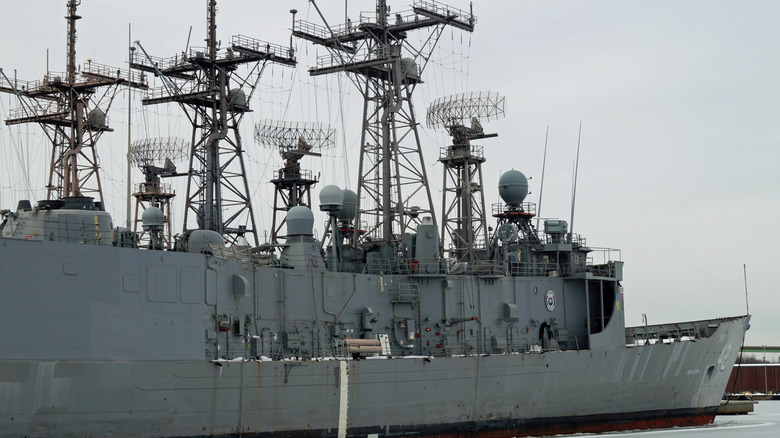
Phillyskater/Getty Images
Exercises like Atlantic Thunder are meant to test live weaponry against real targets, and also are important drills between navies of different nations. In this case, all the ordnance "worked," but the old Klakring proved just how hard it is to actually sink a warship these days. They are designed, of course, to be tough to take down. Still, if this story demonstrates anything, it's that submarines remain the apex predators of the oceans (when they're not busy taking billions of dollars just to be idled).
Before the shooting began, the Navy did scrub down the Klakring for contaminants and also checked for dolphin and whale activity. So despite all the destruction, the environmental impact ought to be minimal. As for the Klakring, it can proudly say that it died for something, not of something. Instead of wasting away in the old folks' home, it literally went out in a blaze of glory. It will now spend eternity where it always belonged: the sea.