Keep medical doctors in academia — without them, health-care research will suffer
tags:Physician-scientists are well placed to do translational and clinical research.Credit: Janiec Bros/Getty
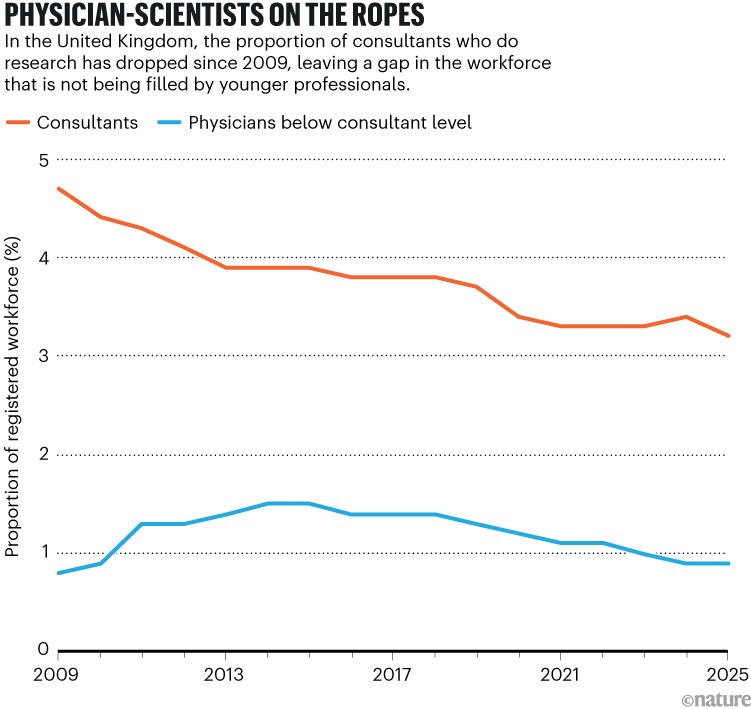
Medical doctors who also do research are an increasingly rare breed. Physician-scientists made up nearly 5% of the US medical workforce in the 1980s; today, that figure is closer to 1.5%1. In the United Kingdom, the proportion of senior doctors working as academics fell from almost 5% in 2009 to roughly 3% in 2025 (see ‘Physician-scientists on the ropes’), with the number of physician-scientists under the age of 36 plunging by a whopping 25% between 2024 and 2025 (see go.nature.com/4ygjfev). In Japan, 2.1% of all doctors were physician-scientists in 1996; this proportion dropped to 1.6% in 2016. Moreover, the number of physician-scientists aged 39 or younger halved in the same period2.
Whistleblowing in science: this physician faced ostracization after standing up to pharma
Underlying the decline is an inability to retain young physician-scientists at a high enough rate to replace senior professionals as they retire. Around the world, clinical academics describe funding instability and a lack of career support as barriers to staying in their posts3–6. In the United States, according to a survey posted on the preprint website medRxiv, more than half of early-career physician-scientists are considering quitting their academic duties to pursue a purely clinical career7. That’s markedly higher than the 31% of US physicians who report considering leaving their current post within two years.
This trend is alarming because physician-scientists are hugely valuable for health-care research. Their expertise makes them ideally placed to pioneer advances in translational medicine, formulate and run medical trials to improve clinical practice, and drive economic growth. More than one-third of the Nobel Prizes in Physiology or Medicine and Lasker Awards for basic science have been awarded to physician-scientists8.
Source: go.nature.com/4acmbgp
South Korea offers a glimpse of what is at stake. The number of medical research papers it published was already declining — probably owing to funding cuts — when, in 2024, mass resignations by resident physicians forced physician-scientists to abandon research to cover clinical duties9. That year, publications fell by 12%, roughly double the decline in the previous year, presumably in part because of the lack of papers from physician-scientists.
Our own experiences have further convinced us of the value of this group. Two of us (R.M. and R.B.) currently lead the University College London MB–PhD programme, which has run since 1994. It enables undergraduate medical students to undertake a PhD in scientific research, typically between their fourth and fifth years — one of several routes to becoming a physician-scientist. Papers authored by our cohort of 131 graduates from the programme between 1994 and 2026 received about three times as many citations each per year as did comparable papers in related fields10.
These results are just a snapshot from a small group, and there are many factors that could contribute to the cohort’s high performance. However, we think that they highlight the importance of the blended expertise that defines physician-scientists.
That expertise is now eroding around the world. Governments, funders, universities and others must take urgent steps to stop the decline.
Reasons for the drop-off
In many countries, medical graduates are matched to their first postgraduate positions by centralized, algorithmic systems built for all physicians. These systems do not always consider research potential. In England, for instance, two-thirds of posts historically reserved for aspiring physician-scientists are now allocated by an algorithm that does not take into account publication record11. When recruitment processes consider research, they often reward the quantity of a candidate’s research output rather than quality.
Long COVID still has no cure — so these patients are turning to research
There’s no guarantee that the location to which a physician-scientist is recruited will have an academic department nearby where they can pursue their research area of interest. Schemes implemented in countries such as the United Kingdom, Australia and Canada deliberately post doctors to under-served regions. This is a sensible response to genuine workforce shortages, but one that can inadvertently displace physician-scientists far away from the infrastructure that their research depends on.
Next, there’s a lack of career support. Once a physician-scientist is in a post, health systems often fail to dedicate time and support for research. They might be awarded protected research time on paper but spend it covering rota gaps or absorbing high clinical workloads. One UK survey found that more than 50% of physicians reported a lack of protected research time in their job plans12. Mentoring is often lacking13, and when it’s available, it might not come from people who understand both the clinical and scientific sides of the job.

Strong mentorship could help junior physician-scientists to navigate a tricky career path.Credit: Lu ShaoJi/Getty
Pay for physician-scientists often falls short of that for equivalent, purely clinical posts. In the United States, for example, academic physicians are compensated, on average, about US$50,000 less per year than are conventional hospital doctors (see go.nature.com/4y9anls). The same problem occurs across Europe3. And in England, although a pay premium recognizes physicians who combine research with clinical training, some people are ineligible — notably, those who receive a PhD before graduating in medicine.
Underpinning all of these challenges is funding instability, in both medicine and research. In 2025, US federal funding cuts forced universities to rescind offers already made to incoming physician–PhD (MD–PhD) students. The Canadian Institutes of Health Research announced that it would revoke funding for its national MD–PhD training programme in 2015 and has yet to replace it. In the past few years, research funding has been cut in countries including Argentina and the Netherlands14, resulting in fewer grants and fewer researchers.
Rebuild the workforce
A coordinated effort from governments, funders, health systems, universities and physician-scientists is needed to retain more people in this profession.
Health and science ministries should track how many doctors at each career stage enter fundamental or clinical research, remain active or leave. They should publish where and why attrition occurs. This will let ministries target interventions at the points at which talent is lost and assess whether reforms are working.