Iran attacks Gulf countries following fresh US strikes – Middle East crisis live
tags:
@ 12/07/2026
From
1h ago
Summary of the day so far...
Here is a quick recap of events so far today:
Iran launched missiles and drones at its Gulf neighbours this morning in retaliation to a number of US strikes and announced the closure of the strategic strait of Hormuz until further notice.
Jordan, Bahrain, Qatar, Oman and the UAE all reportedly came under attack. Qatar said three people, including a child, had been injured by falling shrapnel but there were no immediate reports of any casualties.
The US said it had struck Iran early on Sunday after the country’s Islamic Revolutionary Guard Corps (IRGC) fired on a Cyprus-registered container ship they claimed was sailing an “unauthorised route” through the strait of Hormuz.
According to state media, the IRGC then said they had hit a second vessel, accusing it of “violating regulations”.
A short time later, US central command said its forces had carried out a round of strikes against Iran, attacking at least 140 targets.
Mohammad Bagher Ghalibaf, Iran’s top negotiator in the peace talks and the country’s parliament speaker, said in a social media post this morning that: “The era of one-sided deals is OVER. We told you: keep your word or pay the price. Reality is knocking.”
In response to the US attacks against Iran, the IRGC claimed they had destroyed a command and control centre and drone hangars in Jordan, targeted a US radar site in Kuwait, attacked US aircraft carrier support and refuelling platforms in Oman and destroyed a jet maintenance centre and command facility in Qatar.
India’s foreign ministry condemned an attack on the commercial vessel – GFS Galaxy – off the coast of Oman earlier today. It said 10 of the 11 Indian nationals on board have been rescued, while one remains missing.
The United Kingdom Maritime Trade Operations (UKMTO) centre said that the maritime security threat level in the strait of Hormuz remains “severe”.
But despite claims from Iran that the strait has been closed, the UKMTO said a southern route remains available, though it warned of potential mine dangers.
Key events
1h ago
Summary of the day so far...
3h ago
Maritime security threat in strait of Hormuz remains 'severe' - UKMTO
3h ago
Era of one-sided deals is over, top Iranian negotiator says, as he warns US 'reality is knocking'
4h ago
Lindsey Graham, key Trump ally, has died after sudden illness, his office says
4h ago
Iran has taken control of the strait of Hormuz with 'power', official says
4h ago
Iran attacks Gulf countries after fresh US strikes
Oman has said 23 people have been rescued from a ship that was attacked by Iran this morning. But authorities said one member of the GFS Galaxy vessel crew was still missing, with searches continuing to find them.
India’s foreign ministry said earlier today that 10 of the 11 Indian nationals on board the commercial vessel, which was attacked off the coast of Oman, had been rescued, while one remains missing.
The US embassy in Oman has urged American citizens to shelter where they are if in the city of Duqm or governorate of Musandam, which lies to the south of the contested strait of Hormuz, “due to recent activity”. In a post on X, the embassy wrote:
double quotation markIf in Duqm or Musandam, to the extent possible, remain in your residence, hotel, or another structure, and stay away from windows.
We are monitoring the situation in the Middle East closely and will keep you updated so you can make decisions about your safety. If you want to leave the Middle East, the US government is ready to assist by providing you the latest information about the departure options available.
President Trump, secretary of state Rubio, and the Department of state have no higher priority than the safety and security of American citizens.
Summary of the day so far...
Here is a quick recap of events so far today:
Iran launched missiles and drones at its Gulf neighbours this morning in retaliation to a number of US strikes and announced the closure of the strategic strait of Hormuz until further notice.
Jordan, Bahrain, Qatar, Oman and the UAE all reportedly came under attack. Qatar said three people, including a child, had been injured by falling shrapnel but there were no immediate reports of any casualties.
The US said it had struck Iran early on Sunday after the country’s Islamic Revolutionary Guard Corps (IRGC) fired on a Cyprus-registered container ship they claimed was sailing an “unauthorised route” through the strait of Hormuz.
According to state media, the IRGC then said they had hit a second vessel, accusing it of “violating regulations”.
A short time later, US central command said its forces had carried out a round of strikes against Iran, attacking at least 140 targets.
Mohammad Bagher Ghalibaf, Iran’s top negotiator in the peace talks and the country’s parliament speaker, said in a social media post this morning that: “The era of one-sided deals is OVER. We told you: keep your word or pay the price. Reality is knocking.”
In response to the US attacks against Iran, the IRGC claimed they had destroyed a command and control centre and drone hangars in Jordan, targeted a US radar site in Kuwait, attacked US aircraft carrier support and refuelling platforms in Oman and destroyed a jet maintenance centre and command facility in Qatar.
India’s foreign ministry condemned an attack on the commercial vessel – GFS Galaxy – off the coast of Oman earlier today. It said 10 of the 11 Indian nationals on board have been rescued, while one remains missing.
The United Kingdom Maritime Trade Operations (UKMTO) centre said that the maritime security threat level in the strait of Hormuz remains “severe”.
But despite claims from Iran that the strait has been closed, the UKMTO said a southern route remains available, though it warned of potential mine dangers.
Jordan has condemned what it described as “brutal” Iranian attacks across the region today, which targeted the UAE, Bahrain, Oman, Kuwait and Qatar (see post at 11.06 for more details).
The attacks posed a threat to the “security” and “stability” of these countries, represented a “dangerous escalation” in the conflict, were a “blatant breach” of international law and a “flagrant violation” of sovereignty, according to a statement published on X by Jordan’s foreign ministry.
Jordan, a US ally, said it stands in “absolute solidarity” with the affected countries. Iran’s Islamic Revolutionary Guard Corps (IRGC) earlier said it had hit a US base in Jordan in response to a wave of fresh US strikes on military targets. This has not been confirmed by authorities in Jordan.
There has been almost no visible traffic in the strait of Hormuz so far today, with only two oil products tankers seen approaching the narrow waterway, according to a Bloomberg report.
As a reminder, the US president, Donald Trump, has declared the ceasefire over while leaving the door open for talks, and mediators have been trying to salvage a diplomatic solution despite the attacks intensifying.
Trump restarts war with Iran and plays nice(ish) with Nato | Politics Weekly America
In a social media post, Qatar’s transport ministry urged all marine vessel owners and users to “temporarily suspend navigation and marine activities” until further notice.
The ministry said the order was given in the interest of “public safety” and included pleasure boats, fishing boats and “water motorcycles” as the types of vessels that should suspend activities for the time being.
Maritime security threat in strait of Hormuz remains 'severe' - UKMTO
The United Kingdom Maritime Trade Operations centre (UKMTO) has put out an advisory note warning that the maritime security threat level in the strait of Hormuz remains “severe”.
The British shipping security monitor said that, despite Iran announcing the strait is closed, the “southern route” is still available and “has been expanded to accommodate two-way traffic”.
It advised mariners to be wary of mine dangers and strongly encourages coordination with the US Naval Cooperation and Guidance for Shipping, NCAGS, an American navy entity that monitors and coordinates with merchant ships.
Oman’s territorial waters are the only stretch of the strait where Tehran cannot easily lay mines or exert control in other ways. The US has urged mariners to travel on the southern route through Oman’s territorial waters to avoid Iran.
But Iran has laid out a system of lanes through the north of the strait close to the Iranian coast, and has insisted that all vessels use this route (or face consequences).
The advisory note from the UKMTO read:
double quotation markCoordination with NCAGS is not mandatory. Ships may transit the southern route without coordination. There is no controlling authority regulating passage or fee required for any route.
Era of one-sided deals is over, top Iranian negotiator says, as he warns US 'reality is knocking'
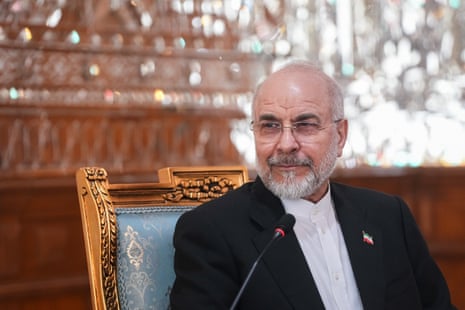
Mohammad Bagher Ghalibaf, Iran’s top negotiator in the peace talks and the country’s parliament speaker, said in a post on X this morning:
double quotation markThe era of one-sided deals is OVER. We told you: keep your word or pay the price. Reality is knocking.
Although he didn’t go into detail about what he meant, Ghalibaf published his post alongside an image of a section of the US-Iran memorandum of understanding that Tehran interprets as meaning it has the ultimate say about what routes ships can use while travelling through the strait of Hormuz.
Mohammad Bagher Ghalibaf, a senior Iranian negotiator and parliament speaker, has said US pressure would not lead anywhere. Photograph: Hamed Malekpour/Iranian Parliament Communication Office/ Handout via Getty Images
In response to the US attacks against Iran, Iran’s Islamic Revolutionary Guard Corps claimed they had destroyed a command and control centre and drone hangars in Jordan, targeted a US radar site in Kuwait, attacked US aircraft carrier support and refuelling platforms in Oman and destroyed a jet maintenance centre and command facility in Qatar. We have not been able to independently verify these claims.
Here are some of the reactions from the US-allied countries apparently targeted by Iran:
Qatar
A child was among three people injured by falling shrapnel after the country’s air defences intercepted attacks earlier today, Qatar’s interior ministry said.
Qatar said the injured people were receiving medical attention and did not report any casualties.
In recent weeks, Iran had hit Kuwait and Bahrain while avoiding Qatar, a key diplomatic mediator, since early April. Doha has previously said it would not act as a mediator if it came under attack.
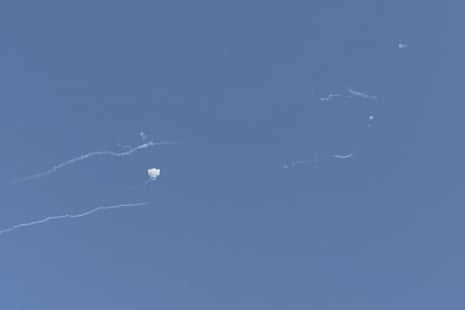
Air defence systems are activated over Doha after explosions were heard amid a missile attack on 12 July, 2026. Photograph: Ali Altunkaya/Anadolu/Getty Images
UAE
The UAE, meanwhile, said missile threats were detected this morning outside its “borders”, adding that the monitoring of security threats is happening “around the clock”.
Kuwait
Kuwait’s foreign ministry condemned what it called “sinful” Iranian aggression that targeted it this morning, saying it represented a violation of international law and was a direct threat to the safety of its citizens.
Bahrain
In a series of posts on X this morning Bahrain’s interior ministry said sirens had been sounded and urged residents to head to the nearest, safest location.
Jordan
Jordan’s communication ministry said three Iranian missiles had fallen within its territory this morning, causing minor material damage but no casualties.
Oman
The Omani state news agency said drones struck sites in northeastern Oman, in the area that sits on the strait of Hormuz.
Lindsey Graham, key Trump ally, has died after sudden illness, his office says
David Smith
Lindsey Graham, a longtime US senator and key ally of Donald Trump, has died from a sudden illness, his office said in the early hours of Sunday. He had just turned 71.
Graham’s abrupt death will send shockwaves through Washington and the Republican party. He had served in the Senate since 2003, representing South Carolina, and was running for re-election in November.
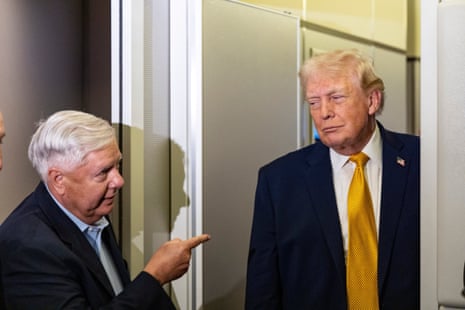
Lindsey Graham gestures as Donald Trump speaks with reporters while in flight on Air Force One in January 2026. Photograph: Alex Brandon/AP
Graham, a retired air force reserve colonel who specialised as a military lawyer, was known as a hawk who supported the Iraq war and had long urged military action in Iran.
He opposed the nuclear agreement negotiated by President Barack Obama and has been one of Trump’s most outspoken defenders in the current conflict.
Several leaders in Israel expressed condolences. Itamar Ben-Gvir, the national security minister, posted on X: “Today, Israel has lost one of its greatest friends. Senator Lindsey Graham stood with Israel not because it was easy, but because he believed it was right. His unwavering support, courage, and moral clarity earned him the admiration of millions of Israelis.”
India’s foreign ministry has condemned an attack on the commercial vessel – GFS Galaxy – off the coast of Oman earlier today.
It said 10 of the 11 Indian nationals on board have been rescued, while one remains missing.
India’s embassy in Oman is closely monitoring the situation, and coordinating with the Omani authorities in the ongoing search and rescue operation, the ministry said.
double quotation markThe continuing incidents of attacks on commercial shipping in the region are deeply worrisome. We reiterate our call for immediate de-escalation of tensions, and the conclusion of ongoing negotiations for a diplomatic solution so that peace and stability can return to the region.
The targeting of commercial shipping and civilian infrastructure in the region must end, and free and unimpeded navigation and commerce through the international waterways in the region, in keeping with international law, must be restored at the earliest.
Iran has taken control of the strait of Hormuz with 'power', official says
Ebrahim Rezaei, the spokesperson for the Iranian parliament’s national security and foreign policy commission, has said that Iran has taken control of the strait of Hormuz with “power”.
double quotation markWe have taken control of the strait of Hormuz with power, and we will preserve it with power as well.
The latest exchange of strikes came hours after regional diplomats finished talks aimed at resolving the impasse over the strait of Hormuz, which Iran has sought to assert its sovereignty over and sees as its main point of leverage in negotiations with Washington.
During Saturday’s talks, Oman proposed a plan to fully reopen both shipping lanes through the strait, according to US outlet Axios, citing a diplomat briefed on the negotiations.
The report said that under the proposal the southern route through Omani waters would reopen without the need for prior approval, reverting back to the position in place before the US and Israel attacked Iran in late February.
The Iranian delegation, however, was unable to gain approval for the plan in Oman and took it back to Tehran for internal deliberations, the diplomat told Axios.
The US is demanding that Iran publicly state it will stop attacks on ships in the strait - and that all lanes will be open with no tolls through the waterway.
Iran attacks Gulf countries after fresh US strikes
Iran launched missiles and drones at its Gulf neighbours this morning in retaliation to a number of US strikes and announced the closure of the strategic strait of Hormuz until further notice.
Jordan, Bahrain, Qatar, Oman and the UAE all reportedly came under attack, in the latest escalation that undermines the US-Iran memorandum of understanding aimed at ending the war.
The US said it had struck Iran early on Sunday after the country’s Islamic Revolutionary Guard Corps (IRGC) fired on a Cyprus-registered container ship they claimed was sailing an “unauthorised route” through the strait of Hormuz.
According to state media, the IRGC then said they had hit a second vessel, accusing it of “violating regulations”.
“A vessel that had jeopardised maritime security by switching off its systems was struck and brought to a halt,” the navy of the IRGC said.
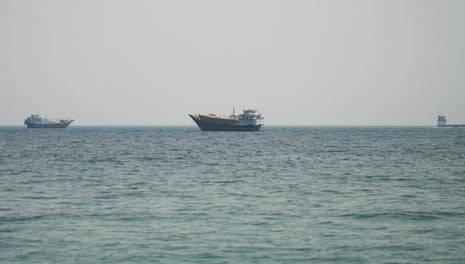
Vessels at the strait of Hormuz, as seen from Oman on 12 July 2026. Photograph: Reuters
A short time later, US Central Command said its forces had carried out a round of strikes against Iran, attacking at least 140 targets.
“The United States is imposing a heavy cost by continuing to degrade Iran’s ability to attack civilian mariners and commercial ships freely transiting the strait,” the military said.
The targets included missile and drone sites, naval capabilities, ammunition depots, communication networks and surveillance locations, it added.
The IRGC said that in response to American attacks it closed the strait of Hormuz, through which about a fifth of the world’s oil supplies usually flow, until further notice as it warned of a severe response to US “aggression”.
It comes after incidents earlier this week which saw the most extensive exchange of fire between the two sides since the interim deal was signed last month.
US central command said 80 targets had been struck in the early hours of Wednesday in response to Iranian attacks on three commercial vessels that were transiting through the strait of Hormuz on Tuesday.