Greece returns priceless relics – and suggests UK should follow suit with Parthenon marbles
tags:In a ceremony replete with the sort of fanfare usually reserved for great events, Greece and Bulgaria have formally exchanged “a treasury” of relics and bones, sealing a cultural deal negotiated over decades.
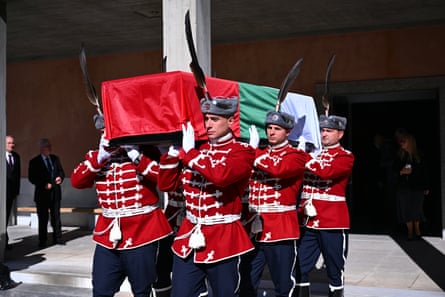
The handover involved priceless religious objects removed from Greece at the height of the first world war, as well as remains thought to belong to Tsar Samuel, Bulgaria’s revered medieval warrior ruler.
Greece hailed the exchange as emblematic of the headway countries could make in similar repatriation disputes, with the prime minister, Kyriakos Mitsotakis, saying he hoped the accord would bolster Athens’ campaign to retrieve the Parthenon sculptures and send a clear message to Britain.
“The global community is essentially re-evaluating its longstanding stance on protecting cultural heritage,” he told a crowd gathered for the ceremony in Thessaloniki on Saturday. “This shift is embodied by today’s initiative, which rests on the obvious principle that monuments and historical heirlooms cannot be treated as spoils of war, nor as the result of circumstances subsequent to their creation.”
The Greek-Bulgarian deal, reached after 50 years of intense cultural diplomacy between the two neighbours, was also an example of the “political will” needed to settle the west’s longest running cultural row, Mitsotakis said, referring to the fifth century BC Parthenon marbles. “It took time, and above all, political will and determination to overcome the obstacles of the past,” he added.
Under the agreement, 48 relics, including icons, crosses and ornate ecclesiastical vessels, pillaged by Bulgarian troops from churches and monasteries in northern Greece during the first world war, will be returned to Athens. In the more than 100 intervening years, they had been safeguarded at the National History Museum in Bulgaria.
Meanwhile, the remains of Tsar Samuel, regarded as a national hero for his role in battling to preserve his country’s independence from the Byzantine empire, were discovered by archaeologists more than 60 years ago in a border area of Greece.
Authorities arranged a homecoming with full state honours, with the tsar’s bones flown to Sofia, the Bulgarian capital, on a military aircraft accompanied by an escort of jet fighters and a 21-gun salute upon arrival. Free transport had been organised for pilgrims to pay their respects.
In his own address at the handover, Bulgaria’s prime minister, Rumen Radev, a former air force officer, said: “These are items that belong to both our peoples; they constitute our memory and our bond, and our compatriots and future generations deserve, and must have, the opportunity to pay tribute to their ancestor. If in the past Tsar Samuel divided us, I can say that today he unites us. He strengthens our strategic cooperation and makes the historical relations between our states and peoples even stronger.”
Mitsotakis emphasised that Greece’s campaign to win back the Parthenon marbles was neither “dictated by a vague national claim, nor does it call into question the mission of museums worldwide”.
Athens remained committed to repatriating the sculptures, he said, because it would allow viewers to fully enjoy what has long been seen as the high point of classical art if the masterpieces were reunited.
“It is precisely this same principle – the principle of the integrity of a monument – that underpins our continuous efforts to reunite the Parthenon sculptures. The Parthenon constitutes a unique and singular case,” he said of the building that is the predominant temple on the Acropolis of Athens.
“[The campaign] is about the restoration of a universal monument that remains violently dismembered. My country will not accept arrangements that imply recognition of foreign sovereignty or the supposed borrowing of its own treasures. On the contrary, it now believes that the time has come for truth, for reason, for justice and morality.”
The fifth century BC carvings were sawn from the Parthenon on the order of Lord Elgin, Britain’s then ambassador to the Sublime Porte, in what have since become highly contentious circumstances.
They were acquired by the British Museum in 1816 after the bankrupt peer was forced to sell them and have been on display there ever since.