Can better civics education restore voter dissatisfaction over political corruption?
tags: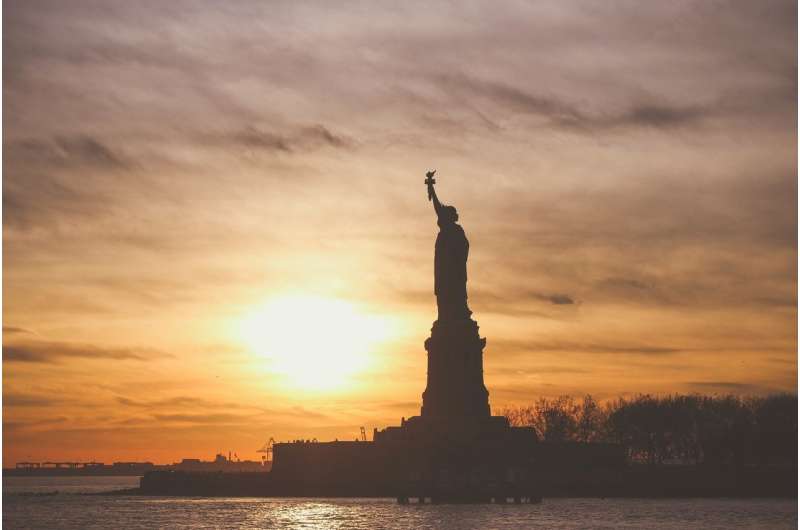
This summer, America celebrated the 250th anniversary of the signing of the Declaration of Independence, widely recognized as the formal founding of our nation and one of the early stages of establishing a democratic government.
Over the past two decades, in particular, democracies all over the world have struggled with a lack of clear support. Democracy scholars have referred to these challenges as evidence of backsliding, in which political institutions slowly erode from within by backing away from democratic rules and norms and abandoning pro-democratic behavior. This phenomenon has many political and social scientists concerned.
One indicator of a democracy's health is how satisfied a country's citizens are with their system of government and how committed they are to making it successful. Depending on how happy citizens feel about it, they will behave accordingly—either by participating in democratic processes and living out democratic ideals or not.
Democratic dissatisfaction predicts lower civic engagement
On this point, a study recently published in the Proceedings of the National Academy of Sciences found that dissatisfaction with democracy resulted in lower support for democratic behaviors in Mexico, according to development economist and co-author Enrique Seira Bejarano of the University of Notre Dame. Seira, the Joe and Deborah Loughrey Professor of Economics, studies how malfunctioning political institutions can cause economic issues and how democracy benefits and spurs economic growth in a country.
Surveying more than 50,000 Mexican citizens across 6,300 electoral precincts during Mexico's 2017 state elections, Seira and his research team found that low levels of satisfaction led to a reluctance to participate in three democratic activities: attending poll worker training (a requirement for citizens during elections), staffing a polling station on Election Day and voting in the presidential elections a year later.
"We find that dissatisfaction with democracy predicts lower democratic engagement across all three behaviors," Seira and his co-authors wrote. Rather than relying on self-reported behaviors or country-level comparisons, the researchers studied the link between satisfaction with democracy and democratic behaviors at the individual level, merging administrative measures and analysis to create original data.
The research indicated that the more dissatisfied citizens were, the less they engaged. Those who reported the lowest level of satisfaction (in other words, surveyed as "not at all satisfied") were 4.6% less likely to attend poll worker training, nearly 12% less likely to staff their polling station and 2% less likely to turn out to vote.
Based on data from the Integrated Values Surveys, Mexico ranks 54th out of 75 democratic countries in average levels of dissatisfaction with democracy, according to the study. This suggests that numerous other countries are struggling with the same challenges—if not more so—than Mexico.
"Both globally and in Latin America, citizens' satisfaction with democracy has decreased by 10 to 15 percentage points since 2010," the researchers wrote.
Relatedly, in the United States, the share of citizens who think it is essential to live in a democracy is 71% for those born in the 1930s versus 29% for those born in the 1980s, Seira and his co-authors noted.
"Support for democracy as measured in surveys—which has been on a more than decade-long decline—is worrisome, since it is associated with a decline in civic behaviors," Seira said.
How corruption erodes trust, diminishes support
But what causes citizens to lose favor with their system of government and way of life?
According to Seira, who is also a faculty fellow at Notre Dame's Kellogg Institute for International Studies, part of the Keough School of Global Affairs, there are several potential reasons. One is that American voters and those in other parts of the world are growing impatient with gridlock in Congress and how government struggles to accomplish goals and objectives.
Another possibility is that the welfare state has been retreating worldwide since the financial crisis of 2008, and citizens place blame on their democratic governments for causing some of that downfall. A third possibility is the influence of social media, which causes polarization in societies both in the U.S. and abroad, making it harder for democracies to function.
Yet another possibility—and one that has received less attention—is that citizens increasingly perceive corruption (the use of public office for private gain) as endemic. "The fraction of Americans who think the U.S. government is corrupt has been increasing and is now close to 70%—and, surprisingly, it is on the same level as democracies in Latin America," Seira said.
This statistic led Seira and his co-authors to conduct a second study on democracy—this one looking at whether and how government corruption leads to further civic disengagement. Seira and fellow researchers from MIT and Stanford studied 17 Latin American countries using both a field experiment and tens of thousands of surveys collected over a decade.
In their working paper, Seira and his team found that when citizens were exposed to high-level politicians' scandals, individual voter turnout causally decreased by 10 to 20 percentage points. In addition, contributions to support elections and honesty and trust between individual citizens all suffered. Furthermore, voting was affected most when incumbents perceived as honest were implicated in corruption cases close to election time.
"When they hear about these scandals involving high-level officials such as presidents, cabinet members, prime ministers and justices, voters are less likely to turn out to vote by 20 percentage points," Seira said. "When a president steals, citizens don't just lose faith in that president—they lose faith in democracy itself.
"And we show it causally," Seira explained. "Watching real footage of top politicians taking cash cut actual voter turnout by up to 27% and lowered support for democracy. Democracy is built on the promise of political equality, and corruption undermines that very promise."
Citizens' willingness to donate time to support the organizations of democracy—by volunteering to be an electoral observer, for example—decreased by 43% (relative to the 4.9% who volunteered on average). It similarly reduced their willingness to donate money in support of election activities by 16% (relative to 22.8% who donated). Even more worrisome, the researchers discovered, is that when top-level politicians participated in corrupt activities, explicit support for democracy declined in favor of authoritarianism.
Seira said the media plays a big role in highlighting political scandals. "The number of news stories about corruption has tripled in Spanish and doubled in English in the last 20 years, which just means that more of these events are in the public eye than they used to be."
This visibility creates an unfortunate trade-off, one for which a solution needs to be found, according to Seira. On the one hand, public disclosure forces accountability and denunciation of such behavior, which is needed for democracies to work. On the other, when citizens see that the system is corrupt at the highest levels, it can be very damaging to the credibility of the system itself. The culprit may not be that corruption is disclosed, but that it goes unpunished, as is often the case in Latin America and other developing countries.
In the field experiment part of the study, Seira and his colleagues found not only that corruption undermined citizens' trust in democratic institutions, but that trust in one another also suffered, with citizens less willing to entrust neighbors with money in incentivized lab-in-the-field experiments. In addition, exposing citizens to footage of their politicians taking bribes made it seem as if such behavior was acceptable, prompting individuals to steal money the researchers had endowed them with.
Can better civics education help?
Providing ample and relevant civics education to the next generation may be one way to strengthen democracy while combating dissatisfaction and corruption, Seira believes. Because the effectiveness of civics courses has not been widely tested, Seira and his co-authors are currently conducting research through a multi-country study of the effects of civics education on democratic behaviors.
"What we want to know is how effective these courses are," Seira said. "Do they generate more informed citizens? Do they allow citizens to critically assess the alternatives to democracy? Are citizens more willing to donate time and effort to support democracy? And to what extent can we make better citizens through education?"
Seira noted that even though the first two studies were conducted in Mexico and Latin America, respectively, and were not specifically reliant on U.S. data, parallels can be drawn between the regions and in how survey participants would have responded. The third study is ongoing.
Publication details
Andrés Santos Vargas et al, Satisfaction with democracy predicts democratic behaviors, Proceedings of the National Academy of Sciences (2026). DOI: 10.1073/pnas.2517671123
Working paper: Apex Corruption Erodes Democratic Values
Who's behind this story?

BA art history, MA material culture. Former museum editor, paramedic, and transplant coordinator. Editing for Science X since 2021. Full profile →

Bachelor's in mathematical biology, Master's in creative writing. Well-traveled with unique perspectives on science and language. Full profile →
Citation: Can better civics education restore voter dissatisfaction over political corruption? (2026, August 11) retrieved 12 August 2026 from https://phys.org/news/2026-08-civics-voter-dissatisfaction-political-corruption.html
This document is subject to copyright. Apart from any fair dealing for the purpose of private study or research, no part may be reproduced without the written permission. The content is provided for information purposes only.