5 Exotics That Are More Practical Than You Might Expect - Jalopnik
tags:
Sjo/Getty Images
No matter what you think of hypercars or super sports cars, these beacons of road-legal engineering represent what happens when engineers chase speed, performance, and handling even at the expense of other things we've come to expect from a car. Start with the engine. It usually sits in the mid or rear section, which helps with weight distribution but it messes with practicality, visibility, and overall proportions.
That layout also eats into the space where a normal car keeps its trunk, so you're often left with a frunk barely big enough for a weekend bag. On top of that, they're typically two-seater, two-door cars that don't offer the luxury of four seats and doors, and they obsess over shedding weight, so anything that isn't strictly necessary — sound deadening, cupholders, a proper infotainment screen — sometimes doesn't make the cut.
Then there's the ride: suspension tuned for the track, ground clearance that turns every pothole into a potential insurance claim, and cabins that can be quite difficult to climb in and out of. Ultimately, performance and practicality tend to sit on opposite ends of the spectrum; chase more of the former and you'll usually end up with less of the latter. Still, a handful of cars manage to give you the best of both worlds. Here are five exotics — including the Koenigsegg Gemera, Chevrolet Corvette ZR1X, and Ferrari Purosangue — that are more practical than you might expect.
Koenigsegg Gemera
Martyn Lucy/Getty Images
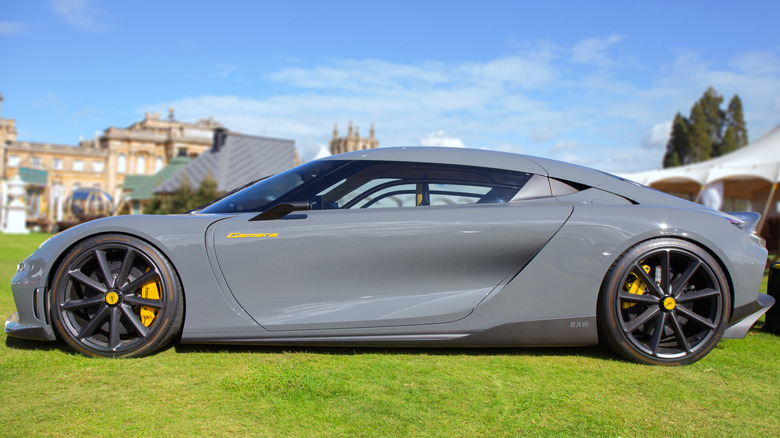
If you know anything about Koenigsegg, you know it was never a brand focused on practicality, but rather record-breaking top-speed runs and hypercar levels of performance. Still, there is one Koenigsegg model that does it a bit differently — the Koenigsegg Gemera. In our ridiculously detailed look at the Koenigsegg Gemera, we noted that the car basically offers family-hauler levels of practicality thanks to huge doors, four seats, and lots of luggage space.
The Gemera is the only hypercar to offer that kind of genuine four-seat practicality. This is not your typical Honda Odyssey, but rather a 2,300-horsepower car that combines 5-liter twin-turbo V8 power with electric motors. Its top speed is estimated at 249 mph, and it reaches 62 mph in 1.9 seconds.
Where the Gemera separates itself from the hypercar pack is inside. Koenigsegg fits four equally sized heated bucket seats, and describes it as a car where the rear and front seats accommodate four adults with ease. Three of the four seats come with Isofix anchor points for child seats, it has wireless charging for your phone, and eight genuine cupholders — four heated and four cooled.
The Gemera holds 7.1 cubic feet of luggage and fits four full-sized carry-ons. If you need even more space than that, you can outfit it with roof racks and cargo boxes for ski trips. It is a genuinely unheard-of level of practicality in this segment.
Chevrolet Corvette ZR1X
Erman Gunes/Shutterstock
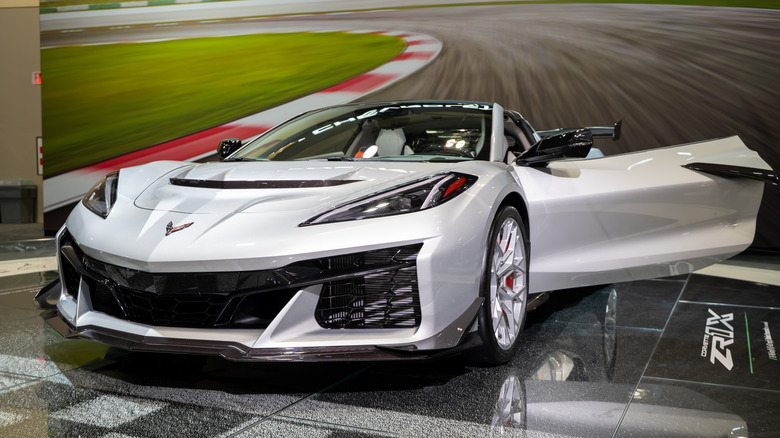
Some people will dismiss the ZR1X as an exotic because it isn't special enough, but since it can match or sometimes even outrun a Bugatti Chiron or a Koenigsegg Jesko on a drag strip, it would be pure nonsense to skip it. The ZR1X is a weapon of a car. It can do 0-60 on prepped surfaces in less than 2 seconds, with a quarter-mile time of less than 9 seconds.
You'd expect a car like this to be extremely compromised. For instance, the Aston Martin Valkyrie offers similar straight-line performance and power, but to have a conversation in the Aston, you need noise-canceling earphones because it's so loud. The Aston excels as a performance car, but that's all.
The Corvette is different. For starters, it has a proper 9.1-cubic-foot trunk, even though it's a rear-mid-engined car with insane levels of performance. This is more than you get with the Audi A3 sedan, a car designed for practicality within its segment. Plus, the ZR1X has a decent amount of storage space behind the two seats.
When Tim Burton, aka Shmee150, who has driven pretty much everything, documented his U.S. cross-country ZR1X trip on his The Shmuseum channel, he said at the end, "It just amuses me how a 1,250-horsepower car ... can take as much luggage as it does." He added that he didn't "think there's a single other car in the world that can say it does that."
Ferrari Purosangue
Martyn Lucy/Getty Images
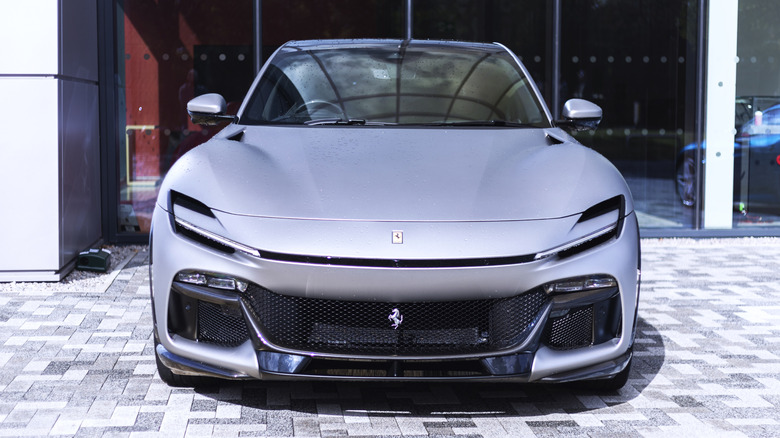
When you want to buy a front-engined, naturally aspirated V12 Ferrari with upward of 700 horsepower, you probably want it because you love exotic GT sports cars with superior levels of performance. That's what the Ferrari 12Cilindri is for, since it's a low-slung car that seats just two. However, if you want four seats, four doors, lots of luggage space, and a large cabin, you can still have a naturally aspirated Ferrari V12 in the Purosangue, which is as close as Ferrari gets to a family hauler.
Ferrari doesn't like people calling the Purosangue an SUV; the company prefers FUV (Ferrari Utility Vehicle). Branding saltiness aside, the Purosangue does most of the things you'd expect from a posh SUV. It comes with a 16.7-cubic-foot trunk, the biggest cargo area of any Ferrari ever built. It has four separate, individually adjustable heated seats, a 10.25-inch infotainment screen, surround-view cameras, and a Burmester sound system.
The Purosangue's SUV stance has even caught the eyes of off-road tuners. German specialist delta4x4 published a concept study imagining the Purosangue as an off-roader, rendered with a lift kit, all-terrain tires, and a rooftop tent. Sure, it's a design exercise rather than a built car, but it's also a sign of how far the FUV idea can stretch.
Before the Purosangue, Ferrari's four-seaters were the FF and the GTC4Lusso — but both were two-door shooting brakes. The Purosangue is Ferrari's first four-door, and with its spacious trunk, it's the most usable of the three for family duty. If you don't like the Purosangue's looks, of course, you can go instead for a Ferrari Mansory that arguably looks better.
McLaren GT
Just dance/Shutterstock
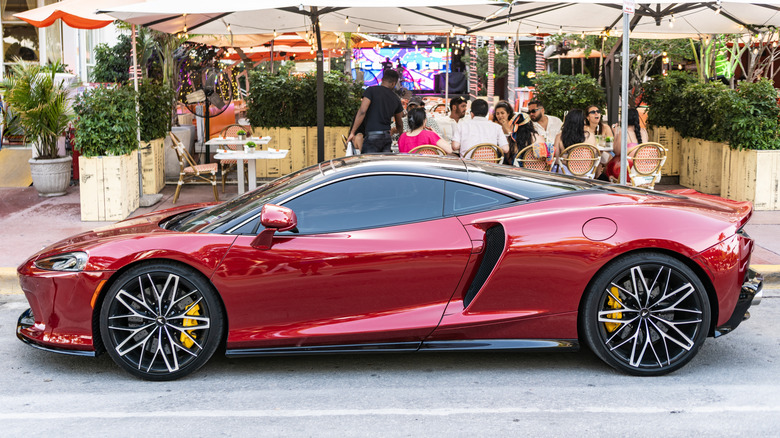
McLaren is the idea of an exotic to many people, because it truly goes to town with performance as the number one thing and everything else close to irrelevant. This is why McLarens are typically the lightest cars in their segments, and why they use carbon-fiber monocoque chassis. This makes the cars more rigid, lighter, and better-handling, but isn't the best in terms of sound deadening, comfort, and ride quality.
The GT is the exception — a McLaren built specifically for grand touring. It's mid-engined like every other McLaren, which normally leaves nowhere to put luggage, yet it gets a 15-cubic-foot load area behind the cabin and a 5-cubic-foot compartment up front, for a total of 20 cubic feet. This is more than you get from the rear trunks of the 2026 Mercedes S-Class and the 2026 Mazda MX-5 combined.
The rear space sits above the engine, under a glass tailgate — a long, shallow shape that will fit your golf bags, skis, boots, and whatnot. Living with it is easier than the car's shape suggests. A hydraulic nose lift raises front ground clearance from 4.3 to 5.1 inches over speed bumps, and there's a 19-gallon fuel tank for long stints between fills.
None of it waters down the McLaren part: a 4.0-liter twin-turbo V8 rated at 612 horsepower, a curb weight of 3,373 pounds, and 62 mph in 3.2 seconds. In December 2023, McLaren lightly revised the GT into a successor called the GTS, bumping power to 626 horsepower and trimming 22 pounds, all while retaining the practicality that was the whole point of the McLaren GT.
Porsche 911 992.2 Turbo S
Brandon Woyshnis/Shutterstock
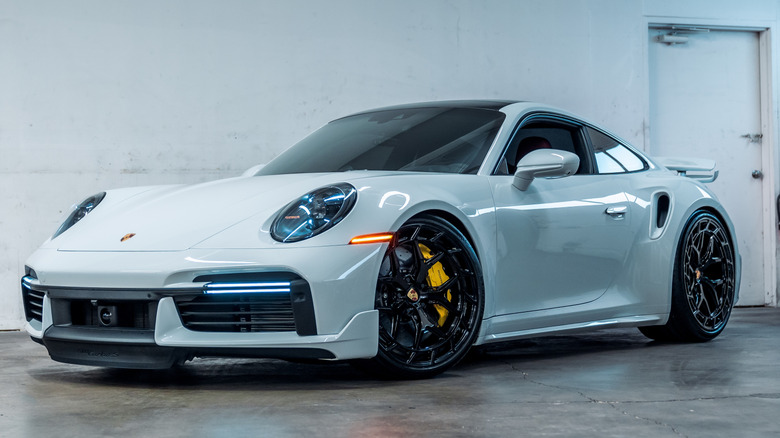
If daily driving a 200-mph-plus car is something you want to do, it's difficult to find one that does it as well as the 701-horsepower 911 Turbo S. It's a 911, which means it will start every time, it won't be temperamental, and you can drive it to work without much fuss. When the road lets you, you can even reach 60 mph in 2.0 seconds and keep going until you reach a limited top speed of 200 mph. Plus, the new 2026 911 Turbo S is a T-Hybrid, so it will return an EPA-estimated combined 18 mpg.
The party trick isn't just speed, though — it's that none of it comes at the cost of living with it. Where a mid-engined exotic gives you two seats and a shallow frunk, the Turbo S is a two-plus-two with rear seats and all-wheel drive. The frunk holds 4.8 cubic feet, and the rear cargo area behind the seats adds another 9.2 cubic feet; fold or delete the rear seats and that grows to 13 cubic feet.
Owners routinely fit two carry-on suitcases up front and up to six behind the seats, which is more than enough for two people to travel for a week. The beauty of the 911 Turbo S is that it isn't as shouty as all the other cars on this list. It doesn't come with massive rear wings or loads of expensive carbon fiber that costs a ton if damaged, and it isn't too loud or too in your face. It's a supercar you could genuinely use as your only car — which, on a list about practicality, might make it the most practical exotic of them all.