Question: What's the difference between wheelchair tennis and quad wheelchair tennis?
Grace in Newcastle
Answer: The Open division is for players whose impairment affects their lower limbs, while the Quad division is for athletes with impairments affecting three or more limbs, including reduced arm or hand function. That additional upper-body impairment makes shot-making and racquet control even more challenging.
…%!s()
Why is the prize money for wheelchair players so much less than non-wheelchair players when their expenses may be greater?
Hilary in Poole and Susan in Scotland
Answer: The draw size is smaller in wheelchair tennis than in non-wheelchair tennis, meaning there are fewer rounds so less prize money in the pot. But it is an area that is improving every single year. Compared with most other disability sports it's very high. Each Grand Slam event will have a different rationale behind their prize money.
Question: What speed do gents wheelchair players serve at?
Roger in Bedford
Answer: In the men's division, Tokito Oda has the fastest serve in the world and tops out at about 112mph. In the women's division Diede de Groot, one of the best players of all time, has a serve of about 90mph, so also pretty fast!
Typical first serve speeds are 90-115mph (145-185kmh) in the Men's Open division. The biggest servers can occasionally reach 120mph (193kmh).
In the Women's Open division, typical serve speeds are 70-95mph (113-153kmh) and the fastest servers may occasionally exceed 100mph (161kmh).
The Quad division can see serves of about 55-90mph (89-145kmh) for men and 50-80mph (80-129kmh) for women. Speeds vary more here because of the differing levels of upper-limb function.
Question: Is the net the same height for wheelchair tennis?
Rachel in Lincolnshire
Answer: Yes the net is the same - every single thing in terms of the court, the dimensions, net height is exactly the same for wheelchair players as it is for standing players.
Question: How is Hawk-Eye adjusted to account for the Wheelchair game?
Danesh in Horsham
Answer: Hawk-Eye isn't affected by whether it's tracking play from a standing or wheelchair player as it only tracks the ball. In fact, in some ways Hawk-Eye is a better system than line judges in wheelchair tennis, because something that used to happen with officials is that a wheelchair player could block their view of the line more.
Question: Do wheelchair players use different wheels for different surfaces?
Jill in Norfolk
Answer: The key thing players often change per surface is a slight tyre pressure adjustment. So on a surface such as grass they might let a little bit of PSI out of the wheels so they don't dig in quite as much, but the wheels themselves stay the same. The only time there is an actual wheel rule is when it comes to castors - the smaller wheels at the front and back of the wheelchair. Wimbledon have a special rule where they have to be a certain width just to make sure they don't damage the grass.
Question: Is there a foot fault equivalent in wheelchair tennis?
Lynda in Edinburgh
Answer: It's called a 'wheel fault' if the front wheel is over the line before the serve has been hit.
Question: Do the wheelchair tennis players use different chairs for singles/doubles to optimise for speed/manoeuvrability, or do they stick to one chair? And what are the wheelchairs made from?
Answer: Tennis wheelchairs are made of:
Aluminium alloy - The most common material. It's lightweight, durable and relatively affordable, making it popular for club and competitive players
Titanium - Premium chairs often use titanium. It's lighter than aluminium for the same strength, absorbs vibration well and resists corrosion, but it is significantly more expensive.
Carbon fibre - Used for selected components (and occasionally parts of the frame). Carbon fibre is extremely light and stiff, helping improve acceleration and manoeuvrability.
They use the same wheelchairs for singles and doubles.
This article is the latest from BBC Sport's Ask Me Anything team. %!s()
An on-air analyst for a top US sports broadcaster says he is pulling back from his role indefinitely as he heals from a car crash in Missouri that forced him to undergo a life-saving amputation – and while he reportedly faces a law enforcement investigation into possible financial improprieties connected to what he billed as side charity work.
… %!s()
Matt Miller’s announcement on Friday that he was taking indefinite leave from ESPN provided only the latest twist in an unusual case that has drawn significant attention from both media as well as the substantial number of American football fanatics who follow his area of expertise: the process by which NFL teams select, or draft, collegiate prospects.
The saga centering on Miller effectively began on 23 June, when he shared on the social media platform X that he had recently been in a devastating car crash in his home state of Missouri for which he had to have his left arm amputated to save his life.
Missouri’s KOAM News reported that Miller had crossed into oncoming traffic and collided with a semi tractor trailer truck while on a state highway on 18 June. KOAM said that Miller was then flown to a hospital, attributing the information to authorities and friends of his.
In addition to the amputation, Miller, 42, wrote that he had suffered multiple fractures and broken ribs, leaving him to navigate “a long road”.
“I’m focused on my recovery and taking things one day at a time,” he wrote.
Miller’s post about his crash shocked the roughly 316,500 followers that he had accumulated on X alone through his work. The native of Joplin, Missouri, had contributed NFL draft analysis to the online publication Bleacher Report and ESPN for 12 years before making his on-air debut at the latter of those outlets in April 2023.
And as word of his plight spread across the digital sports landscape, many contributed to an online campaign meant to help Miller raise money to help cover his medical costs. Prominent ESPN personalities including Pat McAfee, Mina Kimes and Adam Schefter contributed to the campaign as it raised more than $50,000 for Miller.
But the fundraiser was ultimately paused after Miller was met with a series of complaints alleging that he had fielded payments for certain endeavors without delivering in return what was promised. In question was work he ostensibly did on the side, such as administering fantasy football leagues or paid lessons on scouting prospective ball players that were supposed to generate money for charity.
A 21 May thread on the Reddit platform named “Matt Miller Leagues and Scam” contained many allegations against him, gained notice as news of the crash and fundraising campaign proliferated, and caught the attention of the US sports news and media website Awful Announcing.
Awful Announcing reporters then said they spoke to at least seven people who recounted paying entry fees as high as $500 for charity fantasy leagues whose commissioner was Miller – then not being able to reach him when they sought to collect their winnings or information about where the charitable proceeds had ended up.
One person quoted by Awful Announcing detailed paying Miller $500 for scouting lessons – and getting back only a single, five-minute phone call.
The outlet said more than 40 additional people contacted Awful Announcing with similar accounts about Miller after publishing its reporting. Many provided evidence bolstering their stories, according to Awful Announcing.
Awful Announcing established that compliance failures had resulted in the forcible dissolution of a charity run by Miller in 2019. It reported that an account associated with Miller on the fantasy football platform Sleeper was listed as the commissioner of 91 leagues during the 2025 NFL season alone.
According to Awful Announcing, people who spoke to the outlet said “there was a surge of communication and repayments in the days before Miller’s crash”, though it was unclear to them what may have precipitated that.
skip past newsletter promotion
after newsletter promotion
All of those circumstances gave way to an early July statement from the Missouri state attorney general’s office telling Awful Announcing and other outlets that the agency had “an open investigation into this issue” with Miller. The office asked anyone believing “they may have been misled” to contact the agency, saying Missouri’s attorney general, Catherine Hanaway, “takes consumer protection very seriously”.
Miller’s first statement since the news about the attorney’s general office investigation was on Friday, and it conspicuously did not address the inquiry confirmed by the agency.
But Miller’s statement did declare that the surgery to remove his left arm “was successful with hopes of an eventual prosthetic replacement”. And it said related “femur and patella surgeries were also successful”, saving Miller’s left leg.
That statement then addressed Miller’s short-term professional future, saying: “To best focus on my healing and recovery, I’m stepping away indefinitely and will be placed on leave from ESPN.
“Thank you to all for the prayers and thoughts; please keep them coming.”
Schefter and former all-pro wide receiver Michael Thomas were among those who responded to Miller’s post on Friday, with each expressing their wish for him to have a “speedy recovery”.
The Guardian understands Miller’s leave from ESPN is strictly medical in nature, aims to allow him to focus on recovering from the crash, and therefore is likely to be for an extended period.
Meanwhile, a source with direct knowledge of the situation told the Guardian that ESPN also anticipates addressing the Missouri attorney general’s investigation into Miller, though it was not immediately clear when that may be. %!s()
The Israel-Gaza war created gaping divisions in the Democratic party and contributed to a resounding loss in a critical presidential election year in 2024. Two years later, the issue continues to dominate races across the country, as progressives try to seize on Israel’s falling popularity and a broad anti-war sentiment ahead of November’s midterms.
… %!s()
A recent debate among two Democrats vying for one of the most competitive US Senate seats in the country openly displayed the tension between progressive and moderate camps of the party.
“They clearly want one individual and it’s not me,” Michigan Democratic contender Abdul El-Sayed said, referring to pro-Israel groups such as the American Israel Public Affairs Committee that are spending against him. “So long as our politicians continue to be bought off by Aipac, do not be surprised when we fight wars that are in their best interest to annex Lebanon, or to do genocide in Gaza.”
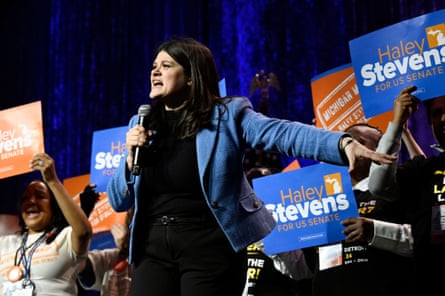
Haley Stevens, the moderate US representative benefiting from pro-Israel spending in the Senate race, retorted that Israeli prime minister Benjamin Netanyahu was “trashing” her on CNN that day, saying she wasn’t afraid to stand up to Israel either.
“No one owns my vote and no one owns my policies,” she said during the debate. “Anyone who is contributing to my Senate campaign is doing so because of my proven record of fighting for Michigan.”
Senate candidate Abdul El-Sayed at a campaign rally in Detroit in May. Photograph: Sarah Rice/Getty Images
The careful balance of rhetoric and policy required of candidates trying to capture American sentiment on Israel has become a fraught litmus test.
A poll by the Associated Press in June shows a third of US adults of all political backgrounds, and roughly half of Democrats, believe Israel has committed genocide in Gaza. The share of Democrats who said the US was too supportive of Israel was nearly 60%, up from 45% in January 2024.
While younger Democrats were more likely to hold this view, older Democrats increasingly share it too, the poll found. Barack Obama official and moderate Democrat Rahm Emanuel’s speech in Tel Aviv this week could serve as evidence of that shift. With his eye on the 2028 presidential election, the former mayor of Chicago emphasized that US military aid to Israel should end, and in related interviews said he wouldn’t take money from Aipac. Both of these statements would have been taboo for a moderate Democrat a few years ago.
This year, the prominent role that foreign wars and outsized political spending play in the primaries has been particularly stark in Michigan. El-Sayed frequently ties these wars to affordability, saying he wants to invest in families in the US through healthcare or schools or infrastructure rather than sending billions to wars overseas. His campaign put up a website looping Stevens saying, in part: “Israel comes to me in my dreams”.
The United Democracy Project, an Aipac-affiliated Super Pac, has spent about $11m to boost Stevens or oppose El-Sayed so far, with more ad buys slotted for the last few weeks of the primary, which is set for 4 August. The group is one of the biggest spenders in congressional elections.
“We are trying to ensure that pro-Israel Democrats have a voice in the primary process,” said Patrick Dorton, a spokesman for the Aipac Super Pac. “There is an insidious attempt by fringe left socialists to drive pro-Israel Democrats out of the party. We are not going to let what happened to the Labour party in the UK happen to the Democratic party in the United States.”
Haley Stevens in Detroit in May. Photograph: Jose Juarez/AP
But pro-Israel groups are also facing increasing headwinds nationwide. In New York, a slate of democratic socialists who didn’t hesitate to speak out against the war in Gaza have notched victories against incumbents. In Colorado, a Democratic socialist who had been fired after speaking out about Gaza beat a longtime representative. A doctor who worked in Gaza won a Democratic primary in New Jersey. In Illinois, pro-Israel groups created pop-up Pacs with benign names to spend big in Democratic primaries, largely without success.
Still, establishment picks, some with backing from Aipac-affiliated groups, continue to win in many places. Adrian Boafo won a Democratic primary in Maryland after benefiting from millions from pro-Israel groups.
“There isn’t a one-size-fits-all answer,” said Tali deGroot, vice-president of political and digital strategy for J Street, a liberal pro-Israel and pro-peace lobby group.
Even among the American Jewish community, the US-Israel relationship is not typically the number one issue bringing people to the polls, deGroot said. (And this demographic is contending with its own shifts on the issue; a recent poll found that Zohran Mamdani, the face of the rising left, is more popular than Israel’s Benjamin Netanyahu among Jewish Americans.)
Foreign policy usually doesn’t crack the top five issues voters rank as important in a general election, deGroot noted. But it is one area where Democratic primary voters can see differences between candidates.
“A candidate’s willingness to buck the status quo of our foreign policy is a good example, a good symbol for them to show that they’re going to be willing to buck the status quo on all kinds of issues that people care about right now,” she said.
A visitor holds an Aipac folder in an elevator on Capitol Hill. Photograph: Alex Wong/Getty Images
Whether and how these issues translate into the general election, and the salience of the issue in swing districts or states, remains to be seen. But war in Iran, and high gas prices that go along with it, keep the issues in the news and on voters’ minds. For some voters, a position on Gaza is a required part of a progressive platform.
‘Do you see how mad they are?’
The debate over Israel’s war on Gaza brings forward a host of other key planks for the progressive left, including affordability and rampant money in politics.
“There’s something about taking a position on Israel, Palestine and Gaza that is about authenticity,” said Andy Levin, a former congressman who lost his seat to Stevens in 2022 after Aipac poured millions into the race. “The Gaza issue almost exemplifies now the questions about authenticity and truth-telling in politics that the people are caring about.”
Francesca Hong, a democratic socialiststate representative in Wisconsin who is running for governor of that state, said standing up for Palestine is about integrity. There are some voters for whom Israel/Palestine is a top concern, but also those who recognize the economic strains they’re feeling are tied to military spending, Hong said via email.
“Voters understand that a politician unwilling to fight against the massacre of children abroad (which we’re funding), they won’t stand up for folks back home,” she said.
Francesca Hong speaks on stage. Photograph: Daniel Boczarski/Getty Images for WisDems
Darrin Madison, a state representative in Wisconsin who is also a democratic socialist, said voters in the state want to standup against special interests trying to buy elections, such as when Elon Musk poured tens of millions in a supreme court race in the state.
As he’s traveled around the state, he’s hearing thatvoters’ number one concern is affordability. Number two? “People have consistently asked questions about if candidates are being bought out by special interests.”
There should be room for nuance, said deGroot – for candidates to talk about the rights and needs of Israeli citizens alongside Palestinians, and there should be room for candidates to evolve their positions.
But some of the discourse around the topic veers more into bullying, she said. Scott Wiener, a state senator running for Congress in California, was hounded by protesters at a trans pride march and said people were “cornering me, touching me or trying to physically bully me out of a public event”.
In Democratic primaries, the issue ranks highly, and is fueling strong passions.
Misty Ramsey, a delivery driver in Macomb county, Michigan, recently told the Guardian she didn’t follow the Middle East for a long time. But a song by the rapper Macklemore about Hind Rajab, a five-year-old girl killed in Gaza, led to her researching more and more about the war. She felt the American public had been “conditioned to not care”.
“If you’re pro-Israel: fuck you,” she said. “There shouldn’t be a question of if it’s OK or not. We’re so far past it being, ‘Is it all right?’”
Ali Fawaz, 34, an independent voter in Dearborn, Michigan, said most people in his community have direct ties to Palestine or Lebanon, and seen their families affected by Israel’s attacks, making them more attuned to how candidates talk about the issue. There’s frustration at both parties for aiding Israel and over outsize spending by pro-Israel groups in elections, he said.
“When it comes to the presidency, whether it’s Democrat or Republican, we’ve seen for the last 25 years there hasn’t been a single change in the trajectory of what’s going on in the Middle East,” he said.
There’s a broader anti-establishment wave afoot that pushes back on Democratic inaction and shuns the idea of choosing the most cautious, centrist candidate, Levin said. It’s “shallow and pat” to seek out the middle when a host of people are staying home entirely, not believing any party will do anything that helps them.
“Are you awake? Are you paying attention? Do you see how mad Republican and Democratic primary voters are?” Levin said. “They’re sick of it.”
Kat Abughazaleh, who ran in a Democratic primary for Congress in Illinois and lost, said voters frequently brought up Israel/Palestine on the campaign trail because it was a “litmus test for a lot of reasons”. Abughazaleh, who is Palestinian, said she won the most conservative part of her district and inChicago, and in both places, Gaza came up an equal amount.
Madison, of Wisconsin, also described it as a litmus test, a sign of whether a candidate will stand up for marginalized communities.
“If you aren’t willing to take that stance, what other communities are you willing to abandon?” he asked. “Is that folks of color, rural communities, working-class communities?” %!s()
A new exhibition of work by LS Lowry will “bust a few myths” about the Mancunian artist, who the show’s co-curator says is still wrongly derided for being “naive and uncultured”.
… %!s()
LS Lowry: the Theatre of Life features 140 paintings by the artist, who captured working-class life in the industrial north-west of England during the early and mid 20th century.
A Guardian review from 1948 described him as “direct, unpretentious and refreshingly honest”, but the stripped-back nature of his paintings have led to his work being misinterpreted, according to one of the curators behind the show, which opens on 24 October.
“What we’re hoping to do is actually to bust a few myths,” says Anthony Spira, the director of MK Gallery in Milton Keynes. “He wasn’t just an industrial painter. He certainly wasn’t naive or isolated or self-taught; he spent many years at art college.
“He used to go to the opera, the theatre, the cinema. He collected art as well, with works by the pre-Raphaelites, Jacob Epstein and Lucien Freud. He was much more cultured and engaged than he’s given credit for.”
LS Lowry photographed for a Guardian profile of the painter in 1955. Photograph: Tom Stuttard/The Guardian
Included in the exhibition is the rarely seen 1932 painting A Football Match, which depicts a game between two unknown teams. It will be the first time the painting has been seen in public for nearly 85 years – the last time it was shown was at the Royal Academy a decade after it was painted.
Lowry, who was a Manchester City fan, did paint his favourite team in action against Sheffield United in 1938, but it was unusual for him to depict a real-life event rather than a piece composed of several combined scenes.
“It probably was an event that he witnessed,” says Spira. “It’s likely an amateur game … most of his scenes are more about crowds than actual sports.”
Earlier this year, LS Lowry: The Unheard Tapes gave viewers an insight into the inner workings of the artist through rediscovered interviews, which were lip-synced by Sir Ian McKellen playing Lowry.
The BBC film was based on interviews conducted in 1972 by a young woman named Angela Barratt, who approached the artist and asked if she could interview him. When she died in 2022, the tapes were discovered by her son. The conversations were described by the Guardian as “tender, revealing – and desperately moving”.
McKellen criticised Tate in 2011 for not giving enough attention to Lowry. Two years later, Lowry was given a show at Tate Britain featuring 90 of his works, which were mostly focused on his industrial scenes of workers and factories.
Spira said those works, such as Coming Out of School and The Pond, are part of a Lowry signature style that can – if presented in isolation – lapse into a “negative caricature” of his output.
“He actually did a lot more than that,” Spira says of the industrial work scenes. “He did a lot of leisure, not just people going to football games, but also seasides, festivals, people having fun, enjoying themselves – classic English social life.”
His most famous painting, Going to the Match, was bought for £7.8m in 2022 by the Lowry arts centre in Salford, saving it from disappearing into a private collection.
The exhibition at MK Gallery is timed to coincide with the 50th anniversary of his death. Lowry died just a few months before the opening of a major retrospective exhibition at the Royal Academy. %!s()
The ASUS ProArt KD300 keyboard is a compact wireless keyboard with long battery life and crisp shine-through keycaps.
ASUS
Computer giant ASUS has been exceptionally busy of late, expanding its highly regarded ProArt ecosystem. The sub-brand has long been a favorite among content creators, graphic designers and photographers who appreciate its color-accurate monitors and powerhouse laptops. ASUS has also developed a range of desktop peripherals, including a ProArt keyboard and mouse.
… %!s()
The centerpiece of this new push is the ASUS ProArt Keyboard KD300, a low-profile, 65% mechanical keyboard designed for use with the companion ProArt MD301 wireless mouse. Both devices are aimed at reducing clutter on people’s desks with minimalist and high-performance designs.
The ProArt KD300 has a compact 65% form factor that does away with the traditional numeric keypad and a dedicated row of function keys. The idea is to claw back valuable desk real estate. Measuring just 26.8mm thick and topped with a premium aluminum plate, the keyboard has a sleek “Black Aerolite” finish that looks at home next to high-end graphics tablets or studio monitors.
Thanks to its 65% layout, the KD300 leaves more space for other tools like a mouse or graphics tablet.
ASUS
Tri-Mode Connectivity
Despite its diminutive footprint, ASUS hasn’t scrimped on connectivity because the KD300 has robust tri-mode connectivity, enabling it to pair with up to five devices simultaneously using a combination of a low-latency 2.4GHz wireless USB dongle, Bluetooth and traditional USB-C cable.
MORE FOR YOU
For professionals moving between a studio desktop and a mobile laptop, the switching process is seamless. Crucially, ASUS has included a physical PC/Mac toggle switch on the rear of the keyboard, alongside a clever magnetic garage for storing the 2.4GHz wireless dongle when on the move.
Another standout feature of the KD300 is the integrated active touch panel and multi-function switch, which is positioned at the top left of the keyboard. The customizable strip lets users adjust volume levels, control media playback and tweak backlight configurations on the fly.
The ASUS KD300 has backlights that make it suitable for use in darkened edit suites.
ASUS
Low-Profile Optical Switches
Under the keycaps, ASUS has used its proprietary RX Red Low-Profile optical switches. With a super-fast 1.0mm actuation point and a feather-light initial force of 40–55g, the switches provide a smooth and linear travel with real precision.
To satisfy anyone working in quiet communal studios, the keyboard has been fitted with dual layers of integrated silicone dampening foam, which effectively eliminates any hollow pinging noises and dampens echoes
To configure the hardware, ASUS has taken a refreshing approach of using its web-based Gear Link interface for customization, instead of forcing users to download a bloated software package,
The top row of keys on the ASUS KD300 shows how much battery life is on board.
ASUS
Custom Settings
The Gear Link platform runs entirely in a HID-compatible web browser like Google Chrome or Brave. Gear Link allows deep customization of key mappings, custom macro recordings and the programming of up to 10 preset “showcards” configured with shortcuts for third-party software packages like Adobe’s Creative Suite.
Battery life on the KD300 is impressive. With the backlighting turned off, the internal 4,000mAh lithium-ion battery can last up to 16 months on a single charge. Even with the backlights blazing at maximum brightness, users can still expect to achieve an impressive 100 days of continuous use.
In a clever piece of UI design, ASUS has turned the numerical top row of keys — from Esc to 9 — into a real-time battery gauge. Press the status function and the keys glow a crisp white, with each key representing 10% of juice. When power dips below the 20% mark, the Esc to 1 keys glow red, signaling it’s time to plug in the supplied 180cm USB-C cable and recharge the battery.
The ProArt Mouse MD301, a lightweight and ergonomically sculpted mouse weighing less than 100g.
ASUS
A Mouse To Match
To complement the KD300 keyboard, ASUS has developed the ProArt Mouse MD301, a lightweight and ergonomically sculpted mouse that weighs less than 100g. The mouse has a high-performance 8,000 DPI optical sensor capable of tracking flawlessly on glass studio desks.
Like the KD300, the MD301 supports tri-mode connectivity and offers a 1,000Hz polling rate over a 2.4GHz wireless dongle and USB, making it sufficiently responsive for elite-level gaming during any downtime, yet there’s enough precision for intricate pen-tool work using packages like Adobe Photoshop or Illustrator.
The wireless mouse boasts six fully programmable buttons, including forward and backward buttons, a horizontal thumb wheel and left/right buttons. All the controls can be programmed using the Gear Link browser tool and feature a fast-spinning scroll wheel for racing through lengthy code or spreadsheets.
In a nod to sustainability and long-term durability, the primary switches are rated for up to 80 million clicks and they are completely hot-swappable, enabling users to easily swap out micro or optical switches down the line.