Even as home price growth has slowed, the housing boom during the first half of the 2020s means many owners are sitting on substantial equity — and they appear willing to use it.
… %!s()
Homeowners tapped an estimated $47 billion in equity — the difference between their mortgage balance and the property's market value — during the first three months of 2026, according to a new report from Intercontinental Exchange, a financial markets technology and data company. While down from $49 billion in the final quarter of 2025, the figure marks the highest first-quarter withdrawal figure since 2021.
Home equity lines of credit, or HELOCs, and home equity loans accounted for 54% of withdrawals in the quarter, and the remainder came from cash-out mortgage refinancing, the report shows. Nearly two-thirds of those second-lien borrowers have mortgages that were originated between 2020 and 2022, when average rates were in the 3% to 4% range.
Read more CNBC personal finance coverage
Trump Accounts: Who is eligible, how $1,000 deposits work and how to open one
Student loan borrowers on new RAP plan can lose key benefits if they pay late
Here's the inflation breakdown for June 2026 — in one chart
PSLF has new rules — 3 changes student loan borrowers should know about
CNBC's Financial Advisor 100: Best financial advisors, top firms ranked
CNBC Elite Advisors: Top ultra-high net worth wealth management firms for 2026
"The housing market continues to be defined by the lock-in effect," said Andy Walden, head of mortgage and housing market research at ICE, in the report.
"Millions of homeowners are sitting on first mortgages with rates well below current market levels, making second liens and HELOCs an attractive way to access equity without giving up those loans," Walden said.
Homeowners are sitting on $11 trillion in equity
Rates on a standard 30-year fixed-rate mortgage currently are trending above 6.5%, according to Mortgage News Daily. After the low rates offered from 2020 through most of 2022, rates brushed 8% in October 2023 before trending downward.
The median price of an existing home in the U.S. was $429,300 in May, up 1.3% from $423,700 a year earlier, according to the National Association of Realtors. However, that figure is about 50.8% above the May 2020 median price of $284,600.
The upshot is that there's an estimated $11 trillion in home equity available to borrowers, according to ICE. And, experts say, accessing it for extra cash can be tempting.
watch now
However, "home equity is not free money," said certified financial planner Joon Um, a tax advisor with Secure Tax & Accounting in Beverly Hills, California.
"With borrowing costs still relatively high, homeowners should make sure the purpose of the loan is strong enough to justify the cost," Um said.
In other words, the reason for tapping the equity should make sense from a financial standpoint, experts said.
With borrowing costs still relatively high, homeowners should make sure the purpose of the loan is strong enough to justify the cost.
Joon Um
Tax advisor with Secure Tax & Accounting
For example, if the funds are used for repairs or upgrades, "then the money is being spent on capital improvements for your home, which might make sense," said CFP George Gagliardi, founder and financial advisor with Coromandel Wealth Strategies in Lexington, Massachusetts.
"If it is for vacations or other discretionary expenses, ask yourself if you are now living beyond your means in terms of your income," Gagliardi said. "You might end up paying many years of interest on that summer vacation."
Refinancing or getting a second loan
If you do consider tapping your equity, it's worth knowing the differences in the options available.
A cash-out refinance generally involves refinancing your mortgage and taking out some equity as cash as part of the new loan.
This route involves going through the entire mortgage approval process, as well as paying closing costs — which include things like fees, taxes and title insurance — and typically run 2% to 5% of the new loan, according to Zillow. Lenders may let you roll those costs into the new mortgage, which would mean spreading them out over the life of the loan and paying interest.
However, "a cash-out refinance may be difficult to justify if it means giving up an existing mortgage with a much lower rate," Um said.
In the first quarter, nearly half of cash-out refis came from borrowers refinancing mortgages originated in 2023 or later, according to the ICE report. Another quarter came from borrowers giving up the low rates they secured between 2020 and 2022 in order to withdraw equity.
Meanwhile, some homeowners choose to keep their first mortgage and instead get a home equity loan, which generally comes with a fixed interest rate and fixed payment amount. The average rate on a five-year home equity loan is 8.12% as of June 3, according to Bankrate. For a 15-year loan, the average is 8.2%. Generally, the longer the loan, the higher the interest rate.
These loans also come with closing costs, although they may be lower than those associated with a first mortgage, according to Bankrate.
What to be aware of with HELOCs
Meanwhile, HELOCs let you tap a line of credit over time as you need the money instead of getting it all at once, as you would with a home equity loan.
While HELOCs may have fewer upfront costs than a home equity loan, they generally come with an interest rate that is variable, so it will move up and down based on a benchmark like the prime rate, which banks use as a basis to set rates on a variety of loans. And, while the Federal Reserve doesn't control that rate, it is influenced by changes the Fed makes to the so-called federal funds rate.
The average interest rate for a $30,000 HELOC is 7.43% as of June 3, according to Bankrate.
Many HELOCs also have a "draw" period when you can take money out, which often lasts five or 10 years. During that time, you typically are only required to pay the interest on any funds you've withdrawn. After that, however, you'll enter a repayment period of, say, 10 or 20 years, when you're required to pay both interest and principal. Because of that, your payments will jump if you've only been paying interest.
"Make sure the payments fit comfortably in your budget, and remember that your home is the collateral," Um said. %!s()
Carbon monoxide in Uranus's deep atmosphere indicates that the planet contains more ice than rock, suggesting it formed more like Neptune than we thought
19 June 2026
…
What lies at the centre of Uranus?
JPL/NASA
Uranus appears to have far more water frozen as ice in its interior than astronomers thought, potentially settling a long-running mystery about whether it formed differently to its closest neighbour, Neptune.
Ice giants like Uranus and Neptune have thick, gassy atmospheres. This makes it hard to know what is inside the planets’ interiors or how they formed. Scientists can, however, measure gases in their atmospheres, which they can then link to processes and elements deeper inside.
Carbon monoxide in a planet’s atmosphere is often associated with its deepest parts being rich in water or ice, but while neighbouring Neptune has displayed abundant carbon monoxide suggestive of an ice-rich centre, Uranus has been lacking, which has led some astronomers to argue it instead has a rocky interior. If true, this would mean that Neptune and Uranus formed in very different ways and aren’t as similar as they appear.
Now, Thibault Cavalié at the University of Bordeaux in France and his colleagues have found carbon monoxide in Uranus’s lower atmosphere for the first time, suggesting it is far richer in water than previously suspected.
“We find that Uranus is more on the ice-giant side than on the rock-giant side,” says Cavalié. “It tells us that this controversy is over now. We have to be careful when we say things like that, because things also depend on modelling, but that’s the feeling we have.”
Cavalié and his colleagues used the Atacama Large Millimeter/submillimeter Array telescope in Chile to observe Uranus three times between 2022 and 2024 and detected significant amounts of carbon monoxide in the planet’s lower atmosphere. They then used several models with different ratios of rock and ice to try to reproduce the amount of carbon monoxide they measured, finding that they could only reproduce it with the ice-rich models.
They also detected carbon monoxide in Uranus’s upper atmosphere, but this suggests it is from a different source than from inside Uranus, probably from a comet striking the planet several centuries ago, says Cavalié.
Finding carbon monoxide is an important step in understanding Uranus’s deep interior, but it isn’t clear where it might be coming from, says Vanesa Ramirez at Leiden University in the Netherlands. “Interpreting atmospheric abundances requires assumptions about chemistry, mixing and internal structure, all of which remain uncertain for Uranus.”
These assumptions and the wide range of models used to simulate Uranus’s interior means there are many different rock-to-ice ratios that are compatible with the available data, says Ramirez. “On its own, it does not settle the question of whether Uranus should be regarded primarily as an ice-rich or rock-rich giant.”
Topics:
Solar system %!s()
tags:
@ 19/06/2026
Astronomers using the Atacama Large Millimeter/submillimeter Array (ALMA) have tracked down the source of a powerful neutrino burst with the help of a remarkable cosmic phenomenon that acted like a natural telescope. What they discovered challenged expectations.
… %!s()
Researchers initially suspected that a supermassive black hole was powering an extraordinarily bright distant galaxy linked to the neutrino signal. Instead, observations revealed that the galaxy's energy comes from intense star formation. The finding provides important evidence that could help explain where many of the Universe's mysterious high-energy neutrinos originate.
Tracking One of the Universe's Most Elusive Particles
Neutrinos are among the most puzzling particles known to science. Vast numbers of them pass through space, and even through Earth, with very little interaction with matter. Although astronomers have identified a handful of galaxies capable of producing neutrinos, those known sources are not enough to account for the large population of high-energy neutrinos detected so far.
To investigate the origin of one such particle, an international team of researchers from MITOS Science Co., LTD., National Central University, Chung Yuan Christian University, Tohoku University, Fukui University of Technology, and the National Astronomical Observatory of Japan conducted follow-up observations using ALMA and several other telescopes.
Their target was the high-energy neutrino event IC 210922A, which was detected by the IceCube Neutrino Observatory at the South Pole. The search led them to an exceptionally luminous galaxy known as JCMT0402−0424, located roughly 11 billion light-years from Earth.
The Mystery of Shadow Blaster
The galaxy is heavily veiled by dust, making it difficult to see in visible light. At submillimeter wavelengths, however, it shines intensely. Because of its hidden nature and extreme brightness at those wavelengths, the team gave it the nickname 'Shadow Blaster.'
A Natural Telescope Reveals the Galaxy's Core
Astronomers were able to look deep inside Shadow Blaster thanks to a fortunate alignment with another galaxy positioned between it and Earth. The foreground galaxy's gravity bent and amplified radio waves coming from Shadow Blaster, effectively creating a natural telescope.
This gravitational lensing effect produced brighter and enlarged images that allowed ALMA to examine the distant galaxy in far greater detail.
The radio observations again showed no sign of a powerful black hole. Instead, the data pointed toward another source of energy. The gas and dust throughout the galaxy appear to be heated primarily by vigorous star formation.
Researchers also identified a dense "compact core" at the center of Shadow Blaster. Large quantities of gas and dust are packed into a region only about 1,500 light-years across. Such an extreme environment is capable of generating neutrinos.
A New Explanation for High-Energy Neutrinos
The results suggest that intense star-forming galaxies may represent an important and previously underappreciated source of high-energy neutrinos.
According to the team, compact, dust-rich starburst galaxies undergoing rapid star formation could contribute a substantial share of the high-energy neutrino background. Their analysis indicates that these galaxies may account for as much as 20% of the total population of high-energy neutrinos observed across the Universe.
If confirmed by future studies, the discovery could significantly reshape scientists' understanding of how some of the Universe's most elusive particles are produced. %!s()
Are you choosing between Semrush and the Enterprise platform for your brand visibility strategy? In this quick guide, you'll learn everything you need to make the right decision.
Here's the short answer: Semrush is for small to mid-sized teams who want to grow their online visibility across Google and AI search, create content, research competitors, and launch effective ad campaigns. Semrush for Enterprise works best for large organizations that need to govern and scale that visibility across multiple brands, markets, and teams.
… %!s()
Both solutions run on the same foundation. But the scope, customization, and automation capabilities are built for different needs.
Semrush vs Semrush for Enterprise: In a nutshell
The main difference is depth and scale. Semrush gives teams an accessible way to manage and grow their search visibility — from Google to LLMs like ChatGPT — and provides powerful tools for competitive intelligence, market research, and more. Semrush for Enterprise builds on that with deeper segmentation, advanced automation, and governance controls.
Semrush
Semrush for Enterprise
Best for smaller teams that need SEO, AI visibility, and broader marketing tools in one workflow
Best for large organizations managing organic visibility across multiple brands, regions, and teams
Self-serve setup with fast time-to-value
Advanced automation, governance, and enterprise reporting
Plans from $139/month, with Semrush One plans starting at $199/month combining SEO with AI visibility. Additional toolkits like Traffic & Market and Advertising Toolkit are priced as add-ons.
Custom enterprise pricing
What Semrush and Semrush for Enterprise have in common
Both Semrush and the Enterprise platform help teams track and grow visibility across traditional search and AI platforms from a single place.
With both platforms, you can:
Track visibility across Google AI and AI platforms like ChatGPT (although Enterprise gives you access to more LLMs)
Monitor rankings, brand mentions, AI citations, and competitor visibility
Analyze SEO and AI visibility together across keywords, prompts, citations, etc.
Access Semrush's core search and AI visibility datasets, including 27.9B keywords across 142 geo databases and 261M+ real AI search prompts
Identify opportunities to improve how your brand appears in both search engines and AI-generated answers
Semrush: for teams that need simplicity, clarity, and speed
Semrush combines SEO and AI visibility to help teams grow their organic brand visibility. It also offers tools for content creation, market research, advertising campaigns, and more. Teams can get started immediately with self-serve access to the platform, without needing to go through a sales process.
Who it's for
Semrush works best for practitioners who need to track SEO and AI visibility in one place, monitor competitor changes, and get recommended actions to improve their results.
The ease of entry makes it an ideal toolkit for solo marketers, consultants, and teams working with SMBs and mid-market companies. The interface is also easy to navigate, even if you're not an SEO expert.
And if you want to dig deeper, you can access more advanced insights – e.g., the data on AI brand positioning, keyword cluster strategy suggestions, etc.
What Semrush does well
Beginner-friendly, self-serve setup: Anyone can jump in and start getting value from day one, even as a solo marketer or small team.
Everything you need to grow your online presence: You get a full set of tools covering SEO, AI visibility, content marketing, advertising research, and competitive intelligence. It lets you identify competitor gaps, source concrete ideas, generate professional monthly reports, and more.
Fast time-to-insight: The platform highlights what to act on and provides recommendations stemming from Semrush's powerful data, packaged into opportunities you can act on.
Deep insights on AI brand perceptions: You learn how AI describes your brand, explore AI sentiment, framing, and the competitive context AI associates with you.
Affordability and flexible pricing: Plans start at $139/month, and every plan includes access to 5 LLMs without paying separately for each AI platform.
Pricing
Semrush plans start at $139/month. Other toolkits — like Traffic & Market — are available for an additional fee.
For combined SEO and AI visibility, Semrush One pricing starts at $199/month ($165/month on the annual plan) and includes both SEO and AI visibility tools, with all major LLMs included. The most advanced plan costs $549/month and includes features for larger teams and agencies, including expanded API data access and tracking for up to 40 websites daily.
Semrush for Enterprise: for organizations that need scale, automation, and control
Semrush for Enterprise offers a set of tools, dashboards, and automation workflows for larger teams looking to control their brand narratives and grow search visibility.
Who it’s for
Semrush for Enterprise is the right choice if your organization operates across multiple brands, product lines, markets, or regions. It works especially well for tying visibility data to ROI, implementing governance across distributed teams, and executive-ready reporting.
This makes the platform especially valuable for companies with 1,000+ employees, large agencies, and global organizations where a central team sets the direction, and multiple contributors bring it to life.
What the Enterprise platform unlocks
Multi-workspace governance: The platform provides central control with role-based access across teams and regions.
No hard limits on scale: It supports massive data volumes, comprehensive crawls of large enterprise websites with millions of pages. You can also customize and segment your data to see the right picture for every brand, product line, and location.
Forecasting and scenario modeling: You can plan and defend decisions at a leadership level and support your ideas with real data.
Executive dashboards with ROI analysis: Automated reporting that connects visibility to revenue is essential for large-scale, high-budget projects.
Personalized services: Expert-led onboarding and consulting turn Enterprise capabilities into measurable results and help navigate the complexity when there are multiple users and stakeholders involved.
Automation at scale: Bulk audits, content generation, forecasting, and automated SEO and AI visibility workflows, with executive dashboards that update in real time.
Pricing
Book a demo and get a custom quote based on your scope and needs.
Semrush vs Semrush for Enterprise: Side-by-side comparison
Semrush
Semrush for Enterprise
Team size/company type
Small businesses, mid-market brands, solo marketers, consultants, and small agencies
Businesses with 1,000+ employees, global brands, and larger agencies
Primary need
Getting started with SEO and AI search tracking, creating content, building an initial strategy, and spotting low-hanging growth opportunities.
Governing and scaling SEO/AI visibility across brands, markets, and teams
AI platforms covered
ChatGPT, Google AI Overviews, Google AI Mode, Gemini, Perplexity
ChatGPT, Gemini, AI Overviews, AI Mode, Perplexity, Claude, Microsoft Copilot, Grok, DeepSeek
Keyword tracking (daily)
500-5,000 keywords, depending on your plan
Up to 25,000 keywords
AI prompt tracking (daily)
50-200 prompts, depending on your plan
Up to 15,000 prompts
Other needs covered
Content creation and content optimization, technical website health, AI brand sentiment recommendations, advertising research and ad management, market analytics
Content creation and content optimization, social listening, brand monitoring, technical website health, user journey mapping
Pages crawled/month
100K-1M, depending on your plan
Up to 8M for the Platinum+ package, but you can purchase an infinite number of add-ons
Reports
300 reports/day
Unlimited
API access
Model Context Protocol (MCP) is included on all plans, and expanded API data access is available on Advanced
API access available across all products and plans
Pricing model
Plans from $139/month (Semrush One from $199/month), self-serve, free trial
Custom annual contracts, customer-service-led
Support model
Self-serve, standard support, robust knowledge base materials
How to choose between Semrush and Semrush for Enterprise
To choose between Semrush and the Enterprise platform, answer these four questions:
1. How big is your team, and how many markets or brands do you operate in? Semrush covers the needs of solo marketers and small teams focused on one brand in one market. The Enterprise Platform serves teams managing visibility across multiple brands, regions, or business units with distributed local execution.
2. Do you need governance and role-based access across teams? Semrush supports one user by default and offers user add-ons at $45 - $100 per user, depending on the plan. The Enterprise Platform includes 40+ users, role-based permissions, multi-workspace controls, and unlimited guest users. Large distributed teams that need to collaborate without conflict will benefit from using the Enterprise Platform.
3. Are you reporting visibility metrics to executives and connecting them to revenue? Semrush serves practitioners reporting on rankings, visibility scores, and content opportunities. The Enterprise Platform equips CMOs and VPs leading large teams to connect organic visibility directly to pipeline and revenue conversations.
4. What's your budget model — self-serve subscription or a custom enterprise contract? Semrush offers transparent, predictable pricing with no sales conversation required. The Enterprise Platform delivers custom, contract-based pricing structured around the individual needs of each brand.
If you need to build a complex strategy for a multinational brand and have substantial resources allocated to your goals, Enterprise is the better fit. If you need to start growing your visibility today and your budget is limited, Semrush is a better choice.
FAQs
What's the difference between Semrush and Semrush for Enterprise?
Semrush is a brand visibility platform built for smaller teams, covering SEO, AI visibility, content, advertising, competitive research, and more in a self-serve setup. Semrush for Enterprise adds advanced automation, customization, governance controls, forecasting, and executive reporting for large organizations operating across multiple brands, markets, and teams.
How much does Semrush cost?
Semrush plans start at $139/month. For combined SEO and AI visibility, Semrush One offers three plans:
Starter: $199/month
Pro+: $299/month
Advanced: $549/month
Each plan includes different tracking limits and website allowances. Additional users are available as separate add-ons.
How much does Semrush for Enterprise cost?
Semrush for Enterprise uses custom pricing based on your organization's size, workflows, reporting needs, and data requirements.
Does Semrush include AI visibility tracking?
Yes. Semrush includes AI visibility tracking across major AI platforms and search experiences, including ChatGPT, Google AI Overviews, Google AI Mode, Gemini, and Perplexity.
Can I upgrade from Semrush to Enterprise later?
Yes. Many teams start with Semrush and move to Enterprise as their reporting, automation, and collaboration needs evolve. %!s()
If you find yourself looking for an alternative to American-style buttercream—which we all know can be cloyingly sweet—you may enjoy this whipped frosting instead. Made from only 4 simple ingredients, this lightly sweetened frosting is fabulously creamy and fluffy, but still holds its shape when piped with a piping tip. Enjoy it with vanilla cupcakes, white cake, chocolate cake, lemon blueberry cupcakes, or anywhere you’re looking for a lighter frosting option.
…
I originally published this recipe in 2022, and I’ve since updated it with additional success tips to help guarantee perfectly thick and creamy frosting.
Enjoy Creamy, Lightly Sweet Whipped Frosting
Today’s recipe can be titled many things, including whipped frosting, creamy lightly sweetened frosting, whipped cream frosting that pipes well, won’t-give-you-a-toothache-frosting, etc. I settled on Not-So-Sweet Whipped Frosting so you understand the selling point as soon as you read the title… this is a whipped frosting that isn’t too sweet. 😉
This frosting is, more or less, a very sturdy whipped cream. Think of a thicker, fluffier version of soft whipped cream. Even though it’s thick, it’s still pretty light and airy. There’s something known as stabilized whipped cream and today’s recipe could fall into that category, but it does contain cream cheese so there’s a little extra flavor.
You can pipe this whipped frosting on cupcakes, spread on cakes or ice cream cake, or even use between layers of pastry in homemade mille-feuille. If you’ve made this cookies and cream cake before, you’ve made a version of today’s frosting!
One reader, Erika, commented: “I wanted an alternative to buttercream, which always seems overly sweet and heavy. This came out amazing. I followed the directions exactly and it came out so silky smooth and light.★★★★★“
One reader, John, commented: “This is the best ‘whipped’ frosting recipe I have ever made. I was cautious to make it about a year ago for my daughter’s birthday cake, but I went ahead and tried it. I was not let down. EVERYONE LOVED IT. I have not bought store-made frosting since. I have used it at least half a dozen times and it has been a hit every single time. I have been asked by multiple people for the recipe. The great part is that it’s not a difficult recipe. In addition, you make it very easy to follow, so thank you for that. I look forward to using this for years to come.★★★★★“
Whipped Frosting Details
Texture: Light, airy, fluffy
Flavor: A little tangy and flavored with vanilla
Sweetness: Less sweet than buttercream
Difficulty: Easy
Time: 10 minutes
Best For: Cupcakes, cakes, fruit desserts
Key Tip: Use cold ingredients for best volume
I especially love this whipped frosting with soft cakes that have strong flavor such as lemon blueberry cake, pumpkin cake, and citrus cake. You can’t really taste the cream cheese, but if you really dislike cream cheese, you may be able to detect it. (A few taste testers had no idea there was cream cheese in the frosting!)
If you love the consistency and structure of Swiss meringue buttercream, but are looking for something simpler, this whipped frosting is a prime choice. It’s probably the easiest frosting you’ll ever make because even if you mess up, there’s likely a solution to fix it. All you’re doing is mixing the ingredients together in a particular order at various speeds.
Even though this recipe is easy, I want to set you up for success by giving you all the information you need to get started. Review these headnotes because they will help you understand the best ingredients to use and the target consistency you need.
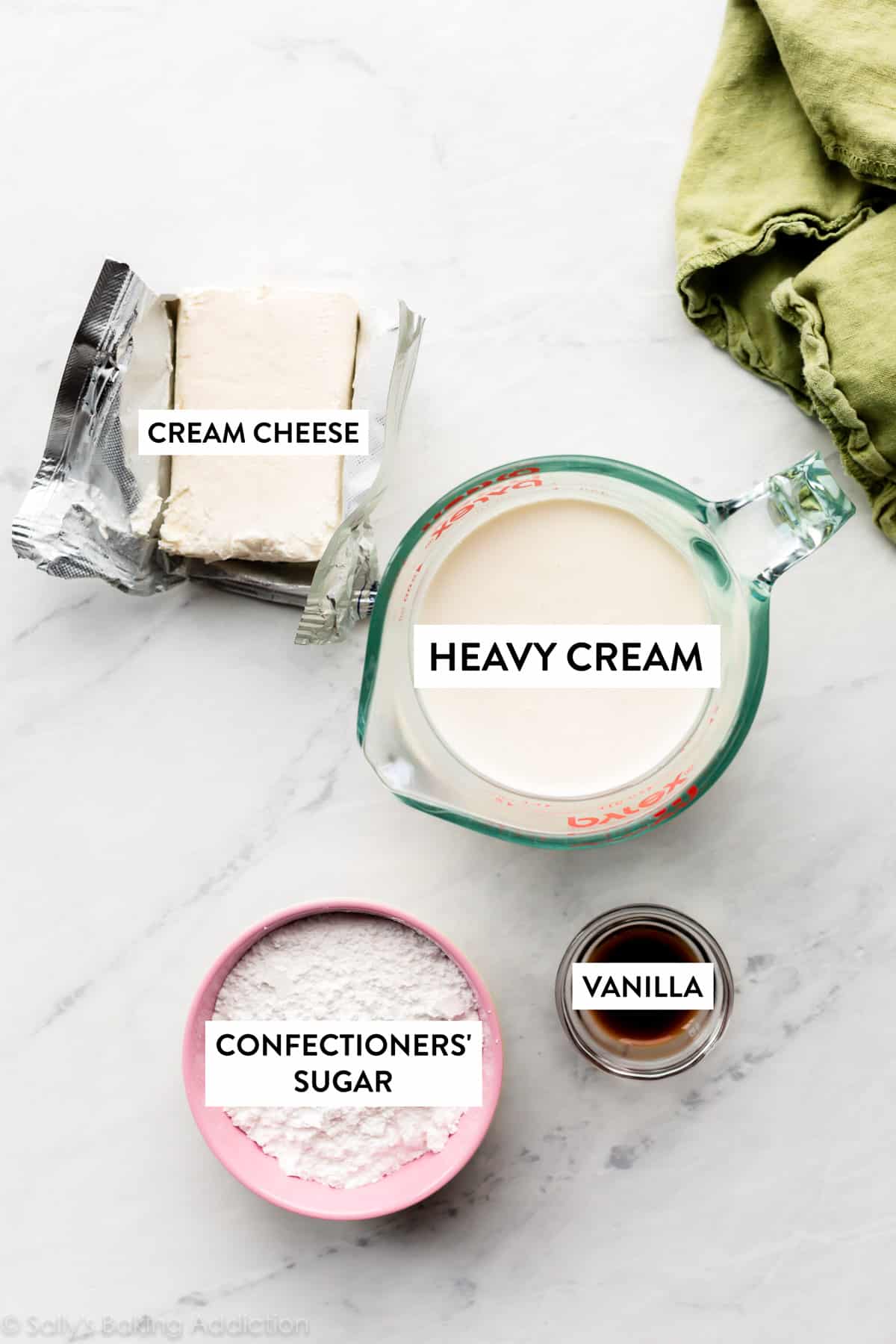
This Whipped Frosting Has 4 Ingredients
And with only 4 ingredients, it’s imperative you use the correct ones!
Room-Temperature Full-Fat Brick Cream Cheese: Cream cheese is the magical ingredient because it acts as the sturdy, structured base. Make sure you use full-fat brick-style cream cheese, not cream cheese spread in a tub or reduced-fat cream cheese. It must be softened to room temperature so you can successfully rid any lumps. You need 6 ounces (170g), which is a little less than one 8-ounce brick.
Confectioners’ Sugar: Confectioners’ sugar sweetens the frosting and compared to many frosting recipes like vanilla buttercream, you need a fraction of the amount to produce the same volume of frosting. Wow!
Vanilla Extract: Vanilla extract adds flavor. If you want to get started or already have some going, homemade vanilla extract is fantastic in this whipped frosting. Vanilla bean paste is also wonderful.
Cold Heavy Cream: Emphasis on the COLD temperature. You may remember this from making regular whipped cream, but the colder the heavy cream, the easier and more successfully it will whip. Make sure you use cream labeled heavy cream, heavy whipping cream, or double cream. All contain 36% or higher milkfat. Whipping cream (without “heavy” in the title) is a little lighter, with 30% milkfat. Do not use that because your frosting will never firm up.
By the way, this recipe is very easy to scale up or down. Use 2 ounces (57g) of cream cheese per 1/4 cup (30g) confectioners’ sugar and 1/2 cup (120g/ml) heavy cream. Add more or less vanilla extract. When you’re whipping in the heavy cream, reduce or extend that length of time based on the volume. Whip for less time if you scaled down the recipe and whip longer if you scaled up the recipe.
If you’re looking for a lighter topping, I recommend regular whipped cream. For a sturdy, yet lightly sweetened frosting, try Swiss meringue buttercream. If you need a whipped buttercream, use the frosting found with this vanilla sheet cake. Or search for whipped frosting made without cream cheese—some recipes use cornstarch or instant pudding mix instead.
Let’s Make Whipped Frosting!
In terms of preparation, the recipe reminds me of no-bake cheesecake. We’re using mostly the same ingredients found in the filling, except that recipe instructs you to whip the cream cheese and heavy cream separately. Here, we’re doing it all in 1 bowl in different stages.
First, beat the cream cheese to begin breaking it down and smoothing it out. You can use a hand mixer or a stand mixer with a whisk attachment.
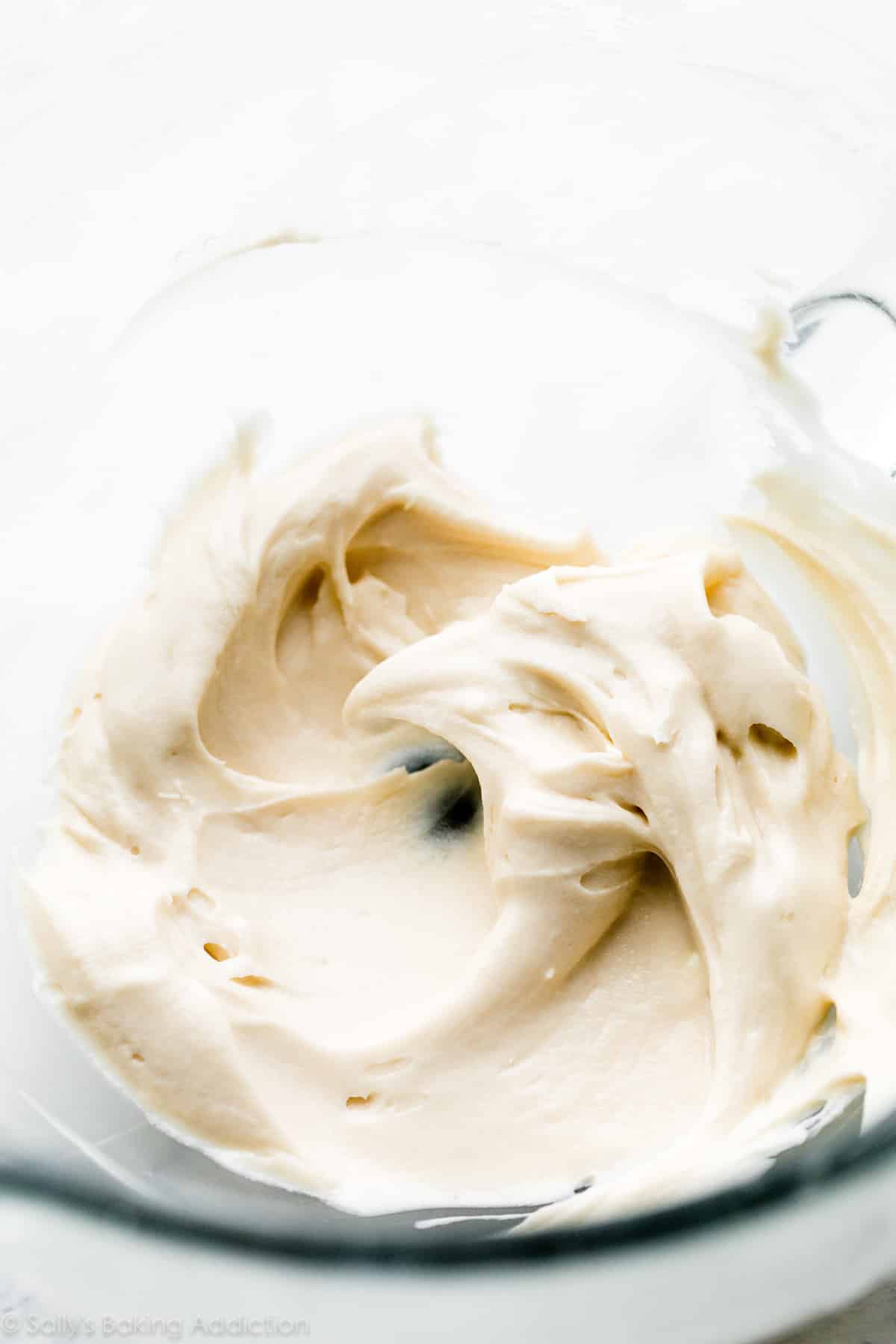
Then add the confectioners’ sugar and vanilla extract and beat together. You really want to rid all the lumps:
Now here comes the *magic*!
Turn the mixer on low speed and add a few Tablespoons of the cold heavy cream. Once that’s fully incorporated and the mixture has smoothed out again, slowly—in a steady stream—pour in the rest of the cream. After all the cream has been added, turn the mixer up to high speed and watch your new favorite frosting fill with air and rise up in the bowl.
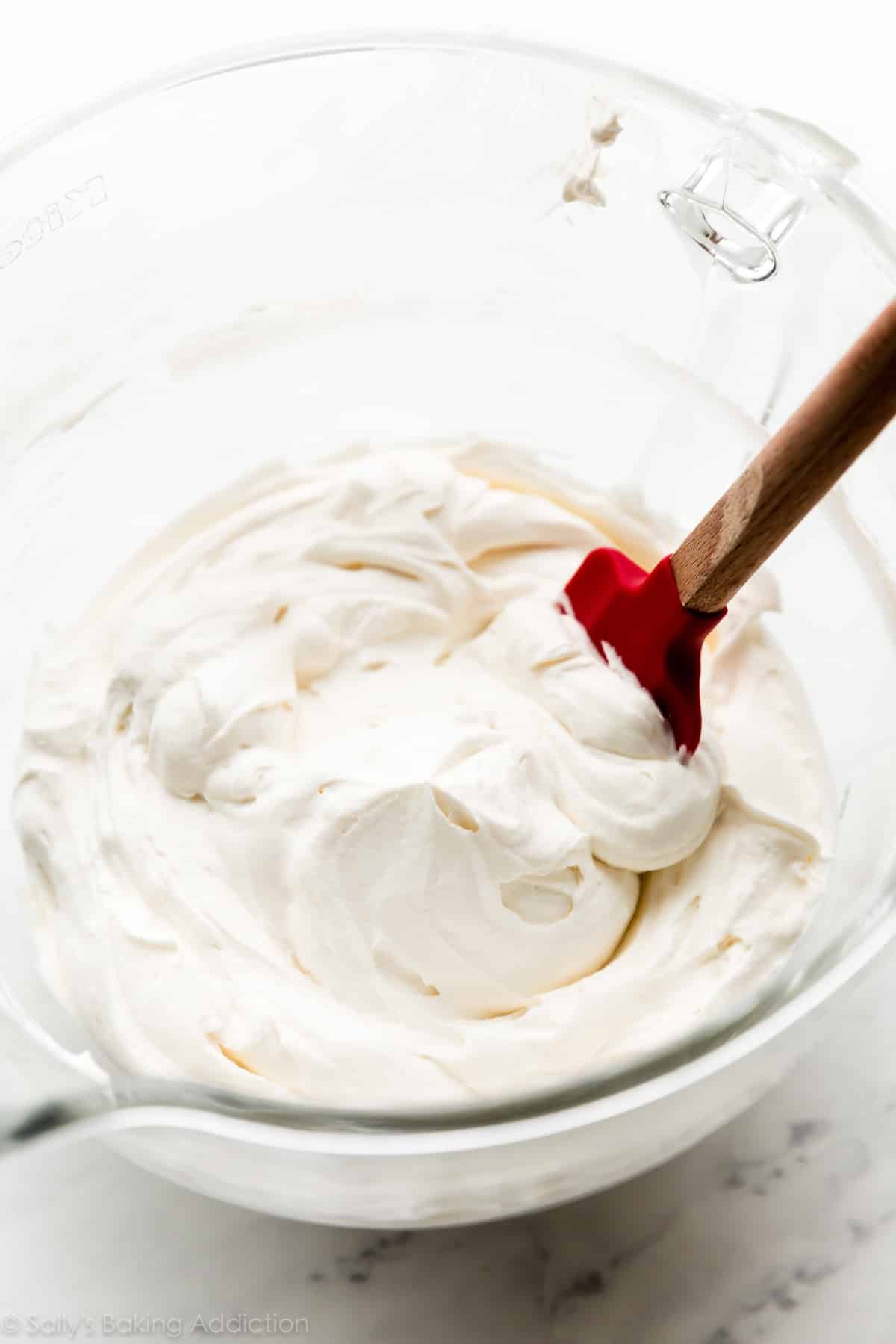
You’re looking for a thick, airy consistency with stiff peaks. If you were to shimmy and shake this bowl, the frosting would hardly move:
Now let me show you what not to do.
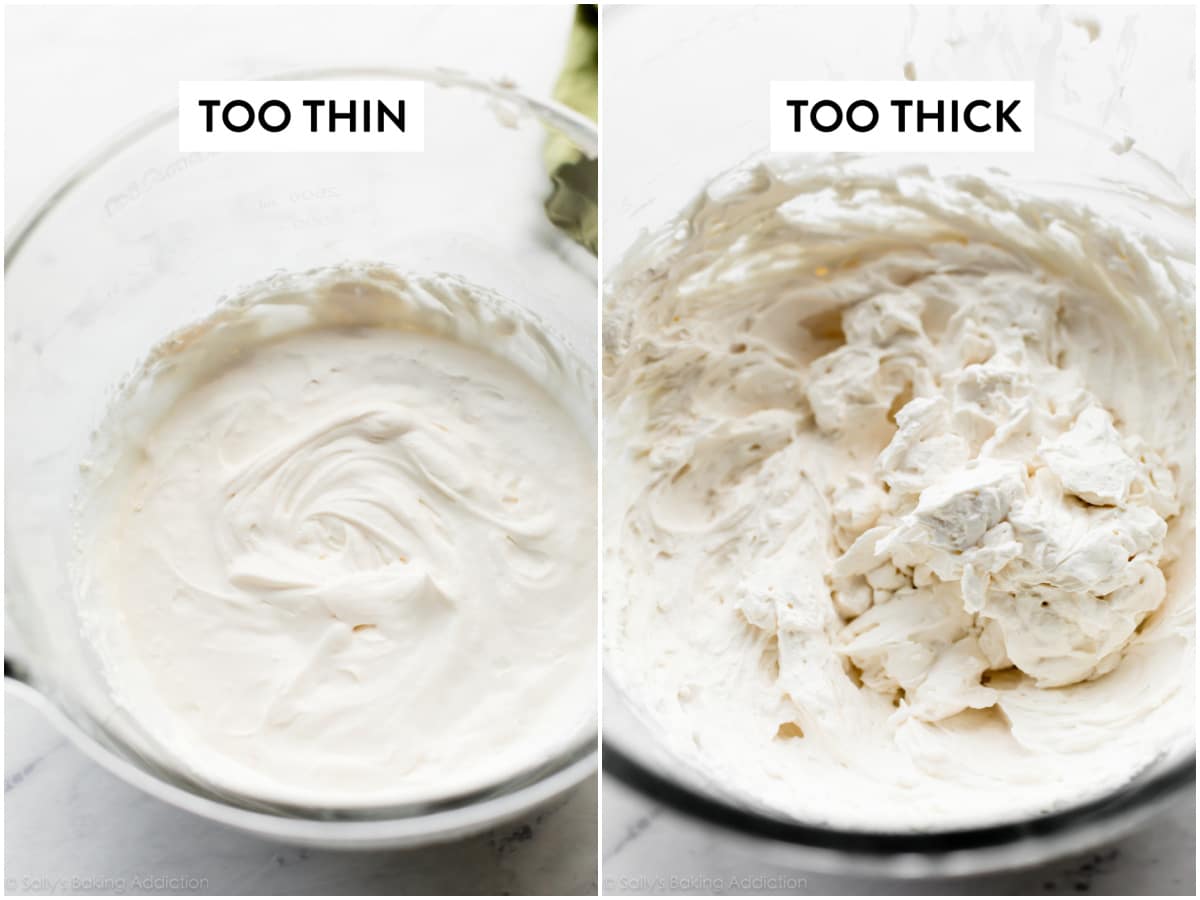
Too Thin vs Too Thick
Too thin: If you do not whip the mixture long enough, you’ll have soft, soupy, thin frosting. If you were to shake a bowl of under-whipped frosting, it will jiggle all around like a jello mold. This is an easy fix—just keep whipping until you have the consistency above.
Too thick: If you over-whip the frosting, it will appear chunky and curdled. While my fix isn’t perfect, it will certainly help: Stir in a splash of cold heavy cream, a Tablespoon at a time, by hand with a spatula or wooden spoon until the frosting smooths out again.
Whipped Frosting: 4 Success Tips (Do Not Miss These!)
No lumps in cream cheese. Be sure to start with room-temperature cream cheese. Cold cream cheese will give you stubborn lumps. While you can over-whip the frosting after you add the heavy cream, you cannot over-mix the first 3 ingredients in the recipe. Beat the cream cheese, confectioners’ sugar, and vanilla extract together for as long as you need to rid all of the cream cheese lumps. Stop and scrape down the mixing bowl as needed.
Add the heavy cream gradually. Start by beating in just a few Tablespoons of the cream, until the mixture smooths and thins out. Then pour in the remaining cream very slowly while the mixer runs on low speed.
Don’t leave. After you’ve added all the cream and increased the mixer speed, do not walk away. The frosting could set up in 1 minute or it could take closer to 5 minutes. Keep your eyes on the mixture to avoid over-whipped frosting.
Pop the air bubbles if needed. After you make the whipped frosting, you’ll notice that the consistency can change the longer it sits in the bowl. The frosting can develop more air bubbles; if you want the silky, yet thick consistency back, stir the frosting by hand a few times to deflate the air. I don’t notice this as much when the frosting sits on a finished cake and that’s likely because you handled it a lot in the frosting process—the bubbles develop most when the frosting is just sitting in the bowl before you use it. Likewise, if you notice the frosting looks really airy or over-whipped as you pipe it, either “massage” the frosting while it’s in the piping bag (sounds weird, but this can help deflate air bubbles) or pipe back into the mixing bowl and gently stir it.
The success of this recipe depends on the ingredients used and length of time mixing. Follow the recipe below carefully. It’s so nice to have an easy sturdy frosting that isn’t too sweet!
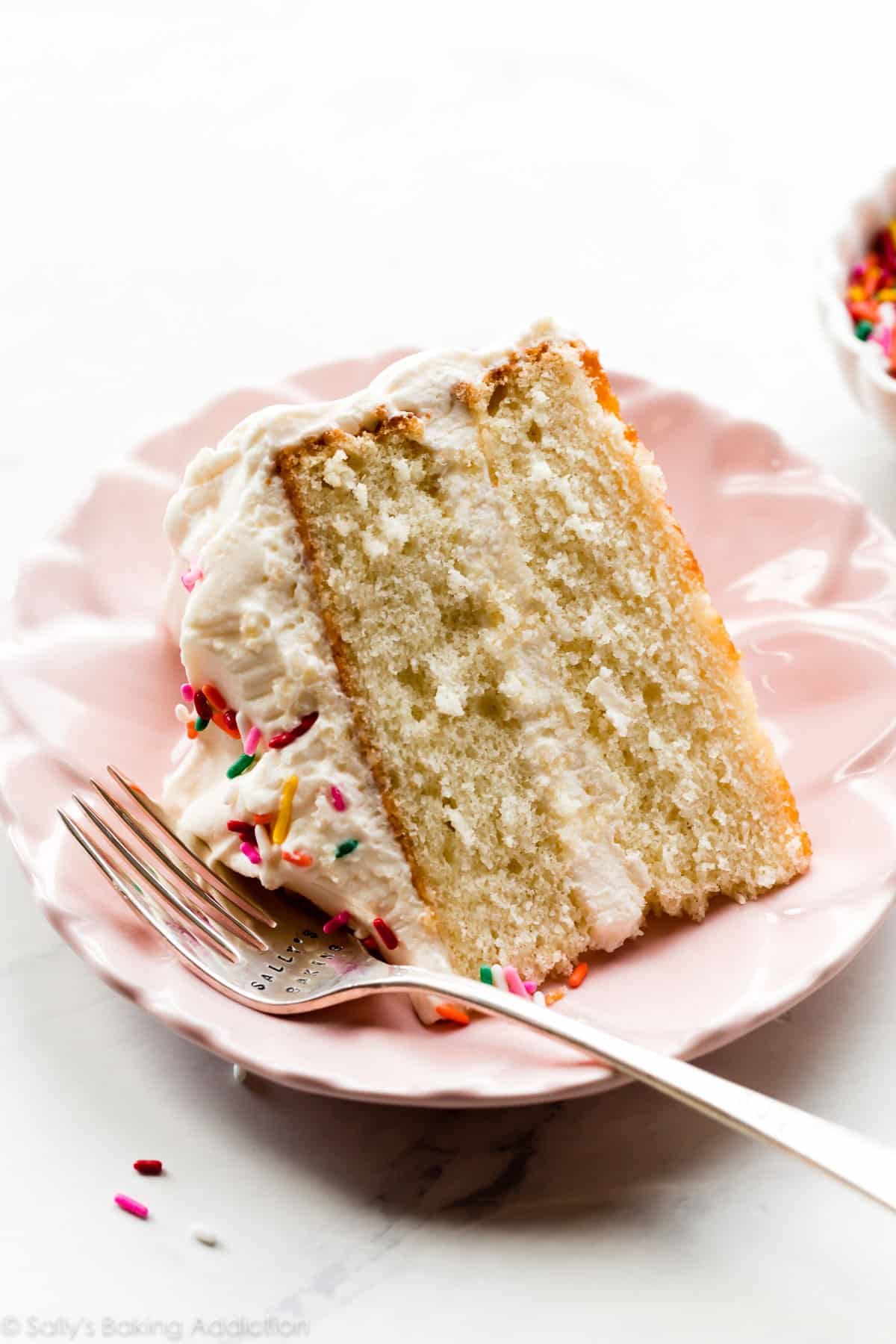
Pictured below: my soft and springy white cake with today’s whipped frosting. Dessert perfection!
Can I make whipped frosting ahead of time?
Yes, but whipped frosting is really best used the same day. You can prepare and store the whipped frosting in the refrigerator for up to 2 days. If needed, re-whip the frosting to smooth it out before using.
Why isn’t my whipped frosting thickening?
If your frosting is soupy and not thickening, the likely culprits are that your heavy cream is not cold enough, you poured in the cream too quickly/all at once, and/or that it hasn’t been whipped long enough. Also, be sure you’re using cream that’s at least 36% milkfat, as well as full-fat cream cheese.
Can I pipe with whipped frosting?
Absolutely! When whipped to stiff peaks, this whipped frosting holds its shape well for piping.
Is whipped frosting stable?
Whipped frosting is less stable than traditional American-style buttercream and therefore should be refrigerated.
Print
Description
Made from only 4 ingredients, this lightly sweetened whipped frosting is creamy and fluffy, yet holds its shape when piped with a piping tip. For best results, review the success tips above and recipe Notes below before you begin.
6 ounces (170g) full-fat brick cream cheese, softened to room temperature
3/4 cup (90g) confectioners’ sugar
1 and 1/2 teaspoons pure vanilla extract
1 and 1/2 cups (360g/ml) cold heavy cream or heavy whipping cream (very cold!)
Cook Mode
Prevent your screen from going dark
In a large bowl using a handheld or stand mixer fitted with a whisk attachment, beat the cream cheese on medium speed until creamy, about 1 minute. Scrape down the sides and bottom of the bowl and beat again as needed until completely smooth (no lumps). Add the confectioners’ sugar and vanilla extract, and beat on medium speed until combined and completely smooth, at least 2 full minutes. Scrape down the sides and bottom of the bowl and beat again as needed.
Add a few Tablespoons of the cold heavy cream, and beat until the mixture smooths and thins out. Scrape down the sides and bottom of the bowl as needed. Then, with the mixer running on low speed, pour in the remaining cream in a very slow and steady stream. After all of the cream has been added, increase the speed to medium-high and whip until stiff peaks form, about 2–4 minutes. This time can vary depending on exact temperature of ingredients, temperature in the kitchen, and even the humidity. Do not walk away during this time and do not be concerned if your frosting takes less or more time to whip. You’re looking for a thick, airy consistency with stiff peaks. If you were to shimmy and shake your bowl, the frosting would hardly move. If your frosting appears curdled, it’s over-whipped. To fix, stir 1 Tablespoon of heavy cream into the frosting by hand with a spatula to smooth out again.
After you make the whipped frosting, it’s ready to frost your cupcakes, cake, or other confections. After frosting a cake or cupcakes with this frosting, I strongly recommend refrigerating them uncovered for at least 30 minutes to help “set” the frosting (especially when using on a layer cake). Then you can serve or set out for a couple hours before serving. And note that you’ll notice the frosting becomes thicker and airier the longer it sits in your mixing bowl. This is not a problem and can easily be fixed by gently stirring it to pop any air bubbles. Likewise, if you notice the frosting is really airy and looking over-whipped as you pipe it with piping tips, either “massage” the frosting while it’s in the piping bag to help deflate air bubbles, or pipe back into the mixing bowl and gently stir it with a spatula. You can stir in a splash of cold heavy cream to smooth out if needed.
Serve or Make Ahead: After the 30 minutes of refrigerating to “set” the frosting as instructed in step 3, frosted confections are fine to serve or sit out at room temperature for a couple hours. If you plan to serve later than that, such as the next day, I recommend storing in the refrigerator. Lightly cover as best you can (a cake carrier/cupcake carrier works great for storing). Confections topped with this frosting can be made ahead and refrigerated for up to 2 days.
Notes
Freezing Instructions: This whipped frosting freezes and thaws surprisingly well. For best results, I recommend freezing the frosting after you’ve already frosted your cake or cupcakes—as opposed to freezing the frosting in your mixing bowl or other container. Frost your baked good(s), refrigerate for at least 1 hour to set the frosting, and then cover and freeze for up to 3 months. (Note that covering this frosting can get messy and I haven’t found a workaround for that.) Thaw your frosted baked good(s) at room temperature or in the refrigerator.
Can this frosting sit out at room temperature or in a warm environment? A couple hours at room temperature is fine. If you’re serving your frosted confections outside on a hot day (I’ve done this a few times), refrigerate your frosted cake/cupcakes for up to 1 day. Remove from the refrigerator 30–60 minutes before serving them. This way they start out a little colder and can last longer in the heat.
Can I leave out or replace the cream cheese? No. See notes above. Instead, I would try a different recipe like regular whipped cream, Swiss meringue buttercream, or this whipped buttercream.
Can I tint this frosting a color? Yes. This frosting holds onto food coloring nicely and I strongly recommend using gel food coloring or natural food coloring powder. If you plan to tint the frosting, it’s best to add the food coloring when you add the heavy cream. If you need to add more food coloring after the frosting is done, gently stir it in by hand. If the frosting becomes too thick, stir in a splash of heavy cream to thin out again.
Can I flavor this frosting? Yes. Feel free to replace up to 1 teaspoon of vanilla extract with another extract of choice such as lemon or coconut extract. If it’s a potent extract such as peppermint extract, I would only use 1/2 teaspoon. You can also turn this into a whipped strawberry frosting by replacing 1/4 cup (30g) confectioners’ sugar with 1/4 cup freeze-dried strawberry crumbs/dust. See strawberry frosting for how to do that.
If your frosting begins losing shape: If your frosting becomes unstable or thins out/loses shape overtime, whip it on high speed until stiff peaks form to reintroduce more air.
Quantity: This recipe yields about 4–5 cups of frosting. This is enough to heavily frost 12–16 cupcakes (as pictured), a 9×13-inch quarter sheet cake, or a 2-layer cake. For a 3-layer cake, I recommend slightly scaling up the recipe by using 8 ounces (226g) of cream cheese, 1 cup (120g) confectioners’ sugar, 2 teaspoons vanilla extract, and 2 cups (480g/ml) heavy cream. After adding the heavy cream, you may need to whip the mixture for slightly longer.
Piping Tip: I used (affiliate link)Wilton 1M piping tip in the photos above. This is one of my favorite piping tips and you can see how to use it in this piping tips tutorial video.