Trump administration says ‘historic’ agreement will ‘reinforce global nonproliferation standards’ and create jobs in US.
The United States and Saudi Arabia have reached a civilian nuclear cooperation deal, the administration of US President Donald Trump announced, as Washington and Riyadh push to deepen ties.
… %!s()
The US Department of Energy hailed the agreement as “historic” on Wednesday, saying that US companies will provide nuclear technology to the kingdom.
Recommended Stories
list of 3 items
list 1 of 3Proposed US-Saudi nuclear energy deal: What we know so far
list 2 of 3Trump push for Syrian intervention against Hezbollah ‘short-sighted’
list 3 of 3Key takeaways from Khalil al-Hayya’s first speech as Hamas leader
end of list
The deal consists of an accord under Section 123 of the Atomic Energy Act of 1954, known as a 123 agreement, “alongside an accompanying bilateral safeguards agreement”, the department said.
“These agreements reflect our two nations’ shared commitment to strengthening US-Saudi commercial relations, delivering prosperity at home and security to our allies abroad,” Energy Secretary Chris Wright said in a statement.
“Rest assured, these agreements uphold the highest standards of nuclear safety and nonproliferation, while relying on the world’s best nuclear technology and scientists, designed right here in the United States.”
Some US media reports have suggested that the deal will allow Saudi Arabia to enrich uranium domestically rather than import nuclear fuel from the US.
The Energy Department’s statement did not provide details on enrichment. If the reports are confirmed, the deal is likely to face opposition in Washington.
‘Reinforce global standards’
The statement called the agreement a “decades-long, multi-billion-dollar partnership” and said it will now be submitted to Congress for review.
Trump, together with Israel, launched a war on Iran in February to prevent the country from enriching uranium and acquiring a nuclear weapon, which Tehran denies seeking.
The US and Israel also bombed Iran’s nuclear facilities last year.
The Nuclear Non-Proliferation Treaty (NPT) does not prohibit uranium enrichment – a process of isolating and garnering the most radioactive variant, or isotope, of the uranium atom. But highly-enriched uranium can be used to produce nuclear weapons.
Israel is the only country in the region that is believed to possess a nuclear arsenal.
The Trump administration said the deal with Saudi Arabia will create jobs in the US, “reinforce global nonproliferation standards”, and strengthen the strategic partnership with Riyadh.
The announcement comes as the US-Israel war on Iran continues to rage. During the hostilities, Iran has launched missiles and drones against bases hosting US troops in the region, as well as some energy facilities in the Gulf. %!s()
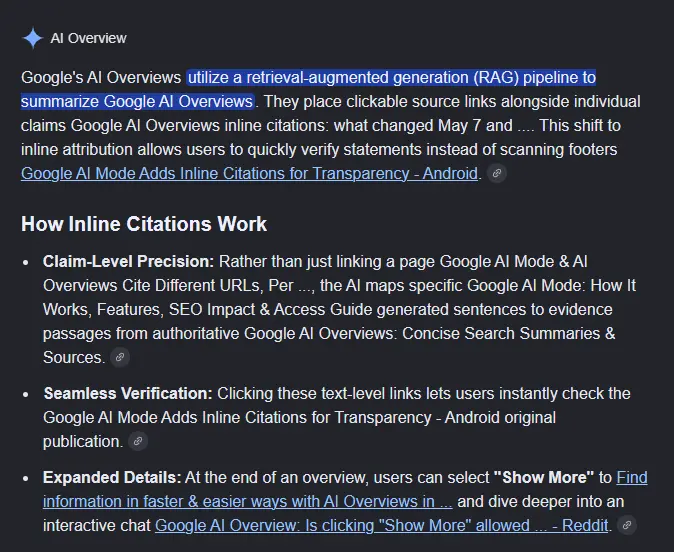
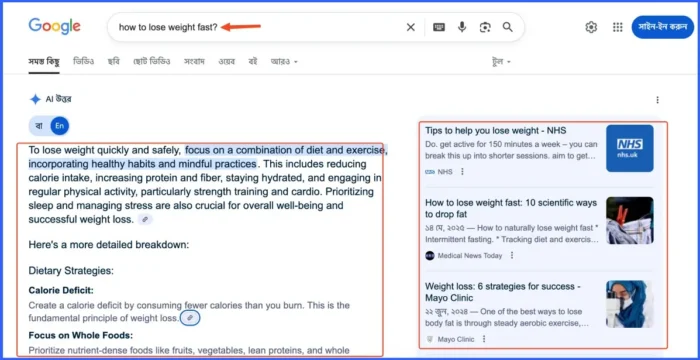
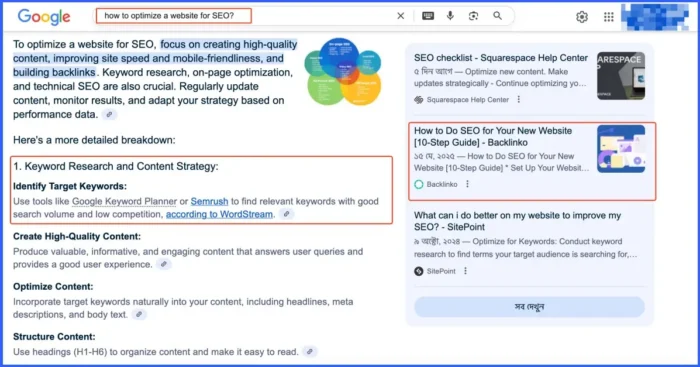
Google is rolling out five updates to AI Mode and AI Overviews that make source attribution more visible and informative.
New features like inline citations, hover previews, and enhanced publisher attribution are designed to encourage more users to visit external websites.
The updates address long-standing concerns from publishers about declining referral traffic from AI-generated search experiences.
As AI search evolves, creating authoritative, citation-worthy content is essential for maintaining organic visibility.
Marketers should continue monitoring traffic patterns and adapt their SEO strategies as Google’s AI experiences mature.
AI search and AI Link Attribution is changing how people find information, and how publishers reach them. Google’s AI Overviews and AI Mode now deliver direct answers inside the search results page, which has raised a real question: if users never need to click, what happens to your traffic?
… %!s()
Google’s latest update is a direct response to that concern. The company announced five improvements to how AI Mode and AI Overviews credit sources, making citations more visible and giving users more paths to explore beyond the AI-generated answer.
Here’s what changed and what it means for your SEO strategy.
What Changed in Google’s AI Link Attribution?
Google’s latest update goes beyond adding more links. The focus is on making AI link attribution more useful.
Previously, one of the biggest criticisms of AI Overviews was that source attribution often felt secondary. Users could receive an answer without clearly understanding where the information came from or why a particular website had been cited.
The latest changes make attribution much more visible throughout the AI experience.
Each update is worth a closer look.
Inline Citations Appear Next to AI-Generated Text
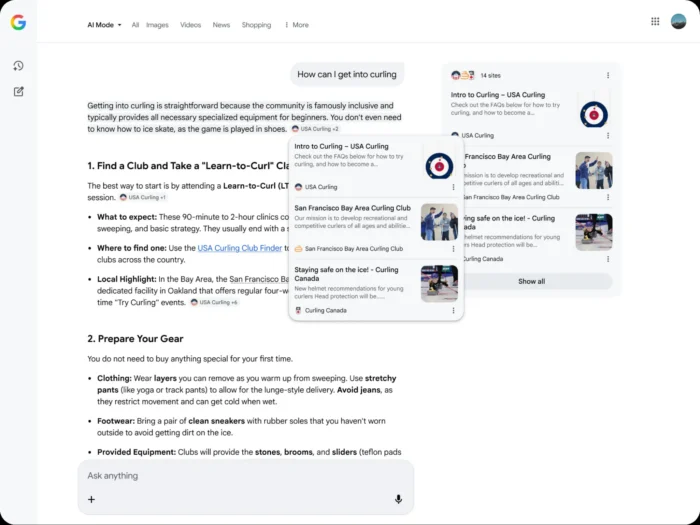
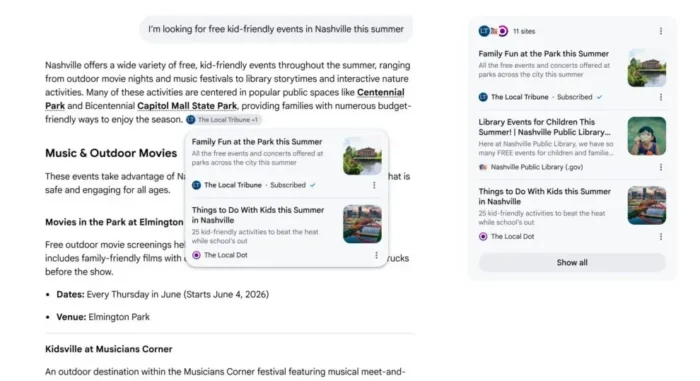
One of the most noticeable changes is the placement of citations directly alongside the content they support. Instead of grouping sources at the end of an AI-generated response, Google now places links next to the relevant text, making it easier for users to identify where specific information originated.
On desktop, users can now hover over many citations to preview information about the linked webpage before clicking. These previews provide additional context about the source, helping users decide whether they want to explore the website further.
Google is also giving news publishers greater visibility by displaying clearer publisher branding and, in some cases, subscription information alongside AI-generated responses. Providing more context about where reporting originated helps users identify and access the original source.
Google is also improving how it references social content.
AI Mode now provides richer attribution for social media content by displaying creator names or profile handles alongside links, giving users enough context to recognize who created the content before they click.
Suggested Research Angles Encourage Deeper Exploration
The final update may have the biggest long-term impact.
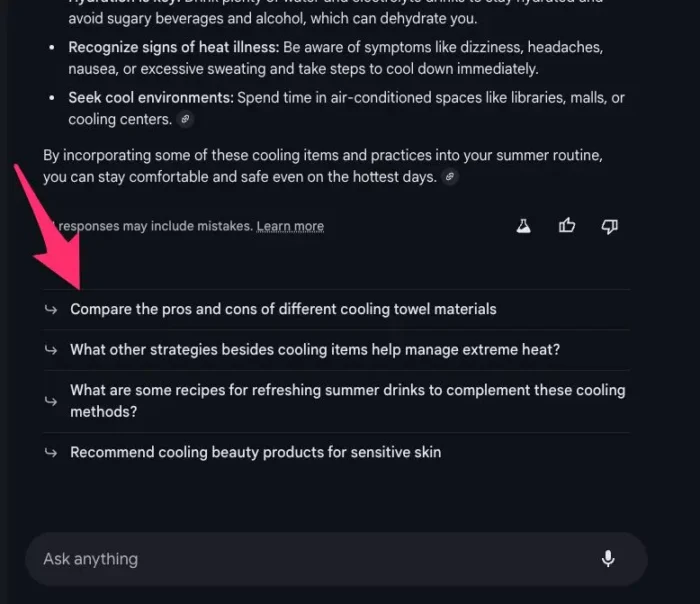
Rather than ending with a single AI-generated answer, Google now suggests additional questions and related topics users may want to explore. These prompts push users to keep researching instead of treating the AI response as the final word.
Since AI Overviews launched, one concern has dominated conversations among publishers and SEO professionals: will AI answers reduce website traffic? It’s a reasonable one. If users receive complete answers directly in search results, fewer people may feel the need to visit the websites that originally produced the information.
Google has consistently argued that AI search should help users discover high-quality content, not replace it. These latest attribution updates reinforce that message.
Citations now sit closer to the relevant text, and hover previews add context before a click. Publisher identities are easier to spot too. Together, these changes make it easier and more appealing for users to continue their journey beyond Google’s interface.
These updates are a positive step. They show Google listening to publisher feedback and working to balance the user experience with the health of the open web as generative search matures.
Whether these improvements lead to higher click-through rates remains to be seen, though they demonstrate that Google recognizes the importance of supporting the broader web ecosystem as AI search evolves.
What These Updates Mean for SEO
Google’s attribution updates don’t change the fundamentals of SEO, but they do reinforce what Google values as AI-powered search continues to evolve. Rather than introducing a new ranking system, these changes make it easier for users to discover and engage with the sources behind AI-generated answers. For marketers, that means authoritative, user-focused content is still the clearest path to visibility.
AI Visibility Creates New Opportunities
As AI Overviews and AI Mode become a larger part of the search experience, earning a citation within an AI-generated response becomes another opportunity to reach potential visitors. Google’s latest updates make those citations more prominent, giving brands another way to stand out beyond traditional organic rankings.
Authority Drives AI Citations
AI-generated answers rely on trustworthy sources. That raises the value of original research and firsthand expertise. Content that demonstrates real knowledge and offers something users can’t find elsewhere is more likely to earn both traditional rankings and AI citations.
Richer Attribution Improves Click-Through Rates
Google’s new attribution features are designed to help users better understand where information comes from before they click. Richer source information and hover previews create a more transparent search experience that could encourage users to visit the original content instead of stopping at the AI-generated summary.
How to Optimize Your Content for AI Attribution
Google’s latest attribution updates don’t require a completely new SEO strategy. Instead, they reinforce what has always contributed to search visibility: content that’s original, built on real expertise, and useful to the people reading it. As AI search continues to evolve, these qualities remain the foundation of search visibility.
Publish Original Insights
Google’s AI systems need reliable information to reference. Original research, proprietary data, or genuine firsthand experience gives your content value that AI-generated answers can’t easily replicate.
Strengthen Your EEAT Signals
Experience, Expertise, Authoritativeness, and Trustworthiness (EEAT) remain key indicators of content quality. Clear author credentials and reputable sourcing help establish credibility, and regularly updated content reinforces it further for both users and Google’s AI systems.
Create Citation-Worthy Content
Well-organized content is easier to understand and easier to cite. Use descriptive headings, answer questions directly, and support key points with statistics or concise explanations that can stand on their own.
Monitor AI Search Performance
As Google continues refining AI Overviews and AI Mode, keep a close eye on your analytics. Monitoring changes in impressions, click-through rates, and referral traffic can help you understand how new AI features affect your organic visibility and where your strategy may need to adapt.
AI Search Is Becoming a Gateway Instead of a Destination
One of the biggest concerns surrounding AI search has been that users might get all the information they need without ever leaving Google’s results page.
These attribution updates suggest Google is moving in a different direction.
By making citations more visible and giving users richer context around sources, Google is positioning AI search as a gateway to high-quality content rather than a replacement for it.
For marketers and publishers, that’s an encouraging signal. While AI search will continue to evolve, success will still depend on creating original, trustworthy content that’s valuable enough for users and Google’s AI systems to reference.
FAQs
What are Google's AI link attribution updates?
Google introduced five enhancements to AI Overviews and AI Mode that improve how sources are displayed, covering inline citations, hover previews, publisher attribution, social media context, and suggested follow-up topics. Together, they’re designed to make it easier for users to find and visit the content behind AI-generated answers.
Why is Google improving AI attribution?
The updates appear to address concerns from publishers and content creators about declining referral traffic from AI search experiences. By making sources more visible and informative, Google aims to create a better balance between providing instant answers and driving users to the original content.
How can I optimize my content for AI citations?
Focus on publishing original, authoritative content that demonstrates expertise and provides unique value. Strengthening your EEAT signals, organizing information clearly, and supporting claims with credible sources can improve your chances of being referenced by Google’s AI systems.
Will AI Overviews replace traditional SEO?
No. Traditional SEO remains essential, but AI search introduces another layer of visibility. Rather than replacing organic rankings, AI Overviews create additional opportunities for authoritative content to reach users through AI-generated responses.
Conclusion
Google’s latest AI link attribution updates may seem like small interface improvements, but they represent a meaningful shift in how AI-powered search connects users with the broader web.
By making citations more prominent and adding richer context around publishers and creators, Google is acknowledging that high-quality content remains the foundation of its search experience, even in the era of generative AI.
For marketers, the takeaway is clear. The best way to earn visibility in AI search isn’t to chase every new feature. It’s to continue producing original, authoritative content that users and Google’s AI systems can trust.
As these experiences continue to evolve, keep a close eye on your analytics and be prepared to adapt your strategy. The fundamentals of SEO haven’t changed, but the ways users discover your content certainly have.
If you want to stay ahead of Google’s latest search developments, explore our resources on AI SEO and content strategy, or reach out to the NP Digital team to learn how emerging search experiences can fit into your long-term marketing strategy.
It's been 23 years since Concorde darted passengers across the Atlantic Ocean in record time, but we could be close to a decades-long ban on overland supersonic flights being scrapped. The Federal Aviation Administration is working to establish new acceptable noise thresholds for supersonic flight by mid-2027. To collect data to set these standards, NASA will conduct test flights to survey the population's reaction to the noise.
… %!s()
The sonic booms that heavily restrained supersonic air travel could be a thing of the past. Boom Supersonic hopes to capitalize on a concept it calls "Boomless Cruise." The startup successfully used the Mach cutoff phenomenon on its XB-1 demonstrator, causing sound waves to refract off the atmosphere rather than reach the ground. With a similar goal in mind, NASA took its X-59 test plane supersonic for the first time in June to produce sonic "thumps" instead of booms. On the future of supersonic flight, Transportation Secretary Sean Duffy said in an FAA release:
"The Trump Administration is continuing its unprecedented work to deliver exciting new travel options to the American flying public — and we're ensuring people on the ground won't be subject to excessive noise."
There's a lot of money behind this supersonic revival
Boom Supersonic
The Trump administration claims it wants to lift restrictions to stimulate the economy. In fairness, Boom Supersonic already has 35 orders for its debut airliner, the Overture, from American Airlines and United Airlines. With the new plane carrying a sticker price of $200 million, there's a lot of money on the line for investors. The airlines view supersonic flights as the ultimate halo product to outshine the competition. Also, Boom founder and CEO Blake Scholl coincidentally met with the President in the Oval Office last year.
Financial upside aside, the larger concern should be the impact on the general population. NASA will hopefully use caution when conducting its test flight over populated areas. It was a completely different story when the federal government tested how Oklahoma City's residents reacted to sonic booms in 1964. U.S. Air Force jets bombarded the city with 1,253 sonic booms over six months. The massive backlash eventually led to the FAA's 1973 ban on overland supersonic flights. If this ban is overturned, it should be due to advances in technology, not moneyed interests. %!s()
Do you drink Coke? Or Pepsi? Perhaps you prefer beer…Bud? Or Heineken? Maybe you're into energy drinks and you're a Red Bull person. These are among the many household beverages served in Ball Corp's sustainable aluminum packaging.
… %!s()
Beyond beverages, Ball's containers package everyday personal care, cooking, and cleaning products. Chances are high that you — and millions of consumers worldwide — purchase goods packaged in Ball Corp cans on a weekly basis.
Ball Corp is entering an encouraging operational phase driven by improving cash flow and a refreshed management team seemingly intent on more disciplined capital allocation and leverage reduction. That's important because it's worth noting that Ball Corp's debt is not yet rated investment grade by Moody's or S&P. However, management's credit-focused commitments and capital discipline offer a clear roadmap toward potentially improving their balance-sheet, which in turn could result in upgrades from rating agencies which would modestly lower borrowing costs and potentially dampen equity volatility.
Stock Chart IconStock chart icon
BALL YTD
Looking ahead, FY2027 estimates suggest a free cash flow yield of more than 4%. Forward PE is a modest 14x adjusted EPS of $4.52. The street anticipates modest top-line expansion tracking general economic growth, coupled with expanding YoY operating margins and net income.
Ball Corp is scheduled to report earnings during the first week of August. While earnings reports naturally introduce event risk, historically Ball's earnings-related-moves have been fairly modest — as one might expect given the industries they serve don't tend to exhibit massive short-term swings in demand. BALL typically moves only in the mid single-digits on earnings release days and even one month post earnings the average historical move is less than 8%.
This muted volatility regime provides an ideal setup for premium sellers seeking high probability of profit.
The trade: Cash-secured put income strategy
For investors comfortable taking delivery of a quality consumer-staples packaging leader at a discount, selling out-of-the-money puts offers an advantageous risk/reward profile. Selling the August $60 Puts would collect $1.20 per contract. This yields a standstill rate of return of ~2% premium relative to the $60 strike, creating a net breakeven of $58.80 per share, or ~24% annualized.
By selling the August $60 put, options traders capture rich implied volatility ahead of August earnings while capitalizing on Ball Corp's robust cash flows, debt reduction discipline, and favorable historical post-earnings price stability. One caveat, selling that put will tie up a great deal of margin in your account.
Hisense has finally launched the PX4 Pro, the ultra short throw projector it first demoed at CES 2026, bringing its flagship TriChroma RGB laser technology to living rooms with a fairly hefty price tag, a cent-shy of $4,000.
… %!s()
Designed to replace a traditional TV, the PX4 Pro can throw an image ranging from 80 to 200 inches from just inches away from the wall.
It uses a triple-laser light engine that Hisense says covers 118% of the BT.2020 color space, while pumping out 3,500 ANSI lumens, combined with a 7-level adjustable Iris lens and 6500:1 contrast ratio, so it should even perform well during the daytime.
A enhance shadow detail, preserve subtle gradation, and keep bright scenes balanced—even with ambient light in the room.
The projector also features Hisense's CineBlack Pro system, pairing a seven-level adjustable iris with a claimed 6,500:1 contrast ratio to improve black levels and preserve detail in darker scenes.
As you’d expect at this price range, the home theater credentials are strong; the PX4 Pro supports Dolby Vision, Dolby Atmos and IMAX Enhanced content, while its built-in speaker system has been tuned by French audio experts Devialet.
It runs the Hisense VIDAA smart TV platform, found on its smart TV ranges, which gives you access to all the usual streaming apps without the need for an external device.
Gaming features are pretty strong with Hisense calling the PX4 Pro the world’s first ultra short throw laser projector to get FreeSync Premium certification, which should mean smoother gameplay with reduced screen tearing and lower latency on displays of up to 200 inches.
MORE FOR YOU
As mentioned, at $3,999.99 the PX4 Pro sits firmly at the premium end of the projector market, taking on rivals from the likes of Samsung, LG and Epson in the increasingly competitive ultra short throw category.
The Hisense PX4 Pro is available now from Hisense, Best Buy and Amazon in the US. %!s()