Human remains have once again been discovered at Lake Mead outside Las Vegas, Nevada, marking the latest in a line of gruesome discoveries as water levels in the crucial reservoir continue to drop, authorities said.
… %!s()
These remains were discovered on 16 August, USA Today reported. The National Park Service (NPS) told the outlet there did not appear to be anything suspicious about the body.
Las Vegas police reportedly said “a non-criminal, dead body report was taken for the remains”. The local coroner said authorities were trying to identify the deceased person, as well as determine the manner and cause of death, USA Today said.
As water levels have declined in recent years, authorities have found multiple bodies. In 2022, authorities recovered a body in a barrel, USA Today noted.
Authorities reportedly said the man seemed to have been shot, potentially during the late 1970s or early 1980s. Some experts believe Lake Mead’s location near Las Vegas – an organized crime hotspot – means it’s probable still more remains will be discovered.
This week’s grim finding underscores Lake Mead’s perilously low water levels amid a historic drought and broader water crisis in the US west. Weeks ago, Lake Mead’s water level dipped to 1,040.4ft above sea level, nearing the 28 July 2022 record low.
Lake Mead is integral for water storage on the Colorado River, which provides water to about 40 million people across seven states, as well as tribal nations and Mexico. The river basin is reeling from a mix of extended drought, extreme heat, waning snowmelt and over-consumption.
The second major reservoir on the river, Lake Powell, is also seeing historic low levels as the global climate continues to warm.
“In the 21st century, the ultimate cause of the problem is declining runoff,” Jack Schmidt, director of Utah State University’s Center for Colorado River Studies, previously said of the water crisis. “There’s less water in the system. It’s caused by a warming climate, period.” %!s()
Andy Burnham has said government money alone may not be enough to get rough sleepers off the streets by Christmas, as experts called for more of a plan to deal with the problems that cause homelessness.
… %!s()
Speaking on a visit to the north-east of England, the prime minister said he felt “very passionately” about tackling rough sleeping and wanted the wider society to play a part in wiping it out.
He acknowledged that not every rough sleeper may take the offer “for their own reasons”. But he said a nationwide effort to stop as much rough sleeping as possible by Christmas was the aim – replicating what happened in the Covid pandemic.
Burnham told reporters: “The government money may not fully get us there, and I’m saying to wider society, faith organisations, let’s see if we can do this together.
“Let’s see if Britain can do this. Give everybody an offer to come inside before Christmas. You know, that is just something we can do.
“We did it in the pandemic. We can do it again, and it’s a rallying call, really, that I’m putting out there today, with a lot of government money behind it.”
Burnham wrote in the Guardian on Tuesday that rough sleeping has become so common it now “feels like part of the scenery”, as he pledged another £100m to tackle the problem this winter.
The announcement puts tackling homelessness as a central policy for Burnham’s government, and gives voters a measure by which to judge his success.
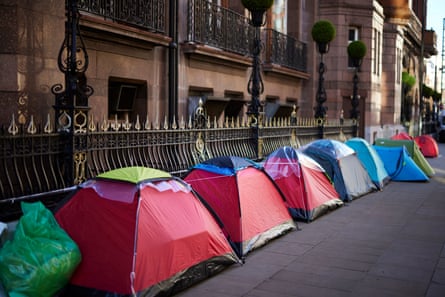
A row of tents outside the Midland hotel in Manchester last year. Photograph: Christopher Thomond/The Guardian
As mayor of Greater Manchester, Burnham introduced schemes such as A Bed Every Night to offer emergency accommodation, but while the number of rough sleepers fell, it then began to increase again.
He said this was because “we were the only place providing that level of support, and understandably, people then travelled to Greater Manchester to access that support”.
He added: “So my point is, we can do this, but only if all areas are pulling in the same direction, and that’s what this funding is designed to achieve – to make this a nationwide initiative as we go into the Christmas period, getting everybody behind it.”
He said people being left to sleep on the streets “can often cost more to the state because people can be in and out of A&E, and in and out of hospital beds, and sometimes in contact with the police”.
As part of the national effort, Burnham said he would host a summit this autumn to “bring together leaders from across society – from business, finance, charities, health, faith communities and more – to ask what role each of them can play in ending rough sleeping”.
Will Andy Burnham get rough sleepers off streets by Christmas? – The Latest
Council leaders and experts have applauded Burnham’s aims but also called for more work on how to deal with issues underlying rough sleeping, from mental health problems to addiction.
Liam Robinson, leader of Liverpool city council and chair of the Local Government Association’s inclusive growth committee, said there may need to be “future conversations” about more funding to tackle homelessness, including the thousands of people living in temporary accommodation.
“It does need to be resourced more,” he said. “We know councils are spending £950m more than they were five years ago on this issue, so we’re really just talking about the tip of the iceberg with rough sleeping. There may be a requirement for more funding.”
He added that extra money may need to be for “more than just housing-related funding”.
skip past newsletter promotion
after newsletter promotion
“It probably requires more NHS investment for better mental health and addiction support,” he said. “It’s more than just paying the bills of hotels and landlords.”
Ayesha “Ish” Camp, regional head in east London for the homelessness charity St Mungo’s, added: “Yes it’s good to give everyone a bed for the night but what else are we doing to support them to stay in it?
“Entrenched rough sleepers have usually been round and round all of the systems that are available multiple times before, and it hasn’t worked. So we need to look at why it hasn’t worked and what we can do differently this time around.”
She added that the UK needed to learn from the “temporary accommodation nightmare” to ensure the new funding was not funnelled straight into the pockets of private companies.
“If we publicly say all this money is to give people somewhere to stay for the night and we know there’s no social housing to put anyone in, what will hotel owners do? Put their rates up and charge us £250 a night. That money then gets eaten up very, very quickly,” she said.
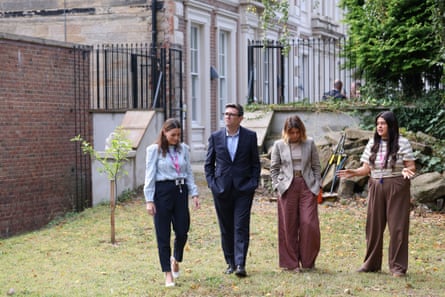
Andy Burnham with officials from the homelessness charity Changing Lives in Newcastle on Wednesday. Photograph: Scott Heppell/Getty Images
Burnham also said on Wednesday that he would be donating 15% of the additional salary he gets as prime minister to homelessness causes.
Speaking to the Big Issue, he said he wanted to continue what he had been doing as mayor of Greater Manchester. He has already said he would donate 15% of the salary he gets for being an MP to local causes in his constituency of Makerfield.
He told the magazine: “For the best part of nine, almost 10 years, I donated 15% of my salary as mayor of Greater Manchester to tackling homelessness in Greater Manchester.
“I am making a commitment to donate the same of my prime minister’s salary. I’m donating part of my constituency MP salary to local organisations, but the extra bit that comes with being prime minister, I’m making the same commitment.
“I wouldn’t want to ask anybody to do anything that I’m not prepared to do. I want to lead from the front. This issue matters massively to me.”
The latest annual national statistics, published in February, estimated there were 4,793 people sleeping rough on a single night in autumn 2025 in England. This was a new record and the fourth annual increase in a row, with 43% of those people sleeping rough in London and the south-east. %!s()
Israel has built about 160 settlements housing 700,000 Jews since it occupied the West Bank and East Jerusalem - land Palestinians want, along with Gaza, for a hoped-for future state - during the 1967 Middle East war. An estimated 3.3 million Palestinians live alongside them.
… %!s()
Despite the fierce international opposition, successive Israeli governments have allowed settlements to grow.
However, expansion has risen sharply since Prime Minister Benjamin Netanyahu returned to power in late 2022 at the head of a right-wing, pro-settler coalition, as well as the start of the Gaza war, triggered by Hamas's 7 October 2023 attack on Israel.
Under international pressure, Israel held off for decades on plans to build in E1.
Many of its allies and Palestinians argued these would deal a major blow to hopes of a two-state solution, effectively bisecting the West Bank.
But the current Israeli government gave the go-ahead for E1 construction a year ago, expressly to "erase" the idea of a Palestinian state.
Despite an Israeli court challenge to the plans by Bedouin Palestinians living in the area and Israeli peace groups, the housing ministry has now issued a tender for 1,234 of the 3,401 housing units approved by the Israeli government last August.
It covers about 12 sq km (4.6 sq miles) between East Jerusalem and the settlement of Maale Adumim.
At the time of their unveiling, Finance Minister Bezalel Smotrich, who is ultranationalist and settler, said the idea of a Palestinian state was "being erased".
The deadline for bids is 19 October, just days before Israel's general election on 27 October. That should enable the government to sign deals with contractors that it would be much harder for a future government to cancel.
Israel captured the West Bank, including East Jerusalem, from Jordan in the 1967 Middle East War. It annexed East Jerusalem in 1980, in a move not recognised by the vast majority of the international community.
Opponents of the E1 project have warned that it would effectively block the establishment of a Palestinian state because it would cut off the north of the West Bank from the south, and prevent the development in the centre of a contiguous Palestinian urban area connecting Ramallah, East Jerusalem and Bethlehem.
Peace Now, an Israeli anti-settlement watchdog that has challenged the plans in court, said: "The government is trying to sign contracts with contractors before the elections so that it will be much harder for the next government to cancel the construction."
It said even the partial implementation of the construction plans would "fundamentally" alter "the geographic and strategic character of the area by severing the northern West Bank from the south and isolating East Jerusalem".
"Building in E1 will ruin the possibility of reaching an end to the conflict and a peace arrangement based on two states," it said.
Jamal Juma, a Palestinian activist for the Stop the Wall campaign, who lives in Jerusalem, said the project would have a devastating impact on Palestinians.
"It is destruction of the communities, it's destruction of families... this is a disaster", he told the BBC.
He added that more than 40 Bedouin communities would be affected and would have to be evicted. %!s()
A day after a suspected Israeli attack on the Abu al-Duhur airbase near Idlib, northwest Syria, US Ambassador to Turkiye Tom Barrack has suggested creating a “deconfliction mechanism” between Turkiye, Syria and Israel. Barrack called the original attack – which he, along with the Syrian government, blamed on Israel – an “unnecessary escalation”.
… %!s()
But despite the intervention from the US official, analysts believe the proposal may not be able to stop Israel, which has conducted regular attacks on Syria for years, and continues to occupy Syrian territory.
Recommended Stories
list of 3 items
list 1 of 3Why White House envoys cannot sway Israel’s war leader
list 2 of 3Lebanon no longer a safe haven for former Syrian regime officials
list 3 of 3Syria opens Assad-era nuclear programme to UN probe
end of list
“It is difficult to have a deconfliction mechanism [when] only one party [is] causing conflict in the first place,” Samy Akil, a senior adviser with The Syria Report, told Al Jazeera.
Analysts and diplomatic sources say that Israel is the party holding back progress on talks and the easing of tensions with Syria, which is under a new government since the overthrow of former President Bashar al-Assad in December 2024. At the end of a more than decade-long war, Syria is now seeking better relations with the West.
“Israeli-Syrian talks are stagnating because the ball is in Israel’s court and they don’t see a need to prioritise talks with Damascus currently,” Akil said.
Turkiye and Israel trade verbal shots
Under the former al-Assad regime, Israel often attacked Iranian-aligned targets or interests in Syria – including the Iranian consulate in Damascus in April 2024 – but avoided directly attacking Syrian state targets.
That changed when al-Assad fled in the early hours of December 8, 2024. Israel attacked Syria’s military infrastructure around the country, aiming to cripple the new government’s military forces. It also threatened the post-Assad military with deploying forces south of Damascus.
And since the fall of al-Assad, Israel has also shifted focus from Iranian influence in Syria to Turkish influence in the country. The Turks backed a number of anti-Assad rebel groups, many Syrians in exile spent considerable time in Turkiye, and Ankara has sought to build strong ties with Damascus and Syria’s new President Ahmed al-Sharaa.
Analysts told Al Jazeera that Tuesday’s attack was in fact a message from Tel Aviv directed at the halls of power in Ankara.
On Tuesday evening, the Israeli Prime Minister’s Office issued a statement that seemed to confirm that suspicion, while it stopped short of claiming responsibility for the actual attack.
“Israel and Syria agreed to a status quo in security matters, which Syria was on the verge of breaching by permitting Turkish troops to deploy at an airbase near Aleppo,” the statement said.
“Israel repeatedly warned Syria that such a deployment would pose a threat to Israel’s security. Syria chose to ignore these warnings.”
Turkiye has slammed the Israeli account of events.
“The untenable allegations put forward by the Israeli Prime Minister’s Office are intended to legitimise Israel’s unlawful airstrikes targeting Syria’s sovereignty and territorial integrity,” the Republic of Turkiye’s Directorate of Communications said.
It also accused Israeli Prime Minister Benjamin Netanyahu of pursuing “expansionist and destabilising policies in the region ahead of the elections in Israel”.
Israeli provocations in Syria
Enter US Ambassador Barrack and the idea of a deconfliction mechanism. This would act as a channel of communication between the concerned actors – Syria, Turkiye and Israel. It would be facilitated by the US, and would aim to prevent military escalations.
The strategy appears to be similar to what the US is trying to build in Lebanon between Beirut and Tel Aviv. That deal is aimed at stopping Israeli attacks on Lebanon, disarming Hezbollah, and convincing Israel to withdraw troops from southern Lebanon. However, experts say these processes have yet to show results, largely because of Israel’s military superiority and the Netanyahu government’s willingness to undermine negotiations through unilateral military actions.
For its part, the Syrian government has shown a strong willingness to find a solution with Israel, even if it has emphasised that it is not willing to agree to full normalisation.
That is despite the Israeli landgrab of Syrian territory in the Golan Heights and Jabal al-Sheikh in December 2024, and the continued deployment of checkpoints that harass and at times kidnap Syrian citizens.
Early on Wednesday morning, Israeli troops reportedly conducted a raid on Quneitra in southwestern Syria and abducted two people.
Analysts say that for any deconfliction mechanism to work, all parties must be committed to working towards the goal.
“In other words, at what point does a deconfliction mechanism provide added value when any sort of Syrian military buildup 300 kilometres [186 miles] away from Israeli borders is perceived as a threat?” Akil said, adding that Syria’s small Soviet-era air force would not “seriously pose a threat to Israel”.
Netanyahu’s re-election escalation
Galip Dalay, a senior research fellow at Chatham House, told Al Jazeera that for any mechanism to work, the US would need to apply pressure on Netanyahu’s government.
Dalay said Netanyahu, who is running for re-election in October, is likely looking for an escalation with either Lebanon or Syria – or in Palestine – after US President Donald Trump pressured Israel to back down in the war on Iran.
But earlier in August, Netanyahu explicitly rejected the Gaza disarmament plan announced by Trump, forcing it to be altered – and did not receive any public pushback from the US.
“If the US puts proper pressure on Israel, they would listen,” Dalay said. “We saw this with Iran. It was the US who made the decision, and even though Netanyahu didn’t like it, they had to go along with the decision.”
Dalay added: “The question is not only about if there is a need for a deconfliction mechanism in Syria; it is to what extent the US is willing to make it credible and functional, and if the US is willing to put pressure on Israel.” %!s()
New trade deal ensures no tariffs for US farmers and businesses exporting to Canada, Trump announces.
United States President Donald Trump said the US has reached “a very fair” trade deal with Canada that will include no tariffs on exports by US farmers and businesses to Canada.
… %!s()
“We have no tariffs going into Canada,” Trump told reporters on Wednesday, adding that “tariffs will be non-existent for farmers”.
Recommended Stories
list of 4 items
list 1 of 4Landmark trial on Meta’s impact on children’s mental health begins in US
list 2 of 4Trump and Carney speak ahead of US tariff deadline
list 3 of 4Trump pauses 50 percent tariffs on Canada in last-minute deal
list 4 of 4China’s Unitree soars in market debut as investors bet on humanoid robots
end of list
Late Tuesday, Trump announced that he would put a three-day pause on 50 percent tariffs that were set to take effect on Wednesday following a “good conversation” with Canadian Prime Minister Mark Carney.
“I have paused the 50% Tariffs against Canada that were scheduled to kick in tomorrow morning for a three-day period, based on the fact that Canada and the U.S.A., subject to the finalization of documents, have a DEAL!” Trump posted on Truth Social on Tuesday.
This week’s comments come amid waves of negotiations between Washington and Ottawa. Carney said in a statement on Tuesday that “substantial progress has been made, although there is important work still to be done”.
Neither US nor Canadian officials have confirmed the full details of the agreement. The new tariffs would have covered about $20bn worth of imports. They would have applied to goods regardless of whether they qualify for preferential treatment under the US-Mexico-Canada trade agreement.
The auto sector has been a sticking point, the Reuters news agency reported, citing two unnamed industry sources.
On Monday, in a meeting that included US Trade Representative Jamieson Greer and Commerce Secretary Howard Lutnick, Canada and the US discussed cutting the US’s Section 232 tariffs – a tariff that is implemented after a US Commerce Department investigation finds that imports threaten US national security – on Canadian vehicles to 15 percent from 25 percent, with further reductions based on the amount of US content in each vehicle.
Nearly 72 percent of Canada’s goods exports last year went to the US, and Trump’s tariffs during his second term have strained the US-Canada trade relationship. The additional 50 percent that was being threatened would have exacerbated that pressure. %!s()