The illustrator behind Dragon Ball Super posts a cryptic hint
Image: Toei Animation
Sign in to your Polygon.com account
… %!s()
Since the deeply influential manga artist Akira Toriyama died in 2024, his legendary Dragon Ball manga has been on hiatus. The latest installment in the series, Dragon Ball Super, began running in Shueisha’s V Jump magazine in 2015. While the manga’s future has been up in the air for some time, an X post from the series’ illustrator, Toyotarou, has given fans hope for its return.
On Aug. 5, an X user posted an anecdote about how, after asking their 7-year-old son what he wanted to do for summer vacation, their kid said, “I want to tell Toyotarou-san from Dragon Ball Super to draw more manga!” Toyotarou responded, “Thank you. I got it.” Although the cute exchange occurred earlier this month, V Jump recently reposted it, suggesting that the manga may be close to returning to publication. Toyotarou has worked on several Dragon Ball projects over the years; he illustrated Dragon Ball Super and several manga adaptations of video games and anime, alongside Toriyama, who handled the writing and offered feedback on his storyboards.
Thus far, Toyotarou’s manga career has been entirely dedicated to Dragon Ball. In an interview with CBR, he revealed that he never envisioned himself as a manga artist, but landed the job after showing his Dragon Ball-related portfolio to Shueisha. He was hired to work on art for the Dragon Ball Heroes card game and began working closely with Toriyama from there.
Although the future of the Dragon Ball Super manga hasn't been directly confirmed, several anime projects are in the works. Dragon Ball Super: Beerus, an updated version of this arc with new animation, is set to release this fall. After that is Dragon Ball Super: The Galactic Patrol, which will adapt the arc of the same name from the manga. There are still several manga arcs after Galactic Patrol that haven’t been adapted, such as Moro and Granolah. Beyond anime, there's also the upcoming action RPG Dragon Ball Xenoverse 3 and an apparently unauthorized $7 billion amusement park in France (because why not). %!s()
Lionsgate's vertigo-inducing thriller is streaming free ahead of sequel's release
Image: Lionsgate
Sign in to your Polygon.com account
… %!s()
A survival movie doesn’t need a sprawling cast or an enormous budget to keep audiences on the edge of their seats. There’s something uniquely tense about watching one person face an impossible fight for survival with nowhere to hide. Buried trapped Ryan Reynolds in a coffin, 127 Hours followed James Franco’s fight to escape a canyon and All Is Lost largely placed Robert Redford alone against the open ocean.
One of the more recent survival-thriller hits in that vein is now free to watch on YouTube. It just might not be the movie for you if you’re afraid of heights.
Fall, the 2022 survival thriller directed by Scott Mann, will be available to watch for free on YouTube beginning Aug. 28 at noon EDT. The film will be free to watch on YouTube, with no subscription or rental fee required.
What is Fall about?
The movie follows best friends Becky and Shiloh, played by Grace Caroline Currey and Virginia Gardner, who decide to climb a remote, abandoned radio tower in the desert. Their goal is to reach the top of the 2,000-foot structure and scatter the ashes of Becky’s late husband, who died during a climbing accident. But once the women reach the summit, the ladder breaks apart, leaving them stranded on a tiny platform with no easy way back down.
After the ladder collapses, their backpack — containing their water and drone — falls onto a satellite dish below. With their phones blocked by interference and no one nearby to hear them, Becky and Shiloh try increasingly desperate ways to attract help. As the heat intensifies and their supplies dwindle, they must contend with injuries, exhaustion and vultures circling the tower.
Fall received a generally positive initial response. The movie currently holds a 79% critics score and a 79% audience score on Rotten Tomatoes, with critics largely praising its simple premise and dizzying cinematography.
The production used real tower footage for establishing shots, while the filmmakers built the upper section of the tower on a mountain cliff more than 2,000 feet above sea level. Director Scott Mann also avoided green screens, allowing Grace Caroline Currey and Virginia Gardner to perform much of the film surrounded by real wind, light and open air.
If you’re not afraid of heights, Fall might make you reconsider that by the time the credits roll.
Fall is now free to watch to get audiences amped for Fall 2: Deadpoint, which opens in movie theaters on Sept. 2. %!s()
If you purchase an independently reviewed product or service through a link on our website, Variety may receive an affiliate commission.
Meg Stalter is never not in character.
This summer alone, the comedian has spent eight shows a week playing a boozy, bratty Mary Todd Lincoln in Cole Escola’s “Oh, Mary!,” taking over Broadway’s starry title role after Maya Rudolph and following previous Marys including Escola and Jinkx Monsoon. Her 10-week run, which ends in September, comes just months after “Hacks” wrapped its five-season run — and earned a record-breaking 24 Emmy nominations for its final season, including Stalter’s first individual nod for supporting actress in a comedy for playing Kayla.
… %!s()
While Escola’s catastrophically theatrical first lady has now been played by a growing roster of performers (Bowen Yang is set to replace Stalter next month), the comedian has put her own distinctly juvenile stamp on Mary. “I definitely feel like my Mary’s very childish,” she says. “There’s a lot of sticking my tongue out, I feel like I’m doing a lot of tongue choreography.”
Somewhere amid eight-show weeks and an upcoming trip to the Emmys, Stalter has also apparently become a home cook. That newfound hobby made her an apt partner for the food brand Knorr, which tapped the comedian this summer for its “Ultimate Chicken Roast,” a new campaign built around its Chicken Bouillon and Premium Flavor Base. The partnership included a “Chicken Roast” event in New York earlier this month, where guests were served Knorr-seasoned dishes by partner chef Sohla El-Waylly while Stalter took the mic.
Following the roast, Variety caught up with Stalter to talk her newfound love for cooking, “Oh, Mary” and what we can expect from her Emmys red carpet look:
What advice did the previous Marys, like Maya Rudolph or Cole Escola, give you?
May and I were just talking about how it’s a lot of lines — that before you even go into rehearsal, memorizing as much as possible is really helpful. Which is really practical, but really important. It helped me a lot to memorize it before I got to New York.
I’m shocked that you even had to audition. What was the audition experience like?
I really loved auditioning because it felt like a movie moment when I got it. And also, I wanted them to know what they were getting. People know my comedy, but I’ve never really sung on…well, maybe we shouldn’t say that. But you had to sing in the audition, and I think they wanted to make sure they knew what my take was.
It made me feel really confident because it was like, okay, they know what they’re getting, and I have proven that I understand the play and the character. So it was really fun, and I worked with a vocal coach.
When you first saw ‘Oh, Mary!’, did you immediately know it was something you wanted to do?
I saw Jinkx do it, and I love Cole, and I’ve always wanted to see Cole do it. When I was in New York, I finally got to see Jinkx, and I just have never felt more seen in a character. Which is so funny, because I’m not the president’s wife and an alcoholic, but the way that she loves to perform. I just fell in love with it.
I asked my team if I could audition, and they talked to them about it. So I really, really wanted to audition and do the play after “Hacks.” I feel so lucky to get to do it.
How would you describe the most unique aspect that you brought to the character?
I definitely feel like my Mary is very childish. I know she’s childish in general, but there’s a lot of sticking my tongue out and being really…I feel very young when I’m playing Mary. Of course, everyone plays her as bratty because she just is bratty. But I think I’m doing a lot of tongue choreography.
Are they recording it or anything? I’m so sad that I’m not going to be able to see it.
I think you’ll have to imagine me. Unless you can get ahold of some sort of theater tape.
Have you given Bowen any advice yet?
I’ve told him that I’m so excited that he’s going to do it, but I haven’t given any advice because I think he’s going to be so perfect.
Is there anyone you want to see next in the role?
I want to see Cole do it again. And I’d also like to see just a regular person off the street do it. It should literally be someone who’s not acting at all. Just some random person who works at a company, like at an office, and then they’re chosen out of the office. They have to do it within two weeks.
Heckling has become more common in Broadway audiences, especially when people come for a specific performer What has your experience been with Broadway audience behavior?
We’re so lucky that we don’t get a ton of heckling. But I can tell when people have seen it before because they start laughing a little bit before the punchline. Once in a while, there’s a part where they might say what the punchline is. I’ve had that happen maybe once.
But we’re lucky that we don’t get too much. It’s not heckling like, “I hate this.” It’s more like they’re laughing because they know it.
Broadway is such a crazy schedule. How has that affected your eating schedule and home cooking?
I was actually talking to people in the cast about this. I feel like when you’re doing a show every night, you have to find food that tastes good but also gives you energy and isn’t going to make you feel sick. Chicken is actually one of the foods that all of us have said doesn’t make us feel sick and gives you energy.
I definitely have to think through the times when I’m eating more than if I were just at home. You want to eat a good meal before the show, but you don’t want to eat too much because then you’ll feel so low-energy.
Have you always enjoyed cooking?
I actually feel like I’ve learned how to cook in the last two years, and I love cooking so much. I used to not really cook, but now I cook a lot. I just think it’s really relaxing and really fun, and also a way to show someone that you love them back when you get to cook for them.
At the Knorr Chicken Roast, I did get stocked up on the KnorrChicken Bouillon so I have a lot of it. But it’s going fast because I use it so much. It does help make cooking easier because I’m not an expert chef, but I am getting good, and I do know how to do it now, which is really fun. I’m always looking for ways to make it easier and get flavor fast.
Have you cooked the cast your Knorr-seasoned chicken?
I haven’t cooked for the cast yet, but I need to. I really do.
You’ll have to host them for your last show. Have them over and do another chicken roast, I guess.
Yeah, definitely going to do that. I’m definitely going to have the cast over, and everyone should bring a side dish. Should I make the chicken?
Lastly, congratulations on your Emmy nomination. Do you have your red carpet look planned out?
The Red Cross has said at least 93,000 people may have been affected by Wednesday’s flash floods on the Nepal-Tibet border, which have killed nearly 600 people, left another 1,900 missing, and triggered a huge rescue operation that is being hampered by fears of new flooding.
… %!s()
The International Federation of Red Cross and Red Crescent Societies (IFRC), the world’s largest humanitarian network, said it feared the death toll would continue to rise as some of the hardest-hit areas remained inaccessible after roads and bridges were destroyed by the torrents.
“The trauma of this event is enormous,” David Fisher, the IFRC head of delegation for Nepal, said on Friday.
“Thousands of homes have been destroyed or suffered significant damage. We believe that at least 93,000 people have been affected and are in great need. The death toll is very high and unfortunately likely to continue to rise.”
The deadly floods occurred on Wednesday morning after an enormous section of a glacier in the Himalayas broke loose and crashed on to the valley floor in Nepal’s Langtang national park, unleashing a massive surge of water, mud, rock and ice that thundered down rivers and valleys. The resulting floods obliterated villages and destroyed power stations, roads and bridges.
Nepal’s steep slopes and the lush valleys below are especially vulnerable to flooding and landslides, and extreme weather events, such as intense monsoons, and melting glaciers have become more common because of warming due to human-caused climate change.
“The damage is just incredible,” Lila Pieters Yahia, the UN resident coordinator for Nepal, said on Friday, adding that more than 40 bridges had been destroyed or badly damaged and “over 40km of road completely destroyed”.
By Friday afternoon, the death toll stood at 584 people: 579 in Nepal and five across the border in Tibet, China. Authorities in Nepal said 1,942 people were still missing, including hundreds of foreign nationals who were in the area to work, trek with guides or make a pilgrimage.
On the ground in Nepal after deadly flash floods - video
Rescue teams have reported finding bodies hundreds of miles downstream from the disaster zone in the Chitwan district of Nepal, near the Indian border. Dozens of injured people were transported to Kathmandu for advanced medical care and more than 100 people were rescued by Nepali army personnel in helicopters.
Rescuers were forced to suspend operations on Friday morning after a dam of debris overflowed on Friday, increasing the risk of further flooding. Residents in Nepal’s Rasuwa district, on the border with Tibet, were seen rushing up hillsides to escape a possible surge in the river, according to witnesses.
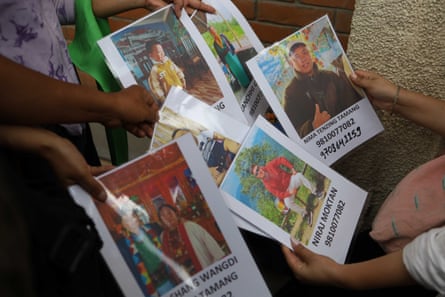
Relatives display photos of missing people outside a hospital in Kathmandu, where they have travelled from Rasuwa to seek information about family members. Photograph: Subaas Shrestha/NurPhoto/Shutterstock
The Chinese state broadcaster CCTV reported that a lake formed by piles of debris from the mudslide had begun overflowing on Friday, sending water towards the area where rescue teams were headed, and forcing a brief pause in operations.
Rescue efforts in Bidur, the capital of the Nuwakot district in Bagmati province, Nepal, were disrupted on Friday morning as the Trishuli River began to rise again after the lake near the border overflowed.
Rescue workers were moved from the area and people who had tried to return to what remained of their homes were told to evacuate again immediately.
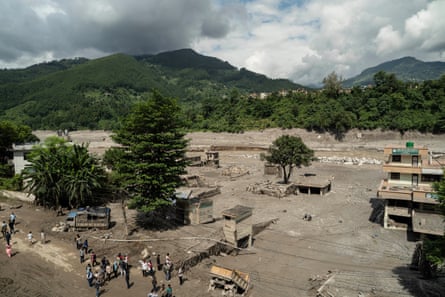
Bidur, once a bustling town on the banks of the Trishuli, now lies in ruins. Most homes were washed away when mud, rocks and debris surged down the river valley early on Wednesday. Survivors described clinging to buildings and trees as the water rushed over them.
People surveying the aftermath of the flooding in Bidur. Photograph: Ahmer Khan/The Guardian
The mangled concrete remains of a bank, a government office and an ATM booth were among the few structures left standing, although they were submerged in mud. Officials said there were bodies inside the buildings but it was too dangerous to recover them.
Nearby, people gathered along the muddy road, calling out for lost relatives and trying to dig out what was left of their belongings.
A woman among the ruins of Bidur. Photograph: Ahmer Khan/The Guardian
Most areas battered by the flash floods remained accessible only by army helicopter. At the Bidur army camp, from where much of the rescue effort was being coordinated, rescue and military helicopters flew in and out every five minutes, bringing in dozens of traumatised victims. Many said the floods had taken their loved ones, their homes and everything they owned in a matter of minutes.
The international community is scrambling to get aid to flood-stricken parts of Nepal and Tibet.
‘Erased before their eyes’: desperate rescue efforts continue after Nepal-Tibet floods - The Latest
Nepal has said it does not yet need foreign assistance as the search and rescue operation – complicated by the destruction of bridges and roads across the mountainous region – continues.
“The offer for help is natural,” Lok Bahadur Chhetri, a spokesperson for Nepal’s foreign ministry, said on Friday. “Our security agencies are doing the search and rescue operation. For now we don’t require such help.”
The Kathmandu Post reported that India, China, the US, Britain, Japan, South Korea, Sri Lanka and Bangladesh had asked the government to allow their search and rescue teams to assist in the operation.
Dinesh Bhattarai, a former Nepali ambassador to the UN in Geneva, said the government’s reluctance to accept foreign assistance may be linked to sensitivities over Rasuwa district and its border with Tibet.
“They may have thought about the locational sensitivity of the region and decided not to accept foreign teams,” Bhattarai told Reuters.
But Chhetri said Nepal’s own rescue teams were handling the operation and the decision to refuse foreign assistance had nothing to do with sensitivities.
Scant information has emerged from Chinese authorities about the scale of the destruction in Tibet, the most tightly controlled part of China even under normal circumstances. Only brief, state-controlled media reports about the floods have been allowed to circulate in China and the authorities have confirmed only five deaths there. Chinese reports have focused on rescue efforts.
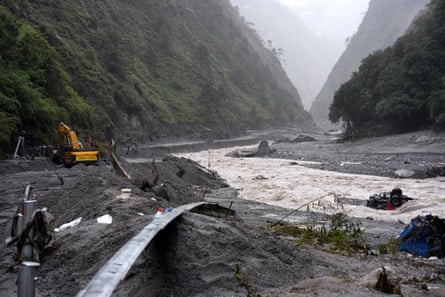
Excavators clear debris to restore a road damaged by the flash floods on the Tibet side of the border. Photograph: China News Service/Getty
The era of generative AI has kindled an era of generative AI witchhunts. It's routine right now for videogame developers to fend off accusations of using the technology, even when they are full-throated in their disapproval of ChatGPT, Claude and their ilk. Recent examples include Sandustry, the 2D factory builder from Hooded Horse with strangely haunting physics, and the just-announced Humankind 2, whose creators Amplitude have rushed to assure players that their announcement trailer is genuine live action film.
… %!s()
The conversation reflects a shifting idea of what AI-generated imagery 'looks like' - shifting because, strictly speaking, AI-generated imagery has no fixed style or quality. It's derived from whatever data the model is 'fed'. The confusion is exacerbated by the fact that the technology is changing, with new or updated buzzwordy tools being added to the pile. Established hallmarks of generated imagery go out of date fast. Meanwhile, generative AI's advocates muddy the waters, conflating tools and framing their capabilities in ludicrously open-ended, investor-baiting terms. Still, some responsibility falls on regular users who've become accustomed to chucking around claims of "AI slop".
Over the past few weeks, I've been chatting to game developers and artists who've been falsely accused of using genAI for visual art in particular, while also trying to understand why, exactly, their images and videos attracted suspicion. It's been a funny journey, both depressing and at times uplifting. The difficulty of identifying generated imagery at a glance is a political and social priority that goes far beyond videogames – genAI fakes are routinely used to manipulate people and foment conspiracies, including racist and xenophobic narratives about the "great replacement". We need to become better at spotting the snakeoil salesmen in our midst. But more positively, learning how to spot genAI is also the act of improving your visual and technical literacy. It's a process of becoming more intimate with art that captivates us.
Image credit: Failbetter Games
Hannah Flynn, comms director for Fallen London and Sunless Skies developers Failbetter, is used to getting flak online. "Most of my job is concerned with putting our games in front of new people," she tells me over email. "Success in my efforts means attention on us, which has always been a double-edged sword (I'm grateful that it's been a while since someone asked me for feet pics, though I fear it's never far from happening again). It’s a new development, though, that if a video gets shared widely or we have a big announcement, we're guaranteed to get asked whether or not we're using genAI."
Failbetter have a statement on the website for their flagship literary text-me-do Fallen London, swearing off any and all generative AI usage in their games. "Some of [the] comments represent genuine concern from our community, who've maybe read our AI statement and are worried that we've reneged on it, or violated it accidentally," Flynn goes on. "I don't mind reassuring our community personally; reservations about the quality of genAI’s outputs aside, we take a lot of pleasure in our craft and no one here is interested in switching career to AI wrangler." More bothersome, she says, are the "social media fly-bys from people who don’t seem invested in our games or the studio".
New Blood Interactive CEO David Oshry has also been fending off generative AI accusations. With regard to the forthcoming Tenebris Somnia, a promising horror game that combines top-down pixelart with live action film, New Blood eventually created a behind-the-scenes video showing off the creation of some props to shut down claims that they had been coughed up by a chatbot. I emailed Oshry to ask whether this was a pre-emptive gesture, or a response to some specific allegations. "LOOK AT THE COMMENTS AND YOU TELL ME," he replied, sharing links to somepreviousvideos.
Image credit: Saibot Studios
According to Oshry, allegations about generative AI have become "pretty much non stop" when sharing footage of New Blood games on social media, and especially Instagram - galling, given that he hasn't been shy about his disdain for the likes of Nvidia's face-plumping DLSS 5. "And we've noticed it's only very recently this has happened," Oshry continued. "Even a year ago we saw very little of this and mostly people just saying 'wow that looks so cool!'" Does he have any idea why Instagram users in particular seem more prone to this behaviour? "I think short form video platforms like Instagram and Tiktok have genuinely fried people's brains."
Still, Oshry is sanguine about the suspicion, noting that the feedback has actually rebounded to New Blood's benefit. "All the engagement has driven up our wishlists (15k added in the last week), but it is a bit exhausting," he tells me. As with Failbetter's projects, a significant proportion of the feedback is from drive-by posters, and New Blood's more committed followers have come to their defence. "As you can see in the comments people are quick to defend us and the game and set the record straight," Oshry goes on. "But we would rather be making cool content ABOUT THE GAME rather than making content proving it's NOT AI SLOP. It is what it is."
Image credit: Abandoned Sheep
Even when accusations are unfounded, some studios may prefer to change their art rather than deal with simmering mistrust. Abandoned Sheep, for example, are the developers of Schrodinger's Cat Burglar, a game about a self-duplicating cat navigating a maze of Portal-style testing chambers. One of the game's older pieces of key art, shown on the right, has been repeatedly called out as AI-generated, as studio director and former Jagex and Sony Cambridge developer Martin Binfield tells me.
"This piece is hand painted by local artist Tom Williams (as is the current key art) and was produced in mid 2022 - predating GenAI's ability to produce work to this standard," he says. Nonetheless, Abandoned Sheep ultimately found it more practical to replace the art than push back on the suspicion, not least because after four years, the art was in need of a refresh. "Honestly I don't begrudge those commenters for their vigilance," Binfield comments. "We as a studio have never and will never use generative AI, and I as a gamer also hate the idea that it might feature in a game I want to play. The 'AI art? No sale' commenters have their hearts in the right place."
All of the above games and artworks look very different, and it's tempting to throw your hands up and say there's no rhyme or reason to some of the accusations. "I honestly have no idea," says David Oshry of Tenebris Somnia, with characteristic forcefulness. "I think people may have honestly forgotten or are too young to know about practical monster makeup and VFX and think everything is either Marvel-style CGI or AI now??? It's baffling. Because as someone who sees a ton of AI slop on the internet every day, Tenebris Somnia definitely doesn't have "that" look. Or at least we thought so!" Asked whether he has any thoughts on the kind of game or aesthetic that gets misidentified as AI, he adds: "I am very old school and not tuned in to this bullshit and try not to be! I've seen people say that GTA 6 looks like soulless AI slop today so I think we've all just clearly lost the plot and hopefully a meteor will strike the earth soon."
Hannah Flynn is perhaps a smidge more optimistic than Oshry. She muses that Failbetter's "painterly art style" may read as generated, as may its penchant for deliciously 'aberrant' bodies that recall the disembodied limbs and knotted proportions of a slightly older variety of genAI photorealism. "It's often observed that AI images are trained on classical styles, which turns around on you when you're using a classical style to create by hand," she says. "And in fairness, we’re known for eldritch horror – some of our artwork genuinely does contain too many eyes or fingers, but I promise it’s on purpose!"
Image credit: Failbetter Games
Flynn adds that the conversation about generative AI is, in some ways, inspiring. "The meaning of made things is a sort of sub-theme" of Failbetter's current project Mandrake, a folkloric, Stardew-esque gardening sim invested with the studio's usual blend of whimsical and macabre. "It feels on point to talk about," she says, "and maybe leads to more people spreading the word!" Without having played Mandrake, I can't quite get into the weeds of this, but it certainly makes me curious to have a go.
If visual errors create grounds for suspicion, so too may immaculate execution. "From the comments, it seems that it was 'unnaturally polished'," says Martin Binfield of the key art for Schrodinger's Cat Burglar. "I presume things like the airbrushing and the reflections in the cat's eye were the aspects that set people off, as there's plenty of rough brush-stroking in the piece at large. This feels to me like a 'cursed by success' thing - Tom's art was super polished and high quality, and one presumes that gen AI has ripped off the highest quality art work for its algorithmic slop bucket. To be accused of being AI in some cases is to be accused of being 'too good to be true'.
"Of course, other times AI accusations are because of an incorrect finger count, but still," Binfield adds. "One comment talked about the cat having missing teeth - not sure which teeth in particular they thought were missing, and the cat is hardly anatomically correct anyway. I think the main trend in the responses I noticed was an absolute sense of being correct. It was rarely a question ('is this AI?') and more often a declaration ('no sale until you get rid of the AI'). I put this down to general internet-comment arrogance - indeed, in the instances where I replied and stressed that we weren't using AI they would generally comment 'that's great to hear! Sorry for getting it wrong!'. Next game, I'm going to draw the key art in crayon using my left hand so it was clearly human-made…"
Image credit: Abandoned Sheep
While talking to the developers about how their work has been misinterpreted, I've been thinking about my own, patchy visual literacy and sensitivity to indications of AI generation – I was embarrassingly caught out in a recent article on ASCII horror game The Carcass. I've been looking for resources to hone my savviness. Among the best I've found is this academic survey created by table-top game and book illustrator Janna Sophia Koppenwallner, which asks the user to sort the slop from a collection of book covers, archive photography, snapshots from news broadcasts, and more abstract 'fine art'. In the process, it feeds you tips: errors to watch out for, such as skin that has a certain Lovecraftian lustre, and contextual giveaways, such as a scarcity of biographical detail about the creator.
Koppenwallner is, in fact, writing a Masters thesis about human AI detection image accuracy. "Before I chose the topic I did a little bit of research on human AI detection and found multiple studies that claimed that it was no better than chance," she tells me over email (here's one example). "I think a part of me didn't want to believe that was true."
I should stress that Koppenwallner's data analysis is ongoing and not yet peer reviewed, with more research needed. Please scatter your salt shaker liberally over what follows. Still, her provisional findings are intriguing, and a bit discouraging. "The data I collected actually shows an average detection accuracy of 74%, and found that people who finished a short training module actually did just a bit worse than those who did not," she says, adding that the actual difference was "pretty marginal", however statistically significant. "From what I've gathered so far, people did get overly suspicious and over-corrected, misidentifying real photos and art as AI generated," Koppenwallner observes. This describes my experience of her survey: I chalked up more false positives than misses.
Image credit: New Blood Interactive
Koppenwallner herself has never been accused of using generative AI, partly because she's been posting her art online for 15 years, so there's ample evidence that she's cultivated her craft. She thinks artists who are just starting out today "might have a much harder time". I'm curious to know whether amateur art with obvious blemishes might be more at risk of being misidentified as AI-generated, and whether there are any artistic traditions or styles that are somehow innately more suspicious.
"There's no data in my survey about that," Koppenwallner began, "but anecdotally I've noticed that those artists being falsely accused of using gen AI had rather popular art styles, that look very clean, highly rendered and polished. Gen AI relies on immense datasets, and the more data a model has, the 'better' the output. Most models still fail to re-produce niche art styles, since there simply isn't enough data for them to draw on. But that might change in the future, and again, depends largely on the AI model." Koppenwallner adds elsewhere in our chat that every generative AI model has "a distinct visual language, which only becomes apparent when you compare a lot of their output". Still, she thinks that generated imagery trends more often arise from certain varieties of art being more popular.
As regards the risk of artists still mastering their techniques being branded genAI users, Koppenwallner offers a fascinating dissection of 'hand-crafted' versus generated error. "When it comes to mistakes in art, the failure patters AI models produce are very different from mistakes a human artist would make," she says. "AI tends to blend things together (like hair suddenly looping into a necklace), because the model doesn't actually know what it creates, it just uses a very good probability algorithm. Again - this wasn't part of my thesis and is purely anecdotal - but human beginners tend to struggle with proportions, colour and lighting (which usually the AI gets somewhat right), while most AI models struggle with anything that requires precise decision making, like lineart, details, textures and ornaments."
In her questionnaire, Koppenwallner encourages people to follow their own intuition – that nagging, inarticulate feeling that something about an image is Wrong. But she also echoes Martin Binfield in remarking that the feeling that something is 'too good to be true' can easily become sheer bias. Intuition has to be deliberately modulated through study. You have to cultivate your own taste. "There's actually a really good book by Robin Hogarth about training intuition," she says. "According to him, intuition is trained through feedback, but if the feedback is wrong our intuition misfires. That's how prejudices are created in the first place. Unfortunately, training correct intuition would require proper training and time to develop a certain level of expertise."
Image credit: Abandoned Sheep
Perhaps inevitably, Koppenwallner has found that fellow creative industry workers do better at her quiz than people in professions that don't involve making or sifting through visual art, but she thinks most internet users at least have a certain passive expertise with photographic media. "I still have to do some research in that area, but I believe that on average people are better at identifying photographs rather than art, since everyone, regardless of profession, is bombarded with photos on a daily basis."
We've hitherto discussed how certain varieties of art can be misinterpreted as AI-generated. Another layer of fiendish complexity, worthy of an article in itself, arises when we start talking about certain older machine learning tools that overlap a little with what is now known as generative AI.
Abdou Bouam is a freelance artist whose work encompasses "a bit of everything really" – from 3D videogame props and scenes to advertising product renders, educational videos, and other "game adjacent" work. He recalls an instance when a client questioned some images he'd sent for feedback, calling attention to some blurry and indistinct patches, and asking if they had been generated or edited using AI. The blemishes were, in fact, created by older denoising methods.
A 10 part image from Abdou Bouam, showing different applications of path-tracing and denoising to create a cinematic horror scene. | Image credit: Abdou Bouam
I know even less about the technology of computer graphics than I do about the history of visual art. Thankfully, Bouam is willing to explain further. To summarise his thoughts, denoising is the automated removal of random variations and anomalies from an image. Amongst other things, it's used to clean up renders – that is, 2D images of 3D scenes – that are created using pathtracing. Pathtracing is a way of creating physically plausible images of different objects and materials by firing out rays from the camera and bouncing them around until they hit a light source, then calculating how much light is transmitted back along the path to the camera. Each repetition of this process is called a sample, and the finished image is produced by averaging out the discrepancies between samples.
"The image starts very noisy, then as more samples are added and averaged, it converges to a final result that's physically accurate," Bouam tells me. "The only way to get a noise-free image is to render it for an infinite amount of time, which is obviously not feasible, so the better approach is to render it until the noise becomes so low that it can be denoised with little to no quality loss." The question, then, is how much time you can afford to spend bouncing rays around before reaching for the denoiser. The difficulty is that, as Bouam goes on, denoising blemishes can resemble symptoms of AI generation. "Details get lost, blurred, and smeared with a lot of artifacting that just feels like genAI."
The other difficulty is that some denoising tools like Nvidia Optix - first released in 2018, and used by many videogames that feature raytracing or DLSS - do fall under the umbrella of "machine learning". But they pre-date "generative AI" as we now understand it, and Bouam argues that they don't have the "same ethical concerns". Rather than relying on access to non-consensually obtained public data, for example, the models in question are created using archives of tailormade images, which "are purposely rendered with a lot of noise, and then compared to the noise-free ones that took ages to render," as Bouam explains. "It's not trained on stolen and unlicensed work. Even if you wanted to, you can't just take any picture off the internet and train with it, you have to use an actual production 3D scene with all the extra data it creates."
These elder denoisers run locally rather than via data centres, Bouam continues, and save energy because they drastically shorten the time required to create an acceptable render. He also feels that they don't represent a loss of artistic control. "It doesn't change the way my scene looks, other than smears and splotches if the sample count is too low and the scene is challenging to render. But it doesn't change my lighting, or 'yassify' my characters, or anything else like that." In a nutshell: it's still his art.
Image credit: Nvidia
I hope all these insights and reflections offer some kind of steer, while navigating the rapids of a world in which generative AI is being shoved into every vocation and pastime. I'm conscious, however, that any takeaways from this piece may soon be obsolete.
Again, the tech keeps changing. Today's generated AI tools display fewer of the unearthly mutations that characterised the first iterations of Midjourney and ChatGPT. "Pure visual detection is getting harder and harder," Koppenwallner tells me in closing, "and I think most clues are in the context of an image these days (what am I seeing, why am I seeing this, can it be true that I will get a fully rendered painting in two days for $200, etc). It's one thing to be aware and to protect oneself, but I'd be very, very careful about calling someone out for using AI, based on a hunch." %!s()

 Image: Toei Animation

 Image: Lionsgate