At first glance, PokeWorld Online is borderline indistinguishable from classic Pokémon
Red from the Pokémon anime with a Jolteon, Charizard, and PikachuImage: The Pokémon Company
Incredible things are happening in Hytale. Yesterday, a modder posted a video on X showing how far they took the sandbox game with PokeWorlds Online, a multiplayer Pokémon fan project made within a Hytale server. Aside from the UI, its gameplay looks virtually indistinguishable from Pokémon FireRed and LeafGreen, which is quite impressive considering that, by default, Hytale is a first-person, Minecraft-style game.
… %!s()
Beyond these familiar assets, the demo shows the player placing Pokémon in their storage box, equipping items, and looking through stats pages. The playable character enters tall grass and triggers a randomly generated battle, leading to an encounter that looks almost identical to these older games. Ultimately, "the goal of this server is to create a multiplayer Pokémon game on Hytale." The trailer didn't show this MMORPG gameplay, but the creator admitted it is a work in progress.
The X post from @PokemonWorldOnlin lays out further plans for the mod. “It will feature well-known regions, more Pokémon, and, most importantly, eventually allow for custom regions, Fakemon, and much more...” They admit that “this project is going to require a huge amount of time. I’m not even sure I’ll be able to finish it, considering how much work it will take, but I wanted to show the community that Hytale could be used as a 'game engine,' rather than simply building on what already exists.” They concluded with, “I can’t wait to see other games and servers emerge 2D, 2D isometric, 3D... with their own assets, gameplay, and universes!”
What is Hytale?
Hytale is a Minecraft-inspired sandbox game from Hypixel Studios that went into early access on Jan. 13, 2026. The studio, which began as a group that ran custom Minecraft servers, was purchased by Riot Games in 2020. Riot canceled the game in June 2025, before its original creator bought the rights back and resumed development.
One of the game’s main features is that it allows players to build and share mods using a set of in-game tools. Still, even in this context, PokeWorlds Online is impressive; Hypixel founder Simon Collins-Laflamme replied to the X post with a GIF expressing his surprise. "I'm extremely happy that I was able to shock the creator himself," the PokeWorlds Online account responded. Hytale has previously been modded to run Minecraft, Doom, Windows 95, and more.
While Hytale was clearly created with this type of freedom in mind, there’s an elephant in the room: the infamously litigious Nintendo. The company is known for aggressively protecting its IP through legal action, whether that’s going after emulators or fan projects that use its characters. While Nintendo has done little as the Trump administration uses its franchises like Pokémon to peddle hate, the company has previously buried defendants in inescapable mountains of debt. Given this context, it seems likely that Nintendo’s lawyers will send a cease-and-desist if they catch wind of PokeWorlds Online.
Thankfully, the mod's creator has accounted for this: "If Nintendo steps in (which would be completely normal and understandable), I’ll remove any assets related to the Pokémon franchise. I’ll then try to replace them with custom assets and Fakemon." Hopefully, this fascinating project can survive first contact with Nintendo. %!s()
The world’s first toaster that works on color instead of time is great. But is it $300 great?
Sam Rutherford for Engadget
RATING : 8.7 / 10
…
Pros
Extremely easy to use
Built-in optical sensors toast by color
Dedicated sourdough and bagel modes
Removable crumb tray
Non-stick ceramic coated top
Cons
It’s very expensive for what it is
Did we mention that this toaster starts at $300
And that’s only for the two-slice model
We may receive a commission on purchases made from links.
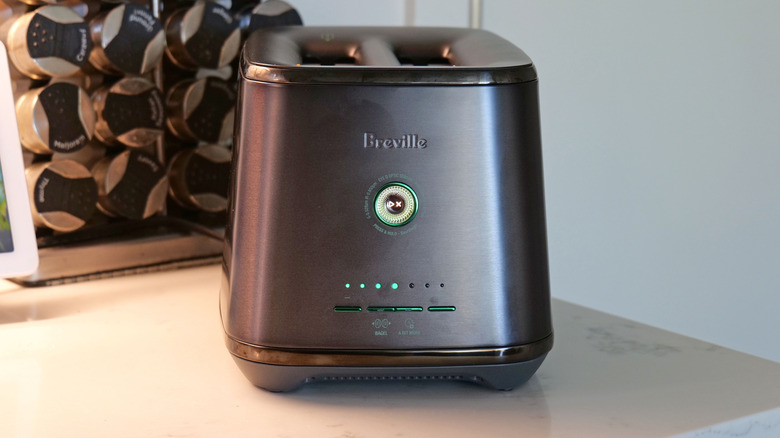
The classic pop-up toaster is arguably one of the simplest kitchen appliances you can own. It's just a box with resistive coils inside, a timer and spring-loaded slots to eject your bread when it's done. It's a well-tested formula that has worked for more than 100 years, and as the old adage goes: If it ain't broke, don't fix it. But what if there was a world in which the pop-up toaster had never been invented and someone tried to make one with today's technology? The result would probably look a lot like Breville's new $300 Eye Q Toaster, which is the first of its kind to crisp up bread based on color instead of time.
Design
Sam Rutherford for Engadget
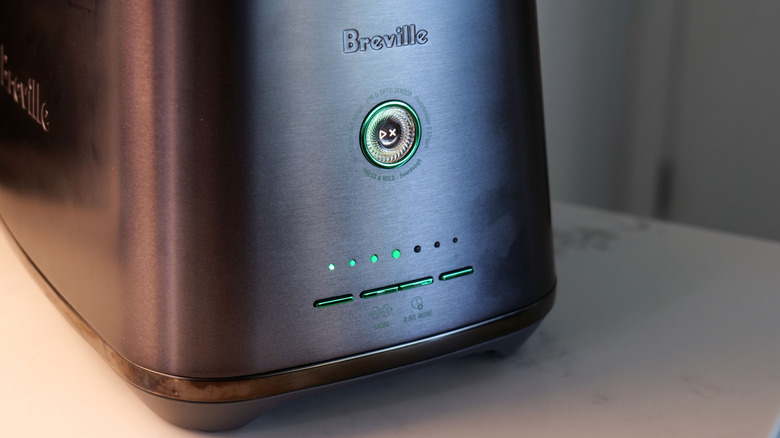
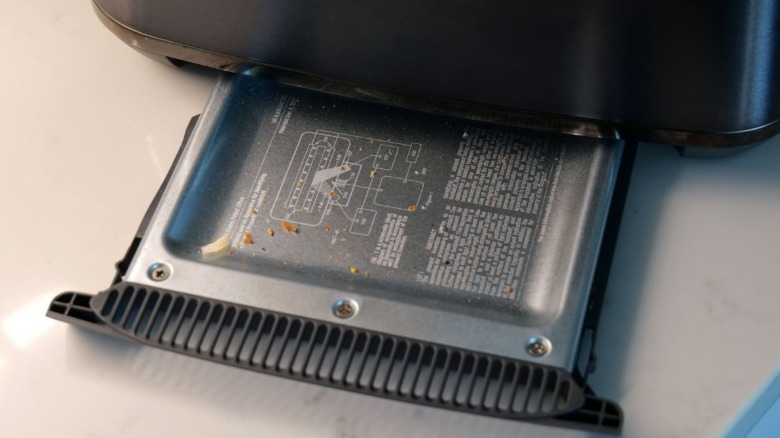
There's only so much you can do to spruce up a toaster, but Breville still managed to give the Eye Q a decidedly futuristic appearance. It features rounded edges and a minimalist design that seems like it would fit in better on a spaceship than a typical mid-century modern home. On top, there's a non-stick ceramic coating that does a great job of keeping the toaster clean while also allowing crumbs to neatly fall down into its removable tray. There's also a handful of rather intuitive buttons for adjusting how light or dark you want your bread to get.
When the light is in the middle, you get a really nice golden brown. If you want a blonder roast you can simply press the minus button on the left, or tap the button on the right for a deeper toast. There's also a dedicated button for bagels and an "A bit more" button in case your bread needs just a little extra tan. And of course, instead of a spring-loaded lever, there's a big button in the middle that tells the toaster when it's time to get to work.
How it works
Sam Rutherford for Engadget
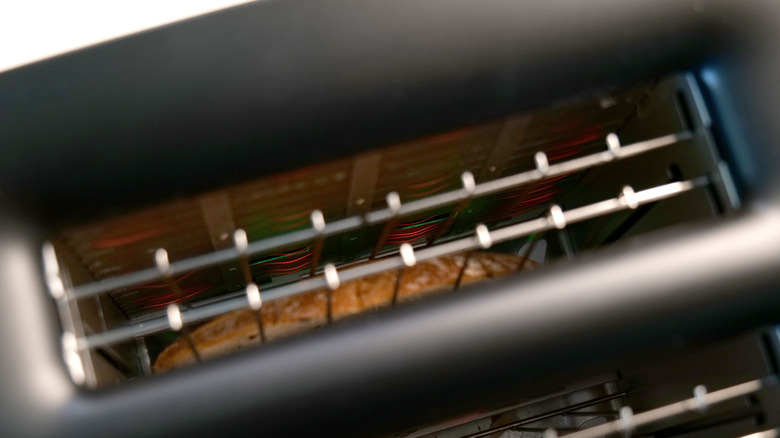
As soon as you press the start button, the Eye Q uses its built-in motors to clamp down on your bread and slowly lower it inside. The whole process definitely feels more sophisticated than slamming down on some springs, but in practice, it doesn't really change much. The big difference is what happens when the coils inside heat up.
In a traditional toaster, there's a timer you can set that tells the toaster how long to cook your bread. When it's done, you get that classic ding, the toast pops up and you get what you get. The issue is that depending on how hot the coils are and what kind of bread you're toasting, achieving the perfect golden brown nirvana often feels very hit or miss. And that goes double when you're using a toaster that you aren't familiar with.
Sam Rutherford for Engadget
That's where the Eye Q changes things. Instead of a timer, it has a handful of optical sensors inside that tracks the color of the toast 10 times per second. When it hits your desired shade, alongside a helpful beep, your bread smoothly rises up to let you know that it's done. No need to guess if a minute, a minute and a half or two minutes is what you need to properly sear the surface of your bread or bagel. Your toast is ready when its color is right, not when it's been singed for an arbitrary length of time.
The toast test
Sam Rutherford for Engadget
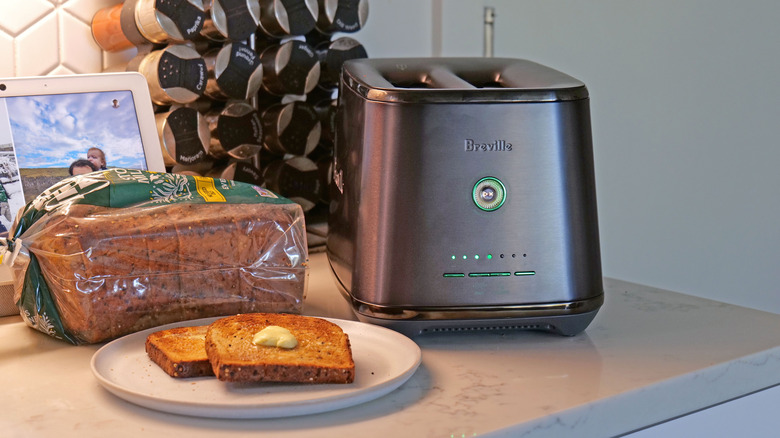
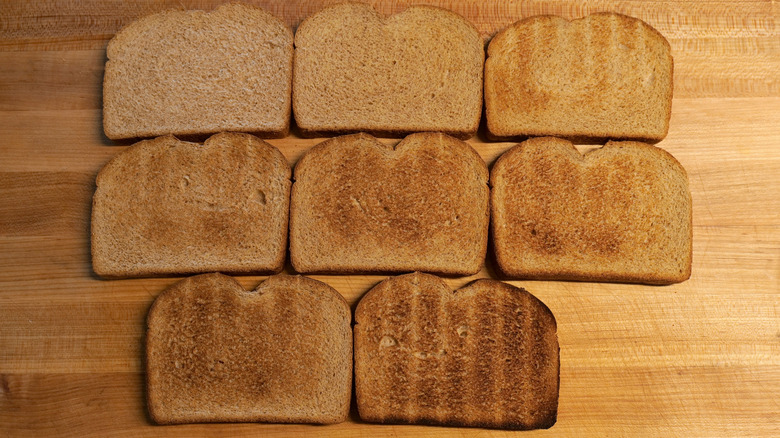
In order to put the Eye Q through its paces, the first thing I did was buy a fresh loaf of whole wheat and then toasted a slice on each one of Breville's seven color options. The result was a surprisingly smooth gradient from light to dark that would make the paint section of your local home improvement store proud. The lightest setting was so faint that it was more like merely crisping up the crumb of the bread without really changing its color, while the darkest slice was a deep brown that critically stopped short of being burnt — aside from the very edges of the crust. And in the middle, the Eye Q produced a perfect golden slice of toast that practically anyone would be happy to eat. In fact, the standard middle option was so on point that I just left it there for nearly all of my regular toast needs after that. (Note: In the picture above, the slice in the top left is an untoasted control, followed by seven progressively darker pieces of toast made by the Eye Q.)
If I'm really nitpicking, sometimes you can see the grill lines of the toaster where it holds each slice of bread in place. I also noticed that some pieces of bread looked a bit more splotchy while others featured a more uniform coloring. But those are almost entirely cosmetic differences because after smearing a touch of butter on, the taste of the toast was on point. There's no need to guess if the bread should cook for 30 or 45 seconds or whatever, the Eye Q can figure things out on its own. Though if you do want a little extra crunch, you can always hit the "A bit more" button like tapping snooze on your alarm clock. You can even toast frozen bread straight out of the fridge without worrying about it coming out overdone.
Sam Rutherford for Engadget
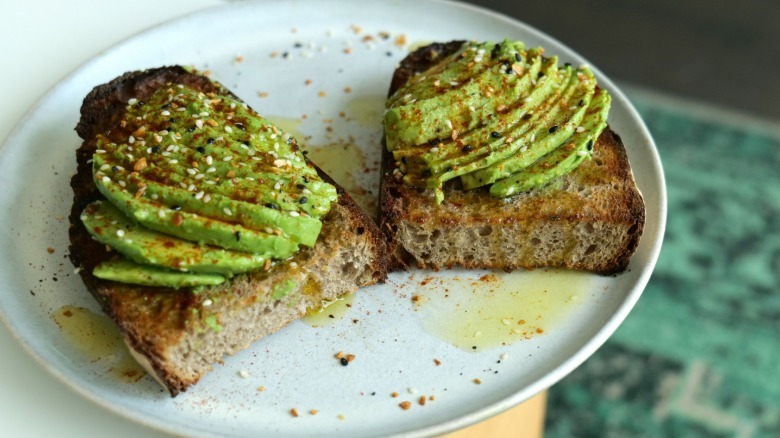
Of course, that's not all the Eye Q can do. If you press and hold down on the main button, you can trigger its sourdough mode. This gives the toaster a bit more freedom to propagate a maillard reaction into the big nooks and crannies you often get on a fancy leavened loaf. As a card-carrying millennial, naturally I used this function to make some avocado toast. And even though I had selected a massive French miche, the toaster produced a wonderfully crisp and perfectly colored slice that served as a perfect bed for Mexico's most famous berry. That said, I did have to cut the bread in half lengthwise so that each slice would actually fit inside the toaster.
The Eye Q can also toast bagels, though as someone who lives in the northeast US and has plentiful access to fresh-baked options, I'm of the opinion that a good bagel doesn't need to be toasted. And in its own way, I feel like Breville agrees. That's because after I went out to my local shop and brought some home, I found that proper NYC-style bagels are often so thick they don't really fit in the toaster, even after you slice them in half, without hacking it up or stuffing it into the slot in a way that just doesn't feel right.
Sam Rutherford for Engadget
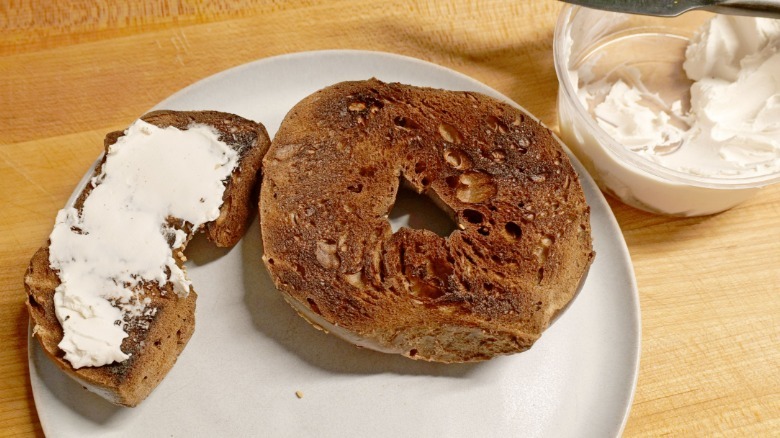
It's also important to note when toasting bagels, you're supposed to face the cut sides outwards for the best results. Unfortunately, when I tried that with a lovely Russian rye pumpernickel, it ended up getting a bit burnt. In the Eye Q's defense, I think that happened because the bagel was simply too big for the space and it ended up too close to the heating elements. So, if you're the kind of person who buys Lender's or whatever other sad excuse for a bagel that you find at your local grocery store, go ahead and toast it as the Eye Q can easily handle that too. But for anyone with access to a proper bagel, I think you should just skip the toaster entirely.
Wrap-up
Sam Rutherford for Engadget
The Eye Q does everything you want a toaster to do, and in almost every circumstance, it does it better than any other toaster I've ever used. You don't need to worry about how long your bread needs to be seared because the toaster already knows and is on alert to make sure it comes out perfect every time. It's easy to use, easy to clean and it's available in both two and four slice models depending on your needs. The Eye Q is basically what a toaster would be if it was invented today with focus on modern components and ultimate convenience.
However, the major hurdle with the Eye Q is that the cheapest version starts at $300. That's a ton of money for a toaster, especially when you consider that you can get a basic one for one-tenth the price. Furthermore, a toaster can really only do one thing, which means it's going to take up a decent chunk of counter space without bringing much versatility, which can feel like an extra restriction for people with small kitchens. Thankfully, at just under six pounds, it's light enough to move around when not in use.
I love what the Eye Q can do. But ultimately, its presence in your kitchen will probably depend more on how much disposable income you have as opposed to its ability to crisp up bread better than your average slotted box. %!s()
Paul Deraval, Cofounder & CEO of NinjaCat, is a software veteran with 20+ years driving innovation in martech, AI and agency growth.
getty
We’re in the maxxing era. Looksmaxxing for those wanting to improve their appearance; proteinmaxxing for the diet-focused; moneymaxxing for the future rich; and bedmaxxing for the chronically exhausted. Then, of course, there is tokenmaxxing—the trend of maximal AI use to climb a corporate leaderboard or catch the AI wave at all costs.
… %!s()
While the productivity and product results didn’t materialize, the costs sure did. According to Fortune, “Uber burned through its entire 2026 AI budget in four months,” joining the nearly 70% of companies reporting AI cost overruns in 2026.
Unsurprisingly, executives and companies big and small are trying to rein in this spending. They are looking at which models cost less. It’s the right objective with the wrong approach.
The biggest AI costs rarely come from model selection alone. They come from operating AI without visibility. For example, according to TechSpot, Amazon integrated Anthropic’s Claude Sonnet model to match author information with product listings. The project ran for five months before the cost overrun was detected, ultimately generating a $1.8 million AI bill, 860% above its original budget. The incident highlighted how difficult it can be for enterprises to track and control AI spending when usage is metered by tokens.
The maxxing era is coming to a close. We are entering the value era, and the companies creating the most enduring value may not be using the best models, but they will know how to use their tools more intelligently. Here’s how you can make the shift.
1. Stop measuring tokens like they’re just another cloud bill.
Aware that AI won’t be free, most organizations are tracking their AI spend. They are measuring their cost per token, unsure what token usage actually represents but certain that high token usage equates to waste. It doesn’t.
Tokens reveal how AI is behaving. They indicate where models are spending the most effort, which workflows require excessive reasoning, where prompts lack clarity and where context forces unnecessary computation.
It’s like receiving a surprisingly high energy bill from running the air conditioner during the summer. It could be a sign that you need to use the air conditioner less, or that it has been running nonstop because a window was left open. Closing the window is probably a better solution than turning off the air conditioner.
Token usage is a diagnostic tool that can help your company use AI more effectively, not just limit overall expenditure.
2. Optimize the work before you optimize the model.
Nobody wants to be the next infamous headliner, so organizations have AI costs top of mind. It’s part of the reason open-weight models, from DeepSeek to Kimi K3, receive so much attention. Companies want to control costs, and these models promise a far cheaper alternative.
Leading with upfront cost is the wrong starting point. Instead, consider the work you are asking the AI to perform, understanding how much reasoning the work requires and the information the AI needs to succeed.
If cutting costs is the only goal, the cheapest model will probably achieve this outcome, but it may produce significantly worse results. Additionally, one study found that choosing cheaper models with higher error rates, even very modest ones, can easily erase the initial cost savings. Understand the work you need the AI to perform and optimize that task before selecting the model to run it.
3. Change how you think about models.
AI models are specialists, not generalists. Executives often think about models the same way they think about employee seniority. They assume that an expensive model must be used for important work, and a cheaper model is for lower-stakes tasks. In reality, different models are designed for different jobs.
Some excel at complex planning and pattern recognition, while others are built for scalable content generation or data classification and extraction. Running an advanced reasoning model on repetitive work wastes resources, while running a lightweight model on strategic analysis yields disappointing results.
Instead of running an advanced reasoning model on repetitive work and wasting resources, switch to a lightweight model purpose-built for high-volume execution. The most expensive model isn’t always the right choice, and matching the right model to the right task is the best way to maximize capability without incurring cost overruns.
Visibility is your AI competitive advantage.
Visibility is already a standard discipline across every other core business function. Advertising relies on campaign reporting to optimize conversion rates and return on spend, cloud infrastructure uses telemetry to monitor system health and uptime and finance uses data dashboards to track burn rates and prevent budget leaks. Too often, AI operations are opaque, even as businesses spend money to scale them enterprise-wide.
They don’t know which models are running, which workflows are creating value, which systems are struggling or which prompts require improvement.
Visibility changes this dynamic, allowing leaders to intentionally improve workflows rather than simply reacting to costs after the fact. The next competitive advantage in AI won’t come from having access to the newest model. The companies that outpace the competition will understand each required task before assigning a model, they will provide the context the AI needs to operate effectively and they will monitor how it performs, not just what it costs. They will do all this to refine workflows that improve performance and control costs without compromise.
Forbes Technology Council is an invitation-only community for world-class CIOs, CTOs and technology executives. Do I qualify?
Crunching tackles that help win hard-fought away points in an all-action performance are the kind of things Everton fans have become well accustomed to when watching James Garner.
Now the rest of the Premier League are starting to take proper notice.
… %!s()
Following Everton's goalless draw at Tottenham on Saturday, during which midfielder Garner bested a home line-up boasting the near-£200m midfield pairing of Sandro Tonali and Mateus Fernandes, Match of the Day pundit Thomas Frank hailed Garner's display.
It featured crucial challenges on Tonali and Fernandes to halt promising home attacks - by a player who missed a significant part of pre-season after hernia surgery.
"Garner today was extremely good," said Frank. "He is aware; he's talking; he's organising.
"In a high-press situation, he does the recovery, and that's just so exceptional and so important when you are playing against a team who are dominating you.
"He was running so hard, so that's one side of his game, but also so important is his touches. He is a lot on the ball. It's through him that a lot of things are happening."
Fellow pundit and former Everton defender Ashley Williams said: "He's really impressive. If you're a centre-back behind him, he's the type of midfielder you want."
Garner was signed for an initial fee of only £9m from Manchester United in 2022, having spent the previous season on loan helping Nottingham Forest get promoted to the Premier League.
The academy graduate did not make a Premier League start for United.
After taking two seasons to settle at Everton under Frank Lampard and then Sean Dyche amid a backdrop of financial problems and points deductions, the 2025-26 campaign proved to be a watershed moment.
Garner played all but six minutes of Everton's Premier League campaign to spearhead a European push that lasted for much of the season.
In December Everton travelled to Forest with a depleted squad and won 2-0 to move within four points of the top four.
Garner scored Everton's opening goal in a commanding display that underlined his development.
Following that win, manager David Moyes said: "When I came in, I still saw a bit of a boy and I think I now see someone who's turning into a really good leader as well, beginning to take a bit more responsibility and grow up and begin to start to act like a real midfield player."
The data backs up Garner's growing maturity.
He ranked top for a host of metrics for Everton last season, in terms of creativity and physicality, making the most successful passes, tackles and interceptions, but also providing the most assists and engineering the most chances.
Perhaps most impressively, he stepped up in the absence of key winger Jack Grealish - four of Garner's seven assists came after Grealish's season was ended by injury in January.
"He's been fantastic since I came in," said Moyes. "I didn't realise probably how good he was. He's been so good." %!s()
Thaci, 58, was sentenced to 25 years in prison for crimes including murder, torture and illegal detention.
The Kosovo war crimes tribunal has convicted former Kosovar President Hashim Thaci of four counts of war crimes committed during his country’s war for independence from Serbia.
… %!s()
Thaci, 58, was sentenced on Wednesday to 25 years in prison for crimes, including murder, torture and illegal detention, committed as top commander of the ethnic Albanian Kosovo Liberation Army (KLA) during the territory’s violent break from Serbia in the 1990s.
Recommended Stories
list of 3 items
list 1 of 3Former Kosovo President Hashim Thaci faces verdict for alleged war crimes
list 2 of 3Kosovo finds remains of 23 people in mass graves search
list 3 of 3Kosovo finds third wartime mass grave site as officials widen search
end of list
The Kosovo Specialist Chambers (KSC) in The Hague, Netherlands, said he was guilty of the murder of 96 political opponents and perceived collaborators with Serbian security forces by the KLA during the conflict.
Thaci denied all the charges.
Wearing a suit and tie, he stood in silence as Presiding Judge Charles Smith read out the sentence.
Three former KLA senior commanders were also sentenced for several different charges.
Jakup Krasniqi was sentenced to 25 years in prison, Kadri Veseli was given 18 years, including the time he spent in custody, and Rexhep Selimi was sentenced to 13 years, including the time spent in custody.
Kosovo Albanians gather during a rally in Pristina on September 16, 2026 to call for an acquittal [AFP]
The four men were acquitted on six charges of crimes against humanity because the judges said the prosecutors failed to prove that crimes were committed as part of a widespread and systematic attack on civilians.
Before reading the sentences, Judge Charles Smith referenced the severe torture and killings by the KLA.
“No flag is big enough to hide the shame of killing innocent people,” he said, citing a quote by American historian Howard Zinn.
The trial has been controversial within Kosovo as many Kosovan Albanians see the KLA and Thaci as revered figures because of their role in the 1998-99 independence war.
In Kosovo’s capital, Pristina, thousands of people watched the reading of the verdict live on a huge screen and were stunned at the sentence. Some started shouting slogans in support of the KLA and Thaci. %!s()


 Sam Rutherford for Engadget
 Sam Rutherford for Engadget
 Sam Rutherford for Engadget