Avengers star Mark Ruffalo has responded to the suggestion he had invoked "antisemitic tropes" in his ongoing criticism of Paramount's $111 billion Warner Bros. buyout.
Responding to the claim, made in a lengthy and unusual statement by Paramount itself, Ruffalo dubbed the accusation as "appalling and fundamentally dishonest."
… %!s()
The issue stems from Ruffalo's continued pressure on Paramount over its controversial takeover of Warner Bros., a transaction that Ruffalo and numerous other Hollywood stars have said will likely result in consolidation, cost-cutting and job losses, plus particular concern surrounding the independence of Warner Bros.' news organization CNN. Paramount is owned by David Ellison, and the buyout's finances will be backed his father Larry Ellison, the billionaire co-founder of technology firm Oracle and the world's sixth-richest person.
In an Instagram story last week, Ruffalo commented on a video featuring Oracle vice chair Safra Catz, who discussed Oracle's public backing of the Israeli military in the wake of October 7 terrorist attacks, and the subsequent deployment of what she described as Oracle's "really profoundly scary technology" to the Israeli army.
"We have a chance to stop this," the actor continued. "There are 12 state Attorneys General suing to block this merger. It will be catastrophic for our film industry. Mergers like this one are almost always bad for workers, consumers and the industry they tend to dominate. It's a classic antitrust case. It will hike up the cost of cable and flatten out competition. This means less choice for our audiences. It also concentrates an enormous amount of creative control to companies that say and do things like this strange woman from Oracle."
Mark Ruffalo's initial post discussing Oracle. Image credit: Mark Ruffalo/Instagram.
In a response statement issued to The Hollywood Reporter, a Paramount spokesperson took the unusual step of directly quoting and discussing Ruffalo's Instagram story, branding his message as containing "antisemitic tropes" and suggesting that such statements expose "the true motivation of some who have advocated opposition to this transaction." Paramount's response lies below in full:
"We are, as always, troubled when antisemitic tropes are invoked in purported service of a business dispute," the Paramount spokesperson stated. "Words like 'genocide' and 'apartheid,' applied to a corporate transaction, aren't just wrong — they're a bridge too far, and they cheapen the very real suffering those words are meant to describe. This doesn't deserve a response in kind — and to be clear, we don't tolerate prejudice of any kind, against anyone.
"This brings us to a moment to lower the temperature, not raise it. We'd rather build than further engage in such rhetoric. This simply exposes the true motivation of some who have advocated opposition to this transaction. On the other hand, our commitment to great content is matched by our commitment to acceptance – to every story, every storyteller, and no blacklists, no exceptions, for anyone.
"We understand people feel strongly about this merger and are hopeful and expect that it will be judged based on the legal merits, not underlying bias. We're asking for the same good faith we're extending: less rhetoric, more understanding. Paramount's future is being written for everyone who wants to make and watch great stories."
It's this statement from Paramount that Ruffalo has now responded again to condemn, in a post on X/Twitter which seeks to separate his criticism of Oracle and its links with the Israeli military from the suggestion that such criticism cannot exist without being antisemitic. Ruffalo's response lies below in full:
"The accusation that I am antisemitic is appalling and fundamentally dishonest. Criticizing the actions of the Israeli prime minister, a military technology contract, or the executives who supply it is not the same as criticizing Jewish people. This critical and necessary dialogue is then dishonestly framed as being anti-Israel. To be clear, my views come from my own political convictions and should never be interpreted as hostility toward Jewish people, for whom I have deep love and respect. Everything I know about acting, activism, and humanism has been profoundly shaped by the Jewish friends, colleagues, and loved ones who have been integral and family throughout every point of my life.
"This merger has real consequences for real people, and for the entire country. Scrutinizing the Ellisons, including Oracle’s business built on data, surveillance technology and government contracts, and the serious threat to editorial freedom and the loss of a livelihood for thousands of families, is fair and necessary. The $111 billion deal would hand one family control over CNN, HBO and Warner Bros., backed in part by foreign money whose influence on editorial decisions has never been fully explained to the public.
"Lawmakers on both sides of the aisle have called for serious national security review, and regulators still haven't given the public a real answer. Until they do, the merger shouldn’t move forward. Now is the time to dive boldly into all these issues, not step back or concede."
Last month, Paramount's buyout of Warner Bros. was postponed until the conclusion of an antitrust trial, which could keep the deal from closing until the legal process is concluded, or June 2027 at the latest. Ruffalo, meanwhile, was most recently seen in portraying his veteran Marvel character Bruce Banner/The Hulk in Spider-Man: Brand New Day, which has now passed $2.22 million at the box office.
Rwandan President Paul Kagame has again blamed the Democratic Republic of the Congo (DRC) for the continuing conflict in the country’s east, linking Rwanda’s involvement in the conflict to the continued presence of the Democratic Forces for the Liberation of Rwanda (FDLR), a Rwandan Hutu armed group, on Congolese territory. He said Rwanda would continue to take whatever measures it considers necessary to protect its security.
… %!s()
Speaking at a news conference in Kigali, Kagame reiterated that the FDLR’s presence in the DRC is Rwanda’s main concern, adding that “if this problem is not resolved, it is natural for Rwanda to remain involved” in the conflict.
Old accusations, renewed claims
Kigali accuses the FDLR, which was formed from remnants of the Rwandan army accused of involvement in the genocide against the Tutsi, of threatening Rwanda’s security from Congolese territory.
Kagame said Rwanda has information that Congolese authorities “are arming the FDLR and integrating its members into their own forces”.
Kinshasa, meanwhile, accuses Kigali of supporting the M23 movement, an armed group in eastern DRC, and of sending Rwandan troops into Congolese territory. Rwanda denies the allegations.
Kagame told reporters that Kigali’s evidence includes testimony from former FDLR members. Some returned voluntarily to Rwanda, while others were captured. He said they all “tell the same story” about the support the FDLR receives from Congolese authorities.
The Rwandan president said United States and European missions, as well as United Nations missions, had visited the Mutobo centre and heard testimony from the fighters themselves.
The Mutobo Demobilisation and Reintegration Centre is located near Musanze in northern Rwanda and operates under the supervision of Rwanda’s Demobilisation and Reintegration Commission.
The centre’s task is to disarm former fighters from armed groups arriving from eastern DRC, particularly the FDLR, and prepare them to return to civilian life through training and financial support.
Kagame also criticised calls for Rwanda to stay out of the crisis in eastern DRC, saying those making such calls should first address the armed group.
“Remove this problem, and then see whether Rwanda is using it as an excuse or not,” he said.
Fighting for peace
Kagame stressed that protecting Rwanda’s security remains a non-negotiable priority.
“The right thing to do is to protect ourselves, and we will do so without fear, day or night and at any time,” he said.
Kagame also said Rwanda seeks to work with countries in the region to achieve peace, adding that Rwanda is “ready to fight for it” and wants to work with others to that end.
Peace tracks
On March 18, 2025, Qatar’s Emir Sheikh Tamim bin Hamad Al Thani brought Kagame and DRC President Felix Tshisekedi together in a meeting described as historic, paving the way for two peace tracks: One between Rwanda and the DRC and another between the parties to the conflict in the DRC.
On June 27, 2025, Rwanda and the DRC signed a peace agreement in Washington that included provisions to end support for armed groups, respect sovereignty, and coordinate security efforts, as well as plans for regional economic integration.
Alongside the Washington track, Qatar hosted a series of talks between the parties to the conflict in the DRC that resulted in the signing of the Doha Framework Agreement for Peace on November 15, 2025, between the DRC government and the M23 movement.
The agreement contains eight implementation protocols aimed at protecting civilians, restoring state authority, and strengthening national reconciliation and economic and social development, with Qatar, the US and the African Union overseeing implementation.
Ceasefire verification
In a joint statement, representatives of the DRC government and the Congo River Alliance-M23, along with Qatar, the US, Togo, Switzerland and the AU Commission, welcomed the field mission on August 20, conducted with logistical support from MONUSCO in preparation for the first mission to verify the ceasefire.
On the evening of August 24, local sources told Al Jazeera that a delegation from the joint mechanism tasked with verifying the parties’ compliance with the ceasefire under the Doha peace agreement had arrived in South Kivu province in eastern DRC.
The delegation arrived with logistical support from MONUSCO. %!s()
Kremlin accuses Burnham of wanting Ukraine war to continue
Kremlin spokesperson Dmitry Peskov has accused Andy Burnham of wanting the conflict in Ukraine to continue, saying the UK prime minister and Finnish president Alexander Stubb belonged to the “party of war”, Russian media reported.
… %!s()
During a visit to Kyiv yesterday, Stubb said he supported Ukraine’s long-range strikes on Russian territory, arguing that they could raise the cost of war for Russia and help force Moscow to the negotiating table.
When asked to respond, Peskov said: “We now see that such escalatory statements have prevailed. Mr Stubb is also a prominent representative of the ‘war party’, along with the British prime minister. They have distinguished themselves over the past few days with such bellicose statements. They want the war to continue.”
Key events
38m ago
Zelenskyy: Ukraine has received a small number of US-made Patriot interceptors
1h ago
Russia rejects French accusations of Moscow carrying out cyberattack campaign
2h ago
US military plane lands in Moscow - report
2h ago
Kremlin accuses Burnham of wanting Ukraine war to continue
3h ago
Perpetrators behind German airport drone bomb 'will pay,' says Merz
3h ago
At least 35,000 excess deaths recorded in Europe’s back-to-back heatwaves
4h ago
Opening summary: Burnham to take Zelenskyy's pleas for Patriot missiles to Trump - report
Raphael Boyd
A man from Yorkshire is believed to be the first British citizen to die fighting for Russia in its war against Ukraine.
Bradley Townsend, a 33-year-old fisher from Barnsley, left Britain in April to join up with Russian separatists in eastern Donbas to aid in their invasion of Ukraine, despite having no previous combat experience or familiar ties to eastern Europe. Alongside 49-year-old Ben Stimson and 39-year-old Aiden Minnis, Townsend was granted Russian citizenship for joining the country’s military campaign.
He is believed to have been killed by a remote-controlled first-person-view drone near Lyman, a city in Donetsk, on 10 June. He appeared in videos posted to social media by pro-Russian accounts, including one seemingly owned by Stimson, who was jailed in the UK in 2015 prior to Russia’s full scale invasion for travelling to join pro-Russian troops to fight in the region.
Read more:
Zelenskyy: Ukraine has received a small number of US-made Patriot interceptors
Ukraine has recently received a small number of US-made Patriot interceptors capable of downing Russian ballistic missiles, President Volodymyr Zelenskyy said on Tuesday.
Reuters reports the country also got confirmation of future supplies of the French Crotale surface-to-air missile system. He did not say how many had arrived, or who had supplied them. Zelenskyy was speaking to Ukrainian state broadcaster Suspilne.
Russia rejects French accusations of Moscow carrying out cyberattack campaign
A lot of diplomatic news out of Moscow today, where the Russian foreign ministry has rejected accusations by France that Moscow allegedly conducted a cyberattack campaign against European countries including France, saying Paris was trying to revive the “myth of a ‘Russian threat.’”
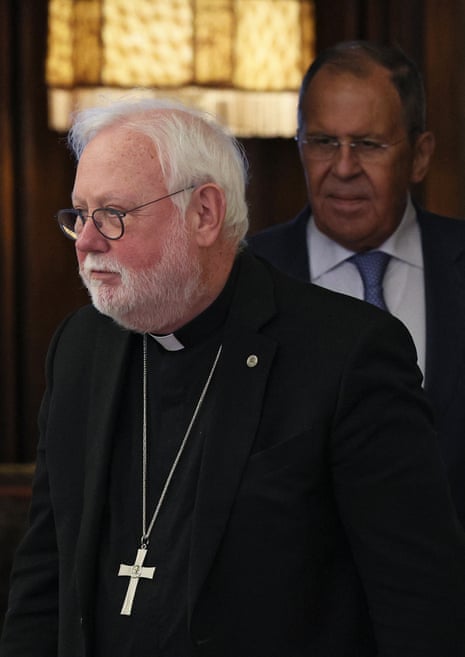
Vatican envoy Paul Gallagher met Russian foreign minister Sergei Lavrov in Moscow earlier today, and Reuters has some snap quotes from Pope Leo XIV’s representative following the meeting. He is quoted as saying that “The Ukrainian war must end” and that the pair discussed “avenues for pursuing lasting and just peace in Ukraine”.
In relation to the post on a US military plane landing in Moscow (at 11:23), Reuters reported that the last time a US jet flew to Russia from Europe was in January, when special envoys Steve Witkoff and Jared Kushner travelled to Moscow to meet Vladimir Putin for peace talks.
Also in Moscow this morning, Vatican envoy Paul Gallagher met Russian foreign minister Sergei Lavrov, stressing the importance of diplomacy and dialogue during what he called a difficult time for international relations, Reuters reports.
Gallagher said the world needed diplomacy more than ever.
Paul Gallagher, Vatican envoy and secretary for relations with states and international organisations of the Holy See, and Russian foreign minister Sergei Lavrov arrive for a meeting in Moscow. Photograph: Ramil Sitdikov/AFP/Getty Images
US military plane lands in Moscow - report
A US military transport aircraft has landed in Moscow, according to air traffic monitoring data cited by Russia’s Tass news agency.
Data showed the plane departed from Joint Base Andrews near Washington on Sunday, transited Riga in Latvia and landed in Moscow at about 10am local time this morning.
Kremlin spokesperson Dmitry Peskov had no information about the Boeing C-17A Globemaster III that landed in Moscow, Tass reported.
There’s scant information available at the moment but we will bring you more as we get it.
Kremlin accuses Burnham of wanting Ukraine war to continue
Kremlin spokesperson Dmitry Peskov has accused Andy Burnham of wanting the conflict in Ukraine to continue, saying the UK prime minister and Finnish president Alexander Stubb belonged to the “party of war”, Russian media reported.
During a visit to Kyiv yesterday, Stubb said he supported Ukraine’s long-range strikes on Russian territory, arguing that they could raise the cost of war for Russia and help force Moscow to the negotiating table.
When asked to respond, Peskov said: “We now see that such escalatory statements have prevailed. Mr Stubb is also a prominent representative of the ‘war party’, along with the British prime minister. They have distinguished themselves over the past few days with such bellicose statements. They want the war to continue.”
Perpetrators behind German airport drone bomb 'will pay,' says Merz
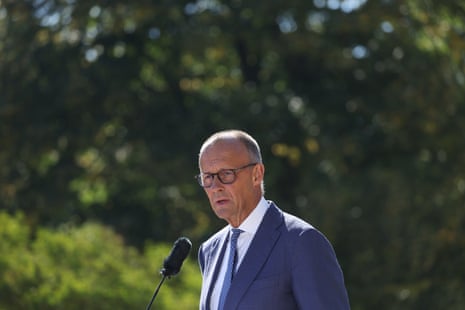
We are seeing the first reports of German chancellor Friedrich Merz’s statement this morning ahead of a cabinet meeting in Brandenburg.
He has spoken out for the first time about the attempted drone attack on Leipzig airport earlier this month. As my colleagues Deborah ColeandAndrew Roth reported at the time, a small drone carrying explosives was found at Leipzig/Halle airport, a major cargo and military logistics hub that handles aid shipments to Ukraine. The incident triggered an alarm and forced several flights to be diverted. German police deployed a bomb disposal robot to defuse and destroy the explosive device, which was found in the vicinity of several Ukrainian cargo planes.
German chancellor Friedrich Merz speaks to the media at the start of a two-day cabinet retreat. Photograph: Sean Gallup/EPA
Merz said Germany has “increasingly come into the crosshairs of hybrid attackers” and that perpetrators must face consequences. “They will pay for it,” Merz said, according to the German newspaper Die Welt.
Merz said his government was “working closely with the security authorities” on the matter, and that it will present its findings “shortly”.
Local media, citing security sources, have reported potential Russian involvement in the attempted attack, but Merz did not comment on the possible perpetrators.
At least 35,000 excess deaths recorded in Europe’s back-to-back heatwaves
In other news, at least 35,000 more people died during Europe’s record-breaking heatwaves this summer than would normally be expected, the Guardian’s Europe correspondent Jon Henley reports.
According to provisional national figures, which cover barely half of the continent, excess mortality in three of the EU’s larger countries – Germany, France and Spain – has already exceeded 25,000, as experts warn the toll will rise significantly once August totals are consolidated.
Read more:
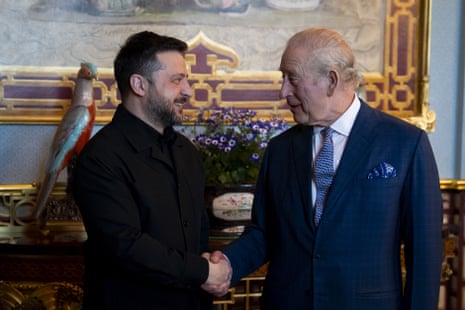
Zelenskyy has been thanking world leaders individually on X for their messages of support on Ukraine’s independence day (35, and counting). Here is his message to King Charles and Queen Camilla:
double quotation markWarm and sincere Independence Day wishes from His Majesty King Charles III and Her Majesty The Queen are deeply moving and exceptionally meaningful.
I am grateful for the emphasis on Ukraine’s history, rich culture, and unyielding national spirit, as well as the resilience of the Ukrainian people, who continue to defend their homeland and uphold the values that define our state.
The steadfast friendship between Ukraine and the United Kingdom remains an invaluable wellspring of strength for our nation.
We are sincerely grateful for the constant solidarity shown by the British people. Our special bond is built upon our shared commitment to freedom, democracy, and justice.
I wish His Majesty good health and continued success, as well as peace and prosperity for the United Kingdom and its people.”
Ukrainian president Volodymyr Zelenskyy shakes hands with King Charles at Buckingham Palace on 17 March 2026. Photograph: Aaron Chown/AP
It’s worth reading Zelenskyy’s social media post about Trump in full (particularly the last line). Here is what he wrote on X:
double quotation markI received warm and heartening congratulations from President Trump on the 35th Anniversary of the Restoration of Ukraine’s Independence:
“Dear Mr. President:
On behalf of the American people, I congratulate you and the citizens of Ukraine on your Independence Day. August 24 is a day to celebrate our enduring friendship built on 35 years of diplomatic relations, a bond that has only deepened since Ukraine gained its independence.
With courageous, brave, and talented people, you have built a great country. As you commemorate this important occasion, know that the United States stands in admiration of your resilient spirit, honors your sacrifices, and remains confident in your future as a sovereign, prosperous nation.
Let us seize this moment to end the conflict and build a durable, lasting peace that unleashes the tremendous potential of Ukraine for generations to come.
Sincerely,
Donald J. Trump”
These words, much like the sound of a Patriot PAC-3 launch, lift our spirits and give hope that lives can be protected from Russia’s savage attacks and that a dignified peace can be achieved. Thank you, President Trump and all Americans, for your support and congratulations!”
Opening summary: Burnham to take Zelenskyy's pleas for Patriot missiles to Trump - report
Hello, and welcome to our Europe live blog. A day after hosting world leaders in Ukraine for the country’s independence day celebrations, president Volodymyr Zelenskyy has taken to social media with a flurry of posts thanking those who sent their best wishes, including Donald Trump.
The Ukrainian president appeared to make a pointed nod to one of his most pressing requests, saying Trump’s message of support lifted spirits “much like the sound of a Patriot PAC-3 launch”. The US Patriot air defence system has been instrumental in protecting Ukraine’s cities from Russian attacks, but stocks are running dangerously low. The shortage has been compounded by the US and Israel’s war on Iran, with Patriot interceptors diverted to defend US bases and regional allies in the Middle East, leaving fewer available for Ukraine as Russia continues to launch waves of ballistic missiles.
In his first international trip as prime minister, Andy Burnham arrived in Kyiv yesterday where he announced the UK government will release the blueprints for British-made components for the Scalp missile, a French version of the UK’s Storm Shadow cruise missile, allowing Ukraine to work with France to produce its own version.
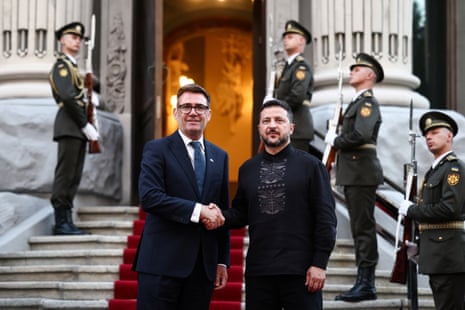
Ukraine’s president Volodymyr Zelenskyy shakes hands with Britain’s prime minister Andy Burnham ahead of their bilateral meeting in Kyiv on Monday.
“Ukraine has been Europe’s protector, not a drain on our security, but the frontline of keeping Europe safe,” Burnham said.
In an interview with Bloomberg, Burnham said he would travel to the New York next month to join European leaders lobbying Trump to supply Ukraine with Patriot missiles. If it goes ahead, it would be his first trip to the US as prime minister.
Burnham said he was “really optimistic” that Ukraine’s interceptor shortage was “fixable”, but added: “There are other players who could help in the mix who we have influence with. It’s probably going to be a solution that involves a lot of layers and a lot of negotiation.”
Also today:
European council president, António Costa, is on his way to Slovakia as part of his annual tour of European capitals. He is scheduled to hold talks in Bratislava with prime minister Robert Fico, who has not been as forthcoming as other European leaders on military aid to Ukraine.
Russia’s foreign minister Sergei Lavrov will host the Vatican’s most senior diplomat, Paul Gallagher, for talks in Moscow. The official Vatican News described the four-day visit as “a mission of dialogue and peace”, but made no mention of whether Ukraine would be on the agenda.
German chancellor Friedrich Merz is back from summer recess and is meeting with his ministers in Brandenburg this morning. He faces a crucial test at the polls next month, with his party under pressure to hold ground against the surging far-right Alternative for Germany (AfD). The AfD has a real chance of taking power in the eastern state of Saxony-Anhalt on 6 September – one of three state elections taking place this autumn – in what could be a major blow to Merz’s coalition.
Gao Zhen, a prominent Chinese artist known for provocative sculptures of the former leader Mao Zedong, has been sentenced to three years in prison after being found guilty of slandering China’s “heroes and martyrs”. The sentencing came two years after he was detained while visiting the country with his family, according to his wife and human rights groups.
… %!s()
The case has attracted international condemnation, largely because the artworks at the centre of the case were created more than 10 years before China created the law under which Gao was charged.
The law, which bans defamation of China’s heroes and martyrs, came into force in March 2018. Courts have previously used the law to charge people who challenge official accounts of Chinese history.
Gao, 70, a Chinese citizen and US permanent resident, was detained on 26 August 2024 after returning to China with his wife and son. Police later raided his studio near Beijing.
In one of Gao’s most famous works, he depicts Mao kneeling. In another he portrays a firing squad made up of seven Mao statues pointing rifles at Jesus.
Gao’s wife, Zhao Yaliang, told the Guardian that the two years since her husband’s detention had been a painful ordeal for the family.
“His arrest and trial should never have happened. We have had no choice but to wait in anguish … I am very sad that it’s going to be this long,” she said after the verdict.
According to his wife, two of Gao’s relatives were allowed to enter the Sanhe city people’s court in Hebei province for the verdict, while she waited with their son and several friends outside.
“For two years he has suffered in the detention centre, while my son, our closest family members and I have also endured this torment,” she said.
Gao’s family said he had fainted in detention and was afflicted with back, knee and respiratory problems. His wife said Gao had sustained heatstroke during the summer and described experiencing a feeling of “being close to death”.
Weiquanwang, a human rights monitoring network, said Gao had been sentenced for “infringing the reputation and honour of heroes and martyrs”. The rights network said Gao’s studio and property had been sealed and that friends and supporters had been silenced.
Artworks made by Gao during his time in detention and seen by the Guardian include a series of colourful paper cuttings.
“A body can be confined, but clarity of mind is harder to take away. Mentally he remains remarkably sharp and unbroken,” said Gao’s younger brother Gao Qiang, who spent decades producing art with him as the Gao brothers.
“Art should never be a crime scene waiting to be discovered,” he said.
In a handwritten letter sent from detention to his young son, Gao wrote: “Dad’s eyesight isn’t very good, and I don’t have my glasses, so my handwriting isn’t very good.
“I hope I can finish my work as soon as possible and return to you and Mum,” he wrote. “Son, remember: Dad will always love you!”
Sophie Richardson, a longtime China human rights campaigner, said: “Gao has been prosecuted for conduct that has never been criminal, and his family has endured collective punishment at the hands of the authorities, and that is criminal.”
Sarah Brooks, the China director for Amnesty International, said the decision to sentence Gao to a maximum three-year prison term illustrated “the authorities’ determination to deter others from engaging in independent artistic expression”.
Gao’s wife and their young son have been unable to leave China since his detention. Human rights campaigners said his wife was stopped from travelling abroad based on national security grounds. His young son is a US citizen but has been unable to leave without his parents.
The Chinese foreign ministry was approached for comment.
Within hours of United States envoy Jared Kushner leaving talks with Israeli Prime Minister Benjamin Netanyahu aimed at salvaging the Gaza “ceasefire”, Israeli strikes were again hitting residential areas in the enclave, and by week’s end, senior officers were describing a return to pre-ceasefire rules of engagement.
… %!s()
Kushner’s August 17 talks produced two working groups – on disarmament and humanitarian issues – but exposed rather than resolved the core issues: Israel’s unwillingness to withdraw from Gaza as it believes Hamas will not disarm alongside its refusal to allow the aid, supplies and construction materials required to rebuild the territory. Hamas says Israel’s ongoing attacks and refusal to withdraw its forces from Gaza are a violation of Trump’s 15-point plan announced on July 30.
Recommended Stories
list of 3 items
list 1 of 3Israel threatens attacks in Gaza over children’s kites
list 2 of 3Norway plans further development of Arctic drilling amid EU energy concerns
list 3 of 3US launches ‘Operation Economic Outcast’ to cut Iran’s economic lifeline
end of list
Kushner said he would not object to attacks against “imminent threats” but warned against interpreting that broadly. The attacks that followed suggested that Kushner’s warning had done little to constrain Israel’s interpretation of what constituted an “imminent threat”.
Hours after Kushner left, a strike on a crowded cafe at the Gaza City port – itself a displacement camp – killed at least seven Palestinians, including a child.
The next day, a strike on Gaza City’s former police headquarters killed at least nine people, including the acting director of Gaza’s police force, the head of its women’s police division and a 13-year-old girl.
A Hamas source told Al Jazeera the officials had gathered to prepare for the weapons handover called for under US President Donald Trump’s peace plan – meaning, if accurate, Israel killed the very people organising the disarmament it demands. A separate strike that day killed a man Israel called a Hamas commander in Nuseirat.
The campaign continued all week: a drone attack killed a man Israel said was a Hamas commander in Deir el-Balah on Saturday.
The week’s final trigger for Israel’s return to such bellicose footing in Gaza was, improbably, kites. After several landed in an Israeli border community, Israeli Defence Minister Israel Katz on Sunday ordered the military to treat any kite, balloon and drone from Gaza as “an act of war”, threatening attacks and neighbourhood displacements, according to The Times of Israel.
Netanyahu’s office echoed the warning, declaring Gaza “will not return to the situation before October 7, 2023”. Subsequent attacks on Sunday killed at least three Palestinians, among them four-year-old Muhammad Abdel Salam Taha. A predawn attack on a family’s tent in Deir el-Balah killed two brothers on Monday, according to Palestinian reports.
Gaza’s Ministry of Health put the number of casualties since the October “ceasefire” at 1,288 killed and 4,290 wounded as of Monday, with a cumulative toll of at least 73,422 Palestinians killed since October 7, 2023.
E1 settlement advances
Meanwhile, Israel has continued to advance its illegal settlement project in the occupied West Bank and East Jerusalem, widely seen as a death knell for the prospect of a Palestinian state along 1967 lines as part of the so-called two-state solution.
On August 18, Israel issued a tender for 1,234 units in the southern section of the East1 plan in occupied East Jerusalem, moving the long-frozen project on the path towards active construction. The Palestinian Colonization and Wall Resistance Commission said the plan would sever East Jerusalem from the occupied West Bank by fusing it with the Maale Adumim illegal settlement bloc and fragmenting the northern and southern West Bank.
The move has drawn global condemnations. The United Kingdom, France, Germany, Italy, the Netherlands, Canada and Norway called the tenders “unacceptable” and warned of “legal and reputational consequences” for participants.
The European Union was reportedly preparing a sanctions package should construction begin.
Eight Arab and Muslim-majority states issued a joint rejection, and more than 100 former French and British ambassadors wrote in Le Monde on Saturday that settler violence and demolitions “amount to ethnic cleansing”, calling for suspended trade and an arms embargo.
As for Israel’s strongest ally, the United States, when asked about E1 specifically, its Department of State repeated only its standard line that the US “does not support Israel annexing the West Bank” without naming the project.
Days earlier, US Ambassador Mike Huckabee, a longtime settlement supporter, had invoked the Ten Commandments to warn settlers against seizing Palestinian American property, threatening sanctions against those besieging homes in the West Bank village of Qusra, including one belonging to US citizen Loui Abu Ridi. Huckabee has condemned settlers holding the Palestinian homes under siege as “terrorists”.
That gap – a right-wing Christian Zionist ambassador willing to call settlers “terrorists” and a State Department unwilling to specifically name the Israeli government’s flagship illegal settlement project – captured Washington’s bind: reining in Israel’s worst excesses while remaining its principal guarantor.
The gap between condemnation and consequence was visible elsewhere too, including in Israel’s handling of its own war crimes record in Gaza. On Wednesday, the military announced investigations into the January 2024 killing of five-year-old Hind Rajab and six of her family members – the first time Israel admitted firing on their car – and the March 2025 killing of 15 medics in Rafah. However, at the same time, Israel closed three other cases, including the April 2024 killing of seven World Central Kitchen (WCK) workers.
The Hind Rajab Foundation said it had no confidence Israel’s investigations would produce justice. The UK, Australia and Canada called the WCK investigation closure – announced on World Humanitarian Day – “shameful”.
Sieges, arson and land seizure in the West Bank
A Human Rights Watch report last week found more Palestinians were displaced by settler attacks, demolitions and evictions in the first four months of 2026 than in all of 2025. It accused Israeli authorities of “arming, funding and granting impunity” to settlers. The United Nations Office for the Coordination of Humanitarian Affairs recorded 216 settler attacks causing casualties or damage in July alone.
That pattern continued this week. According to the Palestinian news agency Wafa and local activists, in al-Mughayyir, northeast of Ramallah, a series of attacks included settlers overturning a vehicle carrying women, children and elderly people on Thursday, injuring five people, and ramming a second vehicle two days later. By Sunday, Israeli forces had sealed the village’s only remaining entrance.
In Qusra, south of Nablus, a siege of three homes entered its third week, leaving families cut off from food, water and medicine. Field activist videos showed soldiers throwing a family’s belongings from a home they now occupy.
Settler attacks and arson spread throughout the week. In Sa’ir, northeast of Hebron, armed settlers killed 17-year-old Karim Sanad Shalaldeh and critically wounded a man in his 70s during a raid that also set a home ablaze. In Khallet al-Farra, west of Yatta, settlers set fire to a home with a family of five asleep inside.
UN Special Rapporteur on the Occupied Palestinian Territories Francesca Albanese described the attacks as “pogroms against defenceless civilians”. Experts now back her position, saying the West Bank attacks increasingly fit the definition of a pogrom, which refers to “the organised violence” against a group of people because of their “race or religion”.
Meanwhile, Israel’s territorial grip continued to expand. New or expanding outposts were documented at Tal al-Asur and Marj Sia, east of Ramallah; Umm Safa, northwest of Ramallah; and Mount Tarousa, west of Hebron, where the “Doron” outpost, one of 19 settlements approved last year, received its first caravans, according to Wafa.
Israeli settlements and outposts are illegal under international law.
In the northern Jordan Valley, Israeli NGO B’Tselem reported that armed forces and settlers had cut the last water pipelines supplying several Bedouin communities, placing 47 families – more than 300 people – at imminent risk of displacement in the shadow of Israel’s Crimson Thread Barrier project.
Israeli forces also killed two Palestinians this week. Fathi Zedan Khazem was shot during a raid on his Jenin home on Friday and left to bleed to death after soldiers blocked ambulance access, according to Wafa. Two days later, 14-year-old Islam Ahmad Ajjouri was shot dead during a raid on Askar al-Jadid refugee camp, east of Nablus. %!s()