Chuck D gave Dave Grohl, Krist Novoselic, and Pat Smear the Video Vanguard Award for Nirvana's legacy, but they didn't play any music
By
September 27, 2026
Public Enemy’s Chuck D presented the surviving members of Nirvana — Dave Grohl, Krist Novoselic, and Pat Smear — with MTV‘s Video Vanguard Award on Sunday. Only Novoselic spoke, and there was no performance. “I don’t think there’s ever been a band exactly like Nirvana,” Chuck D said in his speech.
… %!s()
“This award brings back so many memories of making those videos,” Novoselic said. “The ideas for those videos all grew out of the vision of one of the greatest artists of all time, Kurt Cobain. Kurt was one of one … Nirvana continues to resonate so deeply because people are still hungry for authenticity. Or something real, something uncompromising. something that tells you it’s OK to come as you are. Kurt would have loved that legacy.”
MTV announced the band was receiving the award on the 34th anniversary of Nirvana’s unforgettable performance of Nevermind’s “Lithium” at the 1992 VMAs, when Kurt Cobain also teased the opening chords to the then-unreleased In Utero song, “Rape Me,” apparently to irritate network censors. The Video Vanguard Award recognizes artists’ legacies as music video innovators.
Nirvana filmed seven music videos, including memorable clips for “Smells Like Teen Spirit,” “Come as You Are,” “In Bloom,” and “Heart-Shaped Box,” before Cobain’s 1994 death. Videos for “You Know You’re Right” and “Dumb” came out in 2002 and 2023, respectively. They also filmed a legendary episode of MTV Unplugged.
Though they did not perform on Sunday, the surviving members of Nirvana have played together a handful of times since Kurt Cobain’s death in 1994. It first happened Aug. 29, 1997, when the Foo Fighters played Bumbershoot in Seattle, and Krist Novoselic joined the group, which included Nirvana guitarist Pat Smear, for Prince’s “Purple Rain” and Led Zeppelin’s “Communication Breakdown.”
Thirteen years later, on Dec. 21, 2010, the trio of Dave Grohl, Novoselic, and Smear played “Marigold,” which appeared as the B side to Nirvana’s “Heart Shaped Box,” at a secret Foo Fighters club show in Los Angeles. And in 2012, they recorded the new song “Cut Me Some Slack” with Paul McCartney (a project they jokingly dubbed “Sirvana”), which they included on the soundtrack to the documentary Sound City. They also played it live at the 12-12-12 benefit and on Saturday Night Live.
Trending Stories
But they didn’t actually perform any Cobain-penned Nirvana songs until April 10, 2014, when Nirvana were inducted into the Rock & Roll Hall of Fame. “We didn’t even start talking about playing until about eight weeks ago,” Grohl told Rolling Stone just the day after the big night. “It just seemed practically impossible. It was hard to imagine jumping onstage and playing those songs. It takes a little bit of musical preparation, and a lot of emotional preparation.”
Editor’s picks
They initially reached out to a group of what Grohl called “A-list male rock stars,” but they all turned them down since the task felt so daunting. But once Joan Jett agreed to sing “Smells Like Teen Spirit,” they decided to only invite women for the other songs. Before long, Kim Gordon, St. Vincent, and Lorde all signed on. “Kim Gordon, from Sonic Youth, was this beacon of light in the predominantly macho, male underground punk rock scene,” said Grohl at the time. “St. Vincent is a wicked musician that’s pushing boundaries now. And Lorde has an incredible future ahead of her as a writer, performer, and vocalist.” That night, they performed with more singers at a private club show. They did it again at Cal Jam in 2018, this time with Jett and Deer Tick’s John J. McCauley.
Hundreds of protesters spent the day blocking the route of a hugely contentious parade in Northern Ireland after a court gave late-night clearance for the Orange Order to march on a historically significant road for the first time in nearly 30 years.
… %!s()
The loyalist Drumcree parade along the mainly nationalist Garvaghy Road in Portadown was given the go-ahead by the Parades Commission for the first time since 1998, a decision denounced by Sinn Féin as “madness”.
It led to a weekend of intense legal wrangling which concluded at 2.15am on Sunday when the court of appeal said it could not interfere with the commission’s decision.
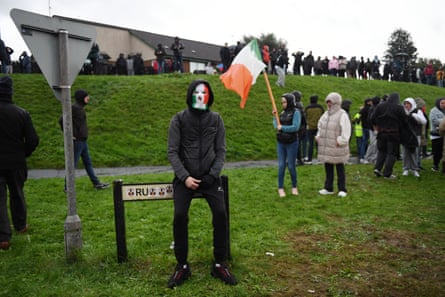
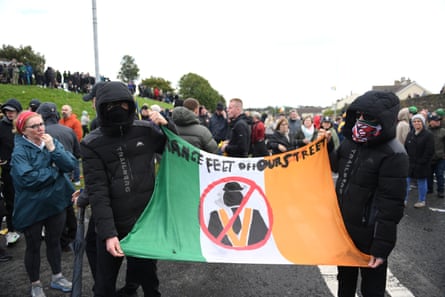
In driving rain on a cold Sunday morning, hundreds of nationalist protesters gathered to block the route. Many linked arms and sang songs as announcements were made over loudspeaker that they were liable to arrest and prosecution.
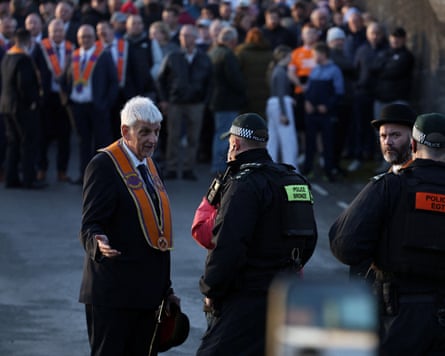
The Orangemen spent the day ensconced a mile away in a church, the proposed start of the march, and said they would wait until police told them the road was clear.
The standoff lasted throughout Sunday, with protesters largely dispersing in the early hours of Monday, when Breandán Mac Cionnaith, from the Garvaghy Road Residents’ Coalition, said he had received “commitments” that the parade would not be proceeding down the road overnight.
Mac Cionnaith told protesters he would meet the Northern Ireland secretary, Chris Bryant, and Police Service of Northern Ireland chief constable Jon Boutcher on Monday morning for talks.
Michelle O’Neill, the Sinn Féin vice-president and Northern Ireland first minister, told reporters shortly after midnight that the Garvaghy Road community had won a “victory”.
Portadown Orangemen at Drumcree Church start their march towards Garvaghy Road, which was stopped a short distance later by police. Photograph: Paul Faith/AFP/Getty Images
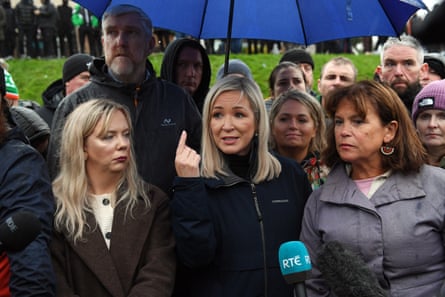
Among the protesters earlier in the day was the Sinn Féin president, Mary Lou McDonald, who said the decision to allow the parade was “madness” and “primitive treatment of any community in the year 2026. It is intolerable, and it will not be tolerated.”
She added: “The mood here has been peaceful. It has been united and orderly. This is a dignified and united community and they are absolutely determined that they and we will not be drawn back into the past.”
Michelle O’Neill (centre) and Mary Lou McDonald (right) speak to the media in Portadown. Photograph: Charles McQuillan/Getty Images
O’Neill was also there and said reigniting the dispute brought “into question how this whole peace process works”. She told reporters: “We’re meeting families who feel collectively traumatised, who feel individually traumatised. Does anybody think that this is a good idea?
“No right-minded person would make this decision. I still do not know the answer to this question – why, after 28 years of a determination to block a march down this road, the Parades Commission thought that this was the right idea today to bring this mess back on to this community.”
The local Democratic Unionist party (DUP) MP, Carla Lockhart, accused O’Neill of “whipping up hysteria” at an “unlawful” protest.
“It is unreal that we have a first minister behaving the way she is behaving,” she said. “If I did it, or if any of my colleagues did it, I would be in the back of a Land Rover.”
Nationalist protesters gathered in Portadown. Photograph: Charles McQuillan/Getty Images
Gavin Robinson, the DUP leader, said: “We now have lawmakers acting as law breakers,” and he accused O’Neill of “giving two fingers to the courts, the police, the rule of law”.
Bryant cut short his attendance at the Labour party conference in Liverpool to travel to Belfast, but said he did not have the powers to call the march off unless police formally requested him to do so. He said the nationalist protest was unlawful and called on politicians to “calm things down”.
Bryant said: “It is incumbent on everybody in political office to take this moment very, very seriously and to take the temperature down, to think twice before … inflating any argument and to think about what somebody else who doesn’t share your opinion might think about the way you’ve put your case.”
Protesters hold banners on Garvaghy Road. Photograph: Charles McQuillan/Getty Images
Earlier in the day the tense standoff drew in the prime minister, Andy Burnham, who appealed for “calm on all sides”.
The Irish taoiseach, Mícheál Martin, echoed that but described the Parades Commission decision as “incomprehensible and wrong”.
He called for the situation to be mediated sensibly in a way “that protects the gains that have been made and the peace and harmony that has prevailed for so long”.
The Drumcree parade on the Garvaghy Road – a Catholic enclave in a largely Protestant town – sparked some of the most serious and violent disorder in Northern Ireland’s history.
On Friday, the Parades Commission granted permission subject to restrictions, including a limit of 35 participants, an 8am start time instead of 1pm, and that it should be held in silence.
Nigel Dawson, known as the district master of Portadown Loyal Orange Lodge, speaks to a police officer. Photograph: Cathal McNaughton/Reuters
The decision was challenged and blocked on Saturday by a judge, Justice Patricia Smyth, who said the “long-running dispute has the potential to escalate” across Northern Ireland.
That decision was then challenged by the Orange Order, leading to two further hearings on Saturday night and Sunday morning.
The final, time-limited sitting, which began at 20 minutes past midnight on Sunday, was heard before Mr Justice Humphreys, who acknowledged the “unusual if not unprecedented circumstances … with a parade scheduled to begin in just over six hours’ time”.
Outlining his decision, Humphreys cited case law that as a public body the courts must respect the commission’s judgment and “their decisions will not be lightly interfered with”. %!s()
Durban, South Africa – Bishop Raphael Bahebwa is in hiding, afraid he could be attacked for speaking out for the rights of foreigners in South Africa.
“I am in hiding now because they say they are going to kill me for speaking about the rights of foreigners,” he told Al Jazeera.
… %!s()
Bahebwa has lived in South Africa for 26 years, after arriving as a refugee from the Democratic Republic of the Congo (DRC).
In that time, he has watched antiforeigner sentiment flare repeatedly in the country he came to call home. But he says this year feels different.
A September 30 deadline declared by March and March, an anti-immigration movement that has led protests across South Africa this year, has renewed fears of violence among migrant communities.
The group has called for undocumented foreign nationals to leave South Africa and has warned of further demonstrations if its demands are not met.
For Bahebwa and other refugees in Durban, however, the distinction between documented and undocumented migrants offers little comfort. They say the hostility they experience on the streets rarely begins with a request to see their papers.
Fears of renewed violence
South Africa will hold local government elections on November 4, in a campaign in which migration has become an increasingly prominent political and social issue.
For months, Bahebwa was among hundreds of refugees and asylum seekers who slept on the pavement outside the Durban Refugee Reception Centre on Che Guevara Road.
Many were from the DRC and Burundi, with others from Uganda, Mozambique and Tanzania. They said they had fled their communities because they feared antiforeigner attacks.
They arrived outside the Department of Home Affairs (DHA) office seeking safety.
Instead, the pavement became their home.
For roughly four months, men, women and children slept outside, exposed to the elements and dependent on civil society organisations and volunteers for food and other necessities.
“It has been very tough,” Bahebwa said. “Never before have I experienced something like this.”
Some of the migrants told Al Jazeera that conditions became desperate. They described irregular access to food and medication and said one man who had tuberculosis died while living at the camp. Al Jazeera has not independently established the circumstances of his death.
The camp was also not far removed from the hostility its residents said they had fled.
On September 3, members of March and March confronted refugees and asylum seekers living outside the centre. Violence broke out, and police intervened. At least four people were reported injured.
At another protest days later, police officers stood between the two groups, forming a barrier as tensions rose.
March and March has described its mobilisation as a campaign against undocumented immigration, crime and deteriorating conditions in South African communities.
The group says the government’s response to immigration enforcement has been insufficient.
Its leaders have repeatedly rejected accusations that their campaign is xenophobic and insist their target is undocumented migration rather than foreign nationals generally.
Bahebwa said documented and undocumented migrants alike have been caught in the hostility.
Earlier this year, six refugees working in salons around Durban’s Warwick Street Market were beaten by men carrying sticks, according to public-interest news outlet GroundUp. Two were hospitalised.
Bahebwa said the migrants had also struggled to obtain help from the authorities after earlier attacks.
“Police said we can’t open cases because we are foreigners. We had nowhere to go,” he alleged. Police have not publicly responded to that specific allegation.
Nowhere obvious to return to
In mid-September, the government moved to clear the makeshift camp outside the refugee centre.
The refugees were given a choice: return to the communities they had fled or accept temporary accommodation at the Lindela facility in Gauteng, hundreds of kilometres from Durban. Lindela is a government-run immigration detention facility used to hold people facing deportation.
The choice divided them.
Malawi migrants to South Africa line up for supplies at an informal refugee camp in Sherwood, Durban, South Africa, after fleeing their homes amid fears of xenophobic attacks [File: EPA]
Some feared going to Lindela, a facility historically associated with immigration detention and repatriation. Others felt they could no longer endure life on the pavement.
On September 15, 274 people were transported by bus from Durban to Lindela. About 150 others chose to remain in Durban and began trying to find alternative accommodation.
For those who stayed behind, leaving the pavement did not resolve the problem that had brought them there in the first place.
Kafuti Muyumba, a small business owner from the DRC and a representative of the refugee community, said many were afraid to return to neighbourhoods where they had built businesses and lives.
People are afraid, he said. “Even the police allow March and March violence. They came with sticks and say we are attacking them,” Muyumba told Al Jazeera.
He said many refugees had lost their livelihoods during the months of upheaval and were now desperate to find accommodation.
“This is not the first time we are experiencing xenophobia,” he said. “In 2008 and then in 2015 we also experienced this.”
In 2008, xenophobic violence spread through townships and informal settlements, killing dozens and displacing thousands.
Further outbreaks of violence against foreign nationals followed in subsequent years.
For Muyumba, those memories make the rhetoric surrounding September 30 difficult to dismiss.
“We don’t trust the police. They are not being fair with us. Some of them are also saying we must go,” he said.
Police have said there are no plans to change their normal policing approach because of the September 30 deadline and that any protesters will be expected to remain within the law.
March and March said all it wants is for undocumented immigrants to leave the country and return home.
But Muyumba said returning to the DRC is not a viable alternative for many Congolese refugees.
“There is still war there,” he said.
A country tightening its borders
In response to ongoing protests, the South African government said it had intensified its immigration enforcement.
Between June 14 and August 20, authorities processed 86,596 foreign nationals for deportation and repatriation, according to the government’s Inter-Ministerial Committee on Migration.
Malawians made up the largest group, followed by Zimbabweans and Mozambicans.
Government data says 90 percent of those repatriated had entered South Africa illegally, while 95 percent were classified as having crossed the border outside official ports of entry.
The government says the operations form part of a broader effort to strengthen border management and enforce immigration law.
At the same time, officials have repeatedly warned private groups against taking immigration enforcement into their own hands.
March and March’s September 30 deadline has no legal authority. The government says common citizens cannot deport anyone from South Africa.
Protesters hold placards during an anti-immigration march in Durban, South Africa, calling for tighter border controls and the deportation of undocumented migrants [File: Thuli Dlamini/Reuters]
But deadlines do not need legal force to create fear, as was the case for an earlier deadline of June 30. For the refugees who spent months sleeping outside the DHA office in Durban, September 30 is another uncertainty layered on top of many others.
Some have been moved hundreds of kilometres away.
Others are trying to find new homes in the same communities they once fled. But among the migrants Al Jazeera spoke to, there is a shared anxiety that paperwork may offer limited protection when anger is directed first at being foreign.
Bahebwa has spent more than a quarter of a century in South Africa. For now, he says he is hiding and does not know what September 30 will bring.
“They are scapegoating us as foreigners,” he said. “It is not going to end on September 30. It has to do with the elections.” %!s()
Over on Tiktok, Mark Darrah was asked, "If you could go back in time what would you remove from each of the Dragon Age games and what would you add?"
… %!s()
Like everyone who ever installed the Skip the Fade mod for Dragon Age: Origins, Darrah thinks the Lost in Dreams quest needs a snip. "I would be tempted to cut or dramatically reduce the dream sequence part from the Mage Tower," he said. "It's not very good content. It's kind of filler. It was definitely done pretty fast in the end."
As for what he'd add to the original, Darrah suggested the planned human origin where you'd get to play one of the avvar in the Korcari Wilds. "I would like to have another human origin," he said, "but wow, what an expensive add."
For Dragon Age 2, Darrah would remove one of the things I found frustrating about it—no matter whether you side with the templars or the mages, you're forced to fight both at the end. Even if you side with Orsino and the Circle of Magi he wigs out from blood magic, proving Meredith and the templars right in believing the mages are "barely tethered nuclear bombs" who do deserve "to be treated as non-humans."
Darrah's first suggestion for something to add to Dragon Age 2 is "probably just a couple of more levels to use," and yeah, a little more variety in locations would certainly help. He'd also like to have less gold available in the main questline during act two, as the idea was to encourage sidequesting to raise money for the expedition. As it stands, "If you just do the crit path, the crith path gives you enough gold to go on the expedition so it kind of doesn't work. I don't know where I'd make this cut, but I'd be tempted to cut one of those crit-path missions just to get that back."
When I replayed Dragon Age: Inquisition in advance of The Veilguard, the open-world bloat hit me as a much bigger issue than it did on my first playthrough. Darrah suggests snipping parts of it, saying, "I'd probably cut Hissing Wastes maybe or one of the big levels because it's too big. And the other thing I would change would be to dramatically reduce the amount of Power that you need to go on the crit-path missions. That's there for not-super-great reasons, and I think you could cut it by 40 to 60% and the game would just be paced better."
Finally, "Veilguard, the thing that I would add is the Keep. I told them to. It wouldn't take 'that much'. I mean, it would." As for what he'd remove from Veilguard, he says, "I don't have a good answer to that one." I'm sure the internet has plenty of suggestions, but as someone who came around on Veilguard by the time I reached its excellent suicide mission ending, I think it's fine the way it is.
Keep up to date with the most important stories and the best deals, as picked by the PC Gamer team.
Jody's first computer was a Commodore 64, so he remembers having to use a code wheel to play Pool of Radiance. A former music journalist who interviewed everyone from Giorgio Moroder to Trent Reznor, Jody also co-hosted Australia's first radio show about videogames, Zed Games. He's written for Rock Paper Shotgun, The Big Issue, GamesRadar, Zam, Glixel, Five Out of Ten Magazine, and Playboy.com, whose cheques with the bunny logo made for fun conversations at the bank. Jody's first article for PC Gamer was about the audio of Alien Isolation, published in 2015. Jody edited PC Gamer Indie from 2017 to 2018, and he eventually lived up to his promise to play every Warhammer videogame. %!s()
Roy Keane disagreed with Anthony Gordon's assessment that England are at the same level as Spain after the World Cup winners came from behind to beat Thomas Tuchel's side 3-2 in their Nations League opener.
… %!s()
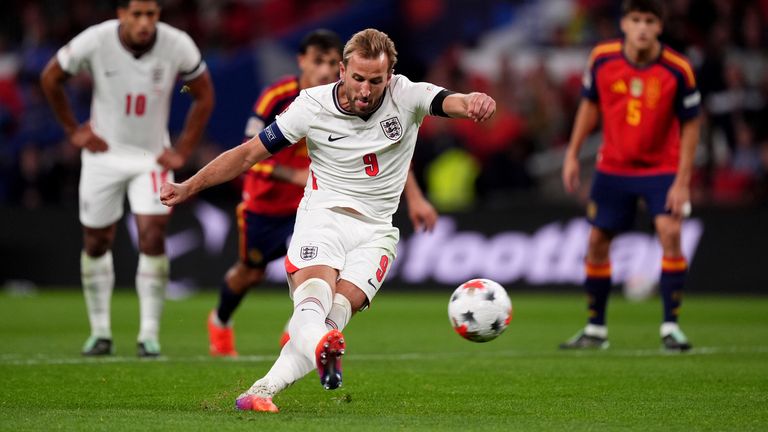
Spain extend their unbeaten run to 39 games with the win at Wembley, but the game could have had a very different outcome had Harry Kane not missed a second-half penalty after he headed England 2-1 in front before the break.
The momentum shifted in Spain's favour after Kane's slip, with Alex Baena equalising off the bench before setting up the winner, scored by fellow substitute Mikel Oyarzabal, who broke England hearts in the Euro 2024 final.
Image:
England's Harry Kane slips and fires his penalty against the bar in the match with Spain
Match report: England 2-3 Spain | As it happened
Teams | Stats | Watch FREE PL highlights
England latest news blog | Nations League scores & news | Tables
Gordon, who scored England's equaliser from a terrific counter-attacking move, felt the performance was enough to win them the game and showed that they are a top team.
"I don't think there is a gap [to Spain] I feel like we're right there," Gordon told ITV Sport. "We can win that game so easily. If the penalty goes in we can go on and win the game. In hindsight it's always easy to say that. But I felt good in the game.
"I don't think there is a gap and I think if we played them in the final I would've felt confident. Being confident doesn't always translate into a win, but I think you've seen here tonight that we're a top team."
Responding to the England forward, Sky Sports pundit Roy Keane said on ITV Sport: "I disagree with Gordon, I think there is a gap. I think there is, obviously [Spain are] world champions, European champions."
Monterosa
This content is provided by Monterosa, which may be using cookies and other technologies.
To show you this content, we need your permission to use cookies.
You can use the buttons below to amend your preferences to enable Monterosa cookies or to allow those cookies just once.
You can change your settings at any time via the Privacy Options.
Unfortunately we have been unable to verify if you have consented to Monterosa cookies.
To view this content you can use the button below to allow Monterosa cookies for this session only.
Tuchel: We thought we had Spain at half-time
Please use Chrome browser for a more accessible video player
Thomas Tuchel reflects on England's loss against Spain.
England scored two goals in the space of four first-half minutes just before half-time - more goals than Spain conceded in the entire World Cup - but failed to capitalise on their dominance after the restart with Kane's spurned penalty proving to be the turning point.
Spain, meanwhile, were ruthless with Lamine Yamal pouncing on Marc Guehi's error to open the scoring after two minutes and Baena's second-half equaliser coming directly after a misplaced pass from Nico O'Reilly.
"We did everything today to beat Spain," Tuchel said after the game. "Details matter on this level. Clear-cut mistakes were too high on our side unfortunately. In the last 20 metres they were more clinical and composed to convert our ball losses into clear-cut chances.
"Still we had them and we had our chance to beat them."
He added: "We wanted desperately to be the team to beat them. We thought we had them at half-time. That was the way the team showed up after half-time.
"It happens too often today and we get punished on the highest level. The execution and composure in the final 20 metres was on the highest level from our opponents."
Spain boss: We had the game under control
Image:
Lamine Yamal celebrates scoring against England
Spain boss Luis de la Fuente felt his side were in charge of the game save for the final stages of the first half when England came from behind to lead at the break.
"The game was under control most of the time, except for six to seven minutes, when England dominated us," he said.
"We got disconnected. Against a rival like England, a superpower, this can happen. I think we had the game under control."
Analysis: 'Missed penalty and a missed opportunity for England'
Please use Chrome browser for a more accessible video player
Anthony Gordon reflects on a tough match against Spain in the Nations League.
Sky Sports News senior correspondent Rob Dorsett at Wembley Stadium:
"One captain's slip, one memorable scalp that slipped away.
"A missed penalty and a missed opportunity for England - though it's hard to argue that Spain weren't the far superior side over 90 minutes.
"The world champions could have been out of sight within 30 minutes, after a dominant display of their prowess. And a couple of self-destructive England passes.
"The fact that Spain were only a goal ahead, gave England hope, and it was a stunning 10-minute spell that saw England grab the lead.
Please use Chrome browser for a more accessible video player
Harry Kane reacts to England's loss against Spain and his penalty kick miss.
"Firstly, a brilliant goal from their best player on the night, Anthony Gordon, and then from captain Kane with a header.
"But the home side started the second half really well, and when Kane missed from the spot to give England a two-goal lead, Spain sensed blood. Their response with strikes from Alex Baena and Mikel Oyarzabal was decisive and deserved.
"A defeat with some merit then, for Tuchel's England. But there still seems to be a gulf in class."
England's upcoming Nations League Group A3 fixtures
Tuesday September 29: Czech Republic (A), kick-off 7.45pm
Saturday October 3: Croatia (A), kick-off 5pm
Tuesday October 6: Czech Republic (H), kick-off 7.45pm %!s()