In front of 66,000 home fans creating an electric atmosphere inside Rabat's Prince Moulay Abdellah Stadium, Morocco appeared set for a date with destiny as they chased their first Afcon title since 1976.
… %!s()
Instead, the final descended into chaos deep into stoppage time.
With the match still goalless, Senegal thought Ismaila Sarr had scored a dramatic winner, only to discover that referee Jean Jacques Ndala had already blown for a Moroccan free-kick.
The controversy deepened in the 98th minute when, after a VAR review, Ndala awarded Morocco a penalty.
Tempers boiled over on the touchline and in the stands. Senegal coach Pape Thiaw led some of his players and staff down the tunnel, while supporters clashed with security as order briefly collapsed.
Play eventually resumed and, in the 124th minute, Morocco missed a golden chance to end their 50-year wait for continental glory when Real Madrid's Brahim Diaz failed to convert a penalty, chipping it 'Panenka' style into the grateful arms of goalkeeper Edouard Mendy.
Pape Gueye's extra-time strike then secured a 1-0 win for Senegal, who lifted the trophy for a second time.
Or so they thought.
Unsurprisingly the Royal Moroccan Football Federation (FMRF) quickly lodged a complaint with the Confederation of African Football (Caf), arguing Senegal had breached competition regulations.
Article 82, contained within a chapter titled "Withdrawals", states: "If, for any reason whatsoever, a team… leaves the ground before the regular end of the match without the authorisation of the referee" they shall be "considered the loser and shall be eliminated from the current competition".
In March, a Caf appeals board agreed, ruling that Senegal had forfeited the match and awarding Morocco a 3-0 victory.
While there is precedent for Caf overturning results during Afcon and World Cup qualifying, others, including one former senior Caf official, argued that only the referee has the authority to abandon a match if a walk-off occurs.
The FMRF said it was seeking the proper application of tournament regulations, but Senegal's federation (FSF) described the ruling as "unfair, unprecedented and unacceptable" and appealed to Cas.
Founded in 1984 and based in the Swiss city of Lausanne, Cas was set up as an independent legal body designed to settle disputes as global sport became more lucrative and, as a result, more litigious.
For governing bodies which recognise Cas' authority, it is deemed to be the supreme arbiter, meaning its ruling is final unless, in rare cases, Switzerland's highest court decides to set it aside based on a limited number of technicalities.
More than 900 cases are filed every year, from more than 50 different sports, covering issues such as employment contracts and transfers, doping, corruption, TV rights and, in this case, the organisation of sporting events.
The appeal will be heard by a panel of three arbitrators chosen by Cas for their expertise in sports law.
In this instance, the panel will be led by 76-year-old Frenchman Gerald Simon, founder of the Sports Law Laboratory at the University of Burgundy and a Cas member for 23 years.
If the panel fails to come to a consensus, its president will make the final decision.
Even though Caf's appeals board is independent, a reversal of its judgement would deliver another blow to the reputation of African football's governing body, which has already been heavily criticised for the retrospective decision to hand Morocco the title.
Caf president Patrice Motsepe said back in March that they will "adhere to" and "respect" whatever Cas decides, so if things go in Senegal's favour, it could mean someone having to tinker with the Afcon rulebook.
The Teranga Lions' walk-off has, however, already brought about a change in football's rules.
"The referee may sanction with a red card any player who leaves the field of play in protest at a referee's decision," said Ifab, the game's lawmaking body, back in April.
"This new rule will also apply to any team official who incites players to leave the field of play. A team that causes a match to be abandoned will, in principle, forfeit the match."
Thiaw has already been given his marching orders by Senegal, having lost his job following the team's last-32 World Cup exit, while Walid Regragui, the man in the Moroccan dugout back in January, was dismissed in March.
Both men will no doubt still view success with Cas as a moral victory.
Whatever the outcome, animosity is likely to linger between the two federations.
The FMRF's senior hierarchy were furious with Senegal's behaviour, believing the pictures beamed around the world irrevocably tarnished the image of the first Afcon hosted by the kingdom since 1988 - a tournament into which a huge amount of time and money had been invested.
The FSF and the Senegalese government have, meanwhile, leaned into a feeling prevalent across the continent that Morocco holds too much influence within African football.
Other incidents also irked them, such as laser pens being directed into players' eyes and ball boys moving goalkeeper Mendy's towel, something which eventually led to the barely believable sight of reserve keeper Yehvann Diouf being tackled to the ground by three ball boys when he tried to intervene.
With the next Afcon scheduled to take place in June and July next year, the chances of a high-profile rematch between Africa's best two teams is a tantalising thought.
But while the chaos of this year's final may have given birth to a new rivalry for fans to revel in, there is unanimous agreement that such encounters should be settled on the pitch and not in a courtroom. %!s()
Merz welcomes new treaty as new opening after UK's 'regrettable' decision to leave EU
Merz is speaking now.
His remark focus exclusively on the bilateral British-German Kensington Treaty, as the pair exchange the documents and formally complete its implementation.
… %!s()
He says the treaty “opens up new opportunities” between the two countries, following Britain’s “regrettable” exit from the European Union.
He focuses on a particular element of the treaty that gives better access to both countries, with no visas required – even for extended stays by school pupils and university students – and for student exchanges between the two countries.
“That is precisely why we are doing this: so that the younger generation, within the context of bilateral relations between Germany and Great Britain, can simply see just how well we Europeans work together and how closely we belong together,” he says.
Key events
15m ago
Zelenskyy: strike on Kramatorsk buses 'will not go unanswered'
35m ago
French education minister to draft proposals on teachers' absences in response to protests
54m ago
Burnham 'committed to securing deeper cooperation' with EU at looming summit
1h ago
Burnham hails Germany as a partner for 'challenging times'
1h ago
Merz welcomes new treaty as new opening after UK's 'regrettable' decision to leave EU
1h ago
Merz and Burnham expected to deliver statements in Berlin shortly
2h ago
Rubio gets pushed on allegations of misconduct by US ambassador to Greece
2h ago
Germany's Merz hosts UK's Burnham for talks in Berlin
2h ago
French high school protests spill over to Belgium with concerns about violence
3h ago
30 people killed after Russian strike on public transport in eastern Ukraine
3h ago
More high school protests take place across France - in pictures
3h ago
One dead, two injured in another knife attack at Polish school
4h ago
EU drops sponsorship of disinformation conference at Trump officials’ request
4h ago
French high school protests this morning - in pictures
4h ago
French education minister to hold talks with high school students later today
5h ago
Morning opening: French high school protests continue despite PM's promise of action
Zelenskyy: strike on Kramatorsk buses 'will not go unanswered'
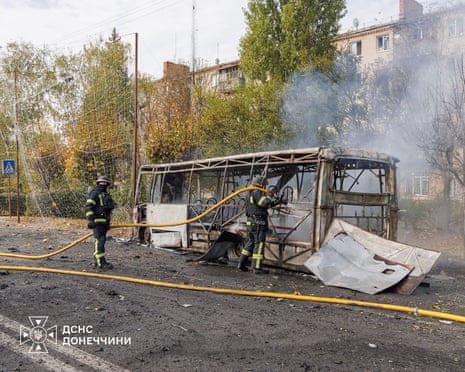
In a post to social media, Ukraine’s president, who included graphic footage from the scene, has said that a Russian strike on public transport in Kramatorsk which has left at least 30 dead “will not go unanswered”.
Doctors are now fighting to save the lives of people injured in the Russian strike on Kramatorsk. As of now, 30 people have been confirmed killed, and sadly, that number may rise. The Russian bomb effectively hit two city minibuses. Some of those killed have still not been identified because of the severity of their injuries. My condolences to all their families and loved ones. Another 18 people were injured in the strike. Residential buildings and cars were also damaged.
This strike will not go unanswered. Russia is trying to destroy all life in Donbas, and a response from the world is a must. A forceful response – exactly as the Russians deserve for all the deaths they have brought. May all those killed rest in peace.
Handout photograph released by the Ukrainian State Emergency Service. Photograph: Ukrainian State Emergency Service/AFP/Getty Images
French education minister to draft proposals on teachers' absences in response to protests
Back to France,education minister Édouard Geffray said his ministry would prepare a plan to address on of the key demands of the students’ movement on providing cover for absent teachers “in a few hours or a few days,” Le Figaro reported.
He is expected to meet with the three main student groups later today to discuss details (10:10).
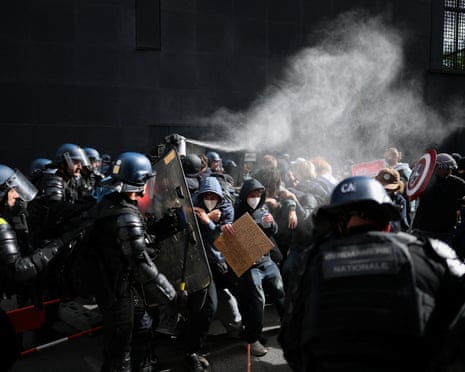
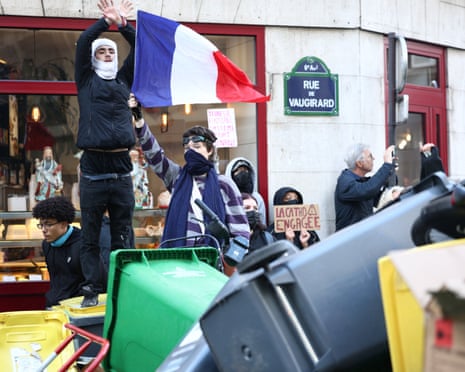
In the meantime, protests continue across the country, and AFP notes that while they have been largely peaceful, some demonstrators resort to acts of violence or clash with police officers.
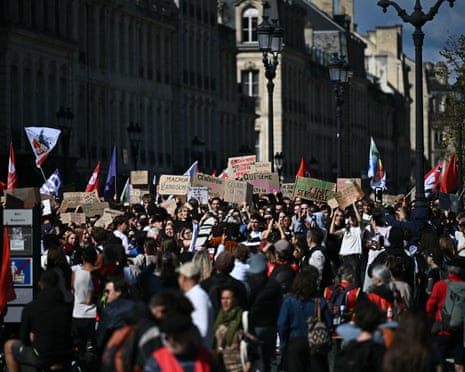
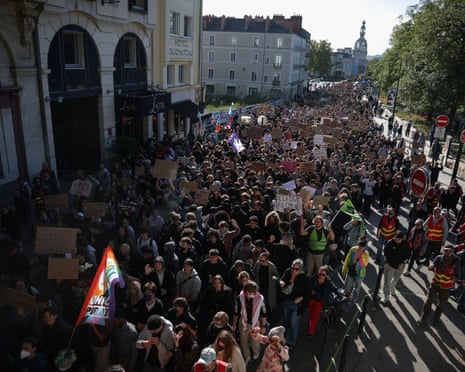
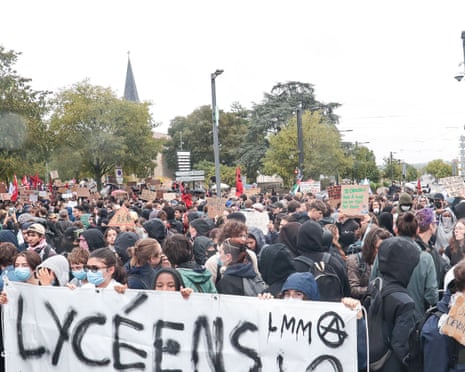
Students take to the streets to protest education conditions in Nancy, France. Photograph: Muhammed Said Tako/Anadolu/Getty ImagesProtesters hold placard as they march during a demonstration of high-school students in Bordeaux. Photograph: Christophe Archambault/AFP/Getty ImagesHigh school students gathered in the Laennec district of Bron, France. Photograph: PITTORE/NEIRDAPROD/SIPA/ShutterstockProtesters clash with French gendarmes, as French high school and university students attend a demonstration in Nantes. Photograph: Stéphane Mahé/ReutersStudents gather outside Paris-Panthéon-Assas University during a demonstration in support of high school students. Photograph: Raphaël Lafargue/ABACA/Shutterstock
Burnham 'committed to securing deeper cooperation' with EU at looming summit
Burnham also talks about rebuilding the UK’s relationship with the EU after Brexit.
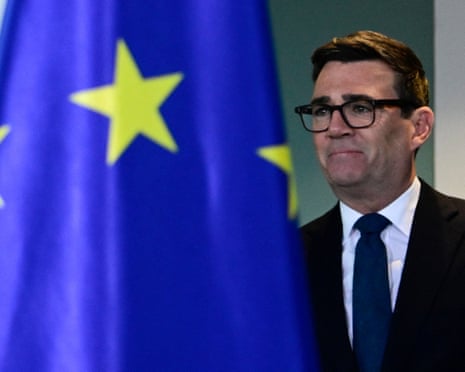
British prime minister Andy Burnham arrives to address a briefing with the German chancellor at the Chancellery in Berlin. Photograph: Tobias Schwarz/AFP/Getty Images
He says their meeting in Berlin comes ahead of the UK-EU summit later this year – expected in late November – as he says he is “very committed to securing deeper cooperation” with the EU at the summit.
He wants to see “if we can bring the UK closer to Europe, particularly in the interest of economic growth and collaboration on irregular migration,” he says.
In terms of more symbolic gestures, he says he will take part in talks with German business leaders later today, and hopes to host them in the UK next year – alongside the full German cabinet to show that “this treaty is not just words on a page, left on a shelf,” but a meaningful document.
He then turns to students standing somewhat awkwardly behind the pair throughout their exchange, and they briefly chat about their experiences with the UK, with someone mentioning their visited Scotland.
Aaaaaand that’s it.
Burnham hails Germany as a partner for 'challenging times'
In his response, Burnham focuses on broader cooperation with Germany.
He says that in these “challenging times, we need the highest quality collaboration with our closest partners.”
He says their talks also looked at defence and security issues, including their preparedness and ability to counter hybrid threats.
He also says the UK is open to Germany joining GCap programme of work on the next generation fighter jet, together with Italy and Japan.
He also flags cooperation on quantum, AI, and tech more broadly.
Merz welcomes new treaty as new opening after UK's 'regrettable' decision to leave EU
Merz is speaking now.
His remark focus exclusively on the bilateral British-German Kensington Treaty, as the pair exchange the documents and formally complete its implementation.
He says the treaty “opens up new opportunities” between the two countries, following Britain’s “regrettable” exit from the European Union.
He focuses on a particular element of the treaty that gives better access to both countries, with no visas required – even for extended stays by school pupils and university students – and for student exchanges between the two countries.
“That is precisely why we are doing this: so that the younger generation, within the context of bilateral relations between Germany and Great Britain, can simply see just how well we Europeans work together and how closely we belong together,” he says.
Merz and Burnham expected to deliver statements in Berlin shortly
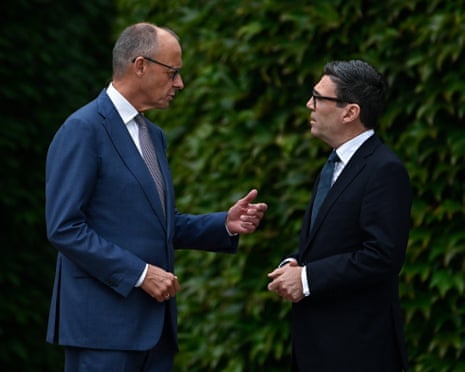
Back to Berlin, Germany’s Merz and UK’s Burnham are about to speak after their talks.
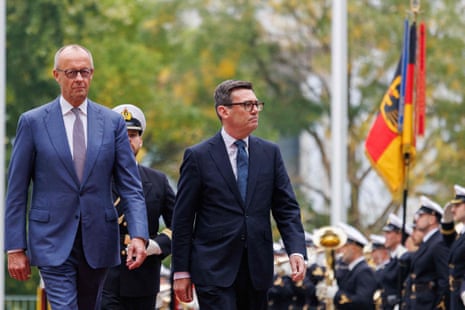
German chancellor Friedrich Merz marches with prime minister of the United Kingdom, Andy Burnham as the honour guard performs military honours at the Federal Chancellery following his arrival in Berlin, Germany. Photograph: Carsten Koall/DPA/AP
Annoyingly, it’ll be just statements, with no questions from the press.
You can watch along below, and I will bring you the key lines here:
Merz and Burnham deliver joint remarks after Berlin meeting – watch live
Rubio gets pushed on allegations of misconduct by US ambassador to Greece
Helena Smith
in Athens
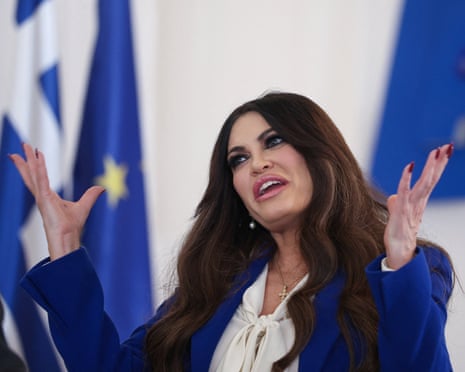
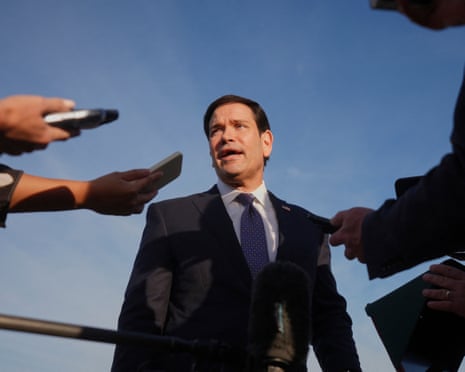
Over in Athens, Marco Rubio, the US secretary of state, has been forced, yet again, to address allegations of misconduct by Kimberly Guilfoyle, America’s ambassador to Greece.
US secretary of state Marco Rubio flanked by US ambassador to Greece Kimberly Guilfoyle arrives to board a plane at Eleftherios Venizelos International Airport near Athens. Photograph: Mark Schiefelbein/AFP/Getty Images
For the second time in the space of 12 days the Wall Street Journal had run a report detailing misconduct by Guilfoyle – the former fiance of the US president’s oldest son Donald Trump Jr.
The report was published late Wednesday as Rubio was holding talks with Greek premier Kyriakos Mitsotakis.
It alleged the former Fox News channel host had asked Eric Deters, a Republican donor and supporter of president Trump, to pay off a $100,000 American Express credit card bill ahead of her confirmation hearing on 9 July 2025. In exchange, Guilfoyle reportedly promised direct access to the White House and high profile officials in the Trump administration.
Kimberly Guilfoyle, US ambassador to Greece, speaks during US secretary of state Marco Rubio's visit at the prime minister's office in Athens, Greece. Photograph: Louisa Gouliamaki/Reuters
Early Thursday as he was about to board a plane for Portugal – the last stop in his three-day tour of Europe – Rubio was asked to comment.
Acknowledging he was aware of the report – and as Guilfoyle looked on – he told reporters:
“You guys walk around thinking that because some source told you something and you reported it, it’s the gospel. It’s not the gospel. It’s not the gospel for me. That’s not the way we do things.”
It was not the first time the foreign policy chief has been forced to address reports of misconduct swirling around Guilfoyle – or alluded to fake news in debunking them.
On Wednesday, at a press conference with Greece’s foreign minister, he was asked if he remained confident in the envoy amid mounting congressional scrutiny of Guilfoyle’s tenure following earlier allegations detailed by Journal.
Visibly irritated, Rubio shot back saying: “This is not the forum to address this, as simple as that. Suffice it to say, our embassy here is doing a great job. Our ambassador here has been a strong ambassador here.”
Late last month the Wall Street Journal ran a report accusing the high-profile ambassador of improper behaviour around the sale of US natural gas exports to the region via Greece.
The paper reported an incident in which Guilfoyle was also said to have boasted about America’s ability to undermine governments, including the Greek government, if they didn’t comply with US wishes.
Germany's Merz hosts UK's Burnham for talks in Berlin
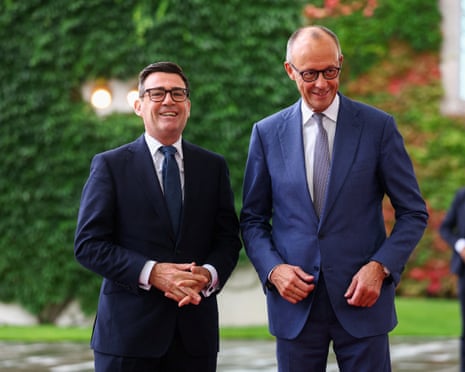
Meanwhile, UK’s prime minister Andy Burnham has now arrived in Berlin, and is taking part in a formal welcome with German chancellor Friedrich Merz.
German chancellor Friedrich Merz welcomes British prime minister Andy Burnham with military honours at the Chancellery in Berlin, Germany. Photograph: Lisi Niesner/Reuters
Some parts of the German media claim it as Burnham’s first stand-alone overseas visit, arguing that both his trips to Ukraine and the UN were part of a broader group. Not sure that really works, but either way his early trip to Berlin shows the importance he attaches to this relationship.
Curiously, there will be no press conference – Politico reported that it was a decision made upon the UK’s request – but the two leaders will deliver some press statements.
German chancellor Friedrich Merz greets British prime minister Andy Burnham as he arrives at the Chancellery in Berlin. Photograph: Tobias Schwarz/AFP/Getty Images
I will bring you the key lines when they step up to the microphones.
French high school protests spill over to Belgium with concerns about violence
The French protests are also spilling over the border to Belgium, particularly Brussels and Liège, Reuters and broadcaster RTBF reported.
In Liege, local media have reported more than 200 arrests in connection with student protests this month, and authorities have imposed a ban on public gatherings of more than three people until 16 October, Reuters reported.
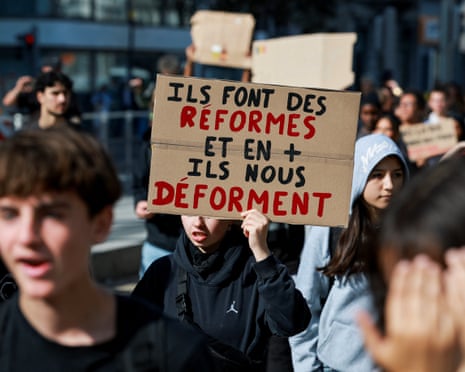
Protestors hold placards during a protest against education reforms by the Wallonia-Brussels Federation government and an increase in student fees in Liège, Belgium. Photograph: Nicolas Tucat/AFP/Getty ImagesA person holds a placard reading: "They make reforms, and on top of that, they deform us.", as high school students take part in a spontaneous street protest in Liège, Belgium. Photograph: Stéphanie Lecocq/Reuters
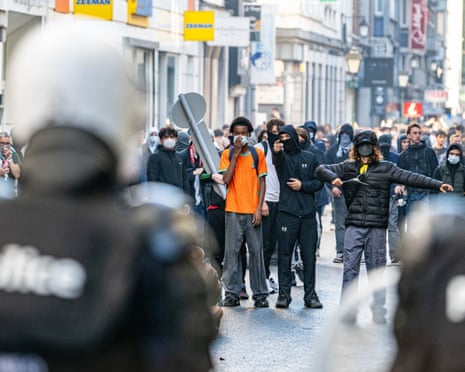
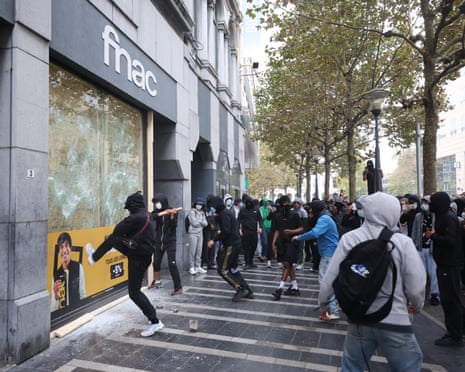
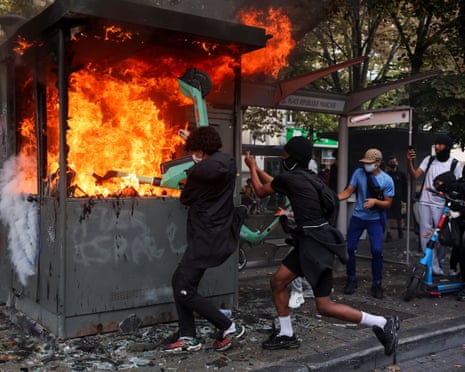
But Belgium’s foreign minister, Bernard Quintin, said hard-left activists had infiltrated the Liège school protests and were causing damage to property.
Youths confront riot police as students gather outside several schools in Liège during a protest against education reforms and budget cuts. Photograph: Jonas Roosens/Belga/ShutterstockDemonstrators smash a shop window as protesters clash with riot police during a high school students' demonstration against education spending cuts in Liège, Belgium. Photograph: Olivier Hoslet/EPAPeople attempt to put an electric scooter into a burning structure on a street in Liège, Belgium. Photograph: Stéphanie Lecocq/Reuters
Julien Doeche, a member of the Liège Antifascist Front, told RTBF Quintin’s claims were “fantasies“.
30 people killed after Russian strike on public transport in eastern Ukraine
Meanwhile, we are getting sad news from Ukraine, where at least 30 people were killed in a Russian attack in the proximity of a bus stop in the city of Kramatorsk in eastern Ukraine.
At least 18 people were also injured.
Responding to the strike, the region’s governor Vadym Filashkin suspended the operation of public transport, warning it was “an attractive target” for Russia given “a single strike can kill the highest number of people.”
“Russia consciously disregards all conceivable rules of warfare and norms of international humanitarian law. It selects targets where it can inflict the greatest suffering on civilians,” he warned.
“Under these circumstances, we have no right to risk the lives of passengers and drivers. The safety of the residents of Kramatorsk and Sloviansk is paramount,” he added.
Ukraine’s president Volodymyr Zelenskyy said earlier that the strike targeted “an ordinary public transport stop.”
More high school protests take place across France - in pictures
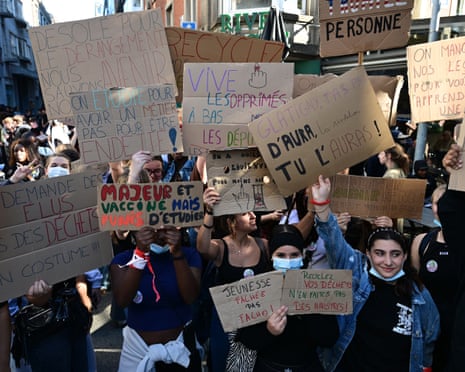
Back to France,let me bring you more pictures from this morning’s high school protests, which are taking place not just in Paris, but also in other cities, including Nantes and Bordeaux.
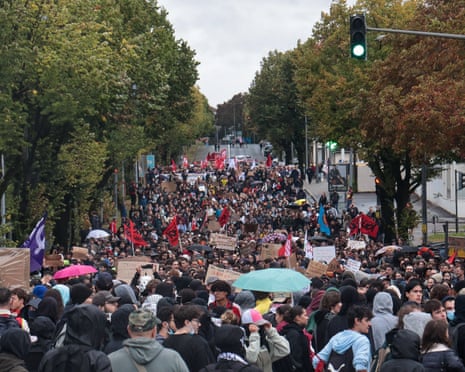
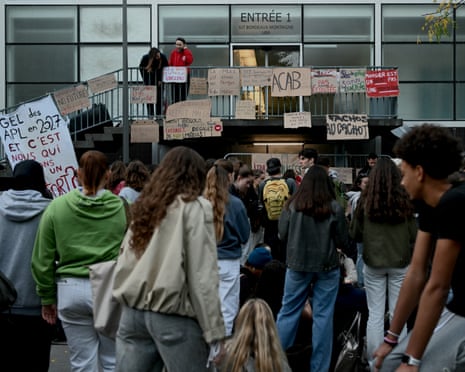
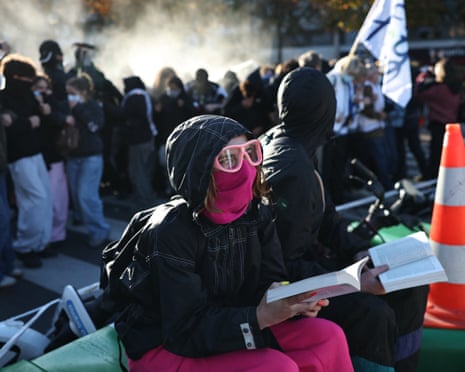
French high school and university students attend a demonstration in Nantes. Photograph: Stéphane Mahé/ReutersStudents protesters hold placards as they gather for a blockade at the IUT Bordeaux Montaigne university institute of technology in Bordeaux. Photograph: Philippe Lopez/AFP/Getty ImagesHigh school students gathered in Bron for a demonstration, as part of student mobilisation taking place today. Photograph: PITTORE/NEIRDAPROD/SIPA/ShutterstockA protester reading a book reacts as tear gas sprayed by police is seen in the background during a blockade action part of a demonstration of high-school students near Helene Boucher high school in Paris. Photograph: Simon Wohlfahrt/AFP/Getty Images
One dead, two injured in another knife attack at Polish school
We are getting reports of another knife attack at a school in Poland.
The incident took place in Leszczydół-Nowiny, east-central Poland, leaving one person dead and two injured. A 15-year-old boy was apprehended at the scene.
It comes just a day after a 17-year-old boy injured nine people in a separate school stabbing attack (Europe Live, yesterday). An improvised explosive device was discovered in his backpack.
Elsewhere in the country, another 17-year-old has been detained on suspicion of planning a similar knife attack.
In response to the wave of incidents, Polish police said they will step up spot checks near schools to scan for knives and identify suspicious behaviour.
EU drops sponsorship of disinformation conference at Trump officials’ request
Aisha Down in London, Joseph Gedeonin Washington andJennifer Rankinin Brussels
In other news, the Trump administration pressured multiple countries to withdraw their sponsorship of a leading European conference on disinformation, with Canada, Lithuania and the EU’s diplomatic service subsequently agreeing to do so, the Guardian understands.
US secretary of state Marco Rubio speaks to the press in Athens Photograph: Mark Schiefelbein/AFP/Getty Images
The conference, #Disinfo2026, taking place Wednesday and Thursday, is the annual meetup of Europe’s counter-disinformation community and has drawn hundreds of researchers, journalists, technologists and policymakers to a hotel in Vilnius, Lithuania. It is run by an independent Brussels non-profit, EU Disinfo Lab.
Days before the conference, the logos of its main supporters – the Lithuanian ministry of foreign affairs, the European External Action Service (EEAS) and Global Affairs Canada, the country’s foreign ministry – were wiped off its website.
Photos of the event shared with the Guardian also show white stickers affixed over the logos of these organisations printed on official conference materials, appearing to indicate they were struck from the program in haste.
Three persons familiar with the matter, including European officials, confirmed that the US state department had been in touch with multiple governments over their support for the conference.
Internal state department documents seen by the Guardian also show US officials thanking Lithuania for “taking US concerns seriously”. The document says Washington was “grateful” Lithuania supposedly found a panel framing the US as a foreign information threat “reprehensible and surprising” and welcomed its decision to limit involvement in the conference.
French high school protests this morning - in pictures
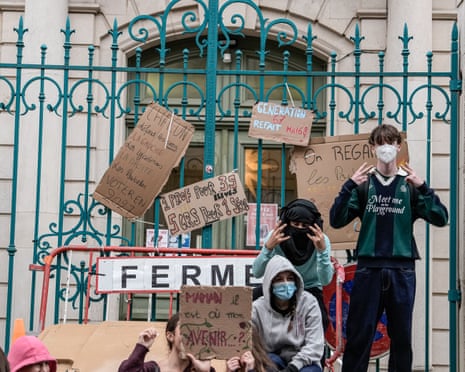
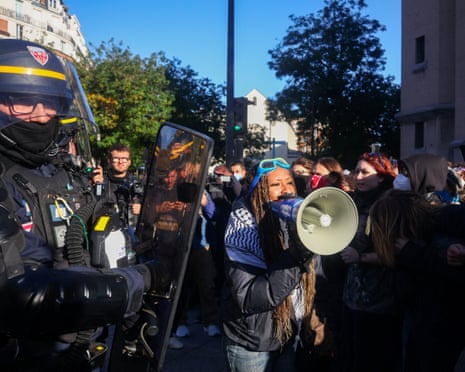
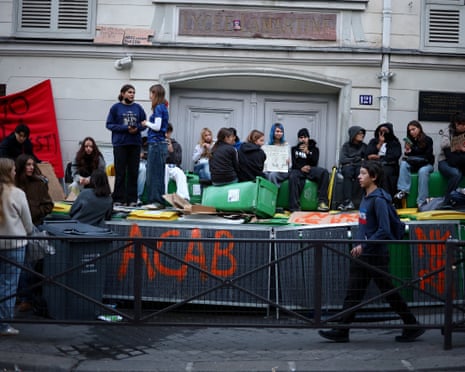
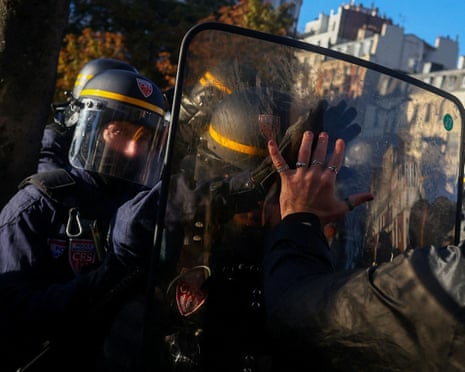
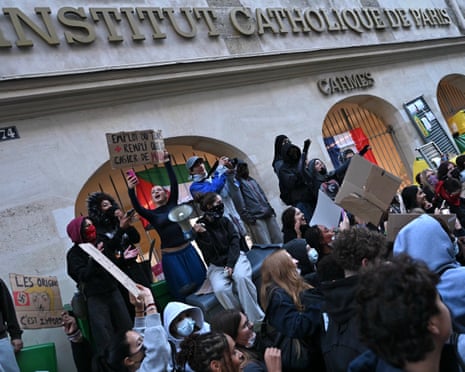
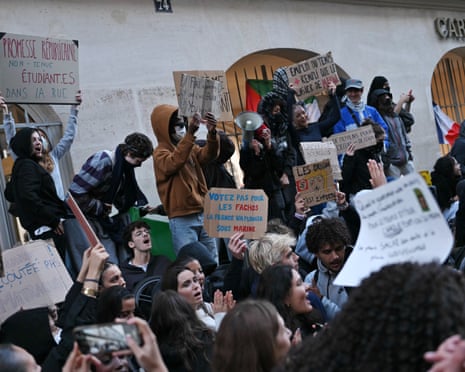
A protester uses a megaphone next to French CRS riot police outside Lycee Helene-Boucher high school, during nationwide protests in Paris, France. Photograph: Pedro Nunes/ReutersFrench high school students sit on barricades outside the Lycee Lamartine high school in Paris. Photograph: Pedro Nunes/ReutersA protester confronts riot police officers outside Lycee Helene-Boucher high school as students block the road, during nationwide protests in Paris, France. Photograph: Pedro Nunes/ReutersStudents demonstrate outside the Carmes campus of the Institut Catholique de Paris (ICP), in Paris, France. Photograph: Firas Altoukhi/EPA
French education minister to hold talks with high school students later today
French education minister Édouard Geffray has invited the three leading high school students associations for further talks at the ministry later this afternoon.
This comes as a recent opinion poll showed that the French public broadly supports the protest – with three-thirds agreeing with the students’ demands, and 55% backing the demonstrations – but is divided on whether they should continue (Europe Live, yesterday).
Students hold placards as they demonstrate outside the Carmes campus of the Institut Catholique de Paris (ICP), in Paris, France. Photograph: Firas Altoukhi/EPA
Morning opening: French high school protests continue despite PM's promise of action
Jakub Krupa
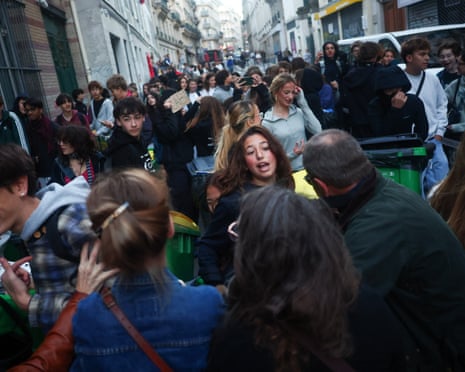
High school protests across France show no sign of slowing down, with nearly 400 educational establishments facing disruptions this morning.
A French high school student confronts people who want to prevent her from building a barricade, outside the Lycee Lamartine high school in Paris. Photograph: Pedro Nunes/Reuters
Demonstrators have rejected a promise by prime minister Sébastien Lecornu to present a plan to fix the country’s education system by the end of the month, demanding he fully engages with their demands sooner than that.
In a televised address last night, Lecornu said the country could not be “indifferent” to their concerns, and acknowledged that their anger “does not come from nowhere,” but did not make any immediate headline-grabbing announcements.
France's prime minister Sébastien Lecornu makes a statement regarding the situation in high schools, fuel prices, the agricultural crisis, and the France's financial situation in Paris. Photograph: Dimitar Dilkoff/AFP/Getty Images
“We want real action, and until we get it, we’ll keep mobilising,” a high school student named Marilou in Fontainebleau told AFP.
I will keep an eye on today’s events in France as they unfold.
Over in Spain, I will look at reactions after last night’s death of María del Carmen Abascal, the 87-year-old whose eviction set off a nationwide wave of protests against Spain’s housing crisis.
Elsewhere, Britain’s prime minister Andy Burnham will meet with Germany’s Friedrich Merz in Berlin for political talks. Unusually, however, the pair will not hold a joint press conference.
Lots to cover.
It’s Thursday, 8 October 2026, it’s Jakub Krupa here, and this is Europe Live.
Andrew Garfield plays OpenAI CEO Sam Altman in "Artificial," which hits theaters on Christmas Day.
Michael Loccisano/Getty Images for FLC
Portraying OpenAI CEO Sam Altman in the upcoming film "Artificial" didn't make Andrew Garfield an AI enthusiast.
… %!s()
In fact, Garfield said it had the opposite effect during an interview with Variety published on Tuesday.
"I got a bit scared. I felt a little mistrusting of the technology," Garfield said. "It feels like the people who are creating and kind of encouraging us to use the technology don't exactly know its capacity themselves. So, that feels a little irresponsible to me, personally."
Garfield said he's used ChatGPT for research or as a "kind of fancy Google," but doesn't need to rely on AI for his career.
"Luckily, I don't need it in my life in the same way other people in other industries might as an actor," Garfield said.
Directed by Luca Guadagnino, "Artificial" details the turbulent period when Altman was temporarily ousted from OpenAI in 2023. The film will be a who's who of Silicon Valley, with Yura Borisov as Ilya Sutskever, Monica Barbaro as Mira Murati, Ike Barinholtz as Elon Musk, and Cooper Hoffman as Greg Brockman. The film hits select theaters on Christmas Day.
In interviews, Altman has said he has some reservations about the film.
"I'm sure it won't be accurate, but I hope it's funny and enjoyable to watch," he told Politico's Decoded this week.
Altman told Vanity Fair he had seen the film's trailer and that Garfield had mastered some of his mannerisms.
"They filmed outside of our house. There were these notices on our street that there was going to be some filming or whatever. I didn't realize what was going on. I paid no attention," he said. "And then one morning I was walking down the street to get coffee, and there were all these cameras, and there was a guy dressed exactly like me with my same backpack walking so much that I felt I was in some weird glitch of the simulation or something."
He called the moment "very strange."
"Then I immediately figured out what was happening. We waved and went on, but it was really weird. I mean, it's like a strange thing to see someone that has nailed your kind of quirky mannerisms or whatever," Altman said.
Read next
Lauren Edmonds
You're currently following this author!
Click to unsubscribe from email alerts.
Plans to run direct train services to Wrexham and Rochdale from London have been rejected by the rail regulator because of “significant pressure” on the line.
The Office of Rail and Road said that there was insufficient space on the crowded west coast mainline to introduce the two new separate train services.
… %!s()
It also vetoed plans for additional London-Blackpool train services wanted by Avanti.
The ORR had last year knocked back plans for a new independent open access service linking Wrexham and the capital put forward by the Wrexham, Shropshire & Midlands Railway Company (WSMR). WSMR had submitted plans for a slightly less frequent service but the ORR said the new routes would still put the reliability of the wider railway at risk.
The new service could have allowed Wrexham to capitalise further on the town’s Hollywood-meets-football mini-boom, fuelled by the Wrexham AFC co-owners Ryan Reynolds and Rob McElhenney.
Proposals for a new Lumo service between London and Rochdale, again slimmed down after being rejected in 2025, were once more rebuffed.
The ORR also said Avanti could not add more Blackpool services from London. However, it did approve one extra London-Chester evening service from Avanti, which would otherwise have run as a “ghost train”, with crew and the rolling stock returning north to the depot overnight. The decision follows the outcry over the ORR’s initial ruling on a Manchester-London service which was barred from taking passengers last year.
The regulator said its assessment, backed by external reviews, was that the “capacity and performance of the southern section of the west coast mainline has not materially changed since similar applications were rejected in 2025”.
It said gaps in the current timetable were needed to provide important space for trains to recover when things went wrong, rather than escalating chaos.
Stephanie Tobyn, ORR’s director of strategy, policy and reform, said: “New services, destinations and greater choice can bring real benefits for passengers and communities. But the west coast mainline is already under significant pressure, with performance reflecting limited resilience on a heavily used part of the rail network.
skip past newsletter promotion
after newsletter promotion
“Our detailed analysis has shown that adding more trains to the current timetable would reduce the ability to recover when disruption occurs, increasing the risk of delays spreading and making reliability of the network worse for all passengers.”
Private operators such as First Group, owners of Lumo, have been looking to increase open-access routes as Labour has renationalised major rail contracts in the transition to Great British Railways.
London-Wrexham direct trains briefly ran from London Marylebone from 2008 to 2011 as an open-access service but stopped owing to financial losses. %!s()
Charlotte Gainsbourg had one artist to recommend to the crowd at her Busan International Film Festival masterclass, and it was not a safe pick.
“I’m not good for recommendation. I have one artist that I listen to, very controversial artist, but I listen to everything he does, and it’s Kanye West,” Gainsbourg said, to laughter from the audience. “I know, it’s very easy.”
… %!s()
She followed up with a tamer pick. If it has to tie back to cinema, she said, film scores are what she listens to most.
Gainsbourg, who is on her first visit to Korea, is in Busan with “Melancholia,” one of four films she made with Lars von Trier. The choice, she explained, came down partly to elimination. “Antichrist,” their first collaboration, won her best actress at Cannes, but “Nymphomaniac” would have meant showing two films.
“I guess it was the easiest choice, ‘Melancholia,’ and also because selfishly, I want to see it again,” Gainsbourg said, laughing. “I haven’t seen it in 15 years.”
The screening followed straight after the session, and the moderator warned the audience they would lose about five minutes so Gainsbourg could catch it.
Then the conversation turned to von Trier himself. “Well, I can’t say he’s a friend, but he’s a dear friend,” she said. “I don’t know him that well, but we exchange text messages.”
The moderator pointed out that film fans and the wider public hold plenty of preconceptions about the director. “As a human being, he’s very tortured. And that touches me. And in his films, he gives a lot of himself. He’s extremely vulnerable,” Gainsbourg said. “I’ve never learned as much as with him about myself, about the film, about being an actress.”
An audience member wanted to know how she plays von Trier’s women, who are at once powerful and powerless. “People exactly think that I am only one side. They think I’m fragile and soft and kind and respectful. I like to show the other side of me, and with Lars’s films, I’m able to,” Gainsbourg said.
When the interpreter described her as having a filmography of more than 80 titles and began to call her prolific, Gainsbourg cut in. “Prolific? No, not prolific,” she said, laughing.
She was more expansive about her few days in Seoul. The Leeum museum opened its doors to her and her friends on a day it was closed, giving her the run of the place. She also ate what she called “a very special barbecue, Korean barbecue, that was incredible.”
“Yesterday was fun, because I got to go to a bar, a restaurant bar with a lot of actors and directors, and it was just so friendly to see people from the industry here just gathering, drinking a lot of alcohol,” she said, drawing more laughs. “It was fun.”
Gainsbourg’s mother, the late Jane Birkin, appeared in Hong Sang-soo’s “Nobody’s Daughter Haewon” during a visit to Korea, so the moderator asked whether her daughter had any Korean directors in mind. Gainsbourg said she would be very open to working here, and that she is fond of Korean cinema and talent, having already met a few members of the local industry. “I’m superstitious,” she said. “So I won’t say any names or anything, but I hope so.”
When an audience member asked about her two most recent releases, Gainsbourg laughed. “What has been released? Nothing!” she said. The film in question turned out to be “L’Affaire Marie-Claire,” Lauriane Escaffre and Yvo Muller’s drama in which she plays real-life lawyer and women’s rights campaigner Gisèle Halimi. The film, which centers on the fight for abortion rights, played in Cannes’ Special Screenings section and opens in France on Nov. 4.
She is also finishing an album she has been working on for years and hopes to make a few music videos for it. She directed her own on her last record. A feature of her own is on her mind, but she said she would need a story so personal “that only me can do it” before she felt she had the legitimacy.
Gainsbourg also looked back on how her acting career began. Her first audition, for “Paroles et Musique,” came via a note her mother left her: “They’re looking for a girl your age. If you want to try, here is the address.” She got the part after a long casting process that came down to two girls, and “The Impudent Girl” followed. For years afterward, she said, she felt she had “stolen the right to be there” because she never trained as an actor.
Her parents have been a big part of her recent work. Gainsbourg spent 35 years trying to turn her father Serge Gainsbourg’s house into a museum, and it finally came together over the past three years. Before it opened, she photographed the house for herself while it was still private, and those pictures ended up as an exhibition in Arles last summer. “It was very emotional for me,” she said.
The 2021 documentary she made about her mother, “Jane by Charlotte,” took about four years to shoot, including a two-year break. “I think she was happy about it,” Gainsbourg said.
Birkin died in 2023. “She was happy knowing how much I loved her, I think,” Gainsbourg added. %!s()