Longest interval of the programme: RC-1186: 95 m at 1.10 g/t AuEq (0.97 g/t Au, 11.99 g/t Ag), including 3 m at 8.11 g/t AuEq (7.78 g/t Au, 30.47 g/t Ag).
Additional significant intercepts include:1
| Hole | Interval (m) | AuEq | Au | Ag |
| RC-1197 | 20 | 3.12 | 2.98 | 12.90 |
| incl. | 5 | 5.22 | 4.97 | 23.40 |
| RC-1196 | 15 | 3.33 | 1.90 | 129.97 |
| incl. | 2 | 16.01 | 5.73 | 934.50 |
| RC-1199 | 26 | 1.82 | 1.30 | 46.56 |
| incl. | 7 | 3.85 | 2.54 | 119.29 |
| RC-1188 | 31 | 1.14 | 1.07 | 6.03 |
| incl. | 9 | 1.63 | 1.57 | 5.33 |
| RC-1198 | 27 | 1.13 | 0.99 | 12.89 |
| incl. | 6 | 2.07 | 1.91 | 14.17 |
Drilling results indicate continuity of mineralisation within the existing Los Nanos Mineral Resource included in the Company's Guanaco Technical Report and intersected mineralisation beyond the current resource model, supporting the bulk-tonnage target at the intersection of the east-west ("EW") to east-north-east ("ENE") and north-west ("NW") structural trends.
Each intercept listed above exceeds the 0.39–0.62 g/t AuEq Los Nanos cut-off grades applied in the Company's Guanaco Technical Report2
The new data will be incorporated into an updated three-dimensional geological and structural model.
Next phase of drilling: up to 8,000 metres expected to commence in Q4 2026.
Sydney, Australia--(Newsfile Corp. - September 28, 2026) - Austral Gold Limited (ASX: AGD) (TSXV: AGLD) (OTCQB: AGLDF) ("Austral" or the "Company"), an established gold producer, is pleased to announce the initial results of the infill drilling campaign at Los Nanos (100% owned). Brownfield exploration adjacent to the Company's operating mines is a core element of Austral's growth strategy.
The programme forms part of the brownfield exploration and resource-conversion activities outlined in the Company's Quarterly Activities Report for the period ended 30 June 2026 and advances the resource-conversion initiative identified in the Guanaco Technical Report (effective 31 May 2026). The Technical Report disclosed that the Company was "executing drilling programs to upgrade the classification in the Los Nanos sector" as a priority for the next three-year period. Los Nanos was also identified as one of two areas offering the greatest potential to expand the Guanaco Mineral Resource inventory.
Initial drilling results indicate continuity of mineralisation within the previously defined resource area and have generated new geological information that expands the sector's exploration potential. Importantly, the results indicate that mineralisation is controlled by a more extensive structural system than previously interpreted, with the broadest mineralised zones appearing to be developed where the principal EW- to ENE-trending structures intersect subordinate NW-trending structures, consistent with the geological model being tested by the Company.
These results are significant because the programme was designed primarily as infill drilling to support resource conversion within a predominantly Inferred Mineral Resource. The results have also identified geological and structural features that enhance the Company's understanding of the mineralised system and provide additional targets for follow-up drilling.
Austral's brownfield strategy prioritises targets within haulage distance of its existing processing facilities. At Guanaco, the Company operates agitation leach and heap leach circuits, supported by established haul roads, power and water infrastructure. Los Nanos is located approximately 2.5 km from this infrastructure, on concessions held by the Company, and hosts Mineral Resources but no Mineral Reserves.
Austral Gold's CEO, Stabro Kasaneva, said: "Los Nanos is one of two areas identified in the updated Technical Report as offering potential to expand the Guanaco Mineral Resource inventory. It hosts the highest-grade Mineral Resource within the Guanaco open-pit inventory, is located on concessions held by the Company, and lies within 2.5 kilometres of our processing plant. While the sector is not included in the current life-of-mine plan, these drilling results have enhanced our understanding of the mineralised system, and the Company intends to advance an updated geological model and continue infill drilling."
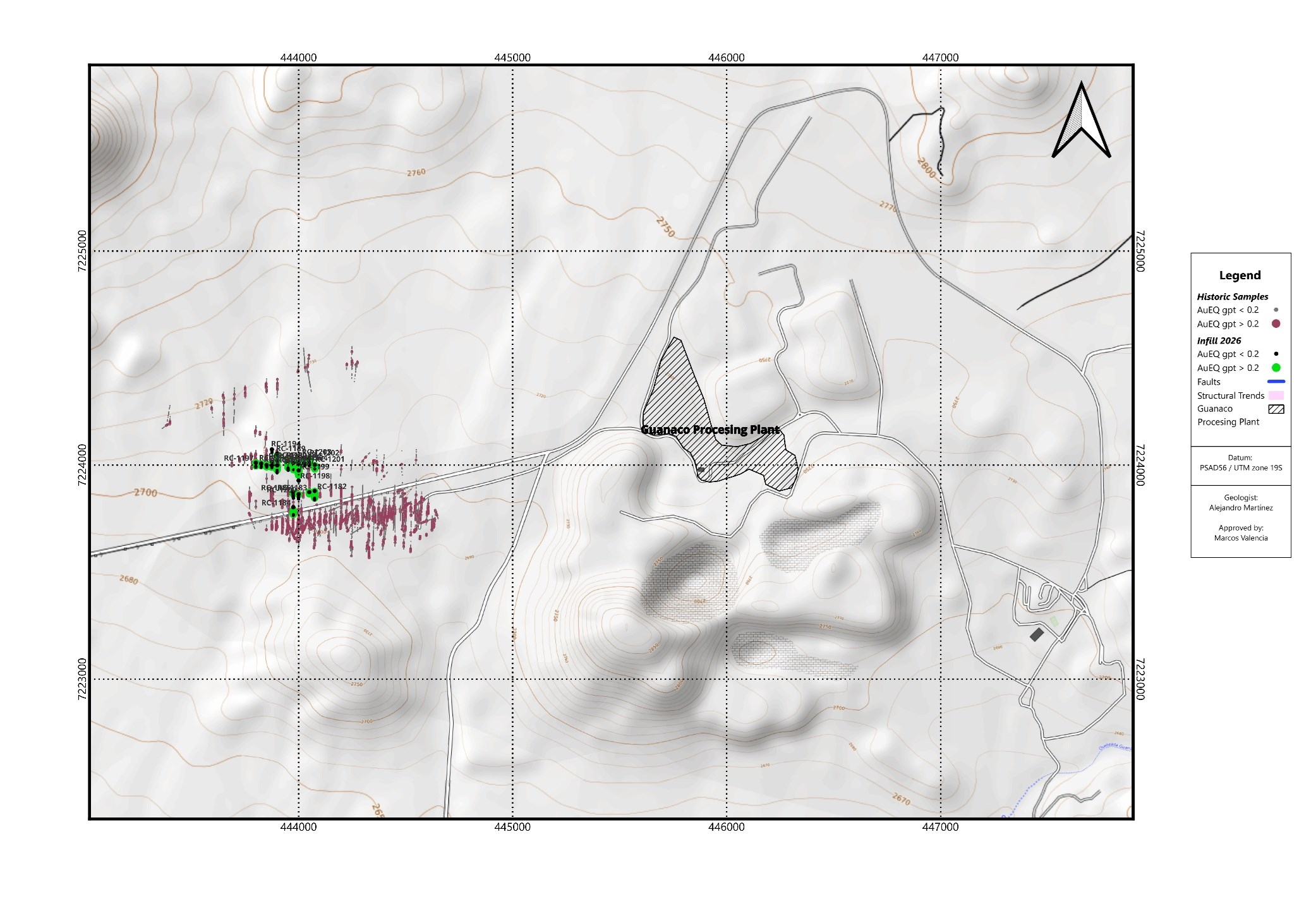
FIGURE 1 Los Nanos location relative to the Guanaco processing plant
Source: Austral Gold. Coordinates in PSAD56 / UTM Zone 19S.
To view an enhanced version of this graphic, please visit:
https://images.newsfilecorp.com/files/690/316262_875b07fcc4535ae1_002full.jpg
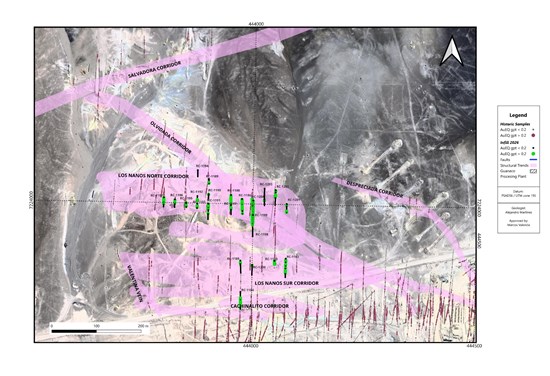
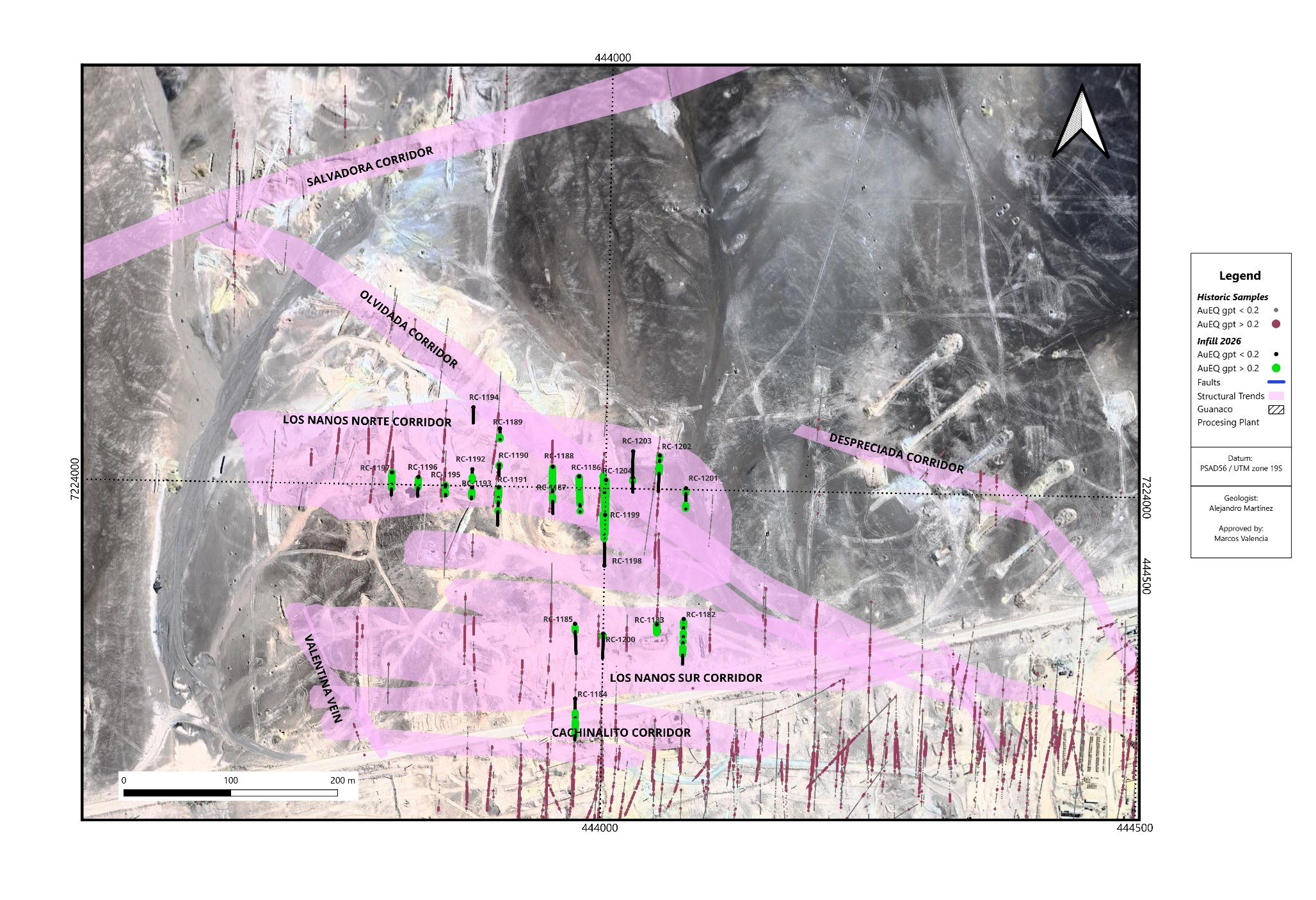
FIGURE 2 Los Nanos infill drilling programme and main mineralised corridors
Source: Austral Gold. Coordinates in PSAD56 / UTM Zone 19S.
To view an enhanced version of this graphic, please visit:
https://images.newsfilecorp.com/files/690/316262_875b07fcc4535ae1_003full.jpg
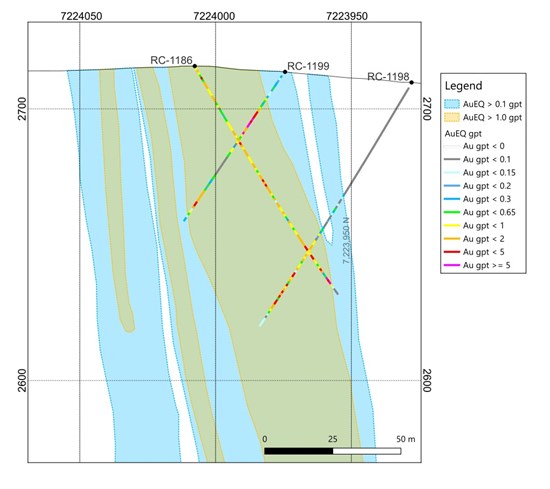
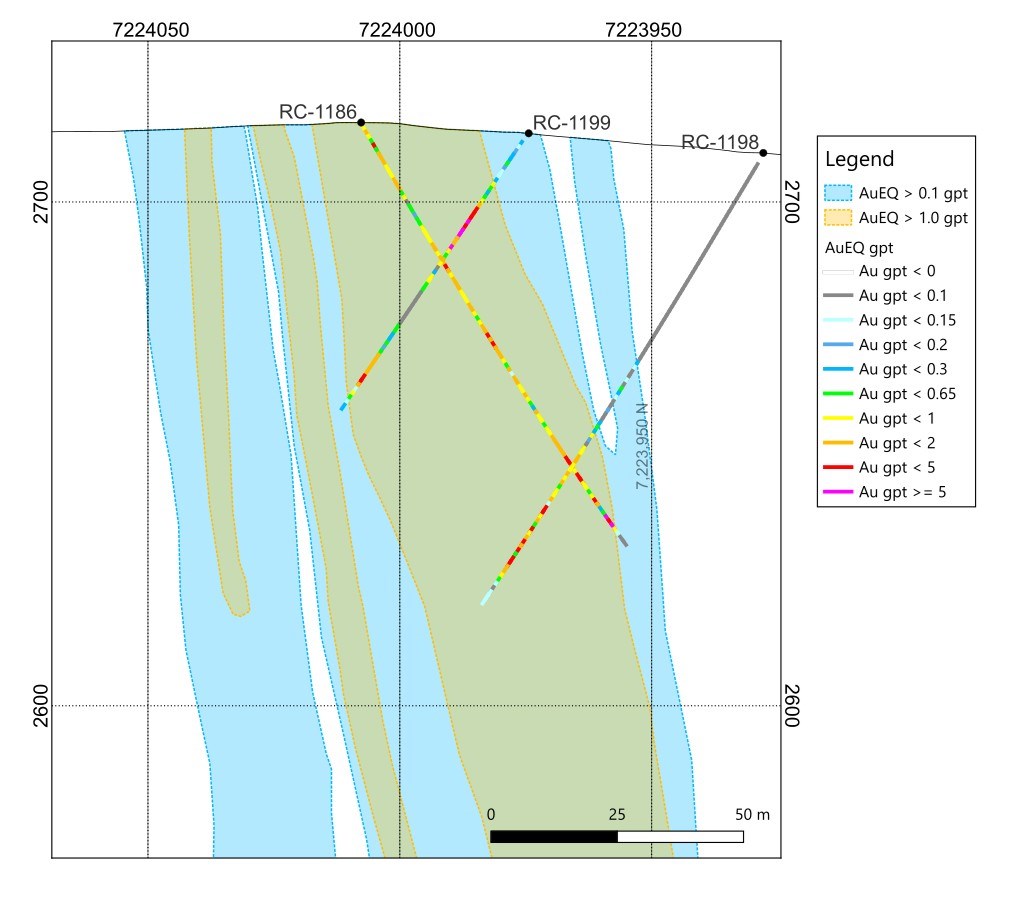
FIGURE 3 Los Nanos – N–S cross-section through RC-1186 showing AuEq grades and interpreted mineralised zones
Source: Austral Gold. Section 444,000 mE, looking east.
To view an enhanced version of this graphic, please visit:
https://images.newsfilecorp.com/files/690/316262_875b07fcc4535ae1_004full.jpg
Drilling Results
The programme consisted of 23 RC holes (RC-1182 to RC-1204) totalling 1,128 metres, drilled between Q2 2026 and Q3 2026 by a local contractor. Holes were drilled on a nominal 25 m by 25 m pattern designed to infill the existing Los Nanos Mineral Resource and to step out along interpreted structural intersections.
Significant intercepts are set out in Table 1. Twenty of the 23 holes returned significant results; holes RC-1194, RC-1203 and RC-1204 returned no significant results and are reported in Table 1 for completeness. Drill hole collar details are set out in Table 2.
Table 1: Los Nanos -Drilling Results
| Hole ID | From (m) | To (m) | Interval (m) | AuEq (g/t) | Au (g/t) | Ag (g/t) |
| RC-1182 | 4 | 7 | 3 | 0.62 | 0.56 | 5.00 |
| RC-1182 | 11 | 12 | 1 | 0.34 | 0.33 | 0.50 |
| RC-1182 | 20 | 22 | 2 | 6.52 | 6.50 | 1.50 |
| incl. | 20 | 21 | 1 | 12.09 | 12.07 | 2.00 |
| RC-1182 | 43 | 48 | 5 | 2.69 | 2.61 | 6.80 |
| incl. | 43 | 45 | 2 | 5.79 | 5.62 | 15.50 |
| RC-1182 | 50 | 51 | 1 | 0.31 | 0.30 | 0.50 |
| RC-1183 | 0 | 4 | 4 | 0.44 | 0.43 | 0.50 |
| RC-1183 | 10 | 16 | 6 | 1.07 | 1.06 | 0.67 |
| incl. | 12 | 14 | 2 | 1.92 | 1.91 | 0.75 |
| RC-1184 | 32 | 33 | 1 | 0.42 | 0.41 | 0.50 |
| RC-1184 | 40 | 52 | 12 | 1.82 | 1.80 | 1.92 |
| incl. | 42 | 43 | 1 | 13.71 | 13.70 | 0.50 |
| RC-1184 | 58 | 62 | 4 | 1.91 | 1.87 | 3.50 |
| incl. | 59 | 60 | 1 | 4.01 | 3.98 | 3.00 |
| RC-1185 | 7 | 11 | 4 | 1.13 | 1.11 | 1.37 |
| RC-1186 | 1 | 96 | 95 | 1.10 | 0.97 | 11.99 |
| incl. | 5 | 16 | 11 | 1.23 | 1.19 | 3.27 |
| incl. | 47 | 52 | 5 | 2.01 | 1.80 | 18.88 |
| incl. | 78 | 84 | 6 | 2.57 | 2.13 | 39.96 |
| incl. | 88 | 90 | 2 | 1.93 | 1.40 | 48.46 |
| incl. | 92 | 95 | 3 | 8.11 | 7.78 | 30.47 |
| RC-1187 | 1 | 2 | 1 | 0.38 | 0.37 | 1.00 |
| RC-1187 | 3 | 4 | 1 | 0.31 | 0.30 | 1.00 |
| RC-1187 | 6 | 16 | 10 | 0.30 | 0.29 | 1.40 |
| RC-1187 | 19 | 21 | 2 | 0.31 | 0.29 | 2.00 |
| RC-1187 | 23 | 24 | 1 | 0.88 | 0.81 | 6.00 |
| RC-1187 | 25 | 26 | 1 | 0.30 | 0.19 | 10.00 |
| RC-1187 | 32 | 51 | 19 | 0.51 | 0.43 | 7.73 |
| incl. | 35 | 38 | 3 | 1.38 | 1.26 | 11.33 |
| RC-1188 | 1 | 32 | 31 | 1.14 | 1.07 | 6.03 |
| incl. | 1 | 10 | 9 | 1.63 | 1.57 | 5.33 |
| incl. | 14 | 24 | 10 | 1.21 | 1.12 | 7.40 |
| incl. | 28 | 30 | 2 | 1.26 | 1.17 | 8.00 |
| RC-1188 | 42 | 45 | 3 | 0.30 | 0.28 | 1.50 |
| RC-1188 | 47 | 48 | 1 | 0.38 | 0.31 | 6.00 |
| RC-1189 | 15 | 16 | 1 | 0.30 | 0.27 | 3.00 |
| RC-1189 | 17 | 18 | 1 | 0.32 | 0.25 | 6.00 |
| RC-1190 | 2 | 3 | 1 | 0.65 | 0.61 | 4.00 |
| RC-1191 | 2 | 17 | 15 | 0.85 | 0.80 | 4.20 |
| RC-1192 | 14 | 20 | 6 | 3.93 | 3.72 | 19.67 |
| RC-1193 | 7 | 17 | 10 | 0.77 | 0.74 | 2.60 |
| RC-1194 | No significant results |
|
|
|
|
|
| RC-1195 | 0 | 4 | 4 | 1.27 | 1.24 | 2.50 |
| RC-1195 | 13 | 14 | 1 | 0.31 | 0.29 | 2.00 |
| RC-1195 | 15 | 16 | 1 | 1.16 | 1.13 | 3.00 |
| RC-1196 | 3 | 18 | 15 | 3.33 | 1.90 | 129.97 |
| incl. | 6 | 8 | 2 | 16.01 | 5.73 | 934.50 |
| RC-1197 | 0 | 20 | 20 | 3.12 | 2.98 | 12.90 |
| incl. | 1 | 4 | 3 | 5.00 | 4.86 | 13.33 |
| incl. | 8 | 13 | 5 | 5.22 | 4.97 | 23.40 |
| RC-1197 | 26 | 28 | 2 | 1.39 | 1.13 | 23.50 |
| RC-1198 | 54 | 55 | 1 | 0.44 | 0.35 | 8.00 |
| RC-1198 | 63 | 90 | 27 | 1.13 | 0.99 | 12.89 |
| incl. | 82 | 88 | 6 | 2.07 | 1.91 | 14.17 |
| RC-1199 | 6 | 7 | 1 | 0.38 | 0.37 | 0.50 |
| RC-1199 | 11 | 37 | 26 | 1.82 | 1.30 | 46.56 |
| incl. | 17 | 24 | 7 | 3.85 | 2.54 | 119.29 |
| RC-1199 | 45 | 63 | 18 | 1.02 | 0.80 | 20.22 |
| incl. | 57 | 59 | 2 | 3.13 | 2.39 | 67.00 |
| RC-1200 | 4 | 5 | 1 | 0.30 | 0.29 | 0.50 |
| RC-1201 | 4 | 7 | 3 | 0.43 | 0.36 | 6.00 |
| RC-1201 | 24 | 26 | 2 | 0.50 | 0.45 | 4.00 |
| RC-1201 | 28 | 29 | 1 | 0.40 | 0.39 | 2.00 |
| RC-1202 | 1 | 3 | 2 | 0.35 | 0.34 | 0.50 |
| RC-1202 | 5 | 6 | 1 | 0.35 | 0.30 | 5.00 |
| RC-1202 | 15 | 24 | 9 | 0.93 | 0.81 | 10.11 |
| RC-1203 | No significant results |
|
|
|
|
|
| RC-1204 | No significant results |
|
|
|
|
|
Notes to Table 1:
1. Intervals are reported above a 0.3 g/t AuEq cut-off, with a maximum of 1 m of internal dilution and a minimum reported interval of 1 m. "incl." denotes higher-grade internal intervals reported at a 0.3 g/t AuEq cut-off.
2. Reported intervals are down-hole lengths. True widths have not been determined; based on the current structural interpretation, true widths are expected to be less than the reported down-hole lengths.
3. Gold equivalent is calculated as AuEq (g/t) = Au (g/t) + Ag (g/t) / 90.91, where 90.91 is the ratio of the gold price of US$2,500/oz to the silver price of US$27.5/oz. These metal prices and the AuEq formula are consistent with those applied in the Mineral Resource estimate reported in the Company's Guanaco Technical Report dated effective 31 May 2026. Metallurgical recoveries have not been applied to the AuEq calculation. Gold and silver are both currently recovered and sold as doré from the Guanaco operation, and it is the Company's opinion that each metal included in the metal equivalent calculation has a reasonable potential to be recovered and sold.
4. Copper and lead were also analysed. Results are consistently low — copper ranged from 4 to 172 g/t (0.0004% to 0.0172% Cu) and lead from 15 to 385 g/t (0.0015% to 0.0385% Pb) across reported intervals — and are not considered material or economically recoverable. They are not included in the AuEq calculation and are not reported in Table 1.
5. Samples were analysed by the Company's internal laboratory located at the Guanaco Mine Site. Laboratory procedures follow CIM best practice guidelines, and the QA/QC program includes the insertion of certified reference materials, blanks and duplicates. The Competent Person has reviewed the QA/QC results and considers the reported assay results to be reliable.
Table 2: Los Nanos — Drill Hole Collar Details
| Hole ID | Easting (m) | Northing (m) | RL (m) | Depth (m) | Dip (°) | Azimuth (°) |
| RC-1182 | 444074.99 | 7223879.26 | 2705.78 | 65 | -50.09 | 180 |
| RC-1183 | 444049.89 | 7223873.76 | 2706.23 | 16 | -59.83 | 180 |
| RC-1184 | 443974.94 | 7223803.11 | 2702.11 | 70 | -59.06 | 180 |
| RC-1185 | 443973.53 | 7223873.05 | 2709.28 | 55 | -61.31 | 180 |
| RC-1186 | 444000.13 | 7224007.76 | 2715.72 | 99 | -59.40 | 180 |
| RC-1187 | 443974.97 | 7224010.62 | 2718.09 | 65 | -60.56 | 180 |
| RC-1188 | 443950.10 | 7224019.19 | 2720.63 | 66 | -49.35 | 180 |
| RC-1189 | 443900.18 | 7224054.09 | 2723.46 | 20 | -57.75 | 180 |
| RC-1190 | 443900.05 | 7224020.03 | 2721.20 | 20 | -58.89 | 180 |
| RC-1191 | 443899.96 | 7223998.99 | 2720.01 | 65 | -58.40 | 180 |
| RC-1192 | 443875.02 | 7224015.57 | 2723.13 | 20 | -58.46 | 180 |
| RC-1193 | 443875.03 | 7223998.42 | 2722.22 | 21 | -59.66 | 180 |
| RC-1194 | 443875.03 | 7224073.40 | 2723.35 | 30 | -59.28 | 180 |
| RC-1195 | 443850.15 | 7224000.43 | 2724.10 | 21 | -60.84 | 180 |
| RC-1196 | 443824.73 | 7224007.40 | 2718.17 | 35 | -59.94 | 180 |
| RC-1197 | 443800.00 | 7224011.36 | 2714.20 | 40 | -56.32 | 180 |
| RC-1198 | 443999.95 | 7223927.93 | 2709.24 | 105 | -58.91 | 0 |
| RC-1199 | 443999.88 | 7223975.17 | 2712.77 | 65 | -55.58 | 0 |
| RC-1200 | 444000.02 | 7223864.26 | 2707.12 | 45 | -59.52 | 180 |
| RC-1201 | 444075.03 | 7224001.29 | 2707.30 | 50 | -49.69 | 180 |
| RC-1202 | 444049.97 | 7224031.45 | 2709.64 | 50 | -47.80 | 180 |
| RC-1203 | 444025.02 | 7224034.85 | 2711.82 | 55 | -50.01 | 180 |
| RC-1204 | 444025.04 | 7224010.19 | 2711.35 | 50 | -50.00 | 180 |
Coordinates are reported in PSAD56, Datum La Canoa – UTM zone 19S.
All holes were surveyed by the GCM Survey Department using Differential GPS - GNSS Pentax Series GX2.
Down-hole surveys were conducted by a DV Drilling contractor using a Devico DeviGyro (serial number 3937) gyroscope device at 10 m intervals.
Geological Interpretation
The drilling results support a geological model in which high-sulphidation mineralisation at Los Nanos is preferentially developed within phreatomagmatic breccias and their associated advanced argillic alteration halo. Vuggy silica ledges are interpreted to represent the principal fluid pathways, while the intersection of the EW–ENE and NW-trending structural systems appears to control the development of the widest mineralised zones.
This interpretation is consistent with the exploration potential assessment in the Guanaco Technical Report, which noted that, although mineralisation is primarily controlled by structural corridors, "phreatomagmatic breccias are the most favourable host rocks and are consistently associated with thicker, higher-grade mineralised zones". The current programme represents the first systematic drill test of that concept at Los Nanos.
The results indicate that the mineralised system extends beyond the discrete, spatially restricted ledge geometry adopted in the current Los Nanos block model. The Company is evaluating the potential for these structures to host additional mineralisation both along strike and at depth.
Forward Programme
The Company plans to continue drilling in the Los Nanos area while advancing an updated three-dimensional geological and structural model to better define the geometry, continuity and potential extent of the mineralised system. The next phase is expected to comprise up to 8,000 metres of infill drilling in more than 40 holes including approximately 600 to 800 metres of diamond drilling. The programme is designed primarily to support resource conversion through infill drilling while also collecting geological, geotechnical and metallurgical information to enhance the Company's understanding of the mineralised system and support future development studies.
Los Nanos Background
Los Nanos is a high-sulphidation epithermal gold-silver deposit located within the Guanaco Mine property in the Antofagasta Region of northern Chile, held through the Company's Chilean subsidiary, Guanaco Compañía Minera SpA ("GCM"). The Guanaco district has been mined intermittently since gold was discovered by artisanal miners in 1878, with Austral recommencing operations at Guanaco in September 2010. Of the 211 mining concessions comprising the Guanaco property, 188 are subject to a royalty payable to Empresa Nacional de Minería (ENAMI) equal to 3% of gross revenue from the sale of gold and silver. Los Nanos is located approximately 2.5 km from the Guanaco processing plant, within the Company's existing mining concessions and is serviced by established haul roads, power and water infrastructure.
Los Nanos hosts the highest-grade Mineral Resource within the Guanaco open-pit inventory, albeit currently over a small tonnage basis. As reported in the Guanaco Technical Report (report effective 31 May 2026; Mineral Resources effective 30 November 2025), Los Nanos contains Measured and Indicated Mineral Resources of 54 kt at 5.06 g/t Au and 6.62 g/t Ag (5.14 g/t AuEq) for 9 koz of contained gold, and Inferred Mineral Resources of 378 kt at 1.54 g/t Au and 11.13 g/t Ag (1.66 g/t AuEq) for 19 koz of contained gold. By comparison, total Guanaco open-pit Measured and Indicated Mineral Resources are 8,958 kt at 1.14 g/t Au. Los Nanos is not currently included in the Guanaco Mineral Reserve estimate or in the current life-of-mine plan.
The Los Nanos and Salvadora structures form part of the same structural system as the Cachinalito deposit.
Los Nanos has seen limited modern drilling. Prior to the current programme, the most recent drilling campaign was completed in 2020, and comprised 19 RC holes for 1,582 metres. Historical artisanal workings are present in the area, and the Guanaco Technical Report notes that the highest exploration potential may exist in extensions of these mineralised structures beneath cover that were not identified by historical mining activities.
The scientific and technical information relating to the Mineral Resources and Mineral Reserves referred to in this announcement is drawn from the technical report titled "Technical Report on the Guanaco Mine, Antofagasta Region, Chile", prepared in accordance with NI 43-101 and Form 43-101F1, with an effective date of 31 May 2026 and a signature date of 21 July 2026. The report is available under the Company's profile on SEDAR+ at www.sedarplus.ca and on the ASX at www.asx.com.au. The Company confirms that it is not aware of any new information or data that materially affects the information included in that report and that all material assumptions and technical parameters underpinning the Mineral Resource and Mineral Reserve estimates continue to apply and have not materially changed.
Competent Person
The information in this announcement that relates to Exploration Results is based on, and fairly represents, information and supporting documentation prepared by Marcos Valencia, who is a Qualified Person as defined by NI 43-101 and a Competent Person as defined by the Australasian Code for Reporting of Exploration Results, Mineral Resources and Ore Reserves (JORC Code 2012).
Mr Valencia is a Fellow of the Australasian Institute of Mining and Metallurgy (FAusIMM No. 323676) and a Registered Member of the Chilean Mining Commission (No. 432). Mr. Valencia is an employee of Austral Gold Limited and is not independent of the Company. Mr. Valencia has sufficient experience relevant to the style of mineralisation and type of deposit under consideration, and to the activity being undertaken, to qualify as a Competent Person under the JORC Code 2012 and as a Qualified Person under NI 43-101.
Mr Valencia consents to the inclusion in this announcement of the matters based on his information in the form and context in which they appear.
About Austral Gold
Austral Gold is a growing gold and silver mining producer building a portfolio of quality assets in the Americas based on three strategic pillars: production, exploration and equity investments. Austral continues to lay the foundation for its growth strategy by advancing its attractive portfolio of producing and exploration assets. Under its equity investments pillar, Austral holds shares in ASX-listed Unico Silver. For more information, please visit the Company's website at www.australgold.com.
Neither TSX Venture Exchange nor its Regulation Services Provider (as that term is defined in the policies of the TSX Venture Exchange) accepts responsibility for the adequacy or accuracy of this release.
Release approved on behalf of the Board by the Chief Executive Officer, Stabro Kasaneva.
Forward Looking Statements
Statements in this news release that are not historical facts are forward-looking statements. Forward-looking statements are statements that are not historical and consist primarily of projections and statements regarding future plans, expectations and developments. Words such as "expects", "intends", "plans", "may", "could", "potential", "should", "anticipates", "likely", "believes" and words of similar expressions are intended to identify forward-looking statements. The forward-looking statements in this news release include, but are not limited to, statements regarding the Company's planned exploration activities, the interpretation of drilling results, the preparation of an updated three-dimensional geological and structural model for Los Nanos, the potential for additional mineralisation along strike and at depth, planned future drilling and its scope and timing, resource conversion activities, and the Company's strategic objectives.
All of these forward-looking statements are subject to a variety of known and unknown risks, uncertainties and other factors that could cause actual events or results to differ from those expressed or implied, including, without limitation, uncertainty of exploration programs, development plans and cost estimates, commodity price fluctuations; political or economic instability and regulatory changes; currency fluctuations, the state of the capital markets, uncertainty in the measurement of mineral resources and reserves; and other risks and hazards related to the exploitation and development of mineral properties, as well as the availability of capital. You are cautioned that the foregoing list is not exhaustive of all factors and assumptions which may have been used. Austral cannot assure you that actual events, performance or results will be consistent with these forward-looking statements, and management's assumptions may prove to be incorrect. Austral's forward-looking statements reflect current expectations regarding future events and operating performance and speak only as of the date hereof and Austral does not assume any obligation to update forward-looking statements if circumstances or management's beliefs, expectations or opinions should change other than as required by applicable law. For the reasons set forth above, you should not place undue reliance on forward-looking statements.
1 All grades are reported in g/t. Intervals are down-hole lengths, true widths have not been determined and are interpreted to be narrower than the reported intervals. Intercepts are ordered by AuEq gram-metres.
2 "Technical Report on the Guanaco Mine, Antofagasta Region, Chile" prepared in accordance with NI 43-101, with an effective date of 31 May 2026 is available under the Company's profile on SEDAR+ at www.sedarplus.ca and on the ASX website at www.asx.com.au. Austral Gold Limited is not aware of any new information or data that materially affects the original market announcement.
To view the source version of this press release, please visit https://www.newsfilecorp.com/release/316262
Markets Insider and Business Insider Editorial Teams were not involved in the creation of this post. %!s()


 Image source, Getty Images
 Image source, PA Media
 Image source, PA Media